Provenance: I received this as a 17th birthday present from two friends, Stef and Amy. Pretty good going for two 16 year-olds who admittedly didn't share my taste in music.
Review: The Rolling Stones have floated around my consciousness ever since I can recall being aware of music, albeit in compilation formats. This was my first Rolling Stones studio album, and it was one of the few CDs that followed me to university. As such, I've listened to it a lot, and it's fair to say that I'm deeply smitten. However, as with many ageing partnerships, one party (me) is starting to get a little rattled by some of Beggars Banquet's peculiarities.
The first one is that I simply don't like what is probably the most celebrated track on the album, 'Sympathy For the Devil'. Just as I don't like whistling on record, neither do I enjoy the weird hooting that plagues half the track. I could possibly tolerate a few bars of hoots here and there, I'm not an unreasonable man; and I positively love 'Sympathy's...' sulphurous lyrics and the hypnotic, insistent candomble rhythm. Yet I almost find myself dreading the commencement of the hoots, because it smothers all those elements that otherwise make the lead-off number a corker. For what it's worth, those nabobs of taste and sensibility over at Rolling Stone rank this the 32nd greatest song ever, so what do I know?
The other issues I have go a little deeper than simply not liking a musical choice or two. A good fifty years and change has passed since Beggars Banquet came into being, so I wish to be careful that I don't slip into anachronism here, but I also claim it as my right in 2020 to find 'Stray Cat Blues' unpleasant. I wasn't too keen on glam-metal guttersnipes Faster Pussycat making approving noises about underage girls, and the same applies to the Stones, no matter that they're treated as the more august and accomplished act. The shame here is that 'Stray Cat Blues' is a smashing rock song, a grinding, swaggering thing, but it's completely undermined by the grim subject matter.
An extremely feeble justification, perhaps, is that 'Stray Cat Blues' is documentary-as-art, a chronicling of the spirit of the age. Because in the world of rock, vulnerable girls were undoubtedly being abused by men, many of whom we now consider to be national treasures. We're happy to (rightly) shun the predator who farted out bubblegum like 'I'm the Leader of the Gang', but less keen to mete out the same treatment to the guys behind 'Space Oddity' and 'Stairway to Heaven', whose transgressions may have been more opportunist or incidental, but which would hardly escape censure if they were carried out by the Average Joe living down the street. Will popular music face its reckoning, or are we just going to wait for these alleged abusers to die quietly?
My other big problem with Beggars Banquet is one that I feel is a little more complex. 'Prodigal Son' but just be my favourite cut on the album - a faithfully downhome recreation of Reverend Robert Wilkins' blues parable. It's the song that pushed me to try open tuning for the first time, opening up new musical vistas for this bodger. So what's my beef? Well, at what point does a tribute, or an attempt at authenticity cross over into something a tad more...problematic? The Rolling Stones made much hay from assimilating / appropriating / popularising (delete as applicable) black blues and R&B music, and in fairness to them Jagger and Richards have never hesitated to publicise the names behind the music. Undoubtedly, all blues-based music contains its own gestures and semiotics, one of which is the almost ubiquitous 'mid-lantic' voice adopted by British exponents, which I have no problem with. However, on 'Prodigal Son' it feels like Jagger takes it a step or two too far, and steps over a line into minstrelsy. One can be generous and hope that the intentions were pure, but the fact remains: it's an uncomfortable listen.
I always think of Beggars Banquet as the most bluesy of the Stones' albums, but closer examination suggests that only about half the joints qualify. We've got the aforementioned 'Prodigal Son', the grisly 'Parachute Woman', 'Dear Doctor' and the beautiful, pining 'No Expectations'. Maybe my mistake is down to these being my personal picks. Nothing else, aside from 'Sympathy For the Devil' is bad, but 'Jig-Saw Puzzle' floats by a little and the country gospel closer 'Salt of the Earth' feels a mite wan and insincere for my tastes. There's no fucking with 'Street Fighting Man' though, which contains a bit of welcome bite and snap, plus the cryptic lyric 'Well now what can a poor boy do / 'Cept for sing in a rock 'n' roll band / 'Cause in sleepy London Town there ain't no place for a street fighting man'. I wonder whether, given the unrest on the continent, and the protests against the Vietnam War in America, Jagger and Richards weren't throwing a couple of jabs at the relative torpor of London? The Stones do politics, eh?
I'm sorry I haven't talked about the music so much here, because much of it is really fun. Beggars Banquet is loose, shambling and a bit scruffy in places, but hangs together through will and personality. It also contains good examples of what Keith Richards called 'acoustic glue' in his autobiography, essentially keeping an acoustic guitar strumming away whatever is happening out front in a bid to force some cohesion to proceedings. If you can stomach the shit bits, Beggars Banquet is otherwise a tour-de-force of British R&B. It's a big 'if', though.
A blog about one man and his stupid music collection. Mainly about the music, though the man intrudes now and again.
Sunday, 9 February 2020
Sunday, 2 February 2020
S.F. Sorrow - The Pretty Things
Provenance: I can't imagine I bought this album without reading about it somewhere. It's very possible that it's another Classic Rock job, although what works against that theory is the fact that I like this album.
Review: I like this album, I love this album, and I think I instinctively knew I'd regard this as something special the moment I heard the weird bent note that serves as an introduction to S.F. Sorrow. As with many wonderful 1960s offerings, where the studio became a playground of the imagination, on this collection the Pretty Things conjured up a raft of sounds that I've yet to hear on any other recording. Thus, I can identify the song 'S.F. Sorrow Is Born' within about half a second.
It's worth noting at this stage that, alongside being a landmark in British psychedelia, S.F. Sorrow is a concept album - maybe the first concept album, as we recognise them, inasmuch as the songs are thematically linked and a narrative flows throughout. As with many of their counterparts dipping their two in the lysergic end of the pop spectrum, a debt is owed to Lewis Carroll's prism of surrealism. However, the biggest IOU needs to go to the Beatles. The Pretty Things went through quite some metamorphosis to reach this point; their first two albums were raw, almost troglodytic R&B, but third album Emotions combined this with a strain of freakbeat. S.F. Sorrow feels like a further filtering of sensibility, a dawning craftsmanship to go with their undoubted energy. Also thrown into the mix is Edwardiana, which no doubt coloured the decision to shape this album around the Great War.
As with the Small Faces, the Beatles, the Hollies and especially the Kinks (who would also look backwards with The Village Green Preservation Society and Arthur (Or the Decline and Fall of the British Empire)) there is a sensibility to all this that is peculiarly British - again, perhaps derived from the readiness of the Beatles to place Music Hall influences front and centre in their music. Even when sung in the mid-Atlantic voicing unique to popular music, it sounds British - nay, English - and never more so when you're yanked back to this dreary little island by accents that seem to have faded somewhat over the past half-century. The verses to the wonderful 'Baron Saturday', for example, are sung-spoke in an uptight, campy sneer that's most reminiscent of Peter Cook (of all people), whilst the plummy voice reading the names of those lost in action at the end of 'Private Sorrow' sounds like it belongs in a museum.
(It's probably worth a quick synopsis of the plot - halfway through my review (I'm good at structure!) - as far as I can make out: a boy called S.F. Sorrow is born; meets a girl; serves in the trenches; is then due to be reunited with the girl who is travelling to meet him on an airship that suffers the same fate as the Hindenburg; and finally, overcome with grief, retreats into a bizarre internal world until he dies alone.)
It can't be overstated how much of a sway the Beatles of Sgt. Pepper has over this album. Both 'She Says Good Morning' and 'Baron Saturday' feature choruses that would bring nods of approval from Lennon and McCartney, whilst 'Bracelets of Fingers' (superb title) starts with a harmonised intro of blissed-out "love, love, love" that suggests to the listener that, perhaps, love is all you need. However, whilst on Sgt. Pepper's Lonely Hearts Club Band the Beatles' emotional lexicon ran as far as bittersweet, the Pretty Things embrace full on bleakness. 'I See You', a number that ebbs and swells like the Moody Blues at their most stately, describes a mind succumbing to dementia, and the pulsating 'Old Man Going', underscored by some Black Sabbath guitar (yes, really) is simply harrowing. The last few tracks on S.F. Sorrow are unutterably dark, and prefigure the boom of downer rock that signalled the sunset on the Age of Aquarius brought about by Altamont and too many bad trips.
However, if I've made it all sound rather derivative, don't be fooled; there's magic on this album. I mentioned Lewis Carroll early on, but the quasi-nonsense lyrics also tip a wink to Edward Lear (and there's even a mention of a 'runcible spoon' in 'Baron Saturday', the sneakiest track on here). As mentioned before, 'Old Man Going' does sound like an ur-Sabbath at times; 'Balloon Burning' feels like a journey to the centre of the mind with its nagging, horror-show lead guitar; and perhaps best of all is 'Private Sorrow', which combines a doddery martial beat with vocals so guileless and wide-eyed that the shrapnel flying overhead transform into objects of kaleidoscopic wonderment.
It would also be remiss of me not to return to the ultimate track on S.F Sorrow, which as I mentioned earlier, completes a trifecta of misery. Yes, 'Loneliest Person' is a glum meditation on solitude but it is also the most beautiful acoustic ballad I can recall hearing in a long while, flickering briefly like the flame of a matchhead before disappearing into smoke and silence.
Review: I like this album, I love this album, and I think I instinctively knew I'd regard this as something special the moment I heard the weird bent note that serves as an introduction to S.F. Sorrow. As with many wonderful 1960s offerings, where the studio became a playground of the imagination, on this collection the Pretty Things conjured up a raft of sounds that I've yet to hear on any other recording. Thus, I can identify the song 'S.F. Sorrow Is Born' within about half a second.
It's worth noting at this stage that, alongside being a landmark in British psychedelia, S.F. Sorrow is a concept album - maybe the first concept album, as we recognise them, inasmuch as the songs are thematically linked and a narrative flows throughout. As with many of their counterparts dipping their two in the lysergic end of the pop spectrum, a debt is owed to Lewis Carroll's prism of surrealism. However, the biggest IOU needs to go to the Beatles. The Pretty Things went through quite some metamorphosis to reach this point; their first two albums were raw, almost troglodytic R&B, but third album Emotions combined this with a strain of freakbeat. S.F. Sorrow feels like a further filtering of sensibility, a dawning craftsmanship to go with their undoubted energy. Also thrown into the mix is Edwardiana, which no doubt coloured the decision to shape this album around the Great War.
As with the Small Faces, the Beatles, the Hollies and especially the Kinks (who would also look backwards with The Village Green Preservation Society and Arthur (Or the Decline and Fall of the British Empire)) there is a sensibility to all this that is peculiarly British - again, perhaps derived from the readiness of the Beatles to place Music Hall influences front and centre in their music. Even when sung in the mid-Atlantic voicing unique to popular music, it sounds British - nay, English - and never more so when you're yanked back to this dreary little island by accents that seem to have faded somewhat over the past half-century. The verses to the wonderful 'Baron Saturday', for example, are sung-spoke in an uptight, campy sneer that's most reminiscent of Peter Cook (of all people), whilst the plummy voice reading the names of those lost in action at the end of 'Private Sorrow' sounds like it belongs in a museum.
(It's probably worth a quick synopsis of the plot - halfway through my review (I'm good at structure!) - as far as I can make out: a boy called S.F. Sorrow is born; meets a girl; serves in the trenches; is then due to be reunited with the girl who is travelling to meet him on an airship that suffers the same fate as the Hindenburg; and finally, overcome with grief, retreats into a bizarre internal world until he dies alone.)
It can't be overstated how much of a sway the Beatles of Sgt. Pepper has over this album. Both 'She Says Good Morning' and 'Baron Saturday' feature choruses that would bring nods of approval from Lennon and McCartney, whilst 'Bracelets of Fingers' (superb title) starts with a harmonised intro of blissed-out "love, love, love" that suggests to the listener that, perhaps, love is all you need. However, whilst on Sgt. Pepper's Lonely Hearts Club Band the Beatles' emotional lexicon ran as far as bittersweet, the Pretty Things embrace full on bleakness. 'I See You', a number that ebbs and swells like the Moody Blues at their most stately, describes a mind succumbing to dementia, and the pulsating 'Old Man Going', underscored by some Black Sabbath guitar (yes, really) is simply harrowing. The last few tracks on S.F. Sorrow are unutterably dark, and prefigure the boom of downer rock that signalled the sunset on the Age of Aquarius brought about by Altamont and too many bad trips.
However, if I've made it all sound rather derivative, don't be fooled; there's magic on this album. I mentioned Lewis Carroll early on, but the quasi-nonsense lyrics also tip a wink to Edward Lear (and there's even a mention of a 'runcible spoon' in 'Baron Saturday', the sneakiest track on here). As mentioned before, 'Old Man Going' does sound like an ur-Sabbath at times; 'Balloon Burning' feels like a journey to the centre of the mind with its nagging, horror-show lead guitar; and perhaps best of all is 'Private Sorrow', which combines a doddery martial beat with vocals so guileless and wide-eyed that the shrapnel flying overhead transform into objects of kaleidoscopic wonderment.
It would also be remiss of me not to return to the ultimate track on S.F Sorrow, which as I mentioned earlier, completes a trifecta of misery. Yes, 'Loneliest Person' is a glum meditation on solitude but it is also the most beautiful acoustic ballad I can recall hearing in a long while, flickering briefly like the flame of a matchhead before disappearing into smoke and silence.
Tuesday, 21 January 2020
Hot Shots: #13 - Tower of Strength - Frankie Vaughan
Frankie Vaughan aka Mr Moonlight was an easy listening icon of the late 1950s into the 1960s, but here in his gutsiest performance he resembles nothing less than a human wind tunnel. Don't believe me? Then why not hear what the good folk over at the excellent Freaky Trigger website say in words more eloquent than I could ever muster:
A record that anticipates, outdoes, and sadly fails to prevent Tom Jones, “Tower Of Strength” is the pop equivalent of those great, famous old Charles Atlas ads. Hey! Wimp! Fed up with having sand kicked in your face? Well, we can’t promise you the secrets of muscle mystery, but we can slap your frustration on vinyl and let you howl along as if you did have biceps like steel cords.
Frankie Vaughan’s performance is beserk – check that first verse, he bellows the lines and then ends each one – “door!”, “knees!”, “mee-eee!” – with a different kind of shriek. When he comes back for more in verse two his voice is more of a bassy gasp, and then he ends it all with a cod-opera flourish. Marcello C has called this one of the great British soul singles – I’d agree, but I think it’s helped hugely by being recorded near the beginning of soul, before its emotional lexicon had been fully compiled.
In the right mood “Tower Of Strength” can harrow you, but in another mood – which also turns out to be ‘right’ – it’s an absolute hoot. Like much of my favourite British music, you can take it as seriously as you like – or need.
Super! Go and read everything else on the site too, it's boss.
Sunday, 19 January 2020
Welcome To The Pleasuredome - Frankie Goes To Hollywood
Provenance: The Burger King advert that featured 'Two Tribes' made a big impression on me. So when I saw this for a princely £2 in HMV, I considered it a low risk gamble.
Review: One of the most baffling, surreal pop experiences you can subject yourself to. Almost everyone knows the immaculate credentials of 'Relax', 'Two Tribes' and 'The Power of Love', but do you know they come from a sprawling double album that features covers of Edwin Starr, Bruce Springsteen and Dionne Warwick? Or that the first track is an aural wonderworld that stretches to thirteen minutes? Or that Chris Barrie (Red Dwarf, The Brittas Empire) provides not one, but two impersonations for spoken word passages?
Like The Lexicon of Love, a favourite album of mine, this is identifiably a Trevor Horn production. As with everything he turned his hand to during this era, ...Pleasuredome sounds incredible on a good set of speakers; and it helps that the performances were given a polish thanks to the presence of various studio hacks. Songwriting credits are spread amongst the band on the original cuts, but singer Holly Johnson is probably the only member of Frankie... who can be counted as a consistent presence.
The only time Horn's golden touch turns to shit is the completely gratuitous, chintzy cover of Warwick's 'San Jose (The Way)' One might argue that most of the covers, skits and interludes are gratuitous, given that they amount to little more than padding, but 'San Jose' simply doesn't fit in with the bombastic, priapic thrust of almost everything else on ...Pleasuredome. It's pretty insipid, especially when compared to their hemi-powered turbo through Springsteen's hoary old classic 'Born To Run' (incidentally, I knew the Frankie... version before the Springsteen original, and I prefer it). Admittedly, the cover of 'War' sounds a little anodyne, sacrificing the raw funk power of the original instrumentation for synthesizers, but it's saved by a bizarre intro courtesy of the aforementioned Chris Barrie, rambling away in a startlingly good Ronald Reagan take-off.
The covers aside, about the only other aspect of ...Pleasuredome I don't like is 'The Power of Love'. Although it's Johnson's most assured vocal on the album (albeit shorn of his usual winking seediness), overall it's a sluggish, insincere mess. How it became the Christmas-defining giant it has morphed into is anyone's guess; I was going to say it belongs in the same division of insipid yuletide pap as East 17's 'Stay Another Day', but that's harsh on Brian Harvey (a man who managed to run himself over after consuming too many jacket potatoes) and company. Go ahead, call me a tin-eared poltroon, but it's a shit song.
However, elsewhere the music fizzes, bubbles, pumps and shimmers in gloriously overblown style. It's easy to forget just how pounding 'Relax' sounds with the dials turned up; on the other hand, it's difficult to understand just how BBC programmers let this one through the net to be played on daytime radio when even the bass line sounds this obscene. The other superstar number, 'Two Tribes', is thrillingly propulsive, coming on more like Iron Maiden's 'Wrathchild' than any piece of chart fluff has any right to. It's also slyly self-referential with the lyric 'Are we living in a land / Where sex and horror are the new gods?', when ...Pleasuredome contains 'Relax' (which was accompanied by a suitably deviant music video) and 'Krisco Kisses', a snazzy paean to fisting.
On that point - the what was originally side four contains some lesser known gems (and 'The Power of Love'), all written by Frankie... personnel. Neither 'Black Night White Light' nor 'The Only Star In Heaven' are classics, but both have their merits; the former rendered especially attractive by its moody minimalism and stuttering rhythms. There's a couple of decent Frankie... generated moments on side three too, chief amongst them the jive-talkin' funker 'Wish (The Lads Were Here)', which features some truly tintinnabulous slap-bass playing.
The very definition of a mixed bag, then, but with Horn at the helm ...Pleasuredome almost always defies banality with sheer presence and heft. Even the quieter moments are swaddled in banks of keyboards and guitar, culminating in a comfortable mid-range miasma that bathes the eardrums. How else, honestly, could you get away with a track like 'Welcome To The Pleasuredome', with its gongs, harmonica, Fairlights, jungle ululations and twisted snatches of Samuel Taylor Coleridge? It rises and swoops like a Gershwin rhapsody for nearly quarter of an hour and never once grows wearying. In some ways it resembles Rush's '2112', inasmuch as it serves as a blueprint for everything to follow. Bonkers, over the top, sublime.
Oh, and Barrie's other impersonation? Prince Charles, ruminating upon the male orgasm. Have fun, kids!
Review: One of the most baffling, surreal pop experiences you can subject yourself to. Almost everyone knows the immaculate credentials of 'Relax', 'Two Tribes' and 'The Power of Love', but do you know they come from a sprawling double album that features covers of Edwin Starr, Bruce Springsteen and Dionne Warwick? Or that the first track is an aural wonderworld that stretches to thirteen minutes? Or that Chris Barrie (Red Dwarf, The Brittas Empire) provides not one, but two impersonations for spoken word passages?
Like The Lexicon of Love, a favourite album of mine, this is identifiably a Trevor Horn production. As with everything he turned his hand to during this era, ...Pleasuredome sounds incredible on a good set of speakers; and it helps that the performances were given a polish thanks to the presence of various studio hacks. Songwriting credits are spread amongst the band on the original cuts, but singer Holly Johnson is probably the only member of Frankie... who can be counted as a consistent presence.
The only time Horn's golden touch turns to shit is the completely gratuitous, chintzy cover of Warwick's 'San Jose (The Way)' One might argue that most of the covers, skits and interludes are gratuitous, given that they amount to little more than padding, but 'San Jose' simply doesn't fit in with the bombastic, priapic thrust of almost everything else on ...Pleasuredome. It's pretty insipid, especially when compared to their hemi-powered turbo through Springsteen's hoary old classic 'Born To Run' (incidentally, I knew the Frankie... version before the Springsteen original, and I prefer it). Admittedly, the cover of 'War' sounds a little anodyne, sacrificing the raw funk power of the original instrumentation for synthesizers, but it's saved by a bizarre intro courtesy of the aforementioned Chris Barrie, rambling away in a startlingly good Ronald Reagan take-off.
The covers aside, about the only other aspect of ...Pleasuredome I don't like is 'The Power of Love'. Although it's Johnson's most assured vocal on the album (albeit shorn of his usual winking seediness), overall it's a sluggish, insincere mess. How it became the Christmas-defining giant it has morphed into is anyone's guess; I was going to say it belongs in the same division of insipid yuletide pap as East 17's 'Stay Another Day', but that's harsh on Brian Harvey (a man who managed to run himself over after consuming too many jacket potatoes) and company. Go ahead, call me a tin-eared poltroon, but it's a shit song.
However, elsewhere the music fizzes, bubbles, pumps and shimmers in gloriously overblown style. It's easy to forget just how pounding 'Relax' sounds with the dials turned up; on the other hand, it's difficult to understand just how BBC programmers let this one through the net to be played on daytime radio when even the bass line sounds this obscene. The other superstar number, 'Two Tribes', is thrillingly propulsive, coming on more like Iron Maiden's 'Wrathchild' than any piece of chart fluff has any right to. It's also slyly self-referential with the lyric 'Are we living in a land / Where sex and horror are the new gods?', when ...Pleasuredome contains 'Relax' (which was accompanied by a suitably deviant music video) and 'Krisco Kisses', a snazzy paean to fisting.
On that point - the what was originally side four contains some lesser known gems (and 'The Power of Love'), all written by Frankie... personnel. Neither 'Black Night White Light' nor 'The Only Star In Heaven' are classics, but both have their merits; the former rendered especially attractive by its moody minimalism and stuttering rhythms. There's a couple of decent Frankie... generated moments on side three too, chief amongst them the jive-talkin' funker 'Wish (The Lads Were Here)', which features some truly tintinnabulous slap-bass playing.
The very definition of a mixed bag, then, but with Horn at the helm ...Pleasuredome almost always defies banality with sheer presence and heft. Even the quieter moments are swaddled in banks of keyboards and guitar, culminating in a comfortable mid-range miasma that bathes the eardrums. How else, honestly, could you get away with a track like 'Welcome To The Pleasuredome', with its gongs, harmonica, Fairlights, jungle ululations and twisted snatches of Samuel Taylor Coleridge? It rises and swoops like a Gershwin rhapsody for nearly quarter of an hour and never once grows wearying. In some ways it resembles Rush's '2112', inasmuch as it serves as a blueprint for everything to follow. Bonkers, over the top, sublime.
Oh, and Barrie's other impersonation? Prince Charles, ruminating upon the male orgasm. Have fun, kids!
Sunday, 5 January 2020
Edgar Broughton Band - Edgar Broughton Band
Provenance: I'm reasonably conscious of the fact that to make points about music I often grab at comparisons. It's cheap and easy, but it relies on the reader knowing something of the artists I use as comparators. I've oft seen this technique used as a form of one-upmanship, a chance to preen with a display of obscurantism designed to dazzle the poor reader.
I realise I'm guilty of this, but in mitigation, I barely know anything. So when I hear wobbly, bubbly synth soundscapes I think "that sounds like the Alan Parsons Project", and when I hear dark, off-kilter psych I think "that sounds like the Edgar Broughton Band." Or more accurately, that sounds like Edgar Broughton Band, their third album, because it's the only album of theirs I own.
Anyway, I saw these guys raving it up in a BBC4 documentary on psychedelia so I bought what looked to be their most promising album. This is it, and I'm now going to review it, so next time I say "this sounds like the Edgar Broughton Band" you can scratch your chin and say "yes, of course" to yourself and feel a whole lot better.
(By the way, earlier in the week I was in a record store with a friend when a vaguely familiar song came on. "That", I started to chirp like the unthinking automaton I am rapidly turning into, "sounds like the Alan Parsons Project". It was Pink Floyd. Again, to defend myself, I'm pretty sure Alan Parsons was the engineer on the track in question.)
Review: I am always up for a good psych band, and the best I've witnessed in a long time was Kikagaku Moyo. What made them stand out from the other acts on the bill was their discipline. Whilst their support were content to meander pleasantly in the realms of sub-Hawkwind space rock, Kikagaku Moyo took a mentality of the cold-blooded killer to their music. That's not to say it couldn't be gentle or affecting, but there was no flab, no excess and they could turn on a sixpence when required. This aspect to their performance was almost as impressive as the music itself.
Likewise, there is little that's too loose on Edgar Broughton Band, and certainly compared to their lysergic-powered contemporaries there is precious little dicking about. Live, apparently, it was a different story, but by and large the temptation to wig out is reigned in. As an individual who finds the Grateful Dead and those interminable fucking 'Mountain Jam' tracks on the Allman Brothers' Eat A Peach albums the very antithesis of good music, this is most welcome indeed. (NB - I like it when good musicians stretch out; there's plenty in jazz, a good few electric blues artists who understand the push 'n' pull dynamics of tension, and I will defend Hawkwind to the hilt; but the prospect of Led Zeppelin 'jamming' a track for half an hour gives me happy thoughts about cyanide pills.)
It's probably a major dysfunction of mine that I'm mildly surprised every time at how much of a country influence is evident on what would have been side one of Edgar Broughton Band. There's a fair amount of acoustic instrumentation scattered throughout, and even some rather cornpone harmonica (though it is very enjoyable, I confess, I confess!). To undercut the rootsiness, there's also a sense of darkness seething throughout; 'Poppy' sounds like a druggy, pin-eyed 'Brother, Can You Spare a Dime?' and 'The Birth' is an unnerving slice of goggly hysteria.
The standout, however, is the majestic 'Evening Over Rooftops', which begins in a quietly unsettling way and builds and builds to a wild, swirling crescendo. The best aspect of 'Evening Over Rooftops' are the lyrics, which manage to be surreal and terrifying at the same time. I think what seizes me each time I hear 'Evening Over Rooftops' is that I can't recall another rock song with such an unsteadying lyric; it's like the most deathly of Anna Akhmatova's poems set to a kind of symphonic armageddon. Intriguingly, the backing singers on 'Evening...' are the Ladybirds, most notable for their frequent appearances on The Benny Hill Show.
Side two drops off a little bit, and although there's nothing here I actively dislike, 'Madhatter' grates a little with its rinky-dink Syd Barrett affectations. Still, there's more than enough to hold the attention - 'House of Turnabout' ducks and weaves nicely, 'Getting Hard/What Is a Woman For?' is another fantastic slowburn track with suitably bonkers vocal (points off for the horrible, horrible title though) and 'Thinking Of You' is a chilling, spiky cut of Brit folk (featuring Mike Oldfield on mandolin!), coming across like a dead-eyed Incredible String Band, or a twisted Planxty (minus the Irish brogue). Edgar Broughton's singing merits a mention, because it's hard and tough most of the time, and at times he genuinely evokes Till Lindemann of Rammstein fame.
Okay, so the album ends on a bit of a crawl with the surprisingly schmaltzy sounding 'For Doctor Spock', but its saved by its elliptical lyric featuring babies going on strike (the Dr Spock of the title being Benjamin Spock, the famous parenting guru), resonating with the environmental concerns that flit in and out of Edgar Broughton Band's music. Overall, it's a weird, disconcerting and varied journey through a bingo hall of early 1970s Brit psych, but rewarding for the sojourner. Rewarding? Bloody brilliant. Also, the bonus tracks on my CD are cool, which is never a given on these reissues, standout number 'Call Me A Liar' hitting a real groove.
I realise I'm guilty of this, but in mitigation, I barely know anything. So when I hear wobbly, bubbly synth soundscapes I think "that sounds like the Alan Parsons Project", and when I hear dark, off-kilter psych I think "that sounds like the Edgar Broughton Band." Or more accurately, that sounds like Edgar Broughton Band, their third album, because it's the only album of theirs I own.
Anyway, I saw these guys raving it up in a BBC4 documentary on psychedelia so I bought what looked to be their most promising album. This is it, and I'm now going to review it, so next time I say "this sounds like the Edgar Broughton Band" you can scratch your chin and say "yes, of course" to yourself and feel a whole lot better.
(By the way, earlier in the week I was in a record store with a friend when a vaguely familiar song came on. "That", I started to chirp like the unthinking automaton I am rapidly turning into, "sounds like the Alan Parsons Project". It was Pink Floyd. Again, to defend myself, I'm pretty sure Alan Parsons was the engineer on the track in question.)
Review: I am always up for a good psych band, and the best I've witnessed in a long time was Kikagaku Moyo. What made them stand out from the other acts on the bill was their discipline. Whilst their support were content to meander pleasantly in the realms of sub-Hawkwind space rock, Kikagaku Moyo took a mentality of the cold-blooded killer to their music. That's not to say it couldn't be gentle or affecting, but there was no flab, no excess and they could turn on a sixpence when required. This aspect to their performance was almost as impressive as the music itself.
Likewise, there is little that's too loose on Edgar Broughton Band, and certainly compared to their lysergic-powered contemporaries there is precious little dicking about. Live, apparently, it was a different story, but by and large the temptation to wig out is reigned in. As an individual who finds the Grateful Dead and those interminable fucking 'Mountain Jam' tracks on the Allman Brothers' Eat A Peach albums the very antithesis of good music, this is most welcome indeed. (NB - I like it when good musicians stretch out; there's plenty in jazz, a good few electric blues artists who understand the push 'n' pull dynamics of tension, and I will defend Hawkwind to the hilt; but the prospect of Led Zeppelin 'jamming' a track for half an hour gives me happy thoughts about cyanide pills.)
It's probably a major dysfunction of mine that I'm mildly surprised every time at how much of a country influence is evident on what would have been side one of Edgar Broughton Band. There's a fair amount of acoustic instrumentation scattered throughout, and even some rather cornpone harmonica (though it is very enjoyable, I confess, I confess!). To undercut the rootsiness, there's also a sense of darkness seething throughout; 'Poppy' sounds like a druggy, pin-eyed 'Brother, Can You Spare a Dime?' and 'The Birth' is an unnerving slice of goggly hysteria.
The standout, however, is the majestic 'Evening Over Rooftops', which begins in a quietly unsettling way and builds and builds to a wild, swirling crescendo. The best aspect of 'Evening Over Rooftops' are the lyrics, which manage to be surreal and terrifying at the same time. I think what seizes me each time I hear 'Evening Over Rooftops' is that I can't recall another rock song with such an unsteadying lyric; it's like the most deathly of Anna Akhmatova's poems set to a kind of symphonic armageddon. Intriguingly, the backing singers on 'Evening...' are the Ladybirds, most notable for their frequent appearances on The Benny Hill Show.
Side two drops off a little bit, and although there's nothing here I actively dislike, 'Madhatter' grates a little with its rinky-dink Syd Barrett affectations. Still, there's more than enough to hold the attention - 'House of Turnabout' ducks and weaves nicely, 'Getting Hard/What Is a Woman For?' is another fantastic slowburn track with suitably bonkers vocal (points off for the horrible, horrible title though) and 'Thinking Of You' is a chilling, spiky cut of Brit folk (featuring Mike Oldfield on mandolin!), coming across like a dead-eyed Incredible String Band, or a twisted Planxty (minus the Irish brogue). Edgar Broughton's singing merits a mention, because it's hard and tough most of the time, and at times he genuinely evokes Till Lindemann of Rammstein fame.
Okay, so the album ends on a bit of a crawl with the surprisingly schmaltzy sounding 'For Doctor Spock', but its saved by its elliptical lyric featuring babies going on strike (the Dr Spock of the title being Benjamin Spock, the famous parenting guru), resonating with the environmental concerns that flit in and out of Edgar Broughton Band's music. Overall, it's a weird, disconcerting and varied journey through a bingo hall of early 1970s Brit psych, but rewarding for the sojourner. Rewarding? Bloody brilliant. Also, the bonus tracks on my CD are cool, which is never a given on these reissues, standout number 'Call Me A Liar' hitting a real groove.
Tuesday, 31 December 2019
Chinese Democracy - Guns N' Roses
Provenance: Ahh, Chinese Democracy - the great white whale of the butt rock scene. I'm aghast at the realisation that I've spent something in the region of 18 years lurking and posting on an old-skool music message board, and for almost half that time the main scuttlebutt was about Chinese freaking Democracy.
When was it coming out? Who's on it? Why is it taking so long? Did Slash sneak in at midnight to record some solos? Did Brian May overdub them? Will this actually be worth it? Has Axl Rose gone mad?
Sifting through the misinformation and gossip that took up most of the discussion, one thing became apparent - this was going to be an expensive album. And so it came to pass - by around 2005, it was revealed that the production of Chinese Democracy hovered around the $13 million mark. Yet it still wasn't ready.
Then, in 2008, news flew up and down the forum, like Paul Revere announcing the imminent arrival of the British. Chinese Democracy was coming! It was going to be released in time for Christmas! Fifteen years after the underwhelming Spaghetti Incident, the band that called itself Guns N' Roses was about to launch its meisterwerk into the world and we, the grateful, desperate idiots that we were, were in raptures. Fifteen years and tens of millions of dollars in the making - this was going to sound like music of the goddamn future!
Review: I saw Guns N' Roses play a headline set at Sweden Rock Festival once. It was truly dreadful. This was the same year as the previously discussed Billy Idol performance, which was very bad. However, in comparison to Rose and his ragtag band of mercs, Idol's set was an exemplar of song selection, pacing and competence. Having missed their stage time by about an hour, GNR finally emerged all cannons blazing with the title track from Chinese Democracy - and it sounded simply incredible. That is, until Rose started singing in a voice best described as a halfway decent impersonation of a geriatric Mickey Mouse. About seven songs in I gave up and headed back to my tent, arriving at roughly the same time as the other folk camping nearby, all equally disgusted. I say 'seven songs'; ultimately I heard a couple more Chinese Democracy cuts done badly, one track from Appetite for Destruction and, oddly, a brace of instrumental solos, one of which was Henry Mancini's Pink Panther theme.
But hey, 'Chinese Democracy' (the song) sounded good live! And here, on Chinese Democracy, with the luxury of a studio at his disposal, Axl hits the mark too, the track sounding like the Scorpions' 'Rock You Like a Hurricane' on anabolic steroids, featuring a truly startling guitar solo from Buckethead. However, even in this - probably the best overall cut to grace the album - the seeds of what makes Chinese Democracy somewhat irksome can be detected. One song with a distant, echoing introduction that suddenly slams into sharp focus is cool, especially out the traps; but the trick is then repeated on 'Riad N' the Bedouins', track nine. (Also, 'bedouin' is the correct plural but I'm not sure too many Guns N' Roses fans are particularly fussed.)
As Alice Cooper once said, it's the little things that drive you wild. At times you can hear a touch of technological 'assistance' in the vocal tracks (though for the most egregious uses of this wizardry, I'd point the reader towards Rod Stewart's Great American Songbook series - unlistenable shite), and some of the production choices already sound dated. Despite it being the older album, you simply can't say that about Appetite for Destruction - yes, you can place it at a certain juncture in time, but it still sounds vital and snappy. The dead hand of digital is all over Chinese Democracy, combined with some synthesiser flourishes that come straight off Billie Piper's debut. What in the everlasting fuck is that weak drum loop on 'There Was a Time' all about anyway? At least it blossoms into a pretty engaging mid-paced epic, as opposed to preceding number 'If The World'; that whole mess sounds like an abandoned Kula Shaker/Babylon Zoo collaboration.
Another thing I've got against Chinese Democracy is that, at 14 tracks and seventy-odd minutes, it's too flabby. Ditch the ballads. Guns N' Roses were never any good at them. You know why Appetite... was so fun? No ballads. Why are both (whew!) Use Your Illusions so exhausting and cringingly self-indulgent? Unspeakably bad content like 'Don't Cry', the endless 'November Rain', 'Civil War' (which also features whistling, by personal bugbear), nine-minutes-and-change of 'Estranged' and a completely unnecessary version of 'Knockin' On Heaven's Door'. Hateful, all of it. Yet here comes Axl with his Baby Grand and delusions of being, seemingly, the next Richard Marx on pap like 'This I Love'.
Whilst we're on the subject of writing, 'Prostitute' and 'Catcher in the Rye' are embarrassing. The latter especially so, with Axl crooning his trademark strangulated 'ooos' around the song's title to arse-clenching effect. It's also a bit reminiscent of Pilot, albeit the wimp-rock quotient is considerably beefed up.
But, listen you, I don't hate it at all! The really primo stuff absolutely glitters - 'Chinese Democracy', 'Better', 'Scraped' and 'I.R.S.' all land knockout punches. They are, by and large, brash and uncomplicated, with guitars to the fore (which prompts another issue; so much six-string talent to hand, so poorly utilised). When Axl and chums try to be cute, they get bogged down in the weeds far too often. And at times there's simply just too much of too much, lending Chinese Democracy a slightly oppressive, suffocated quality. One feels that much of the material began lean and sharp, but was gussied up so much between hither and thither that in the end it hits with the impact of a marshmallow.
For any other band I'd consider a release like Chinese Democracy to be a near miss, an ambitious stab that falls short. I've mentioned before that I find this quality much more endearing than diminishing returns that stick to a formula. However, I can't quite conceive of this as a win for Guns N' Roses - so much time, effort and cash was plowed into its gestation, yet it feels as if mistakes from the past are doubled down upon, but this time accompanied by a few mid-00s beats in a quixotic attempt to appear contemporary. Next time, eh, lads?
When was it coming out? Who's on it? Why is it taking so long? Did Slash sneak in at midnight to record some solos? Did Brian May overdub them? Will this actually be worth it? Has Axl Rose gone mad?
Sifting through the misinformation and gossip that took up most of the discussion, one thing became apparent - this was going to be an expensive album. And so it came to pass - by around 2005, it was revealed that the production of Chinese Democracy hovered around the $13 million mark. Yet it still wasn't ready.
Then, in 2008, news flew up and down the forum, like Paul Revere announcing the imminent arrival of the British. Chinese Democracy was coming! It was going to be released in time for Christmas! Fifteen years after the underwhelming Spaghetti Incident, the band that called itself Guns N' Roses was about to launch its meisterwerk into the world and we, the grateful, desperate idiots that we were, were in raptures. Fifteen years and tens of millions of dollars in the making - this was going to sound like music of the goddamn future!
Review: I saw Guns N' Roses play a headline set at Sweden Rock Festival once. It was truly dreadful. This was the same year as the previously discussed Billy Idol performance, which was very bad. However, in comparison to Rose and his ragtag band of mercs, Idol's set was an exemplar of song selection, pacing and competence. Having missed their stage time by about an hour, GNR finally emerged all cannons blazing with the title track from Chinese Democracy - and it sounded simply incredible. That is, until Rose started singing in a voice best described as a halfway decent impersonation of a geriatric Mickey Mouse. About seven songs in I gave up and headed back to my tent, arriving at roughly the same time as the other folk camping nearby, all equally disgusted. I say 'seven songs'; ultimately I heard a couple more Chinese Democracy cuts done badly, one track from Appetite for Destruction and, oddly, a brace of instrumental solos, one of which was Henry Mancini's Pink Panther theme.
But hey, 'Chinese Democracy' (the song) sounded good live! And here, on Chinese Democracy, with the luxury of a studio at his disposal, Axl hits the mark too, the track sounding like the Scorpions' 'Rock You Like a Hurricane' on anabolic steroids, featuring a truly startling guitar solo from Buckethead. However, even in this - probably the best overall cut to grace the album - the seeds of what makes Chinese Democracy somewhat irksome can be detected. One song with a distant, echoing introduction that suddenly slams into sharp focus is cool, especially out the traps; but the trick is then repeated on 'Riad N' the Bedouins', track nine. (Also, 'bedouin' is the correct plural but I'm not sure too many Guns N' Roses fans are particularly fussed.)
As Alice Cooper once said, it's the little things that drive you wild. At times you can hear a touch of technological 'assistance' in the vocal tracks (though for the most egregious uses of this wizardry, I'd point the reader towards Rod Stewart's Great American Songbook series - unlistenable shite), and some of the production choices already sound dated. Despite it being the older album, you simply can't say that about Appetite for Destruction - yes, you can place it at a certain juncture in time, but it still sounds vital and snappy. The dead hand of digital is all over Chinese Democracy, combined with some synthesiser flourishes that come straight off Billie Piper's debut. What in the everlasting fuck is that weak drum loop on 'There Was a Time' all about anyway? At least it blossoms into a pretty engaging mid-paced epic, as opposed to preceding number 'If The World'; that whole mess sounds like an abandoned Kula Shaker/Babylon Zoo collaboration.
Another thing I've got against Chinese Democracy is that, at 14 tracks and seventy-odd minutes, it's too flabby. Ditch the ballads. Guns N' Roses were never any good at them. You know why Appetite... was so fun? No ballads. Why are both (whew!) Use Your Illusions so exhausting and cringingly self-indulgent? Unspeakably bad content like 'Don't Cry', the endless 'November Rain', 'Civil War' (which also features whistling, by personal bugbear), nine-minutes-and-change of 'Estranged' and a completely unnecessary version of 'Knockin' On Heaven's Door'. Hateful, all of it. Yet here comes Axl with his Baby Grand and delusions of being, seemingly, the next Richard Marx on pap like 'This I Love'.
Whilst we're on the subject of writing, 'Prostitute' and 'Catcher in the Rye' are embarrassing. The latter especially so, with Axl crooning his trademark strangulated 'ooos' around the song's title to arse-clenching effect. It's also a bit reminiscent of Pilot, albeit the wimp-rock quotient is considerably beefed up.
But, listen you, I don't hate it at all! The really primo stuff absolutely glitters - 'Chinese Democracy', 'Better', 'Scraped' and 'I.R.S.' all land knockout punches. They are, by and large, brash and uncomplicated, with guitars to the fore (which prompts another issue; so much six-string talent to hand, so poorly utilised). When Axl and chums try to be cute, they get bogged down in the weeds far too often. And at times there's simply just too much of too much, lending Chinese Democracy a slightly oppressive, suffocated quality. One feels that much of the material began lean and sharp, but was gussied up so much between hither and thither that in the end it hits with the impact of a marshmallow.
For any other band I'd consider a release like Chinese Democracy to be a near miss, an ambitious stab that falls short. I've mentioned before that I find this quality much more endearing than diminishing returns that stick to a formula. However, I can't quite conceive of this as a win for Guns N' Roses - so much time, effort and cash was plowed into its gestation, yet it feels as if mistakes from the past are doubled down upon, but this time accompanied by a few mid-00s beats in a quixotic attempt to appear contemporary. Next time, eh, lads?
Sunday, 22 December 2019
Mojo Working: the Best of Ace Blues - Various Artists
Provenance: Learning how to play guitar, blues was almost one of the first things I gravitated towards. The songs largely stuck to a formula I could follow, it gave me the foundations upon which to fumble around with the minor pentatonic, plus it sounded really cool.
I think I picked this little doozy up in my late teens. I definitely had it before university, because I used Little Willie Littlefield's 'Happy Pay Day' on a video project.
Review: Twenty tracks and not a duff amongst them. I must have picked this up because I recognised a few of the names - BB King, John Lee Hooker, Lightnin' Hopkins - but it's the lesser lights who make this interesting. For a genre that is sometimes dismissed as too simplistic for true sophisticates, it also runs the gamut, from the minimalist vamping of Hooker on the immortal 'Boogie Chillen' via the skronkin' sax-fest of Littlefield's jubilant 'Happy Pay Day' to the lamplit comedown blues of Johnny 'Guitar' Watson's wonderful, idiosyncratic 'Three Hours Past Midnight'. The vast majority of this stuff comes from the 1950s but still packs a right ol' wallop in the speaker department, and makes a lot of what was on the pop charts at the time sound insipid and neutered.
Honestly, this collection probably came along at just the right time. Having (somewhat) shaken off my thraldom to Stevie Ray Vaughan, I was dangerously close to becoming that most dreaded specie amongst blues fans, the Purist. Any taint of commerciality, any hint that the guy I was listening to hadn't flogged his soul at the crossroads, and I wasn't interested. For me, half the excitement was the mystery, the notion of singular men "emerging fully-formed from the Delta", as Elijah Wald has it in Escaping the Delta, his excellent deconstruction of the mythology and assumptions made about Robert Johnson, probably the blues' most totemic figure (a book that also ably demonstrates that Johnson was every bit as swayed by his peers, and contemporary tastes, as any other artist). So, for me, the perfect blues artist had an unknown birthdate, a sketchy recording history, and an early, hopefully disputed, and perhaps grisly, death. Oh, and they played solo.
The archetype, then, was someone like Blind Willie Johnson and his 'Cold Was the Night, Dark Was the Ground'; a piece of music so powerful that it was blasted into the galaxy for space aliens to enjoy, performed by an artist who met a suitably gothic demise. Not quite as tragic, but even more haunting was Skip James' breathtaking 'Devil Got My Woman', used to such good effect in the underrated movie Ghost World. You see, it all resonated with that key watchword for me - authenticity.
So, thank goodness for Mojo Working, with its stylistic breadth and judicious choice of cuts. Yes, it still had those choons that got me all shivering and misty-eyed about southron twilights - the spare, sinister 'Lonesome Dog Blues' from Lightnin' Hopkins chief amongst them - but it also opened my ears to the richness and variety not just of the sonic template of the blues, but also its moods. I've already mentioned the knockabout 'Happy Pay Day', but there's also the sly insinuations of Arthur Gunter's chooglin' acoustic number 'Baby Let's Play House' and the more forthright swamp-braggadocio of Slim Harpo's 'I'm a King Bee' (which features a sound used to create the instrumental hook - I'm not even sure whether it's a bass or harmonica - that I'm yet to hear anywhere else).
Mojo Working basically became by blues primer, the springboard for exploration which has led me to buying albums of at least half of the artists that feature on the compilation. Hell, I've even reviewed a couple of them! But the one I want to dwell on just for a moment is an artist who first tasted success with rhythm and blues in the 1950s, and then again during the 1970s. I am, of course, talking about Johnny 'Guitar' Watson. I am actually more familiar with his hepcat funkster output, but the 1956 joint that appears on Mojo Working sounds astonishingly modern. 'Three Hours Past Midnight' is remarkable not only for its pin-sharp production but the tone Watson coaxes out of his guitar. On an album full of distinctive guitar work (from Elmore James's slashing slide playing to Little Johnny Taylor's busy, jazzy runs up and down the fretboard), Watson's lead sounds like it was beamed in from another galaxy. It's utterly strange! A kind of clucking, quacking noise that's accentuated by Watson's staccato attack (apparently using his thumb alone, which boggles my noggin), but something I can't imagine all the available ProTools plugins could ever replicate.
They might get close, but they'll never quite make it. And what is that unassailable quality that cannot quite be replicated, if it isn't that magic notion, authenticity?
Of the hundreds of albums I own, few have burnt themselves into the memory quite like Mojo Working. Every track appears in the mind's eye as distinct and as whole as entire universes. When I give this a spin, I can convince myself that this is the alpha and omega; no other music exists. And for the span of an hour, perhaps, it doesn't.
I think I picked this little doozy up in my late teens. I definitely had it before university, because I used Little Willie Littlefield's 'Happy Pay Day' on a video project.
Review: Twenty tracks and not a duff amongst them. I must have picked this up because I recognised a few of the names - BB King, John Lee Hooker, Lightnin' Hopkins - but it's the lesser lights who make this interesting. For a genre that is sometimes dismissed as too simplistic for true sophisticates, it also runs the gamut, from the minimalist vamping of Hooker on the immortal 'Boogie Chillen' via the skronkin' sax-fest of Littlefield's jubilant 'Happy Pay Day' to the lamplit comedown blues of Johnny 'Guitar' Watson's wonderful, idiosyncratic 'Three Hours Past Midnight'. The vast majority of this stuff comes from the 1950s but still packs a right ol' wallop in the speaker department, and makes a lot of what was on the pop charts at the time sound insipid and neutered.
Honestly, this collection probably came along at just the right time. Having (somewhat) shaken off my thraldom to Stevie Ray Vaughan, I was dangerously close to becoming that most dreaded specie amongst blues fans, the Purist. Any taint of commerciality, any hint that the guy I was listening to hadn't flogged his soul at the crossroads, and I wasn't interested. For me, half the excitement was the mystery, the notion of singular men "emerging fully-formed from the Delta", as Elijah Wald has it in Escaping the Delta, his excellent deconstruction of the mythology and assumptions made about Robert Johnson, probably the blues' most totemic figure (a book that also ably demonstrates that Johnson was every bit as swayed by his peers, and contemporary tastes, as any other artist). So, for me, the perfect blues artist had an unknown birthdate, a sketchy recording history, and an early, hopefully disputed, and perhaps grisly, death. Oh, and they played solo.
The archetype, then, was someone like Blind Willie Johnson and his 'Cold Was the Night, Dark Was the Ground'; a piece of music so powerful that it was blasted into the galaxy for space aliens to enjoy, performed by an artist who met a suitably gothic demise. Not quite as tragic, but even more haunting was Skip James' breathtaking 'Devil Got My Woman', used to such good effect in the underrated movie Ghost World. You see, it all resonated with that key watchword for me - authenticity.
So, thank goodness for Mojo Working, with its stylistic breadth and judicious choice of cuts. Yes, it still had those choons that got me all shivering and misty-eyed about southron twilights - the spare, sinister 'Lonesome Dog Blues' from Lightnin' Hopkins chief amongst them - but it also opened my ears to the richness and variety not just of the sonic template of the blues, but also its moods. I've already mentioned the knockabout 'Happy Pay Day', but there's also the sly insinuations of Arthur Gunter's chooglin' acoustic number 'Baby Let's Play House' and the more forthright swamp-braggadocio of Slim Harpo's 'I'm a King Bee' (which features a sound used to create the instrumental hook - I'm not even sure whether it's a bass or harmonica - that I'm yet to hear anywhere else).
Mojo Working basically became by blues primer, the springboard for exploration which has led me to buying albums of at least half of the artists that feature on the compilation. Hell, I've even reviewed a couple of them! But the one I want to dwell on just for a moment is an artist who first tasted success with rhythm and blues in the 1950s, and then again during the 1970s. I am, of course, talking about Johnny 'Guitar' Watson. I am actually more familiar with his hepcat funkster output, but the 1956 joint that appears on Mojo Working sounds astonishingly modern. 'Three Hours Past Midnight' is remarkable not only for its pin-sharp production but the tone Watson coaxes out of his guitar. On an album full of distinctive guitar work (from Elmore James's slashing slide playing to Little Johnny Taylor's busy, jazzy runs up and down the fretboard), Watson's lead sounds like it was beamed in from another galaxy. It's utterly strange! A kind of clucking, quacking noise that's accentuated by Watson's staccato attack (apparently using his thumb alone, which boggles my noggin), but something I can't imagine all the available ProTools plugins could ever replicate.
They might get close, but they'll never quite make it. And what is that unassailable quality that cannot quite be replicated, if it isn't that magic notion, authenticity?
Of the hundreds of albums I own, few have burnt themselves into the memory quite like Mojo Working. Every track appears in the mind's eye as distinct and as whole as entire universes. When I give this a spin, I can convince myself that this is the alpha and omega; no other music exists. And for the span of an hour, perhaps, it doesn't.
Sunday, 15 December 2019
Heavn - Jamila Woods
Provenance: My partner went to a Jamila Woods show and bought a copy of Heavn. They said that "I might like it", and it's ended up in our shared, monolithic CD collection (only Blue Oyster Cult and Michael Jackson are kept reverentially separate), so here goes.
Review: I'm really not qualified to talk about Heavn at all.
Now, regular readers of this benighted blog will no doubt be wondering why I've only awoken to my almost crippling limitations this far down the line. And it's fair, I don't consider myself a Robert Christgau (nice website mate) or anything of that calibre. I poke and pry, and sometimes alight on the odd insight or two; I tend to be more at home with metal than other genres; heaven forfend that I try and step up to the plate with a jazz review. I would suggest, humbly, that one of my strengths is that I know what I know, and correspondingly I have a fair idea of what I don't know.
So, I know that I don't know enough to appraise Jamila Woods' full-length solo debut Heavn in anything other than the most superficial aesthetic terms. Why? Because unlike the person I am sharing a life with, I have no idea what it's like to be raised as a black woman in America, and this notion of the beating heart of the song cycle. Okay, you might counter, what could I possibly share with the guys in Motley Crue or ZZ Top, or with Tom Waits? My answer - lots of cultural touchstones, a collective musical inheritance (which ironically appropriates tons from black-origin forms) and a society that is happy to propagate the notion that the least amongst us white folk is still better than someone else. And in the USA, that's black people, Latinx, indigenous peoples, queer folk - and good fucking luck if you intersect across any of these designations.
Here goes, then - this is pretty damn great. The production is whipsmart, all wobbly electro-dreamscapes and snappy beats. Woods is a rather lovely singer - sweet and mellifluous, which honeys some incredibly stark messages. Eric Garner's choking at the hands of the police is referenced in 'Vry Blck', a track that sounds like a playground chant, and I'm sure that the dazzling, swirling 'Heavn' slips in a reference to the slave trade with the same sly, allusory quality employed by Randy Newman on 'Sail Away'.
I like the way that Heavn swings between moods; at times it exhibits a playful, wilful strain of juvenilia that's also present on cuts by Tank and the Bangas; at others, there's a dense, layered jazz-tinged soul-pop sound that resembles KING's first album, which I properly loved. Collaborations are judicious, which makes a change; Chance the Rapper, to take one instance, shifts the pace nicely in 'LSD' with a dense, push-pull verse that abuts Woods' sleeker versifying very effectively.
Perhaps even more than the black female experience, however, is how strikingly personal Heavn is. Little nuggets of a life zoomed in at microscopic level shine through every now and again, to the extent that a line like "I be in my nightgown, chicken wings ready" feels both utterly humdrum and utterly voyeuristic. This intimacy is heightened by the spoken-word interludes studded throughout Heavn, which are made to sound as if Woods is talking down a phone line. It genuinely feels like engaging in a conversation, listening to Woods' joy at unexpectedly being able to bond with other black women through shared schoolyard games, or sharing the story of how she got her name, or musing about living a life true to oneself. It's all apiece conceptually with everything else on Heavn, and it's wonderful.
I'm very sorry if I've blundered through the album, missing any number of references that Woods has painstakingly woven into the tapestry of Heavn. For what it's worth, I'm smitten with this cerebral, passionate, reflective, sumptuously crafted offering. It feels apt that Heavn finishes up on a reprise of the most affirming track, 'Holy' - "woke up this morning with my mind set on loving me / I'm not lonely, I'm alone / And I'm holy by my own" - a message of self-love that everybody could do with, from time to time.
Review: I'm really not qualified to talk about Heavn at all.
Now, regular readers of this benighted blog will no doubt be wondering why I've only awoken to my almost crippling limitations this far down the line. And it's fair, I don't consider myself a Robert Christgau (nice website mate) or anything of that calibre. I poke and pry, and sometimes alight on the odd insight or two; I tend to be more at home with metal than other genres; heaven forfend that I try and step up to the plate with a jazz review. I would suggest, humbly, that one of my strengths is that I know what I know, and correspondingly I have a fair idea of what I don't know.
So, I know that I don't know enough to appraise Jamila Woods' full-length solo debut Heavn in anything other than the most superficial aesthetic terms. Why? Because unlike the person I am sharing a life with, I have no idea what it's like to be raised as a black woman in America, and this notion of the beating heart of the song cycle. Okay, you might counter, what could I possibly share with the guys in Motley Crue or ZZ Top, or with Tom Waits? My answer - lots of cultural touchstones, a collective musical inheritance (which ironically appropriates tons from black-origin forms) and a society that is happy to propagate the notion that the least amongst us white folk is still better than someone else. And in the USA, that's black people, Latinx, indigenous peoples, queer folk - and good fucking luck if you intersect across any of these designations.
Here goes, then - this is pretty damn great. The production is whipsmart, all wobbly electro-dreamscapes and snappy beats. Woods is a rather lovely singer - sweet and mellifluous, which honeys some incredibly stark messages. Eric Garner's choking at the hands of the police is referenced in 'Vry Blck', a track that sounds like a playground chant, and I'm sure that the dazzling, swirling 'Heavn' slips in a reference to the slave trade with the same sly, allusory quality employed by Randy Newman on 'Sail Away'.
I like the way that Heavn swings between moods; at times it exhibits a playful, wilful strain of juvenilia that's also present on cuts by Tank and the Bangas; at others, there's a dense, layered jazz-tinged soul-pop sound that resembles KING's first album, which I properly loved. Collaborations are judicious, which makes a change; Chance the Rapper, to take one instance, shifts the pace nicely in 'LSD' with a dense, push-pull verse that abuts Woods' sleeker versifying very effectively.
Perhaps even more than the black female experience, however, is how strikingly personal Heavn is. Little nuggets of a life zoomed in at microscopic level shine through every now and again, to the extent that a line like "I be in my nightgown, chicken wings ready" feels both utterly humdrum and utterly voyeuristic. This intimacy is heightened by the spoken-word interludes studded throughout Heavn, which are made to sound as if Woods is talking down a phone line. It genuinely feels like engaging in a conversation, listening to Woods' joy at unexpectedly being able to bond with other black women through shared schoolyard games, or sharing the story of how she got her name, or musing about living a life true to oneself. It's all apiece conceptually with everything else on Heavn, and it's wonderful.
I'm very sorry if I've blundered through the album, missing any number of references that Woods has painstakingly woven into the tapestry of Heavn. For what it's worth, I'm smitten with this cerebral, passionate, reflective, sumptuously crafted offering. It feels apt that Heavn finishes up on a reprise of the most affirming track, 'Holy' - "woke up this morning with my mind set on loving me / I'm not lonely, I'm alone / And I'm holy by my own" - a message of self-love that everybody could do with, from time to time.
Labels:
blm,
chance the rapper,
dream pop,
feminism,
heavn,
hip hop,
intimate,
jamila woods,
jazz,
king,
randy newman,
rap,
sea sharp,
soul,
spoken word,
tank and the bangas
Sunday, 8 December 2019
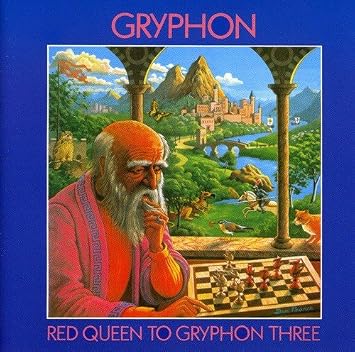
Red Queen To Gryphon Three - Gryphon
Provenance: A few years ago at work, we were idling away the hours on the taxpayer's dime chatting about striking examples of cover sleeve artwork. I recalled an album my dad still owns, Raindance, by today's subjects Gryphon. In the course of searching for the cover art online, I discovered that Gryphon had also produced a work called Red Queen To Gryphon Three, a concept album that's based on a game of chess and features a krumhorn. Armed with that knowledge, what do you think I did next?
Review: You know when people take that "none more black" line from This Is Spinal Tap and apply it to some other scenario, and it's never funny? Well, I'm not about to break the mould here, but in all human endeavour, there is none more prog than Red Queen To Gryphon Three. It takes two of the nerdiest things in existence - prog and chess - and fuses them together via the medium of medieval instrumentation. I imagine this as the product of only the most ascetic of proggers, denying themselves all pleasures of the flesh (most definitely women, although one suspects that wasn't difficult) to come up with this shining anthracite bolus of musical antimatter. So dimly, horrifyingly black that it sucks all pretenders into the gaping maw of its prog-rock singularity. Friends, this is geekery on a colossal scale.
We've got four lengthy tracks called 'Opening Move', 'Second Spasm' (lol), 'Lament' and 'Checkmate'. None of this makes any sense whatsoever, because this is prog so pure that it's entirely instrumental. Why besmirch this magical extravaganza with such earth-bound discordance as the English language? This is the music of the spheres! The universal resonance! I will concede that, possibly, the only thing more progressive would be to either make up your own language or perform your horrible compositions on ice.
I'm not sure I even need to tell you that Red Queen To Gryphon Three begins with a keyboard fanfare, as anyone with a passing knowledge of the genre could've guessed that already. 'Opening Move' is ambitious, in the sense that it takes the listener through a variety of moods - one moment jaunty, the next foreboding - none of which that I've ever experienced when playing chess. The performances are almost virtuoso, and it must be admitted that the quieter, piano-led moments are quite affecting. 'Second Spasm' (still laughing) starts off altogether rather 'hey nonny-nonny', but again, shifts about in timing and atmosphere; however, it retains a cheerfully martial feeling throughout, which gives it a good sense of cohesion, and the main theme (played on a variety of instruments) manages to be both knotty and catchy at the same time. Erk! I'm starting to enjoy this!
Ah, but now we're onto 'Lament', which is very sad and makes me cry. Kidding! Yeah, it's a bit more mournful than the preceding material, and the bassoon (a glum instrument) gets a decent workout, but any true emotion gets sucked out of proceedings by mere dint of it being a fucking prog track. Can you sob in 13/7 time? These guys seem to think you can. Weirdly for a track called 'Lament', there are a couple of brief movements that are frantic and upbeat, all crazy woodwind and Afrobeat guitar sounds. By this point I felt that I'd been listening to RQTGT for about a day, and so these moments of elation mirrored my notion that it was all soon to be over. A glimpse at the stereo revealed I was only just over halfway through.
Ahhhhh, but I can't quite hate it! The music is so guileless, so questing and brimming with ideas that cynicism feels churlish. It's not as if anything hangs around too long, either - Gryphon's modus operandi on RQTGT seems to be "getting bored of this twiddly bit? Don't worry, another will be along soon enough."
However, once you're halfway through 'Checkmate', exhaustion has almost settled in. Despite noble attempts to cut through all the jibjab by establishing a theme for each track, it's all starting to blur together. The jazz guitars! The clavinets! The bassoons! The krumhorns! (Reader, I have discovered that there are two krumhorn players on this album.) In summation, Red Queen To Gryphon Three certainly takes the listener on a journey - one where the destination can, at times, be obscure - but it's a quixotic undertaking. How anyone can conjure up a game of chess whilst being bombarded by this folk-prog maelstrom is beyond me.
At core, though, this is the most potently distilled prog in my collection, and so I shall cherish it forever. I'll probably listen sparingly, because I don't want to actually turn into a wizard, but listen again I shall.
Review: You know when people take that "none more black" line from This Is Spinal Tap and apply it to some other scenario, and it's never funny? Well, I'm not about to break the mould here, but in all human endeavour, there is none more prog than Red Queen To Gryphon Three. It takes two of the nerdiest things in existence - prog and chess - and fuses them together via the medium of medieval instrumentation. I imagine this as the product of only the most ascetic of proggers, denying themselves all pleasures of the flesh (most definitely women, although one suspects that wasn't difficult) to come up with this shining anthracite bolus of musical antimatter. So dimly, horrifyingly black that it sucks all pretenders into the gaping maw of its prog-rock singularity. Friends, this is geekery on a colossal scale.
We've got four lengthy tracks called 'Opening Move', 'Second Spasm' (lol), 'Lament' and 'Checkmate'. None of this makes any sense whatsoever, because this is prog so pure that it's entirely instrumental. Why besmirch this magical extravaganza with such earth-bound discordance as the English language? This is the music of the spheres! The universal resonance! I will concede that, possibly, the only thing more progressive would be to either make up your own language or perform your horrible compositions on ice.
I'm not sure I even need to tell you that Red Queen To Gryphon Three begins with a keyboard fanfare, as anyone with a passing knowledge of the genre could've guessed that already. 'Opening Move' is ambitious, in the sense that it takes the listener through a variety of moods - one moment jaunty, the next foreboding - none of which that I've ever experienced when playing chess. The performances are almost virtuoso, and it must be admitted that the quieter, piano-led moments are quite affecting. 'Second Spasm' (still laughing) starts off altogether rather 'hey nonny-nonny', but again, shifts about in timing and atmosphere; however, it retains a cheerfully martial feeling throughout, which gives it a good sense of cohesion, and the main theme (played on a variety of instruments) manages to be both knotty and catchy at the same time. Erk! I'm starting to enjoy this!
Ah, but now we're onto 'Lament', which is very sad and makes me cry. Kidding! Yeah, it's a bit more mournful than the preceding material, and the bassoon (a glum instrument) gets a decent workout, but any true emotion gets sucked out of proceedings by mere dint of it being a fucking prog track. Can you sob in 13/7 time? These guys seem to think you can. Weirdly for a track called 'Lament', there are a couple of brief movements that are frantic and upbeat, all crazy woodwind and Afrobeat guitar sounds. By this point I felt that I'd been listening to RQTGT for about a day, and so these moments of elation mirrored my notion that it was all soon to be over. A glimpse at the stereo revealed I was only just over halfway through.
Ahhhhh, but I can't quite hate it! The music is so guileless, so questing and brimming with ideas that cynicism feels churlish. It's not as if anything hangs around too long, either - Gryphon's modus operandi on RQTGT seems to be "getting bored of this twiddly bit? Don't worry, another will be along soon enough."
However, once you're halfway through 'Checkmate', exhaustion has almost settled in. Despite noble attempts to cut through all the jibjab by establishing a theme for each track, it's all starting to blur together. The jazz guitars! The clavinets! The bassoons! The krumhorns! (Reader, I have discovered that there are two krumhorn players on this album.) In summation, Red Queen To Gryphon Three certainly takes the listener on a journey - one where the destination can, at times, be obscure - but it's a quixotic undertaking. How anyone can conjure up a game of chess whilst being bombarded by this folk-prog maelstrom is beyond me.
At core, though, this is the most potently distilled prog in my collection, and so I shall cherish it forever. I'll probably listen sparingly, because I don't want to actually turn into a wizard, but listen again I shall.
Sunday, 1 December 2019
Aqualung - Jethro Tull
Provenance: I guess at one time I decided that should get into Jethro Tull. Anyway, I purchased this album before I went to university because it formed part of the meagre collection of burnt CD-Rs that accompanied me to halls of residence. I blasted the shit out of this thing during my first year.
Review: Some artists or albums are hardy perennials - they can be played almost any time of year and slot right in. For some reason, Jethro Tull are a seasonal band; I couldn't imagine spinning Heavy Horses or Songs From the Wood whilst the sun is shining. Very particularly, Aqualung is a winter album. Perhaps it's due to to the imagery of the title track, with its ice and 'December's foggy freeze'. It may be due to the seam of religion that runs throughout, which for some reason I've long associated with a dank coldness (the interiors of churches and cathedrals, perhaps?).
Or it might be that Aqualung goes well with the most deathly season because it sounds pretty goddamn deceased itself. I've got plenty of albums from eras where recording technology was still quite rudimentary, others whereby some creative studio trickery dates the music badly. I've even got a couple made by a sex offender in his basement. Whatever their flaws, none of them sound as dead as Aqualung. There are grime tracks recorded on mobile phones with more presence. The cardboard guitar in the video to Judas Priest's 'Breaking the Law' has better tonality than Martin Barre achieves. There are uncontacted tribes deep within the Amazon who have opinions about the production on Aqualung.
Let's be charitable. It was one of the first albums recorded at Island Record's Basing Street studios. Teething issues, an' all that. It's not as if any other album, being recorded at the exact same time at the exact same facility, sounds any good.
I've got more beef with Aqualung. About the only moment of human warmth and empathy on the entire collection comes early on, in the acoustic mid-section of 'Aqualung', where we are invited to feel sorry for the subject of the track, the titular tramp. For the rest of the album, Ian Anderson's lyrics are by turns arch and sneering, as if he's just that wee bit more clever than the listener. It's particularly insufferable on 'My God' and 'Hymn 43', which come across as 1971's equivalent of watching a YouTube atheist channel. (NB - please don't watch any atheist-themed YouTube content - it almost drove me, a staunch non-believer, to the seminary.)
Take, for example, Sparks - a band who are undoubtedly arch and oh-so-smart, but who wear their erudition lightly, and deploy a winking charm to make their references to Shakespeare, the Rockefellers and the human reproduction cycle slide down easily. Jethro Tull, alas, come across as dour as any carping Presbyter or dorm-room Maoist in their attempts to enlighten.
It's a shame, because putting aside the hectoring and shit production, Aqualung possesses the kernel of a prog classic. The electric guitar riff to 'Aqualung' is a blooter, and is rightly smashed out by greenhorns in guitar shops up and down the country. 'Cross-Eyed Mary' has some wonderfully angular guitar work, and is probably the leanest, dirtiest thing on the platter. 'Locomotive Breath' is another corker, an indomitable chugger that is nevertheless not as heavy as the version that plays in my head. It also sounds like a rubber band is part of the instrumentation. Ah, fuck it, 'Locomotive Breath' properly smokes.
Even 'Hymn 43' doesn't sound so bad, if you ignore the lyrics. In fact, it would have fit in very nicely on Atomic Rooster's Death Walks Behind You, an album that I like very much. Pick of the bunch for me is 'Mother Goose', not only for its delightfully absurd lyrics, but because it best resembles the twisted folk that would appear on my favourite Tull joint, Songs From the Wood. Hey, maybe I'm being tough on Aqualung because it's not Songs From the Wood! Maybe!
Look, I can take the sermonising if the music sounded immaculate, and it doesn't. I still like this weird, somewhat cerebral little beast but it could certainly do with someone like Steve Wilson to give this a bit of remastering spit and polish. Oh, and I was wrong earlier on - contrary to my claims that Aqualung was altogether bloodless, 'Wond'ring Aloud' possesses a lot of heart. It's rather beautiful, in fact.
NB - my CD version of Aqualung contains a rather interesting interview with Ian Anderson about Aqualung. In the interests of fairness, it's not just me who thinks the album doesn't quite sound right; Anderson uses a portion of the conversation to bemoan the production, and the difficulties of getting decent performances on tape in the particular studio Jethro Tull were assigned.
Review: Some artists or albums are hardy perennials - they can be played almost any time of year and slot right in. For some reason, Jethro Tull are a seasonal band; I couldn't imagine spinning Heavy Horses or Songs From the Wood whilst the sun is shining. Very particularly, Aqualung is a winter album. Perhaps it's due to to the imagery of the title track, with its ice and 'December's foggy freeze'. It may be due to the seam of religion that runs throughout, which for some reason I've long associated with a dank coldness (the interiors of churches and cathedrals, perhaps?).
Or it might be that Aqualung goes well with the most deathly season because it sounds pretty goddamn deceased itself. I've got plenty of albums from eras where recording technology was still quite rudimentary, others whereby some creative studio trickery dates the music badly. I've even got a couple made by a sex offender in his basement. Whatever their flaws, none of them sound as dead as Aqualung. There are grime tracks recorded on mobile phones with more presence. The cardboard guitar in the video to Judas Priest's 'Breaking the Law' has better tonality than Martin Barre achieves. There are uncontacted tribes deep within the Amazon who have opinions about the production on Aqualung.
Let's be charitable. It was one of the first albums recorded at Island Record's Basing Street studios. Teething issues, an' all that. It's not as if any other album, being recorded at the exact same time at the exact same facility, sounds any good.
I've got more beef with Aqualung. About the only moment of human warmth and empathy on the entire collection comes early on, in the acoustic mid-section of 'Aqualung', where we are invited to feel sorry for the subject of the track, the titular tramp. For the rest of the album, Ian Anderson's lyrics are by turns arch and sneering, as if he's just that wee bit more clever than the listener. It's particularly insufferable on 'My God' and 'Hymn 43', which come across as 1971's equivalent of watching a YouTube atheist channel. (NB - please don't watch any atheist-themed YouTube content - it almost drove me, a staunch non-believer, to the seminary.)
Take, for example, Sparks - a band who are undoubtedly arch and oh-so-smart, but who wear their erudition lightly, and deploy a winking charm to make their references to Shakespeare, the Rockefellers and the human reproduction cycle slide down easily. Jethro Tull, alas, come across as dour as any carping Presbyter or dorm-room Maoist in their attempts to enlighten.
It's a shame, because putting aside the hectoring and shit production, Aqualung possesses the kernel of a prog classic. The electric guitar riff to 'Aqualung' is a blooter, and is rightly smashed out by greenhorns in guitar shops up and down the country. 'Cross-Eyed Mary' has some wonderfully angular guitar work, and is probably the leanest, dirtiest thing on the platter. 'Locomotive Breath' is another corker, an indomitable chugger that is nevertheless not as heavy as the version that plays in my head. It also sounds like a rubber band is part of the instrumentation. Ah, fuck it, 'Locomotive Breath' properly smokes.
Even 'Hymn 43' doesn't sound so bad, if you ignore the lyrics. In fact, it would have fit in very nicely on Atomic Rooster's Death Walks Behind You, an album that I like very much. Pick of the bunch for me is 'Mother Goose', not only for its delightfully absurd lyrics, but because it best resembles the twisted folk that would appear on my favourite Tull joint, Songs From the Wood. Hey, maybe I'm being tough on Aqualung because it's not Songs From the Wood! Maybe!
Look, I can take the sermonising if the music sounded immaculate, and it doesn't. I still like this weird, somewhat cerebral little beast but it could certainly do with someone like Steve Wilson to give this a bit of remastering spit and polish. Oh, and I was wrong earlier on - contrary to my claims that Aqualung was altogether bloodless, 'Wond'ring Aloud' possesses a lot of heart. It's rather beautiful, in fact.
NB - my CD version of Aqualung contains a rather interesting interview with Ian Anderson about Aqualung. In the interests of fairness, it's not just me who thinks the album doesn't quite sound right; Anderson uses a portion of the conversation to bemoan the production, and the difficulties of getting decent performances on tape in the particular studio Jethro Tull were assigned.
Subscribe to:
Posts (Atom)