Showing posts with label gryphon. Show all posts

Sunday, 23 January 2022

Doremi Fasol Latido - Hawkwind


Provenance: As with Gryphon, Hawkwind are another band I've inherited from my dad. I've got albums, been to see them (and a few of their offshoots) live; hell, I even spent a weekend on the Isle of Wight at HawkFest.

Yet I'm no superfan. It's taken me a while to get around to reviewing Hawkwind on this blog. The reason behind that is, in my life, Hawkwind speak to a very specific mood, or perhaps more accurately, a particular state of mind. A state, as it happens, that is not very congruent to sitting down and tapping away at a computer.

Nonetheless, ultimately it's music - and thus even if my third eye is a little attenuated on a dull Sunday afternoon, I'll give it the old college go.

Review: Almost immediately after hitting the play button on my stereo, I regret that I'm not lying back in a darkened room at midnight. I could close a few curtains but it would be a faint attempt at recreating the ideal conditions to absorb Dave Brock's singular contribution to our specie, Hawkwind. In fact, 2am in a marquee surrounded by other revellers and vision-questers is probably the ideal. As I have mentioned before now, Simon Reynolds has convincingly argued the case that EDM can only be properly experienced at a rave, with the attendant sensations, lighting - and drugs. I think the same applies to Hawkwind.

So, I'm not about to get myself twisted at the same time as Paul O'Grady: For the Love of Dogs is on TV (nor will I ever, really - I'm notoriously boring in this regard). Still, at their best - which Doremi Fasol Latido approaches - Hawkwind are a mighty proposition, beaming in all manner of strange vibrations from the dimly-perceived reaches of the galaxy. For the uninitiated, Hawkwind have worn a few hats in their time, but their most famous guise is as 'space rock' pioneers; long, jammy, semi-improvised pieces with an emphasis on repetition and lashings of burbling synths and crazy guitar tones. Not top forty stuff - for the most part.

For the most part, that's what you get on Doremi Fasol Latido, especially on the likes of 'Brainstorm', 'Lord of Light' and the lengthy 'Time We Left the World Today'. However, there's a very cool acoustic spine to many of the tracks here, which suggests a kind of bridging between the hippy past and the electronic whoosh 'n' clang sound that would come to dominate the space rock genre. The woodiness of acoustic guitar and the extra-terrestrial beeps and blats actually blend very well on tracks like 'Space Is Deep' and a personal favourite of mine, 'Down Through the Night', which sounds like a transmission from the starry vault above. Meanwhile another acoustic number, 'The Watcher', was straight enough a composition to appear in relatively unaltered (albeit, massively amplified) form on Motorhead's debut album.

Yes folks, this is Lemmy-era Hawkwind; in fact, Doremi Fasol Latido is the first studio album he appears on. In what form, however, is a little obscure, simply because his bass is virtually inaudible. His inimitable croak, like a toad regurgitating a sheet of sandpaper, graces one track, though it is in (relatively) limber form compared to how it would sound only a few years down the line. Still, I don't really mind the lack of bottom end, as all the fun stuff on Doremi Fasol Latido occurs in the mids and trebles - the hypnotic two chord buzz-guitar for one, and Nik Turner's free verse flute and saxophone soloing. I've long been a big advocate of people going insane on the flute in rock music, and would love to see a revival.

(A couple of days ago I saw a cool band in Brighton that featured a dude playing amplified accordion. Immensely enjoyable. More of this in rock music, please, but specifically, more hog-wild flute parts.)

Now, whilst I very much like the version of Hawkwind that attempted things like melodies and choruses (Quark, Strangeness and Charm), it's this iteration, one that deals more in sounds and textures, that is dear to my heart. Out go pop song structures - in come grinding guitars, motorik percussion and synthesizers that feel like they're about to split apart. Yes, there's plenty of abandon present, but lurking at the centre of Doremi Fasol Latido is a kind of meditative focus; that through ritual (you could describe much of the music as here in the vocabulary of chants and marches) and intent, we're only a tachyon or two away from hitting upon the universal resonance that opens us up to the music of the spheres.

Take heed my fellow psychonauts, Doremi Fasol Latido is the rocket fuel needed to kick clear of Spaceship Earth, even if it's just for forty minutes or so. It's longer than Bezos managed.

Sunday, 17 January 2021

Led Zeppelin IV - Led Zeppelin

Provenance: My mum owned this on vinyl.

How much of your taste in music is down to your parents? For me, it's a huge factor. I never saw the need to particularly rebel, because by and large my parents knew their onions.

Off the top of my head, in terms of albums my parents own that are mirrored in my collection, there's this and Led Zeppelin III, Tapestry by Carole King, a couple of Alice Cooper albums, ditto Frank Zappa, An Electric Storm by White Noise, a bit of Hawkwind. Not bad.

I didn't really take to Emerson, Lake and Palmer nor Rod Stewart, but although I haven't (yet) purchased Gryphon's Raindance, evidently I'd heard enough to make me curious. It was all very listenable, even if some of my parents' latter day choices (Mika's Life In Cartoon Motion, anyone?) might take a bit of digesting.

However, Led Zeppelin IV (or Zoso, if you're so inclined) was not only instantly gettable, it would also prove to be a watershed moment; I recall walking through the door one day after school, and evidently my mum had cued this bad boy up a moment beforehand. What I was to hear would essentially make me go, "yep, playing guitar, that's what I want to do", setting me on a course of joy and lifelong discovery. 

Review: Per the above paragraph; I heard Robert Plant's wailing, sure, but I felt the guitar in 'Black Dog'. It really was a few seconds, that's all it took, to convert me to a guitar player (albeit, at that time, sans guitar). I'd grown up listening to guitar bands like the Rolling Stones and Cream, and although I had liked what I'd heard, this was something different. Listen to Jimmy Page's opening guitar riff in 'Black Dog' again and you can hear a swagger, an arrogance almost, a sound that didn't just groove or roll, but strutted. Underpinned by John Bonham's thunderous drumming, there was only one word that came to mind: power.

Amazingly, given the time and distance between then and now, little has diminished my original teenaged assessment. Since that time I've become better acquainted with Led Zeppelin's overall body of music, which contains its share of missteps, and I must admit my opinions have been occluded by the impression given that they weren't a particularly likeable bunch; I have also wearied of the kind of pub bore who will insist Led Zeppelin are superb, and that everything else is a pile of horseshit created by computers or young people or whatever. Oh yes, and they were massive plagiarists.

But Led Zeppelin IV? A work of rare genius.

What I love about this album is that it jumps from the very 'eavy 'Black Dog' to the nitro-glycerine boogie of 'Rock And Roll' to the pastoral Tolkien-folk of 'Battle Of Evermore' - and then an amalgamation of all these qualities on 'Stairway To Heaven' - yet it still sounds conceptually tight. And that's just side one. An album that covers so many bases could (should?) be a mess, but it hangs together perfectly. The pacing is exquisite, a rollercoaster in the truest sense inasmuch as each track takes the listener in a different direction, whether it's mood, atmosphere, tempo, and yet each oxbow and undulation remains part of the same overall journey.

In my callow youth my favourites were 'Black Dog', 'Rock And Roll', 'Stairway To Heaven' and 'Misty Mountain Hop', all the muscle and blood tracks basically; now, although I cannot say any of the aforementioned have gone stale (yes, even 'Stairway...'), it's the more ruminative moments such as 'Battle Of Evermore' and the swooning 'Going To California' that have wormed their way deepest into my affections. Special mention must go to Sandy Denny's imperious singing on 'Battle...', a performance that alone impelled me to pay closer attention to Fairport Convention. I have, however, omitted one very important track. It ain't 'Four Sticks' (NB: a good song, but it comes across a little fidgety and half-formed for my tastes).

'When The Levee Breaks' may have been an old Kansas Joe McCoy and Memphis Minnie blues from 1929, but even now the version on IV induces a sense of awe and sublimity. As brilliantly wrought as the rest of the album is, there's sorcery at work here, friends. By a variety of measures there is heavier music out there, but little comes as close to being as weighty or portentous as 'When The Levee Breaks' is. Into the admixture is the haunting, otherworldly harmonica, Page's droning, modal guitar and Plant's anguished vocal; but the true star is Bonham's drumming. Eschewing flash or intricacy, Bonham instead booms away on a beat that sounds like depth charges being detonated. The overall effect is that 'When The Levee Breaks', a song about the Great Mississippi Flood of 1927, comes across every bit as doomy and apocalyptic as its subject matter. Eat that, Randy Newman.

There you have it - simply, in terms of my own personal relationship with popular music, one of the most important landmarks. There's a straight line between IV and me picking up a guitar, which in turn took me down avenues of exploration around blues music, heavy metal and all points in-between. An immense album, and one that has never ceased to be a pleasure. Perhaps those saloon bar stalwarts had a point, eh?

Sunday, 8 December 2019

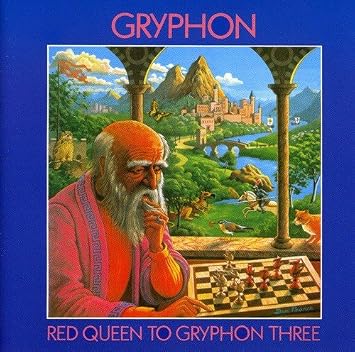
Red Queen To Gryphon Three - Gryphon

Provenance: A few years ago at work, we were idling away the hours on the taxpayer's dime chatting about striking examples of cover sleeve artwork. I recalled an album my dad still owns, Raindance, by today's subjects Gryphon. In the course of searching for the cover art online, I discovered that Gryphon had also produced a work called Red Queen To Gryphon Three, a concept album that's based on a game of chess and features a krumhorn. Armed with that knowledge, what do you think I did next?

Review: You know when people take that "none more black" line from This Is Spinal Tap and apply it to some other scenario, and it's never funny? Well, I'm not about to break the mould here, but in all human endeavour, there is none more prog than Red Queen To Gryphon Three. It takes two of the nerdiest things in existence - prog and chess - and fuses them together via the medium of medieval instrumentation. I imagine this as the product of only the most ascetic of proggers, denying themselves all pleasures of the flesh (most definitely women, although one suspects that wasn't difficult) to come up with this shining anthracite bolus of musical antimatter. So dimly, horrifyingly black that it sucks all pretenders into the gaping maw of its prog-rock singularity. Friends, this is geekery on a colossal scale.

We've got four lengthy tracks called 'Opening Move', 'Second Spasm' (lol), 'Lament' and 'Checkmate'. None of this makes any sense whatsoever, because this is prog so pure that it's entirely instrumental. Why besmirch this magical extravaganza with such earth-bound discordance as the English language? This is the music of the spheres! The universal resonance! I will concede that, possibly, the only thing more progressive would be to either make up your own language or perform your horrible compositions on ice.

I'm not sure I even need to tell you that Red Queen To Gryphon Three begins with a keyboard fanfare, as anyone with a passing knowledge of the genre could've guessed that already. 'Opening Move' is ambitious, in the sense that it takes the listener through a variety of moods - one moment jaunty, the next foreboding - none of which that I've ever experienced when playing chess. The performances are almost virtuoso, and it must be admitted that the quieter, piano-led moments are quite affecting. 'Second Spasm' (still laughing) starts off altogether rather 'hey nonny-nonny', but again, shifts about in timing and atmosphere; however, it retains a cheerfully martial feeling throughout, which gives it a good sense of cohesion, and the main theme (played on a variety of instruments) manages to be both knotty and catchy at the same time. Erk! I'm starting to enjoy this!

Ah, but now we're onto 'Lament', which is very sad and makes me cry. Kidding! Yeah, it's a bit more mournful than the preceding material, and the bassoon (a glum instrument) gets a decent workout, but any true emotion gets sucked out of proceedings by mere dint of it being a fucking prog track. Can you sob in 13/7 time? These guys seem to think you can. Weirdly for a track called 'Lament', there are a couple of brief movements that are frantic and upbeat, all crazy woodwind and Afrobeat guitar sounds. By this point I felt that I'd been listening to RQTGT for about a day, and so these moments of elation mirrored my notion that it was all soon to be over. A glimpse at the stereo revealed I was only just over halfway through.

Ahhhhh, but I can't quite hate it! The music is so guileless, so questing and brimming with ideas that cynicism feels churlish. It's not as if anything hangs around too long, either - Gryphon's modus operandi on RQTGT seems to be "getting bored of this twiddly bit? Don't worry, another will be along soon enough."

However, once you're halfway through 'Checkmate', exhaustion has almost settled in. Despite noble attempts to cut through all the jibjab by establishing a theme for each track, it's all starting to blur together. The jazz guitars! The clavinets! The bassoons! The krumhorns! (Reader, I have discovered that there are two krumhorn players on this album.) In summation, Red Queen To Gryphon Three certainly takes the listener on a journey - one where the destination can, at times, be obscure - but it's a quixotic undertaking. How anyone can conjure up a game of chess whilst being bombarded by this folk-prog maelstrom is beyond me.

At core, though, this is the most potently distilled prog in my collection, and so I shall cherish it forever. I'll probably listen sparingly, because I don't want to actually turn into a wizard, but listen again I shall.