Showing posts with label sex. Show all posts

Sunday, 31 July 2022

Trash - Alice Cooper


Provenance: By the time I bought Trash I was already a big Alice fan. I was deep in the Cooperverse.

I will say this, though - I vividly recall hearing the song 'Trash' for the first time at my friend Chris' house. It was Chris who pointed out that Jon Bon Jovi provides backing vocals, and delivers the immortal line "If my love was like a lollipop, would you lick it?", on the bantering outro. Odd, as said outro is structured as a dialogue between Coop and Jovi.

Review: There's a time and place to revel in sumptuary; likewise there exists occasion to ponder the sublime. And then, there are those instances in life where all you want to do is yell along to "And when you hit the sheets you just turn to - trrrrraaasssshh!".

In many ways, this imperative sums up much of the appeal of Trash. The verses to each song range from the catchy to the workaday but essentially act as a series of previews to some absolutely huge choruses. That's what Trash is - an album of massive choruses. There are ten songs here, and I could sing you eight of the choruses, easily, before giving this its most recent spin.

The act of listening again has really driven home this point - Trash is one of the lesser-played Cooper albums in my collection, and I reckon I haven't listened to it straight through for maybe three years, at least. So, the first twenty to forty seconds of every song bamboozle me, and then the chorus hits and I go "ah! It's this one!". Rinse and repeat nine times; if nothing else, Trash has been a gentle ride featuring a succession of miniature surprises.

Now, I say this process happened nine times, because there's no mistaking opener 'Poison', a song so ubiquitous that even non-rock fans have a fighting chance of knowing it. I certainly heard 'Poison' more than once at Student Union nights. It has an instantly identifiable riff, but - whisper it - I find 'Poison' a little pedestrian. Without totting up the figures I believe I've seen Alice Cooper more than any other live act, and common to all these gigs is my impression that the band drag the tempo of 'Poison' somewhat. But upon review, nope, it really is this plodding. But - crucially - it does have a big dumb chorus!

As, indeed, do the next three tracks - 'Spark In the Dark' (maybe my favourite?), the poppy 'House of Fire' and the bratty 'Why Trust You' - as decent a sequence in the mature (a term I use advisedly where hard rock is concerned) Cooper oeuvre as you'll find. However, because this is hair metal era Alice we have two ballads, 'Only My Heart Talkin'' (featuring Aerosmith's Steven Tyler doing that weird 'bum-de-duppa-do-way' scat that I can't unhear) and 'Hell Is Living Without You'. I suppose you needed a cigarette lighter moment or two, despite the air being freighted with Aquanet hairspray, and these are...serviceable, I suppose. By the books, you could say.

Probably the biggest shame is that Trash cleaves so closely to hair metal tropes, including the key change emotional bump (key changes that present-day Alice probably regrets now, given his limited vocal prowess) and squealy guitar soloing. Chief among the disappointments are the lyrics. If Last Temptation is his grunge-light, Mephistophelean Christian rock record (and a very good one too) and Brutal Planet is his belated stab at high-alienation nu-metal (also pretty good), then Trash is his "I'm a good sex man" album. The late 1980s was rotten with performance braggadocio, replete with fire/desire rhyme schemes and almost-threatening promises about what's gunna go down when the bedroom door closes. No exception here.

At least he doesn't quite reach the nadir of 'Feed My Frankenstein', which is on successor album Hey Stoopid (still a great song in spite of its clunky single-entendre lyric sheet). I only highlight lyrics because, once upon a time, Alice Cooper was such a good and strange writer; think of the ground covered on Killer, Billion Dollar Babies or, hell, the first Alice Cooper solo (as opposed to the band) record Welcome To My Nightmare. Cooper is credited on every song - but then again, bar 'Only My Heart Talkin'', is Desmond Child. Now, Child's facility with writing slick, radio-friendly hits is unquestionable - his track record speaks for itself - but by being able to bottle a type of rock 'n' roll everyman appeal, he smooths away the interesting, quirky aspects of the performer's art. Perfect for Bon Jovi and Ricky Martin, with whom he's had huge success, but his contributions dilute the essence of artists like Alice Cooper. 

Saying that, what did Cooper himself have in the tank at this stage? 'Poison' signalled a career resurrection of a kind for, after all.

In summation, then; if you're after the wild and woolly Alice Cooper of the Alice Cooper Band days, you're not going to find it here. Not a jot. Outside of muttered sexual imprecations you're barely able to detect the shock-rocker Coop who scared a bunch of Top of the Pops-viewing grannies in the 1970s. What you will find is well-executed, punchy and extremely catchy hair metal, and I will say, probably at the top end of the hair metal spectrum in terms of quality. It's lightweight fun, but so what? Dump your brain for forty minutes and rock out, my dude. 

Sunday, 19 January 2020

Welcome To The Pleasuredome - Frankie Goes To Hollywood

Provenance: The Burger King advert that featured 'Two Tribes' made a big impression on me. So when I saw this for a princely £2 in HMV, I considered it a low risk gamble.

Review: One of the most baffling, surreal pop experiences you can subject yourself to. Almost everyone knows the immaculate credentials of 'Relax', 'Two Tribes' and 'The Power of Love', but do you know they come from a sprawling double album that features covers of Edwin Starr, Bruce Springsteen and Dionne Warwick? Or that the first track is an aural wonderworld that stretches to thirteen minutes? Or that Chris Barrie (Red Dwarf, The Brittas Empire) provides not one, but two impersonations for spoken word passages?

Like The Lexicon of Love, a favourite album of mine, this is identifiably a Trevor Horn production. As with everything he turned his hand to during this era, ...Pleasuredome sounds incredible on a good set of speakers; and it helps that the performances were given a polish thanks to the presence of various studio hacks. Songwriting credits are spread amongst the band on the original cuts, but singer Holly Johnson is probably the only member of Frankie... who can be counted as a consistent presence.

The only time Horn's golden touch turns to shit is the completely gratuitous, chintzy cover of Warwick's 'San Jose (The Way)' One might argue that most of the covers, skits and interludes are gratuitous, given that they amount to little more than padding, but 'San Jose' simply doesn't fit in with the bombastic, priapic thrust of almost everything else on ...Pleasuredome. It's pretty insipid, especially when compared to their hemi-powered turbo through Springsteen's hoary old classic 'Born To Run' (incidentally, I knew the Frankie... version before the Springsteen original, and I prefer it). Admittedly, the cover of 'War' sounds a little anodyne, sacrificing the raw funk power of the original instrumentation for synthesizers, but it's saved by a bizarre intro courtesy of the aforementioned Chris Barrie, rambling away in a startlingly good Ronald Reagan take-off.

The covers aside, about the only other aspect of ...Pleasuredome I don't like is 'The Power of Love'. Although it's Johnson's most assured vocal on the album (albeit shorn of his usual winking seediness), overall it's a sluggish, insincere mess. How it became the Christmas-defining giant it has morphed into is anyone's guess; I was going to say it belongs in the same division of insipid yuletide pap as East 17's 'Stay Another Day', but that's harsh on Brian Harvey (a man who managed to run himself over after consuming too many jacket potatoes) and company. Go ahead, call me a tin-eared poltroon, but it's a shit song.

However, elsewhere the music fizzes, bubbles, pumps and shimmers in gloriously overblown style. It's easy to forget just how pounding 'Relax' sounds with the dials turned up; on the other hand, it's difficult to understand just how BBC programmers let this one through the net to be played on daytime radio when even the bass line sounds this obscene. The other superstar number, 'Two Tribes', is thrillingly propulsive, coming on more like Iron Maiden's 'Wrathchild' than any piece of chart fluff has any right to. It's also slyly self-referential with the lyric 'Are we living in a land / Where sex and horror are the new gods?', when ...Pleasuredome contains 'Relax' (which was accompanied by a suitably deviant music video) and 'Krisco Kisses', a snazzy paean to fisting.

On that point - the what was originally side four contains some lesser known gems (and 'The Power of Love'), all written by Frankie... personnel. Neither 'Black Night White Light' nor 'The Only Star In Heaven' are classics, but both have their merits; the former rendered especially attractive by its moody minimalism and stuttering rhythms. There's a couple of decent Frankie... generated moments on side three too, chief amongst them the jive-talkin' funker 'Wish (The Lads Were Here)', which features some truly tintinnabulous slap-bass playing.

The very definition of a mixed bag, then, but with Horn at the helm ...Pleasuredome almost always defies banality with sheer presence and heft. Even the quieter moments are swaddled in banks of keyboards and guitar, culminating in a comfortable mid-range miasma that bathes the eardrums. How else, honestly, could you get away with a track like 'Welcome To The Pleasuredome', with its gongs, harmonica, Fairlights, jungle ululations and twisted snatches of Samuel Taylor Coleridge? It rises and swoops like a Gershwin rhapsody for nearly quarter of an hour and never once grows wearying. In some ways it resembles Rush's '2112', inasmuch as it serves as a blueprint for everything to follow. Bonkers, over the top, sublime.

Oh, and Barrie's other impersonation? Prince Charles, ruminating upon the male orgasm. Have fun, kids!

Monday, 20 May 2019

The Silent Majority - Life Sex & Death

Provenance: A recommendation from the good people who, like myself, spend far too much time picking arguments with each other over the dumbest shit imaginable; music message board posters.

Review: Prior to reading the forum thread about 'great lost records' or similar, I'd never heard of Life Sex & Death. Yet the few posters who spoke up for The Silent Majority were so convincing, bordering almost on reverence, that I simply couldn't resist taking the plunge. I snapped up a copy without listening to a single second of music.

Why? Well, one member of the forum recalled them delivering one of the most scintillating live performances he'd been privileged to witness - and had begun the evening watching frontman Stanley jerking off in the gutter outside the venue. Another testified that he saw Stanley emerging from a dumpster and eating a discarded, half-eaten burrito. And we're not talking about a band on their uppers - this was at the height of the hype.

LSD were and remain a strange proposition - three hair-metal dudes fronted by a homeless guy who smelled like shit and affected psychotic breakdowns in the midst of live shows and interviews. Even if Stanley, aka Chris Stann, wasn't a street guy to begin with (rumours abound that he came from a wealthy background), he took method acting to its furthest reaches. Contemporary accounts suggest he really did wear dirty, ripped clothes, ate food from bins and slept rough.

What a tragedy, then, if this turned out to be some collection of fin-de-siecle butt-rock, or a gloomy alternative metal album about doing heroin and feeling a bit upset. The reality is that The Silent Majority is both of these things, neither of these things, and a whole lot more. It's a daring move to open your album with a live rendition of a torch song called 'Blue Velvet Moon' played on an out-of-tune ukulele; positively stupid, maybe. This rather inauspicious start is brought to a sudden conclusion, a thunderous drum fill kicking off the second part of the track - 'We're Here Now' - a real heads-down, diesel-powered statement of intent.

This approach rather sets the mood for the rest of the album; every time you think you've got a hang of LSD, they undermine what has come before; sometimes with black humour, often with horror, but always with interesting ideas. Track two is the jackboot-stomp of 'Jawohl Asshole'; track three is single 'School's For Fools', with a pop-punk sensibility that apes Twisted Sister's bubblegum anti-authority capers. Then we have 'Telephone Call', probably the best song that Soundgarden never recorded. It's an uncanny, elliptical number that, once it stutters into life, could be about a few topics, child abuse being chief amongst the candidates in this writer's humble opinion - and it rocks hard. The first time I heard the peculiar way that Stanley enunciates the line "you've got - a gun - I can't - outrun - I'm still that little boy, haunted by thoughts in the middle of the night" made me skip back to the start of the song the instant it finished. Bewildering, but brilliant.

Over the course of the album LSD touch upon a huge range of genres - including psychedelic blues, heavy metal, country ('Farm Song' is yet another unexpected twist), glam metal, grunge - and don't really make a misstep. As an hour-long survey of a transitional time for rock music at the dawning of the 1990s it's pretty comprehensive and superbly well-executed. A chorus can be so sweet, and hooky, complete with soaring harmonies, that one could be forgiven for thinking they were listening to Bon Jovi were the song not called 'Fucking Shit Ass'. LSD had the chops to pull of the extraordinarily heavy ('Train', 'Tank'), rousing ('Raise a Little Hell') and stomach-churning ('Guatemala') within the span of about twenty minutes without sounding disjointed. Stanley's voice plays a big part; beseeching, growling, yelping, lascivious, bleating and ever so slightly lisping, always embodying whatever emotion or thought he's trying to convey.

So, you're into the home straight, you've just got through the pummelling 'Big Black Bush', which sounds like Slave to the Grind era Skid Row and features a fun gimmick where the studio recording gives way to live sound midway through, Stanley leading the crowd in chanting the title of the song back to him. Damn me, then, if the last song on The Silent Majority isn't one of the most beautiful and tender piano ballads ever written. 'Rise Above', a delicate discourse on heartbreak, could and would sound like unbearable schmaltz in the hands of another. Here, in context, it sounds like the becalmed centre of the storm raging in its creator's brain. In its own way its utterly shocking. What a neat way to wrap it all up, eh?

Do whatever you need to get hold of a copy - The Silent Majority is the real deal.

Sunday, 3 February 2019

Straight Shooter - Bad Company

Provenance: This dates back to the time when I was first seriously getting into rock music. I am fairly certain my knowledge of Bad Company extended to two songs - 'Can't Get Enough' and 'Feel Like Makin' Love', the latter of which appears on Straight Shooter. As with approximately one third of Bad Company's recorded output, these songs are about makin' it with your old lady (NB: my decision to replace the 'g' in 'making' with an apostrophe is apt as this practice is rife in the Bad Company discography. It demonstrates that they place fast and loose with the rules, see).

Review: I have now reached the age where every contemporary young pop star looks the same. Every single one. And they all have names that, although ostensibly signifying plural nouns, only serve to make them sound like posh butlers from Edwardian farces. It's too much for me. I made a half-hearted attempt to keep up with the grime scene but really, I'm much more comfortable with Ghost because they wear funny masks and sound like Blue Oyster Cult.

However, you shouldn't ascribe any value judgement to what I've just said, as gazing back to the early 1970s I'm amazed anybody could tell Bad Company apart from Deep Purple, Nazareth, Foghat, Uriah Heep, Argent and the rest. It's a blur of denim, hair and yellowed teeth. Rhythm sections appeared to be about forty despite being twenty-five, sometimes people wore kaftans and overall everyone looked immensely shit. A torrid time for fashion, then, but also for music. How anybody endured the live drum / guitar / organ / theremin solos of the era is absolutely beyond me. The tolerance for interminable jamming was a gift to the myriad mediocrities of the time, their every blooz-flavoured squeak or parp given to be evidence of their musical genius.

Bad Company had the awful dress sense, the blues rock stylings and the voguish predilection for cliched guitar solos but on Straight Shooter things are kept relatively tight. The music itself is pretty unimaginative but elevated by the presence of Paul Rodgers, who is one of the great rock voices these islands have ever produced. The ease with which he shifts between gravelly aggression and blue-eyed soul cooing is demonstrated by the rollicking opener 'Good Lovin' Gone Bad' (note the apostrophe) and its neighbour 'Feel Like Makin' Love'. The latter is a rather effective country-tinged power ballad that has, (un)fortunately been irreparably damaged for me thanks to the rendition by Ned Gerblansky that appears on Chef Aid: the South Park Album.

The best song on the album is 'Weep No More', which sounds like a hangover from one of the later Free albums. Tasty string arrangements bump up against a verse driven by a jaunty piano and heartfelt singing. It's a fine rock song, which more than can be said for much of what follows. 'Shooting Star' tries to replicate the rootsy verse / power-chord chorus combination of 'Feel Like Makin' Love' but its married to a lyric that is the most maudlin crap I've come across in quite some time and carries on the fine tradition of 70s navel-gazing that witnessed a slew of bands writing about the perils and pitfalls of becoming very famous and rich. Poor babies!

About the only listenable track on side two is 'Deal With the Preacher', which, although it's about makin' it with your old lady, has enough lead in its pencil to pass muster. The guitar riff in the verse is the strongest on the whole album, pugnacious and dirty. Rodgers yelps and emotes in all the right places, making the finished article a very satisfying hard rocker indeed. Had Bad Company decided to cruise to the finish line with a few more like that I'd be inclined to review Straight Shooter more favourably.

Therefore it's a genuine disappointment that Bad Company fill the home stretch with anaemic bilge like 'Wild Fire Woman', 'Anna' and 'Call On Me'. Despite superficially sounding very different, all are infected with the same strain of 'will-this-do?'-itis. 'Wild Fire Woman' (about makin' it with your old lady) plods along without much heft or purpose. 'Anna' is insultingly poor, a torch song that contrives to sound more like a nursery rhyme than a tender paean to the track's titular subject ("I found me a simple woman..." - fucking embarrassing). 'Call On Me' commits to nothing other than being both boring and lethargic, and has no business stretching out to six minutes. Not even Rodgers can salvage these stinkers, and on 'Anna' he even sounds a bit pitchy.

As an epilogue to this I will say that I caught Paul Rodgers live at a Dutch rock festival in 2004 and he was outstanding. He both looked and sounded incredible, which is definitely not a given for many artists of his vintage. Even though the 2019 version of me can't quite discern the charms of Straight Shooter that were apparent to me in 2001, nevertheless I retain an affection both for the album and Bad Company. If you're a classic rock aficionado give it a spin, especially if you're tryin' to make it with your old lady.

Saturday, 18 August 2018

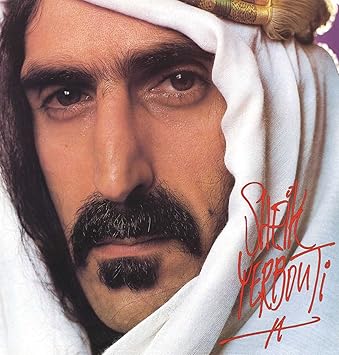
Sheik Yerbouti - Frank Zappa

Provenance: In a not insignificant number of ways I am my father's son, and nowhere is this more evident than my tastes when they edge towards the weirder end of the popular music spectrum. White Noise, Gryphon and today's subject - Frank Zappa - all came into my orbit as a consequence of my dad's listening habits.

In the instance of Sheik Yerbouti, I bought this to signal a small amount of independence. How so? Because dad didn't own this album. I distinctly recall as a youngster being impressed by cover art of both Overnite Sensation and Hot Rats, I thought the guy's name was cool (it sounds like a freakin' laser) and some of the songs made me laugh. Thus when I was older and casting around for my own bit of Zappanalia, I went for an album that was considered one of his more 'hard rock' efforts, as per my own inclinations at the time. Hence Sheik Yerbouti.

May I drift a little here? When it comes to worst fanbases of all time, you have to consider those of the Grateful Dead, Britney Spears and Pantera. They all have their demerits, but for me nothing comes close to being stuck with a Zappa fan when the topic of conversation is Zappa. I've had my head forcibly banged for me watching Iron Maiden, met some Megadeth fans who were happy to show me their Neo-Nazi tattoo collections and saw not one but three fights break out within spitting distance during a Madness gig. I'd happily endure all that again, and then some, if I didn't have to spend another moment in the presence of a Frank Zappa fan (my dad excluded, who is the epitome of the exception that proves the rule).

Review: Well, this is a bit of a disappointment.

I can imagine that, aged sixteen, I found some of this stuff funny. However, I've never found scatalogical humour particularly engaging, and any youthful proclivity I may have had towards it has certainly dimmed with age. In terms of my Zappa listening these days, it tends towards the more instrumental side, Mothers of Invention era cuts or Hot Rats (because 'Willie the Pimp  features the greatest violin riff in rock music). Sheik Yerbouti has slipped to the bottom of the pile, and giving it a listen for this review has done little to rehabilitate it.

You know, 'I Have Been In You' might have elicited the odd yuk back when Peter Frampton was a ubiquitous presence in the homes of Middle America, but pastiche is a dodgy thing to pull off at the best of times. It's saying something that the parodical Bob Dylan harmonica stylings on 'Flakes' is the highlight of 'Flakes'. And revisiting the notion of jokes ageing poorly - whew - 'Jewish Princess' (yep) and 'Bobby Brown (Goes Down)' (a discotheque staple on continental Europe, which is enough to make me a full on Brexiter) would've surely been offensive forty or so years ago. In 2018 they come across as positively Neanderthal with their depictions of Jewish women and homosexuality, respectively. A former English Literature teacher of mine once felt moved to describe Zappa as a 'poet'.

I'm happy to say that, amongst the more overtly comedic songs, one still holds up - 'Dancin' Fool' is a stabby little lampoon of the disco scene that works through a combination of splenetic observational humour and metrical tricksiness, the latter effectively turning it into a disco track that can't be danced to. 'Tryin' To Grow a Chin' is also a lot of fun, drummer Terry Bozzio providing a demented vocal. Plus I like false endings, and this song's got one (sorry to spoil it for you, folks - but are you really going to listen to Sheik Yerbouti any time soon?).

Here's the frustrating part; the first track that appears to privilege musicianship above cheap thrills, the instrumental 'Rat Tomago', hits the mark. The push-pull percussion, jazzy keys and wild guitar improvisations afford a glimpse into realms beyond this album's - consciously applied - limitations. Oh, enjoyed that music, did ya? Never mind, here's some wisecracks about fisting. With Sheik Yerbouti we've reached a point in Zappa's career where he needed to do the stoopid stuff (and take it out on tour) to fund his more serious compositions, which had become prohibitively expensive, especially where recording orchestral works were concerned. At least, that was the line trotted out at the time. Who knows? Maybe that was the case, but then again maybe he just got a kick out of stigmatising homosexuality via the medium of comedy song.

As I have intimated, there are hints of a better (and shorter) album here; all the instrumental cuts are great, with 'The Sheik Yerbouti Tango' coming out on top because it sounds just that little bit out of control. Zappa fans might scream that their formalist hero knew exactly what he was doing, but I think it's sometimes pretty neat to hear the seams of the music. (Isn't this where improvisation becomes truly interesting? When instead of falling back on the rock / jazz / blues playbook of licks, they take their instrument on a journey that teeters between inspiration and failure?). Of the 'straighter' rock stuff, 'Broken Hearts Are For Assholes' has a certain appealing mania to it, even if it does descend into a coda about 'poop chutes'. 'Baby Snakes' is here and gone far too quickly, which is a shame because it's a little gem of hard-edged surrealism. 'City of Tiny Lites' really kicks out the jams - a spacey and strangely soulful number that skips along on busy percussion and a rubbery bass line. The guitar solo is fucking badass too.

I will say this - aside from the more objectionable extremes of Zappa's lyric writing, I enjoyed the experience of revisiting Sheik Yerbouti more than I had expected. It's also told me something about myself, and the ageing process. When I was in my teens, I would often skip the 'boring' instrumental tracks so I could get to the next chucklefest. Now, it would be the other way around. Once upon a time, this would've been my favourite Zappa album because it had some rawk 'n' roll on it, but now I gravitate towards his jazzier output (which coincides with a general awakening to jazz as a genre, I guess). Anyway, Sheik Yerbouti certainly treats the ol' lugholes to some interesting snippets of music, but you have to ask yourself whether it's worth wading through all the snark and calculated dumbassery to reach.

Sunday, 11 February 2018

Get The Knack - The Knack

Provenance: It's got 'My Sharona' on it.

Review: Hmmm.

Hmmmm.

On the one hand, Get The Knack is a wonderfully hooky power-pop gem, redolent of Cheap Trick, the Raspberries and the first Big Star album. Gorgeous melodies and swooning harmonies wrap around jangly guitar and muscular drumming to superb effect. It's a joy from front to back.

However, it's also incredibly sexist and sleazy. Even the most generous of devil's advocates would struggle to justify the fetishisation of pubescent girls that runs through Get The Knack. I suppose The Knack should be congratulated for their singular ability to take the concept of the male gaze and rendering it in the form of a catchy rock album. It's an uncomfortable listen, and that's coming from someone who owns an album by an artist who calls themselves Mr Yellow Discipline (NSFW, quite obviously).

The apex, or perhaps nadir, of this objectification comes on a jaunty little number titled '(She's So) Selfish.' It's hard to sum up quite how nasty the track is in terms of both a projected fantasy and attitudes towards women, but the lyrics can give you an idea. I've long held an unease at what seems to be a specifically 1970s strain of misogyny in rock music (though not limited to that decade, or the genre for that matter - 1957's 'Boom Boom, Out Go The Lights' by Little Walter is particularly grim) but I can acknowledge that lust is a legitimate and very human feeling, and one which informs a considerable amount of music, art and literature.

My issues here are twofold; one, that this sweaty, glandular lust is so unreflectingly unrelenting. Not only does it never stop, but it never stops to ponder the other side of the coin or to gaze into the mirror. It's wonderfully crafted power-pop, but three-minute cherry bombs are rarely executed with the degree of genius necessary to provide nuance. As I said, this wouldn't be so bad if it weren't for the fact that a good three-quarters of Get The Knack wasn't knuckle-dragging objectification. Whilst the sublime 'Oh Tara' shimmers with a rare gentleness, 'Good Girls Don't', 'Frustrated' and 'That's What The Little Girls Do', er, don't.

The other issue is that, even if one attempts to be aware of the anachronism of grafting modern attitudes towards gender relations onto albums from 1979, Get The Knack still fails the sniff test. It is worth bearing in mind that this souffle of sweaty-palmed teenage frottage was written and performed by a band of men all in their mid- or late-twenties. I didn't let Faster Pussycat off the hook for 'Smash Alley', and though I made a glib reference to Lolita it's worth mentioning that Nabokov's work was a sophisticated serio-comic masterpiece in the 'unreliable narrator' vein of writing. For all its merits, and they are legion (in case this review seems overly damning), Get The Knack never aims for anything beyond a pose of arrested development.

Of course, I may well have just tied myself in knots through my inability to engage with Get The Knack through anything other than a contemporary prism of what could be considered 'problematic'. However, I have certainly enjoyed - and continue to enjoy - books, television and film that certainly wouldn't fit anyone's definition of 'woke'. Furthermore, I do so unapologetically. With that in mind, could it be that Get The Knack is, was, and will continue to be merely a squalid little paean to misogyny, albeit one that from a formal point of view sounds absolutely delicious?

What a shame. There's so much good music on Get The Knack that it's entirely deserving of its platinum status on that criterion alone. And viewed in isolation, 'My Sharona' is dangerously close to being the perfect rock song. It's an angsty, propulsive earworm that features one of the catchiest guitar solos committed to magnetic tape. I love it and it still makes me happy, albeit this is tempered somewhat by the knowledge that Quentin Tarantino wanted to use it for the 'gimp' scene in Pulp Fiction. But you know what? Thank goodness, I say, that my aesthetic tastes align with a great cinematic auteur like Tarantino, and not with some sordid, woman-hating trash-purveyor, eh?