Showing posts with label prog. Show all posts

Sunday, 4 April 2021

The Long Good Friday OST - Francis Monkman


Provenance: Unlike most good movies, this one is going to be heavy on exposition. How I obtained the soundtrack to The Long Good Friday is simple enough - I bought it from an online retailer - but the journey leading to that point was somewhat longwinded. No fan of brevity I, so I'll indulge myself a little.

As a youngster I was an avid listener to late night radio. This initially meant falling asleep to the strains of oldies station Classic Gold (828 AM!), later graduating to Talk Radio (1053/1089 AM) before settling on BBC Radio Five Live (909/693 AM), a habit I continue to observe to the present day. My first encounter with the theme to The Long Good Friday was as the intro music to one of the Talk Radio presenters, whose name escapes me now. (I do recall, however, that James Whale used 'Junkie Chase' from Curtis Mayfield's Superfly soundtrack as his theme.)

At some point or another in my teens, I actually got around to watching The Long Good Friday, and I still recall registering the little jolt of surprise that it featured the Talk Radio music. Still, a good track is a good track, so I went to sniff it out at HMV, the only place pre-Amazon where I felt I had a fighting chance of getting hold of it. As it so happens the OST was in the dog-eared catalogue under the counter, so I ordered it, waiting a good two years for it to show up. Every time I went to load up on Joe Satriani or Bad Company albums, I'd enquire at the desk, and the same sad-eyed man in the scruffy polo shirt would tell me no, my soundtrack hadn't arrived.

And that, my friends, was that. I bought the DVD (one of about four films I physically own), have enjoyed the film a few times, recommended it to friends and then quite forgot about the soundtrack. Until, one day at work, I ventured an ill-advised Harold Shand impersonation, which opened the floodgates of my memory to the extent that the same evening I had found and purchased The Long Good Friday OST on CD. It arrived at my flat within three days.

As an aside, it's Easter Sunday and, hey hey, I'm doing The Long Good Friday. This is about the second time I've deliberately themed a review, not something I imagine I'll repeat in a hurry because I'm too lazy to look up birthdays, anniversaries, etc. Nonetheless, happy Easter.

Review: Before Amazon we had the HMV in-store catalogue (which to my mind, contained all the music worth owning); likewise, before we had Lock, Stock and Two Smoking Barrels we had The Long Good Friday. I like both films, but the latter is the far more accomplished and intelligent gangster flick. Starring Bob Hoskins, Helen Mirren and Charlie from Casualty, it's the story of mobster Harold Shand (Hoskins) attempting to cut a property deal with an American crime syndicate whilst, simultaneously, doing battle with the IRA after a botched money-drop.

It captures a fascinating time and place - Shand as an avatar of the dawning age of Thatcherism, trying to go legit with the redevelopment of London Docklands. Footage of the Docklands area, portrayed here as a grimy wasteland dotted with scrapyards and abandoned wharves is in itself a time capsule of a bygone age; the expensive flats and high-rise offices now on the site of riverine industry are not uncontentious in themselves. Here, fiction and reality intersect - watch this fascinating conversation between Hoskins and Barry Norman to see where the emotional nexus of The Long Good Friday originates from.

Final note about the film - whilst not in-depth, writing from Brexit Britain it's interesting to hear East End gangster Shand waxing lyrical about how London soon be considered the capital of Europe. Later, when the Americans get cold feet, Shand threatens to partner instead with "a German mob - the krauts!" and parts with the rejoinder, "what I’m looking for is someone who can contribute to what England has given to the world: culture, sophistication, genius. A little bit more than a ’ot dog, know what I mean?" All rather strange, given the desperation with which the government of the day has tried, latterly, to cosy up to President Trump, the very epitome of transatlantic crassness that Shand so derides.

Wait - isn't this a music blog?

So, to Francis Monkman's (he of Curved Air fame) original soundtrack - a tough one to review, because outside of the main title theme, it feels unfair to comment on music divorced from the images it was meant to illuminate. This is nothing like, say, the aforementioned Superfly soundtrack, which Mayfield wrote as an impressionistic commentary to the film's action. It's straight-down-the-line stuff for the most part, aside from a sticky reggae number that begins promisingly but falls down on an ill-advised - and poorly executed - vocal by Hoskins, here doing a Jamaican accent. 

Having said all that, the incidental music is rather fun! Just like the main theme, many of the successive tracks combine keyboard and synthesizer with traditional instrumentation, a marriage that still feels fresh. Flutes compete with square waveform synths, slashing bursts of electronic static scythe through Philly soul string arrangements, all to great effect. There's the merest intuition that some cues have been taken from Mike Oldfield's Tubular Bells, but everyone borrows from everyone, so why fuss? The exception to this is a delicate, and quite beautiful, solo guitar piece called 'Sarabande in B Minor / Guitar Flamenco'. 

Ultimately, it's Monkman's main theme I came for, and to this day it doesn't disappoint. Urgent, juddering synthesizers set the pulse of not only the track but also the ramping tension of the film, before everything is swamped with the exuberant blart of a showband horn section. Squidging (the correct technical term, I believe) these two disparate ideas together is a musical exercise in tightrope walking, but it works; the effect is electrifying. Crystal Palace used to run out to this music, don'tchaknow!

Don't worry about this OST - I needed to have it, a compulsion to right a (perceived) wrong of the past made me buy it. Instead, experience this music in its proper context by watching The Long Good Friday. You could even treat yourself to a 'ot dog or two whilst doing so - know what I mean? 

Saturday, 11 April 2020

Discipline - King Crimson

Provenance: I volunteered at Reading Festival in 2003 (I realise you're all clamouring to know whether I saw Sum 41 - the answer is yes), and my friend Simon, with whom I was camping (next to members of Linkin Park's extended entourage, some guys from the Datsuns and a former Deep Purple roadie) told me about a record fair that was taking place in the leisure centre next to the festival site.

Desperate to get away from the wretched swine who hemmed me in day and night, I readily agreed with Simon's suggestion to slip away for an hour or two.

I hadn't intended on buying anything, but that's been the perennial bleat I've made every time I've exited from a music shop or bookstore laden with purchases. Anyway, I kept my 'discipline' here, and bought a single album - King Crimson's Discipline(!), influenced jointly by my dad owning In the Court of the Crimson King and having seen the Discipline line-up on a Fridays rerun. They sounded pretty cool, and they had an odd looking fellow playing a Chapman stick. Sold!

Review: When I was growing up in Bournemouth it had a reputation as a place to go once you've given up on life; later on, thanks to the proliferation of clubs with names like Wiggle, Bliss and Toko, weekends in the town became one long bacchanal, if such revels solely consisted of guys in Ted Bakers getting in paggas at taxi ranks and driving modded hatchbacks very slowly around the 'Westover circuit'.

What was never apparent about Bournemouth in those days was its status as an incubator for many a prog-rock superstar. John Wetton (King Crimson, Asia), Greg Lake (Emerson Lake and Palmer) and Robert Fripp (King Crimson) all met each other at Bournemouth College, whilst the Giles brothers (King Crimson) were also local. During my late teens, quite a few then-current / former members of Hawkwind (honestly, they probably couldn't tell you whether they were in the group or not) used to hang around a pub I would frequent, and my mate Max and I would receive semi-regular thrashings on the pool table from these erstwhile psychonauts.

This should mean nothing when it comes to a sober appraisal of Discipline, but my take on their output is tempered with a small but significant - and no doubt idiotic - dose of hometown pride. We had sticky clubs pumping out DJ Otzi megamixes, a shite football team and our most famous residents were Max Bygraves and Jimmy Savile. King Crimson, at the very least, had a degree of credibility, even a touch of mystery - bandleader Fripp was a retiring, elusive presence, and their version of prog left no room for flummery or whimsy. To those of us of sound mind, pop music can't really hurt you, but for my money King Crimson's Red is about as unsettling and scary as the genre can get. Cool!

But Discipline is not Red. This is King Crimson meets Talking Heads, heavily influenced by the new wave and self-consciously arty. However, Robert Fripp is undoubtedly one of the more cerebral guitar slingers out there, and for Discipline he recruited other guys who weren't exactly slouches in the brains department either - Adrian Belew (guitar, vocals), Tony Levin (bass, Chapman stick) and the incomparable Bill Bruford on drums (the single holdover from King Crimson's previous studio album, the aforementioned Red). This adds up to an arch, clever-clever group of musos with the chops to pull off some complex ideas.

Two things at the outset - first, these guys can't sound convincingly playful. Not even wacky old Adrian in his pink suits can escape the po-faced pomposity of some of the subjects that Crimson tackle. I'm not expecting the kind of winking bawdiness that AC/DC do from King fucking Crimson, but even lighter themes are turned into somewhat byzantine word-and-rhythm games. I don't think anyone has ever referred to King Crimson - any line-up of King Crimson - as 'the lads'. The second point, slightly adjacent to the first, is that everything on Discipline is highly technical, highly strung and very buttoned up. Nothing on Discipline sounds at all organic (probably by design, given the name), so one has to be in a certain frame of mind to enjoy it. This isn't music to relax to - quite the opposite - it's tense, itchy, uncomfortable. This latter issue isn't necessarily a criticism.

In fact, when it comes together, Discipline is a marvel. For all that they've sacrificed any notions of looseness or vibe for technical ecstasy, the personnel involved mean that the level of playing is simply dazzling. Bruford is the standout for me, conjuring up polyrhythmic patterns of rare power and drive. I reckon an album solely of Bruford's contributions would be quite listenable. The word genius is tossed around a lot when a simple 'very good' would do, but he's worthy of the mantle.

Elsewhere, the strength in Discipline lies in the sheer range of weird and wonderful sounds the rest of the band coax from their instruments. For example, on opener 'Elephant Talk', some clever sod has got their guitar sounding like a pachyderm's trumpeting; and instrumental 'The Sheltering Sky' features a slew of guitars that have been pushed to their outer limits. Here, the effect is sometimes shrill and uncanny - but on the gorgeous, aching 'Matte Kudasai', the weeping violin effect is mesmerising, elevating an already plangent tune to greater depths of sensibility.

And where necessary, in between the Afrobeat guitars and paradiddles, King Crimson can still muster up a mighty roar. The first instance that the heavily overdriven guitar kicks in during the chorus of 'Thela Hun Ginjeet' is a startling, even overwhelming moment - so all-consuming is the sound that it knocks the wind out of the other instrumentation and almost takes on a physical dimension. Mostly the jump scares are absent, though it really doesn't matter whilst the arrangements ping and whizz around in a dizzying, whirling, triumphal demonstration of what happens when pure ability is harnessed to a singular, iron will. Discipline is whip-smart, deadly serious, a little pretentious - and perversely, a lot of fun.

Oh, and Blur were absolute pony at that year's Reading Festival. I gave up and went to watch Billy Bragg instead.

Sunday, 8 December 2019

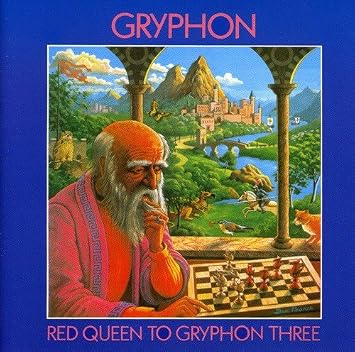
Red Queen To Gryphon Three - Gryphon

Provenance: A few years ago at work, we were idling away the hours on the taxpayer's dime chatting about striking examples of cover sleeve artwork. I recalled an album my dad still owns, Raindance, by today's subjects Gryphon. In the course of searching for the cover art online, I discovered that Gryphon had also produced a work called Red Queen To Gryphon Three, a concept album that's based on a game of chess and features a krumhorn. Armed with that knowledge, what do you think I did next?

Review: You know when people take that "none more black" line from This Is Spinal Tap and apply it to some other scenario, and it's never funny? Well, I'm not about to break the mould here, but in all human endeavour, there is none more prog than Red Queen To Gryphon Three. It takes two of the nerdiest things in existence - prog and chess - and fuses them together via the medium of medieval instrumentation. I imagine this as the product of only the most ascetic of proggers, denying themselves all pleasures of the flesh (most definitely women, although one suspects that wasn't difficult) to come up with this shining anthracite bolus of musical antimatter. So dimly, horrifyingly black that it sucks all pretenders into the gaping maw of its prog-rock singularity. Friends, this is geekery on a colossal scale.

We've got four lengthy tracks called 'Opening Move', 'Second Spasm' (lol), 'Lament' and 'Checkmate'. None of this makes any sense whatsoever, because this is prog so pure that it's entirely instrumental. Why besmirch this magical extravaganza with such earth-bound discordance as the English language? This is the music of the spheres! The universal resonance! I will concede that, possibly, the only thing more progressive would be to either make up your own language or perform your horrible compositions on ice.

I'm not sure I even need to tell you that Red Queen To Gryphon Three begins with a keyboard fanfare, as anyone with a passing knowledge of the genre could've guessed that already. 'Opening Move' is ambitious, in the sense that it takes the listener through a variety of moods - one moment jaunty, the next foreboding - none of which that I've ever experienced when playing chess. The performances are almost virtuoso, and it must be admitted that the quieter, piano-led moments are quite affecting. 'Second Spasm' (still laughing) starts off altogether rather 'hey nonny-nonny', but again, shifts about in timing and atmosphere; however, it retains a cheerfully martial feeling throughout, which gives it a good sense of cohesion, and the main theme (played on a variety of instruments) manages to be both knotty and catchy at the same time. Erk! I'm starting to enjoy this!

Ah, but now we're onto 'Lament', which is very sad and makes me cry. Kidding! Yeah, it's a bit more mournful than the preceding material, and the bassoon (a glum instrument) gets a decent workout, but any true emotion gets sucked out of proceedings by mere dint of it being a fucking prog track. Can you sob in 13/7 time? These guys seem to think you can. Weirdly for a track called 'Lament', there are a couple of brief movements that are frantic and upbeat, all crazy woodwind and Afrobeat guitar sounds. By this point I felt that I'd been listening to RQTGT for about a day, and so these moments of elation mirrored my notion that it was all soon to be over. A glimpse at the stereo revealed I was only just over halfway through.

Ahhhhh, but I can't quite hate it! The music is so guileless, so questing and brimming with ideas that cynicism feels churlish. It's not as if anything hangs around too long, either - Gryphon's modus operandi on RQTGT seems to be "getting bored of this twiddly bit? Don't worry, another will be along soon enough."

However, once you're halfway through 'Checkmate', exhaustion has almost settled in. Despite noble attempts to cut through all the jibjab by establishing a theme for each track, it's all starting to blur together. The jazz guitars! The clavinets! The bassoons! The krumhorns! (Reader, I have discovered that there are two krumhorn players on this album.) In summation, Red Queen To Gryphon Three certainly takes the listener on a journey - one where the destination can, at times, be obscure - but it's a quixotic undertaking. How anyone can conjure up a game of chess whilst being bombarded by this folk-prog maelstrom is beyond me.

At core, though, this is the most potently distilled prog in my collection, and so I shall cherish it forever. I'll probably listen sparingly, because I don't want to actually turn into a wizard, but listen again I shall.

Sunday, 1 December 2019

Aqualung - Jethro Tull

Provenance: I guess at one time I decided that should get into Jethro Tull. Anyway, I purchased this album before I went to university because it formed part of the meagre collection of burnt CD-Rs that accompanied me to halls of residence. I blasted the shit out of this thing during my first year.

Review: Some artists or albums are hardy perennials - they can be played almost any time of year and slot right in. For some reason, Jethro Tull are a seasonal band; I couldn't imagine spinning Heavy Horses or Songs From the Wood whilst the sun is shining. Very particularly, Aqualung is a winter album. Perhaps it's due to to the imagery of the title track, with its ice and 'December's foggy freeze'. It may be due to the seam of religion that runs throughout, which for some reason I've long associated with a dank coldness (the interiors of churches and cathedrals, perhaps?).

Or it might be that Aqualung goes well with the most deathly season because it sounds pretty goddamn deceased itself. I've got plenty of albums from eras where recording technology was still quite rudimentary, others whereby some creative studio trickery dates the music badly. I've even got a couple made by a sex offender in his basement. Whatever their flaws, none of them sound as dead as Aqualung. There are grime tracks recorded on mobile phones with more presence. The cardboard guitar in the video to Judas Priest's 'Breaking the Law' has better tonality than Martin Barre achieves. There are uncontacted tribes deep within the Amazon who have opinions about the production on Aqualung.

Let's be charitable. It was one of the first albums recorded at Island Record's Basing Street studios. Teething issues, an' all that. It's not as if any other album, being recorded at the exact same time at the exact same facility, sounds any good.

I've got more beef with Aqualung. About the only moment of human warmth and empathy on the entire collection comes early on, in the acoustic mid-section of 'Aqualung', where we are invited to feel sorry for the subject of the track, the titular tramp. For the rest of the album, Ian Anderson's lyrics are by turns arch and sneering, as if he's just that wee bit more clever than the listener. It's particularly insufferable on 'My God' and 'Hymn 43', which come across as 1971's equivalent of watching a YouTube atheist channel. (NB - please don't watch any atheist-themed YouTube content - it almost drove me, a staunch non-believer, to the seminary.)

Take, for example, Sparks - a band who are undoubtedly arch and oh-so-smart, but who wear their erudition lightly, and deploy a winking charm to make their references to Shakespeare, the Rockefellers and the human reproduction cycle slide down easily. Jethro Tull, alas, come across as dour as any carping Presbyter or dorm-room Maoist in their attempts to enlighten.

It's a shame, because putting aside the hectoring and shit production, Aqualung possesses the kernel of a prog classic. The electric guitar riff to 'Aqualung' is a blooter, and is rightly smashed out by greenhorns in guitar shops up and down the country. 'Cross-Eyed Mary' has some wonderfully angular guitar work, and is probably the leanest, dirtiest thing on the platter. 'Locomotive Breath' is another corker, an indomitable chugger that is nevertheless not as heavy as the version that plays in my head. It also sounds like a rubber band is part of the instrumentation. Ah, fuck it, 'Locomotive Breath' properly smokes.

Even 'Hymn 43' doesn't sound so bad, if you ignore the lyrics. In fact, it would have fit in very nicely on Atomic Rooster's Death Walks Behind You, an album that I like very much.  Pick of the bunch for me is 'Mother Goose', not only for its delightfully absurd lyrics, but because it best resembles the twisted folk that would appear on my favourite Tull joint, Songs From the Wood. Hey, maybe I'm being tough on Aqualung because it's not Songs From the Wood! Maybe!

Look, I can take the sermonising if the music sounded immaculate, and it doesn't. I still like this weird, somewhat cerebral little beast but it could certainly do with someone like Steve Wilson to give this a bit of remastering spit and polish. Oh, and I was wrong earlier on - contrary to my claims that Aqualung was altogether bloodless, 'Wond'ring Aloud' possesses a lot of heart. It's rather beautiful, in fact.

NB - my CD version of Aqualung contains a rather interesting interview with Ian Anderson about Aqualung. In the interests of fairness, it's not just me who thinks the album doesn't quite sound right; Anderson uses a portion of the conversation to bemoan the production, and the difficulties of getting decent performances on tape in the particular studio Jethro Tull were assigned.

Sunday, 15 September 2019

Death Walks Behind You - Atomic Rooster

Provenance: I heard a version of 'The Devil's Answer' on some completely random rock compilation that also featured INXS and Hootie & the Blowfish. I liked it, so when I came across a CD version of this album that included two versions of 'The Devil's Answer' as bonus tracks (as far as I'm aware, it was only ever released as a single in the UK), I thought to myself, what the heck, let's have a bash at some of their other stuff. Also, you can't fault using a William Blake monotype as cover art.

Review: After the gossamer-light ululations of Kate Bush, we're back down on terra-very much-firma with the clunking fist of Atomic Rooster. The band look every bit as typical and anonymous as you expect them too - like three replacement members of Steppenwolf, or indeed, absolutely anyone from Cactus - and don't make any surprise moves on the musical front either. Another early 1970s 'eavy and 'umble outfit with a few proggy pretensions. File next to virtually every other band of the era aside from Black Sabbath, who at least had the good grace not to lard their nascent doom-metal with lashings of organ. Every fucking band of this time thought a big ol' Hammond was the key to sounding portentous, when really the answer was feed your bassist too much cheese before bedtime and then let him write lyrics about the resultant experience.

This is all a bit unfair with regards to Atomic Rooster - or, at the very least, Death Walks Behind You - because I think it's a top quality album. Just because I've heard a gajillion bands crawling their way through the doped-up sludge rock ooze of the early 1970s doesn't mean that there aren't a few good'uns amongst them. It's true that I spent years trying to convince myself that Deep Purple were decent when they actually weren't, but some, like the Groundhogs, or Mountain, or the Edgar Broughton Band, or even Uriah Heep did something neat enough or funny enough to distinguish them from the patchouli-powered peloton. So, what distinguishes Atomic Rooster's sophomore effort from the likes of Leaf Hound, Elias Hulk, et al.?

The answer - songs, dear boys, songs! Whilst many of their peers seemed content so merely pen frameworks for their semi-improvised jamming (yawn), the Atomic Rooster lads had the good grace to actually write some tunes. I'm sure a goddamn Night Sun album sounds great when your whacked off your gourd, but in the mundane environs my front room in 2019, I'm unlikely to take too many journeys to the centre of the mind assisted by sparkling water and Glacier Fruits. And thus, the music has to stand or fall by its own terms.

Death Walks Behind You starts almost like something from King Crimson's Red, albeit not quite so wilfully oblique, a minor-key piano theme jutting against some dissonant ambient noise, but then it crashes into an unexpectedly funky chorus riff, one that manages to be both catchy and heavy at the same time. The verses are good as well; a descending chord sequence that sounds like a demonic inversion of Chicago's '25 or 6 to 4'. It builds tension admirably, with the release coming in a reprise of the chorus. This is cool! The next track isn't so great, seeing as it sounds a bit like a lumpen version of Yes' 'Roundabout', or perhaps a Focus outtake where Thijs van Leer forgot to bring his flute along, but it's okay as far as rock instrumentals of this vintage are concerned, plus it's called 'Vug' so I sense the band didn't think too much of it either. It is certainly 'eavy though!

However, here's a decent joint on the docket - 'Tomorrow Night', which actually gave Atomic Rooster a UK top twenty hit. Thematically it's a slight departure from the rather chesty boasts about sexual conquests made by many of these spectacularly hairy groups, as it introduces notes of doubt and insecurity into the mix. It's still delivered with stridency by guitarist / vocalist John Du Cann (whose rich low tenor delivery is very appealing), but it fits in with an undertow of existential confusion that runs throughout Death Walks Behind You. At this juncture, I feel I should also mention that Du Cann's rhythm work on the album is really fine, abhorring anything too finicky in favour of a sledgehammer attack, often barrelling huge power chords at the listener in ack-ack bursts. If anything, drummer Paul Hammond is the busiest, his combination of heft and jazzy nous a welcome contribution. Somewhere in the middle is the talented, tragic Vincent Crane (organ / piano), who often complements Du Cann but allows himself the odd Keith Emerson-flavoured wallop on the keyzzz.

I guess it's the forward motion, the propulsion behind many of these tracks, that makes Death Walks Behind You such a listenable confection. 'Sleeping For Years' is a proper standout; in other hands this could have devolved into some interminable head number, but here it whacks you around the chops a bit and then lets you go to enjoy the next offering. That offering is 'Can't Take No More', which sounds a helluva lot like the Electric Light Orchestra's 'Don't Bring Me Down'. Songs sound like other songs, I get that, but Jeff Lynne of ELO fame was added as a writer to The Hives' 'Go Right Ahead' after it was recorded, because the band thought it sounded so similar.

'Go Right Ahead' was released in 2012. 'Don't Bring Me Down' was released in 1979. 'Can't Take No More' was released in 1971.

Death Walks Behind You doesn't really falter in quality as an album until right at the end - 'Nobody Else', the penultimate track, is built around a lovely, plaintive piano theme from Crane - and it's only with closing instrumental 'Gershatzer' that it's a bit ragged and disjointed. It's the kind of thing I guess The Nice did fairly well, and I don't like The Nice. Still, if you can stomach the odd indulgent instrumental for the sake of a collection of high quality, slightly foreboding and melodically strong hard rock, Death Walks Behind You should be on the Crimbo list.

Oh, and 'The Devil's Answer' still rocks!

Saturday, 31 August 2019

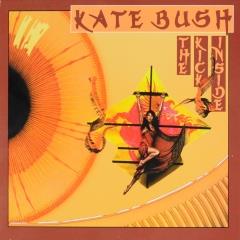
The Kick Inside - Kate Bush

Provenance: Ever since I was young I loved 'Wuthering Heights'. My parents had it on a CD compilation of 1970s hits, and along with cuts by ELO, CCS and the Tom Robinson Band, I would play 'Wuthering Heights' incessantly. Even at a tender age I could detect there was something a bit off-kilter about it.

Did I get The Kick Inside before I went to university? Odds are that I did, because our student bar had a video juke box containing about three songs (seemingly), one of which was 'Wuthering Heights'. It was on all the time, and began to drive me nuts. However, I did make a friend through a shared appreciation of Kate Bush, and I was able to introduce her work to a housemate who became an ardent fan.

Anyway, it was a bit of an anomalous purchase for me around that time, as I was busy having my brain smashed to cottage cheese by the likes of Judas Priest and Dio.

Review: A perfect album. I can't fault it. The worst thing you can do if you're not already familiar with The Kick Inside is to stop reading this bilge and give it a play. Nothing I can say can do this magical platter justice. Even when reviewing the most workmanlike collection I am nagged by the sense that writing about music is akin to dancing about architecture, a suspicion only heightened by playing through this album.

What could one possibly object to? I've been met with naysayers in the past who don't like the high register Bush sings in throughout much of The Kick Inside. I find this to be one of the most appealing aspects of Bush's execution here, however; the sheer ease with which she soars up to the most dizzying heights only serves to bolster an overall sense of ethereality. Here is a voice that celebrates the sensual, the weird and the uncanny elements of life with an almost explosive joy. It's the same breezy virtuosity one feels that they see in sporting performances like those of Simone Biles or Ronaldinho, when the seemingly impossible is delivered with all the thrust and playfulness of a person revelling in their own ability.

Oh, I also think the saxophone sounds a bit blatty and high in the mix on 'The Saxophone Song'. That's all.

How, though, can you gainsay the quality evident in the floaty, woozy opener 'Moving' (dedicated to Bush's dance teacher, the late Lindsay Kemp), and the herky-jerky carnival ride that is 'Kite'? How does one wrap their head around the fact that Bush wrote 'The Man with the Child In His Eyes', an achingly beautiful song pregnant with quiet mystery, at the age of thirteen? Without wishing to dwell on age too much, it's worth remembering that Bush hadn't even reached twenty when The Kick Inside was released. I barely knew how to put two chords together at that age; meanwhile, Bush was creating miniature masterpieces and name-checking freakin' Gurdjieff.

One aspect of The Kick Inside that might put off some listeners is that it's a very self-contained universe. Which doesn't mean that it leaves no room for interpretation; Bush's allusiveness and readiness with esoteric subjects compels the listener to fill in the gaps. However, everything feels like it exists within the world of this album, and has little relationship with a tangible world of things. In much the same way that HP Lovecraft's or Emily Dickinson's writing seemed a step or two away from regular human experience, so Bush sounds like she's singing into existence a Neverland realm. Personally, I find this aspect of Bush's work utterly addictive, but I can see how it may also seem obtuse.

Another thing; this is definitely music for the head, and not for the hips. In fact, the only people who can dance to the music on The Kick Inside are drunk goth girls and Kate Bush herself. Stylistically, it shares with Carole King's Tapestry (another triumph, incidentally) both earnestness and intimacy, and if you strip away some of the more maximalist flourishes of Bush's work, a solid piano-led pop sensibility; but where King's articulated experiences are somewhat more earthbound and recognisable, Bush zags towards cerebral and arcane subjects. What of this pop-sensibility? It's probably closer to the baroque pop of a band like the Zombies, and a dash proggier by my reckoning, but Bush's keen ear for a quirky - but catchy - melody results in an album laden with vocal hooks. A favourite of mine are Bush's interpolations in the chorus of 'Oh To Be In Love', which skims over the top of the music in a way reminiscent of Ry Cooder's sublime guitar work on Captain Beefheart's 'Abba Zabba'.

I don't have much else to say. Just buy this, or virtually any of Bush's other albums, because even when the quality is uneven, there's something interesting there. But first, do yourself a favour; dim the lights, light some candles, run a bath, bust out that family-size mint Aero you've been saving and soundtrack your self-care with The Kick Inside.

Monday, 11 September 2017

Damnation - Opeth

Provenance: I'm just back from a trip to Romania to attend the marriage of my old friend Joe to the lovely Elena. Joe's one of a group of guys who I've all known since the age of 11, and gradually became pals through a shared love of music. At one time or another we've all played with each other's bands and to this day remain tight as a group of people. It's really rather wonderful.

As is customary for any group that bond over music, recommendations fly back and forth, and one I was happy to catch was Opeth. So now, as I reflect upon the sumptuary and sublimity of the Carpathian landscape (Transylvania is a beautiful place), lately surroundings, it seems fitting that my first review upon returning home is one of Opeth's most dreamlike and ethereal collections to date.

Review: Well, I've already given the game away by labelling Damnation 'dreamlike' and 'ethereal'. Let me begin by saying that once upon a time, these would not be words readily associated with Opeth. The band - which continues to be led by the multi-talented Mikael Akerfeldt - began life as a progressive death metal outfit. However, since their 1995 debut Orchid, Akerfeldt has gradually allowed his love of classic prog rock to shine through, with 2003's Damnation representing a culmination of sorts; it was both the most nakedly prog album Opeth had put out to date, and also their most mellow.

Gone, then, are the death growls of pure death metal; in their stead is a stately, sorrowful singing akin to that John Wetton contributed to King Crimson's Red. The King Crimson comparisons don't end there, either; again, Red is invoked with some of the guitar tones and the liberal use of Mellotron to produce the very particular note of mournful foreboding that characterises the album. Which is not to say that Damnation is some kind of sequel to Red; it is perhaps unsurprising that Porcupine Tree also spring to mind, given that Steven Wilson co-produces this album.

However, if it never quite reaches the levels of tension or intensity of Red (and let's face it, what does?), Damnation is very much a collection of uneasy moods, thanks to tricksy minor-key arrangements coupled with drumming that is itchy and imaginative, pulling the seams out of the music, both establishing and deleting a groove at the same time. There are songs here too; by which I mean Opeth write strong melodies throughout, twining them sinuously around the skeletal instrumentation.

It's about this time I feel I should digress a little, and state for the record that I'm fucking sick of music publications that act in amazement when unabashedly progressive bands can write a goddamn tune. From Yes to Caravan, Jethro Tull to Genesis, Steve Hillage to Kevin Ayers, prog has been chokka with superlatively hummable music, some of which just happens to be in 13/8. Of course, there are artists in the genre who chose to create more impressionistic music, or to privilege virtuosity over what one might describe as a certain pop sensibility, but prog has earned an undeserved reputation for masturbatory excess and self-indulgence. If we're talking jam bands - well, now you're onto something, brother...

There's precious little fat on Damnation. At times it can feel like a very quiet album, with a spectral piano refrain picked out, or a shivering, chiming guitar figures ringing out over a sparse, empty landscape of sound. It's not a stretch to say that some of this is utterly spellbinding - and when the Mellotron kicks in, one of the few full-bodied instruments in the mix, the effect is at once both startling and thrilling. The guitar work is woozy and beguiling, natural and harmonic minor scales lulling the listener into that weird, heavy-lidded moment between wakefulness and sleep. The last track, 'Weakness', signs off on the most hesitant and tentative note struck on the entirety of Damnation, bringing to a close an album that feels like it was conjured entirely of gauze and ghosts and fog.

Thursday, 13 April 2017

Tales of Mystery and Imagination - The Alan Parsons Project

Provenance: Along with virtually every other person of my age and origin, the first time I heard the Alan Parsons Project was in Austin Powers: The Spy Who Shagged Me. Was that joke ever funny? My research reveals that a number of NBA sides, most notably the Chicago Bulls, ran out to 'Sirius' during the nineties, and to this day its pomp and majesty serves to pump up the players and fans of Serie A side Sassuolo.

(As a brief aside - I'm generally in favour of sports teams running out to some cool music. It's the one - and only - thing US sports gets right. Having said that, I lament the day when the bugger manning the stereo at Charlton Athletic decided to ditch Francis Monkman's incredible theme tune to The Long Good Friday, as it was both a brilliant and unique choice).

My first conscious experience of the Alan Parsons Project came about from Planet Rock Radio playing a song called 'The Voice', from the album I, Robot. It was such a singular piece of music that I felt compelled to buy the album. Amazon offered to bung Tales of Mystery and Imagination in for the princely sum of eleven quid. I had nothing to lose and everything to gain.

Review: Very quickly by way of precis - Alan Parsons was not, as I'm sure you've gathered, an eminent Cambridge physicist hired by Dr Evil to make a moon laser. He was - is- in fact a noted producer, sound engineer and musician. His credentials are pretty good - he was the sound engineer on Dark Side of the Moon, which doesn't sound too shabby. The eponymous project was rounded out by the late songwriter Eric Wolfson and executed mostly by a clutch of trusted studio hands and special guests.

So I've just hit play and holy fuck tell me that's not the great Orson Welles, star of Transformers: The Movie, Get To Know Your Rabbit and a bunch of other stuff, narrating? It most certainly is! Just in case you're an illiterate philistine, I should point out that this is a concept album based upon the works of Edgar Allan Poe, and here Welles is recounting some of Poe's thoughts on literature in that wonderful, unmistakeable dark chocolate voice.

Our hand now firmly grasped, we're led into the uncanny, dreamlike realm of Poe's imagination through the medium of instrumental prog rock. Because why, when creating an homage to one of the deftest wordsmiths of all time, would you bother with lyrics? Half of this album is instrumental, which seems a tad gratuitous in 2017. But let's put this in context; back in 1976 you were probably going to get pretty chonged before giving this a spin. So it's all good, brother. It's impressionistic, there's a depth to Poe that words can't - and which presumably, synthesizers and blazing electric guitar can - adequately convey. Meanwhile, instead of taking drugs I'm writing about it on something called a blog. Who's the square now, daddy-o?

The more traditionally structured songs are a real treat though. Tackling 'The Raven' is a big ask given its ubiquity but it's rendered here with the satisfyingly overblown treatment the subject demands. However, the real mustard is to be found in 'The Tell-tale Heart', which pushes the madness into the red with a suitably demented vocal from Arthur Brown. I often see Arthur Brown strolling around as he lives quite close to where I work, and he's quite hard to miss considering he wears loon pants and a top hat, and seems about six and a half feet tall. Here's a callback to my opening paragraph; at the start of the 2016/17 football season my team Lewes FC adopted the Crazy World of Arthur Brown's classic 'Fire' as their entrance music, and for the first game of the season Brown himself sang it as the teams emerged. Did he wear a flaming helmet? Of course he did, and it had to be put out with fire extinguishers before the game began.

How freaking rad is that though? You go to watch some division eight bullshit football match and there's your man Arthur Brown screaming "I am the God of Hellfire.." before kick off. You don't get that in the show-pony Premier League.

The next two songs are sublime too. 'The Cask of Amontillado' has probably the cleverest lyric of the bunch and wouldn't seem out of place on the best Paul McCartney albums. When the orchestra kicks in for the first time the effect is widescreen - really, it's almost like the first time you hear Maurice Jarre's theme for Lawrence of Arabia as the camera tracks across the desert. It sounds huge. Meanwhile, 'Doctor Tarr and Professor Fether' is a quirky cod-funk number that should be ridiculous but turns out to be a triumph. How? Superb arrangements, imaginative instrumentation and a sound that is absolutely impeccable, flawless. What else do you expect from a guy who worked with the Beatles and Pink Floyd? They weren't exactly slouches.

Here's the deal, then. Tales... is very much of an era, and as such you're going to hear Orson Welles chuntering over some proggy soundscapes from time to time. The entirety of 'The Fall of the House of Usher' is in effect a tone poem, and if you're intolerant of sonic whirligigs and gewgaws, this isn't for you. It is an ambitious work, and does an excellent job of presenting Poe without getting too hammy or Grand Guignol about it. I guess W.A.S.P. used Poe as source material, punning on the title 'Murder in the Rue Morgue' but singularly failing (spoiler alert) to write a song about a goddamn orang-utan (or whatever) committing murders in Paris (an amazing conceit for a heavy metal song, no? Not according to W.A.S.P.). Nevertheless, give this engrossing and cerebral album a go, at least before you indulge a man who used to sport a saw-blade accessorised codpiece.

Sunday, 9 April 2017

2112 - Rush

Provenance: I'm not sure why or where I bought this album. Fairly certain that it wasn't a gift. Who buys people Rush albums as presents? I knew I had it before university, as the following text will bear out.

Anyway, I was today reminded about Rush as my very good friend Birke matched with a guy on Tinder who said he was a fan. Big respect to anyone who goes public on a hookup site with that. Apparently he works at CERN, which makes sense.

This one's dedicated to you, Birke.

Review: I own not one, not two but five Rush studio albums. They're in a special CD rack that also has multiple albums by artists like Alice Cooper, Cheap Trick, Steely Dan and Tom Waits (though not Blue Oyster Cult - they have their own special rack). That I've bought many albums by these musicians suggests that I like their output, and indeed, many of the albums experience heavy rotation. But I literally had to dust off this motherfucker before putting it in my stereo. Five Rush albums, unplayed, unloved. What's the issue?

I guess it's this - in my head, Rush are a good band without ever being great, plus they wed too much of their material to the risible Objectivism of Ayn Rand. It's like biting into a nice juicy apple to find half a not-so-nice (but equally juicy) worm poking out. I've talked previously about how Ted Nugent's dumbass beliefs spoilt Craveman for me and I'm anticipating something similar here. The other misgiving I have with Rush is that they never overawed me with any one element of their music. Instead, I was often left with an impression of a group of songwriters hobbled by formality, creating a kind of prog that sounds like it was done with compasses and calculators. It never seemed to bounce along as well as a Yes song, was never as earthy as the best Jethro Tull, nor could it compete with the avant-garde leanings of King Crimson. Still, the whole point of this exercise is that I reappraise albums in my collection, so let's give 2112 a fair go.

I know I owned this album prior to university as I made one of my first friends on my course, Mike, discussing it. Specifically, side one - '2112', rather grandly split into seven parts. I credit Mike with opening my ears to the dazzling world of jazz music, but I recall vividly his summation of the intro to '2112' - "it's cool because in 'Overture' they play all the riffs in the coming sections, like it's a blueprint for what you're about to hear." Ha ha! It's not strictly true, but more or less right, and it's a beautiful way to think about it. And truly, I had forgotten how thrillingly virtuosic this section is.

Equally, I had forgotten just how mind-numbingly idiotic '2112' is as a story, and how irritating Geddy Lee's voice was back then. If I do listen to Rush these days it tends to be something more modern, because Lee's dog-bothering upper register is largely absent. No matter though - neither helium lungs nor stupid lyrics can spoil part two, 'The Temples of Syrinx'. Big, bombastic, exhilarating, fun even. The next section, 'Discovery', where a man finds an ancient relic we know to be a guitar (music is tightly controlled by the aforementioned clergy in this dystopian future) is cleverly done; the dissonance of an untuned guitar gently give way to pleasant arpeggios; and as this schmuck becomes more entranced with his discovery, the excitement is mirrored by changes in tempo and picking techniques. Alright, 2112 is pretty good so far.

Unfortunately, nothing in the coming sections of the '2112' suite quite matches either the power or cleverness of the opening two parts, in execution at least. If you don't give a fuck about the storyline - which I don't - then you've got a clutch of movements that start to sound fairly similar to each other, dynamically and tonally. Probably my favourite bit here is 'Grand Finale', where everything is sucked into a whirling sonic vortex and a sinister voice says some crap like "WE HAVE ASSUMED CONTROL", and authoritarianism, as we all know, is a totally metal thing (either its assertion, or busting free from its bonds).

Now it's side two - starting with the risible 'Passage To Bangkok', an absolute turd of a track. In its allusions to drug use this song gives the listener such a prod with the elbow that it would crack a rib or two. Everything fucking sucks, plus they use the 'Oriental riff' twice and I can't tell if they're being ironic or not (probably not), so it's a relief that the succeeding song 'The Twilight Zone' is rather good. Better than that - it's superb, combining punchy verses with a woozy, delicate chorus.

The quality is maintained with both 'Lessons', which marries a jangly Doobie Brothers feel in the verses to a hard rock chorus. It should be said that Lee's voice sounds great here, especially when doubling Alex Lifeson's guitar riff. Next up - 'Tears'. What a belter. Not only is it a welcome change of pace, it also possesses a hitherto unrevealed depth of emotion - a yearningly, achingly crystalline confection, and so simple too. I can play this on a single acoustic guitar and it sounds good (NB: everything sounds good in my capable hands).

Having exposed my prejudices prior to listening it feels as if I've unjustifiably maligned 2112. It's not perfect; that designation is reserved solely for Boston's debut and Steely goddamn Dan. The lyrics are still shite (Neil Peart, a supreme drummer, should have the pen wrestled out of his hands every time he goes near a piece of paper) but it's very listenable and, when one is in the right mood for Objectivist hokum, rather enjoyable.

Tuesday, 14 March 2017

Operation: Mindcrime - Queensryche

Provenance: A bit murky. There's a good chance that the consensus amongst my secondary school muso friends was that Operation: Mindcrime was a Very Good Album™, and purchasing this would make me a pretty hip dude indeed. Another possibility was that the uncle of my friend Chris recommended it to me. He knew his metal, and thus had Good Opinions™.

Either way, Operation: Mindcrime became a bit of a touchstone for the tight-knit group of friends I was part of that attended gigs and European music festivals together. We enjoyed referencing it with a certain ironic relish, especially the moment at the beginning of 'Anarchy-X' where a guy answers the phone and is met with a bitchin' guitar riff. The phrase 'mindcrime' became our shorthand for any unappealing or bad situation.

At our first Sweden Rock Festival we wandered around our designated campsite looking for a place to pitch our tents. We thought we'd found a decent spot next to the perimeter fence and were about to stake our claim when the riff from 'Anarchy-X' piped up from a nearby boombox. We took this to be a bad omen and moved on. It was the best decision we made all weekend too (aside from trying elk kebabs), as we finally broke ground near two Swedish girls who we became friendly with. To this day I am still in touch with the beautiful, charming and extremely funny Camilla. Mycket bra!

Turns out we dodged a bullet as spot near the perimeter fence was adjacent to the biker field. The bikers spent the entire time listening to the worst fucking Eurobeat whilst hopped up on speed.

Review: Operation: Mindcrime is a prog-metal concept album. I'm not really sure what it's about. There's a guy who seems pissed off with the world being all fake and shit, which is great for religious cult leader Dr. X as he recruits and brainwashes this guy into becoming an assassin (cool). There's also a nun in the employ of Dr. X (Sister Mary, who used to be a prostitute of course) and the story hinges on the brainwashed guy and the nun getting too close. Dr. X uses his mind magic and this chap kills Sister Mary...or does he? That's about where it stops making sense to me. He's in hospital at the start of the album and the best song is about how he can't remember anything, so I assume the action occurs in flashback.

I genuinely don't think I'm too far off with the jibber-jabber I wrote in the preceding paragraph, and based on that alone Mindcrime should be terrible. In the interests of fairness, perfectly serviceable thrillers have been written on flimsier premises, but concept albums do seem to have to live up to some never-articulated higher ideal. You can come up with any old bobbins for a cinematic presentation and the greybeards will still take it seriously (i.e. classic Alfred Hitchcock), but dare to set it to rock! music! and you run the risk of being called pretentious, ridiculous or worse.

Anyway, it's all academic because Mindcrime really is a very fine metal album. Without any kind of unifying narrative arc the songs all stand up to scrutiny. However, in this instance, the knotty and overwrought storyline does give the album a definite propulsive force, to the extent where I wouldn't want to listen to any of the songs in isolation.

Alongside the strong concept, two other things push Mindcrime into the upper echelons of progressive metal releases. The first is the fine-tooled songwriting, which never sacrifices a keen ear for a hook in the name of technical ecstasy. From front to back Mindcrime is sleek and accessible, replete with pomp and grandeur but retaining an almost pop sensibility. Thus the likes of 'Operation: Mindcrime', 'I Don't Believe In Love', 'Breaking The Silence' and 'Eyes Of A Stranger' have huge stadium-satisfying choruses.

The second quantity of Geoff Tate's preternatural vocal ability. His voice is simply perfect for the material, and in the metal genre perhaps bettered only by that of Rob Halford (and really, there's a cigarette paper between the two). And whilst I've praised the songwriting, the music is truly brought to life when coupled with Tate's vocals - his extraordinary pipes makes that chorus in 'Eyes Of A Stranger' soar. The only real blot on the copybook comes near the conclusion of 'Suite Sister Mary' at which point the band opt for the dusty ol' device of creepy Latin chanting to signify threat or menace of a religious nature. Sanctus! Dominus! 

It's a shame, then, that Tate turned out to be such a strange and unpalatable character. As with many bands of their era the passage of time saw Queensryche's fortunes steadily diminish, but thanks to Tate's antics there was - for a while - the assuredly unsustainable situation of not one but two Queensryches existing in this universe alone (and who can say how many in a multiverse?). Meanwhile, his questionable sartorial tastes led to the commentariat of Blabbermouth to dub him 'Uncle Vester'.


At least his winery seems to be doing well.

Sunday, 15 January 2017

Motivation Radio - Steve Hillage

Provenance: This is a very new album for me, as I received it for Christmas 2016. However, the reason I had wanted it stretches back a few years. I had been to see Gong play in Exeter, for whom Hillage served as both guitarist and support act. I was rather taken with his solo work I heard that night, especially 'Salmon Song'.

Gong were fantastic that night. The late Daevid Allan dressed in a gnome costume augmented with compact discs and regaled the audience with a story about collecting psilocybin mushrooms from "the wooded glades of the city." May he and Gilli Smyth enjoy the long and cosmic trip back to Planet Gong.

Review: Ugh. After wrasslin' with Ted Nugent's brutish and nasty Craveman it's a delight to lift one's gaze beyond the horizon and peer into the depths of a universe filled with a pure and positive energy. Okay, perhaps Steve Hillage hasn't exactly awoken the New Ager within, but the attitudes of discovery and wonder that pervade this album are certainly infectious. Hell, it's even there in the album cover; a wide-eyed, blissed-out Hillage, dressed like an initiate into a vaguely sinister cult, superimposed upon an image of 'The Dish' at Parkes Observatory. The inference is clear; keep your eyes on the skies and your ears tuned into the music of the spheres.

So what was Hillage concocting back on Earth to aid our ascent to a higher plane? The short answer: something endearingly eccentric.

Within the first track you're already tasting some really cool flavours - strange synthesizer sounds, Hillage's oddly attractive vocals (with no attempt made to hide his English accent) and some questing guitar work. Somewhat unexpected is the definite funk sound that is perceptible early on, and becomes more marked on songs like 'Motivation' and 'Saucer Surfing''. Reading around, I learnt that Hillage had, at this time, become quite enamoured with US funk acts such as Earth, Wind and Fire, and had consciously tried to capture some of that groove. Not that you'll ever confuse this with Mothership Connection.

With his adoption of funk, Hillage has also sloughed off a fair amount of the trappings of prog. That's not to say that this collection is any less weird as a consequence. So the seemingly straightforward heavy riff-rock of 'Light in the Sky' is undermined by Miquette Giraudy's breathy, panicked (and somewhat unexpected first time around) contributions. 'Radio' is the most singular song about radio since Helen Reddy's disturbing 'Angie Baby' (go on, have a listen and try explaining to me what's going on). In a final flourish, Hillage flips the sweaty priapism of Buddy Holly's 'Not Fade Away' into a song about universal love and personal inspiration. Come on, that's adorable!

At a remove of some forty years some of the sentiments can seem twee or naive to the average punter, and the synth tones are decidedly retro (so much so that they are possibly in vogue again). Was it a queer duck in 1977 too? Received wisdom suggests that such sensibilities couldn't survive in the midst of the punk crucible, but on the that punk score received wisdom is utterly wrong. (As an aside - I've lost count of the number of BBC music documentaries that show Rick Wakeman in a cape or Peter Gabriel dressed as a flower and there's a keyboard playing an interminable solo the whole time, and it's interrupted by a narrator going "But then..." and suddenly it's the intro to 'Pretty Vacant' and the Sex Pistols have destroyed everything that came before them. Everything. I mean, it's just pathetic. You can't even call it revisionism, it's just stupidity.)

However, in real time - the time you take to tune in to Motivation Radio - it is genuinely difficult to resist. If music can be escapist, then what better than an album that gives your inner consciousness a road map of the Milky Way and blasts you off with all best wishes in the world? Some music is aimed at the body, some towards the groin, some towards the head. Motivation Radio aims for the galaxy, and is all the more better for doing so.