Showing posts with label country. Show all posts

Sunday, 1 November 2020

Townes Van Zandt - Townes Van Zandt


Provenance: This is slightly odd, insofar as a half-remembered post on a music message board percolated away for more than a decade before breaking through into my consciousness.

Back in 2018 my partner was away for a few days, and I was idly lounging around on my bed trying to think of something new to tickle the tympanic membrane with. For some reason, the name 'Townes Van Zandt' floated to the surface, and as we own a couple of those accursed Amazon Echoes, I asked it to play me some of his music.

The only reason I even knew of TVZ was due to a single poster on the forum, who during the mid-2000s would respond to every 'best songwriter', 'most underrated songwriter', 'most overlooked artist', etc., thread with the same answer: Townes Van Zandt. Going purely by a few detail-light posts sandwiched between threads on John Corabi and Bang Tango, I has assumed he was some sub-Neil Young Laurel Canyon folkster.

Ten minutes after commanding my personal surveillance device, I felt like punching myself. I'd heard what sounded like the strangest, most pungent, deep country music I'd ever encountered - the mighty, cinematic double-cross ballad 'Pancho and Lefty', the harrowing 'Waitin' Around To Die' and one of the most singular compositions ever, the ominous, apocalyptic two-chord blues 'Lungs'. I bought this album, which features the latter two, and The Late Great Townes Van Zandt, almost immediately.

Review: I like discussions about great songwriters - in fact, just last night my father-in-law and I were marvelling together at the prodigious output (and success) of the Brill Building stable of the 1960s and 1970s. A few nights previous, I was advancing to a group of friends that Ray Davies of the Kinks has to be considered in the same bracket as Lennon and McCartney, at least where British performers are concerned. There's no real answer, obviously, because what are you looking for in a song? Beautiful music? Storytelling? Mood creation? Nonetheless, if I were to put together a Mount Rushmore of American songwriters, Townes Van Zandt would be my first nomination.

Here, on his third album, is the most consistent and cohesive collection that TVZ put out in his career. For the most part it's three- or four-chord country music, with acoustic guitar to the fore, songs driven by Van Zandt's deceptively complex fingerpicking and swooning, keening Texan drawl. Although it's absolutely the kind of album to inspire me to dribble out inanities like 'timeless', there are signs of an era; hand drums on 'For the Sake of the Song' and a harpsichord to back that and subsequent track, the pure romance of 'Columbine', mark it as a product of the late 1960s.

These two are perfectly good compositions and would be standouts on any other singer-songwriter collection, but it's on 'Waitin' Around To Die' where things get interesting; an itchy, nervy drum tattoo and tubercular harmonica underscore a tale of almost grotesque woe, taking in abandonment, infidelity, criminality and drug dependence. Reflecting some of the bummer endings creeping into popular cinema at the time, this doozy ends on one of the grimmer twists in country. 

What's abundantly clear is that Townes Van Zandt is a testimony of an artist fully in command of his talent and his craft. In any other hands, 'Colorado Girl' would be pedestrian, perhaps even a little goofy. However, TVZ's ability to imbue his simple, homespun poetry with untold depths of feeling make this remarkable. When he steps outside his established metre to deliver the line "I got to kiss these lonesome Texas blues goodbye" it just about breaks your heart. If you're missing somebody in your life right now, perhaps save this one for later. A few tracks later, he's back to making you feel like utter dogshit again on the tender, consolatory 'I'll Be Here in the Morning'.

Betwixt and between moments where he's duffing your into an emotional wreck, something else remarkable happens - the ominous, hallucinatory 'Lungs', apparently written whilst in an illness induced delirium. Crossing the imagery of the Book of Revelations with the haunted Texas blues of Blind Lemon Jefferson, 'Lungs' feels like an entire dread universe has been called into being in the span of two and a half minutes. As mentioned previously, it's a whole two chords, with a needling guitar riff and some gunslinger slide playing added in to spice the recipe, but that doesn't tell half the story. Above it all is TVZ sounding both fearful and mighty, as if he knows the spell he is weaving possesses a rare and unpredictable power. Lightning in a bottle.

In just ten songs, and less than thirty-five minutes, Townes Van Zandt manages to do something peculiar. The palette of sounds Van Zandt works with is not particularly diverse, and nor does he ever demonstrate much vocal range (albeit, the singing is gorgeous). Nonetheless, this album takes in the ache of romance, existential horror, teary-eyed wistfulness and the depths of insanity. Both 'Lungs' and, say, the delicate country waltz of '(Quicksilver Dreams Of) Maria' are indelibly TVZ songs, yet in terms of sensibility couldn't be any further apart. This is one of the many reasons why I feel Townes Van Zandt ranks right up there: it's not just brilliant, it's also substantial, and maybe even important.

Sunday, 5 January 2020

Edgar Broughton Band - Edgar Broughton Band

Provenance: I'm reasonably conscious of the fact that to make points about music I often grab at comparisons. It's cheap and easy, but it relies on the reader knowing something of the artists I use as comparators. I've oft seen this technique used as a form of one-upmanship, a chance to preen with a display of obscurantism designed to dazzle the poor reader.

I realise I'm guilty of this, but in mitigation, I barely know anything. So when I hear wobbly, bubbly synth soundscapes I think "that sounds like the Alan Parsons Project", and when I hear dark, off-kilter psych I think "that sounds like the Edgar Broughton Band." Or more accurately, that sounds like Edgar Broughton Band, their third album, because it's the only album of theirs I own.

Anyway, I saw these guys raving it up in a BBC4 documentary on psychedelia so I bought what looked to be their most promising album. This is it, and I'm now going to review it, so next time I say "this sounds like the Edgar Broughton Band" you can scratch your chin and say "yes, of course" to yourself and feel a whole lot better.

(By the way, earlier in the week I was in a record store with a friend when a vaguely familiar song came on. "That", I started to chirp like the unthinking automaton I am rapidly turning into, "sounds like the Alan Parsons Project". It was Pink Floyd. Again, to defend myself, I'm pretty sure Alan Parsons was the engineer on the track in question.)

Review: I am always up for a good psych band, and the best I've witnessed in a long time was Kikagaku Moyo. What made them stand out from the other acts on the bill was their discipline. Whilst their support were content to meander pleasantly in the realms of sub-Hawkwind space rock, Kikagaku Moyo took a mentality of the cold-blooded killer to their music. That's not to say it couldn't be gentle or affecting, but there was no flab, no excess and they could turn on a sixpence when required. This aspect to their performance was almost as impressive as the music itself.

Likewise, there is little that's too loose on Edgar Broughton Band, and certainly compared to their lysergic-powered contemporaries there is precious little dicking about. Live, apparently, it was a different story, but by and large the temptation to wig out is reigned in. As an individual who finds the Grateful Dead and those interminable fucking 'Mountain Jam' tracks on the Allman Brothers' Eat A Peach albums the very antithesis of good music, this is most welcome indeed. (NB - I like it when good musicians stretch out; there's plenty in jazz, a good few electric blues artists who understand the push 'n' pull dynamics of tension, and I will defend Hawkwind to the hilt; but the prospect of Led Zeppelin 'jamming' a track for half an hour gives me happy thoughts about cyanide pills.)

It's probably a major dysfunction of mine that I'm mildly surprised every time at how much of a country influence is evident on what would have been side one of Edgar Broughton Band. There's a fair amount of acoustic instrumentation scattered throughout, and even some rather cornpone harmonica (though it is very enjoyable, I confess, I confess!). To undercut the rootsiness, there's also a sense of darkness seething throughout; 'Poppy' sounds like a druggy, pin-eyed 'Brother, Can You Spare a Dime?' and 'The Birth' is an unnerving slice of goggly hysteria.

The standout, however, is the majestic 'Evening Over Rooftops', which begins in a quietly unsettling way and builds and builds to a wild, swirling crescendo. The best aspect of 'Evening Over Rooftops' are the lyrics, which manage to be surreal and terrifying at the same time. I think what seizes me each time I hear 'Evening Over Rooftops' is that I can't recall another rock song with such an unsteadying lyric; it's like the most deathly of Anna Akhmatova's poems set to a kind of symphonic armageddon. Intriguingly, the backing singers on 'Evening...' are the Ladybirds, most notable for their frequent appearances on The Benny Hill Show.

Side two drops off a little bit, and although there's nothing here I actively dislike, 'Madhatter' grates a little with its rinky-dink Syd Barrett affectations. Still, there's more than enough to hold the attention - 'House of Turnabout' ducks and weaves nicely, 'Getting Hard/What Is a Woman For?' is another fantastic slowburn track with suitably bonkers vocal (points off for the horrible, horrible title though) and 'Thinking Of You' is a chilling, spiky cut of Brit folk (featuring Mike Oldfield on mandolin!), coming across like a dead-eyed Incredible String Band, or a twisted Planxty (minus the Irish brogue). Edgar Broughton's singing merits a mention, because it's hard and tough most of the time, and at times he genuinely evokes Till Lindemann of Rammstein fame.

Okay, so the album ends on a bit of a crawl with the surprisingly schmaltzy sounding 'For Doctor Spock', but its saved by its elliptical lyric featuring babies going on strike (the Dr Spock of the title being Benjamin Spock, the famous parenting guru), resonating with the environmental concerns that flit in and out of Edgar Broughton Band's music. Overall, it's a weird, disconcerting and varied journey through a bingo hall of early 1970s Brit psych, but rewarding for the sojourner. Rewarding? Bloody brilliant. Also, the bonus tracks on my CD are cool, which is never a given on these reissues, standout number 'Call Me A Liar' hitting a real groove.

Sunday, 6 October 2019

A Rockin' Decade - Sleepy LaBeef

Provenance: I first heard about Sleepy LaBeef in Peter Guralnick's Lost Highway, a highly readable survey of what could loosely be described as Americana. LaBeef stood out on the page; an interpreter rather than a writer, and something of a human jukebox (claiming to know roughly 6,000 songs by heart) which is impressive enough before you even reach the voice. In his prime the 6'7" native of Smackover, Arkansas must've been an impressive presence merely entering stage left, but what happens when he opens his mouth is something else. His is a clear, generous, country-bred baritone that has an almost physical quality to it - big, wide, deep, indomitable.

However, I never really imagined I would own any LaBeef recordings; he was too cult, too obscure to find without breaking sweat. If he had had anything released on CD, I figured it would be one of those eBay jobs that go for about fifty quid plus. I was therefore pleasantly surprised to find this collection of Sun Records sessions from the 1970s lurking in the late-lamented Eastbourne HMV's bargain racks. Guess I underestimated the thirst for rockabilly in south-east England, eh?

Review: There is nothing original on this album, nothing. Not a single note was penned by LaBeef on A Rockin' Decade, and the 26 tracks that make up the compilation never stray far from the traditional rock 'n' roll template. In compositional terms there are zero surprises, and even the choice of covers cleaves very much to what could be considered a canon of the genre; 'Boom, Boom, Boom', 'Roll Over Beethoven', 'Mystery Train', 'Milk Cow Blues' and 'Blue Moon of Kentucky' all make appearances. The playing is competent and uninspired, the musicians sounding like what I imagine them to be - accomplished meat 'n' potatoes barroom pros.

So, seasoned readers of this blog won't be at all taken aback by the fact that I love this album. Love it, love it, love it.

Why? Well, before getting onto LaBeef's individual gifts, I should point out that a lack of originality in rockabilly is pretty much what I hanker for. It is one of those genres that doesn't benefit at all from tinkering with the formula. I don't want some pointy-head turning 'Roll Over Beethoven' into a raga, I want it neat, all three goddamn chords of it, swinging like Tarzan on methamphetamine at shack-shaking volumes. That fairly sums up my attraction to lots of American roots music - be it rhythm and blues, country or rock 'n' roll; the basic ingredients don't change much, giving plenty of opportunity for the performer to stamp their personality on proceedings. This, LaBeef does with aplomb.

I love Chuck Berry as a songwriter and innovator but LaBeef's version of 'Too Much Monkey Business' absolutely smokes the original. As mentioned before, LaBeef's is a huge voice, so it's a delight to hear him negotiating a tricky little number with such nimbleness. It evokes the same joy as watching a burly centre-half tiptoeing his way through an opposition's defence before chipping the keeper. He does the same thing on Willie Dixon's 'You Can't Judge a Book By Its Cover', with the additional achievement of rhyming 'cane' with 'man' (though Bo Diddley also did a very decent job with the same lyric).

I recall reading a biography of Orson Welles written by David Thomson, in which he employed a rather striking metaphor to describe Welles' voice during his days as a radio star. He described it as possessing the same qualities as a heavy dinner or of chocolate, somehow made incarnate by Welles, the richness, slightly cloying excesses of the voluptuary coming through over the airwaves. Let me try to do something similar for LaBeef; his is the voice of a lonely honky-tonk, of flickering neon lights, of liquor consumed straight and smalltown boastfulness. There's a brashness there, but it's offset by a complete lack of guile, which equates to a queer kind of charm. There's a couple of times where on 'Blue Moon of Kentucky' LaBeef is a step outside of his usual comfort zone, and it only serves to make him sound all the more honest.

A Rockin' Decade is a pretty lengthy document for such a monochrome palette as adopted by LaBeef and his buddies, so tossing it down in one go is not advisable unless you're hosting a sock hop or whatever the fuck people did for fun back then. I almost want to slap myself for advocating shuffle play, but it's the best way to enjoy the album, especially if it's stirred in with a bunch of other stuff. Just imagine getting hit between the eyes with 'Big Boss Man' or 'Flying Saucers Rock 'N' Roll'(!!) after wading through a load of Yes, Rush or Porcupine Tree. Blessed relief, one should think. Sleepy LaBeef is living history, and has greater claim to being part of what makes America great than a slew of more spurious claimants.

Monday, 20 May 2019

The Silent Majority - Life Sex & Death

Provenance: A recommendation from the good people who, like myself, spend far too much time picking arguments with each other over the dumbest shit imaginable; music message board posters.

Review: Prior to reading the forum thread about 'great lost records' or similar, I'd never heard of Life Sex & Death. Yet the few posters who spoke up for The Silent Majority were so convincing, bordering almost on reverence, that I simply couldn't resist taking the plunge. I snapped up a copy without listening to a single second of music.

Why? Well, one member of the forum recalled them delivering one of the most scintillating live performances he'd been privileged to witness - and had begun the evening watching frontman Stanley jerking off in the gutter outside the venue. Another testified that he saw Stanley emerging from a dumpster and eating a discarded, half-eaten burrito. And we're not talking about a band on their uppers - this was at the height of the hype.

LSD were and remain a strange proposition - three hair-metal dudes fronted by a homeless guy who smelled like shit and affected psychotic breakdowns in the midst of live shows and interviews. Even if Stanley, aka Chris Stann, wasn't a street guy to begin with (rumours abound that he came from a wealthy background), he took method acting to its furthest reaches. Contemporary accounts suggest he really did wear dirty, ripped clothes, ate food from bins and slept rough.

What a tragedy, then, if this turned out to be some collection of fin-de-siecle butt-rock, or a gloomy alternative metal album about doing heroin and feeling a bit upset. The reality is that The Silent Majority is both of these things, neither of these things, and a whole lot more. It's a daring move to open your album with a live rendition of a torch song called 'Blue Velvet Moon' played on an out-of-tune ukulele; positively stupid, maybe. This rather inauspicious start is brought to a sudden conclusion, a thunderous drum fill kicking off the second part of the track - 'We're Here Now' - a real heads-down, diesel-powered statement of intent.

This approach rather sets the mood for the rest of the album; every time you think you've got a hang of LSD, they undermine what has come before; sometimes with black humour, often with horror, but always with interesting ideas. Track two is the jackboot-stomp of 'Jawohl Asshole'; track three is single 'School's For Fools', with a pop-punk sensibility that apes Twisted Sister's bubblegum anti-authority capers. Then we have 'Telephone Call', probably the best song that Soundgarden never recorded. It's an uncanny, elliptical number that, once it stutters into life, could be about a few topics, child abuse being chief amongst the candidates in this writer's humble opinion - and it rocks hard. The first time I heard the peculiar way that Stanley enunciates the line "you've got - a gun - I can't - outrun - I'm still that little boy, haunted by thoughts in the middle of the night" made me skip back to the start of the song the instant it finished. Bewildering, but brilliant.

Over the course of the album LSD touch upon a huge range of genres - including psychedelic blues, heavy metal, country ('Farm Song' is yet another unexpected twist), glam metal, grunge - and don't really make a misstep. As an hour-long survey of a transitional time for rock music at the dawning of the 1990s it's pretty comprehensive and superbly well-executed. A chorus can be so sweet, and hooky, complete with soaring harmonies, that one could be forgiven for thinking they were listening to Bon Jovi were the song not called 'Fucking Shit Ass'. LSD had the chops to pull of the extraordinarily heavy ('Train', 'Tank'), rousing ('Raise a Little Hell') and stomach-churning ('Guatemala') within the span of about twenty minutes without sounding disjointed. Stanley's voice plays a big part; beseeching, growling, yelping, lascivious, bleating and ever so slightly lisping, always embodying whatever emotion or thought he's trying to convey.

So, you're into the home straight, you've just got through the pummelling 'Big Black Bush', which sounds like Slave to the Grind era Skid Row and features a fun gimmick where the studio recording gives way to live sound midway through, Stanley leading the crowd in chanting the title of the song back to him. Damn me, then, if the last song on The Silent Majority isn't one of the most beautiful and tender piano ballads ever written. 'Rise Above', a delicate discourse on heartbreak, could and would sound like unbearable schmaltz in the hands of another. Here, in context, it sounds like the becalmed centre of the storm raging in its creator's brain. In its own way its utterly shocking. What a neat way to wrap it all up, eh?

Do whatever you need to get hold of a copy - The Silent Majority is the real deal.

Thursday, 16 November 2017

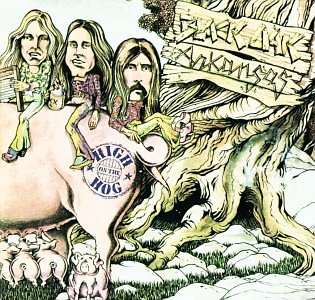
High On The Hog - Black Oak Arkansas

Provenance: I saw these chaps at Sweden Rock Festival one year and had a fine time. Online consensus seemed to suggest that this was a good album for the beginner, so here I am, listening to High On The Hog.

Review: God bless Black Oak Arkansas. They've been around since protozoa first slimed their way onto the primordial beaches of Pangaea, around fifty or so people have passed through their ranks, the rhythm guitarist has two, separate, unrelated nicknames and the lead singer doubles up on the washboard. On that basis alone I am a fan of Black Oak Arkansas. If only they did that cool double drumming thing that .38 Special had going on we might be talking about the world's greatest band.

Alas, they didn't, but a pre Ozzy Osbourne / Whitesnake / born-again Christianity Tommy Aldridge can be found thumping the tubs on this release, though it is unrecorded as to how many nicknames he earned whilst serving his time in 'the Oak'. All kidding aside, this is a really fun slice of southern rock; looser than Skynyrd, less virtuosic than the Allmans, rootsier than Molly Hatchet or Blackfoot, Black Oak Arkansas had a more overt country music influence than many in their genre. What sets them apart is frontman Jim 'Dandy' Mangrum, he of the washboard and a voice that wavers between hillbilly rasp and Beefheartian growl. A curious guy, he's part good ol' boy, part flower child, the self-proclaimed blueprint for David Lee Roth with a penchant for fast living that saw him suffer his first heart attack around age 30.

What I like about High On The Hog is that it's a bit of a grab-bag, with each song inhabiting its own little patch of dirt somewhere below the Mason-Dixon. So 'Swimmin' In Quicksand' has an infectious, funky Memphis groove, 'Happy Hooker' is a fairly straight blues (with a, shall we say, less than progressive lyric?), 'Moonshine Sonata' is a mellifluous instrumental in the vein of the aforementioned Allman Brothers Band and both 'Back To The Land' and 'High 'N' Dry' are down-home, deep-fried, back-porch country; the latter is especially, and unexpectedly, gorgeous.

Where High On The Hog really excels, however, is when it mines a seam of heavy redneck psych that is both slightly unsettling and quite unique. Thus 'Red Hot Lovin'' (these guys love a contraction) 'Why Shouldn't I Smile' and 'Mad Man' all have a faintly ominous atmosphere about them which really works to their advantage in the context of the rest of the album, which is all rather upbeat and rambunctious. Around the same time British bands like Atomic Rooster, Edgar Broughton Band and the Groundhogs were all recording albums swirling with unease and paranoia, so it's interesting to hear these moods given a southern rock twist.

Saying that, for me the masterpiece on the album is the rollicking boogie stomp of 'Jim Dandy', featuring guest vocals from the late, leather-lunged singer Ruby Starr. Doesn't it look like everyone's having the best time?


Given the prodigious turnover of personnel, just by being in the same field as the band there's a good chance that I'm actually a member of Black Oak Arkansas right now. Frankly, if I got to play 'Jim Dandy' and 'Uncle Lijah' (from their first album) and hang out with 'Risky' Rickie 'Ricochet' Reynolds every night, I wouldn't mind one bit. Great album cover, by the way. Top entertainment.

Tuesday, 24 October 2017

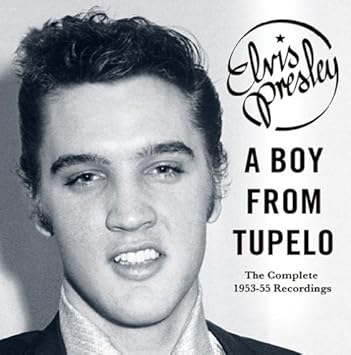
A Boy From Tupelo - Elvis Presley

Provenance: I've been to Graceland, you know. It's the roughly seven-year anniversary of the road trip I took around the Deep South of the USA, during which I met the person who I would later go on to marry.

That journey proved to be the catalyst for me to fall in love with a whole bunch of things, aside from another human being. There's New Orleans, and fried catfish, zydeco and the Great Smoky Mountains, the Arkansas State Fair and Twelve Bones BBQ, small town hospitality and the alluvial expanse of Mississippi's Delta Region. I know, I've reeled off a bunch of cliches - and I stand by them all. For a dumb, wide-eyed young'un from Bournemouth, it was something the hell else.

Rather unexpectedly, I also found myself falling in love with a certain Elvis Aaron Presley. I'm driving down the highway in my rental, destination Memphis. I want to be the biggest tourist around, see Beale Street and the Stax Museum and, of course, take a pipe at Graceland. I've got a passenger with me, a large raw-boned chap called Tommy, a former Aussie Rules player I picked up in Nashville. He's here on business, but taking some time out to travel a bit. About twenty miles out of Memphis and fiddling with the satellite radio I get an Elvis station - live from Graceland - on Sirius XM. (Closer into town and I'm on the newly-christened Isaac Hayes Boulevard, which is nice because it wasn't named after a racist.) W head south toward the airport, hang a right and we're almost there.

Graceland isn't a place for the fainthearted. It's a monument to both a great artist and to folly. It is excessive, tacky, a glittery testimony of all that is crass. To stumble around this bejewelled carbuncle is almost nausea-inducing, and one has to consciously remind oneself that actual human beings dwelt in this funfair house of mirrors. And you think, yes, the star of such cinematic triumphs as Clambake and It Happened at the World's Fair would live in such a place. Yet on the ride in, you heard something pulsing on the radio, something vital...

We got into Graceland fairly late, and as Tommy and I were leaving we noticed trestle tables being set up and barbecues being lit. So we decided to do what any two folk in our position would do - don our suits (don't ask why I packed one, but a great call), hustled our way into the function and spent the evening partying on the verandah, food and drink courtesy of the Tennessee Department of Tourism. We even witnessed what must've been the most high-pressure gig for an Elvis impersonator to perform. Yet even in that pale imitation, there's a whisper of something great...

Review: This handsome three-CD (and book) box-set contains every recording of Elvis spanning the period 1953-55, including service acetates, radio performances, studio takes and singles. I'm only reviewing disc one, containing the acetates, the RCA masters and those immortal Sun masters that cemented Elvis' early reputation.

Nick Tosches is a man who can spin a yarn, the kind of guy whom I imagine considers the gospel truth to be a minor inconvenience when there's a good story to be told. His biography of Jerry Lee Lewis, Hellfire, might be based in part on speculation and hearsay but it's also scintillating. Similarly, there's some tall tales told in Country: the Twisted Roots of Rock 'n' Roll but amidst the mythologising there's some important history on the genealogy of American country music (spoiler: it's all British, and often very old). The book also takes a stand for white hillbilly music's influence in the formation of rock 'n' roll; if not a wholly equal partner with black rhythm 'n' blues, Tosches nevertheless states a strong case - citing plenty of evidence - to suggest that a) there's a clear and obvious country ancestry to rock 'n' roll that's deeper than white performers appropriating black musical forms and b) that blues and country music were cross-pollinating each other for decades anyway. All this is worth holding in mind with regards to A Boy From Tupelo.

From the collection of early acetates you can hear why Sam Phillips initially didn't think he had much on his hands. In a restrained, slightly quavery voice Elvis sings a few torch songs accompanied by his own rudimentary guitar playing. Nothing here for Tosches, or anybody else, to write home about. Even the first couple of Sun masters are on the soporific side. And then, all of a sudden - magic, pure magic, as rockabilly bursts forth from the speakers in full colour. Elvis, along with guitarist Scotty Moore and stand-up bass player Bill Black, tear into Arthur 'Big Boy' Crudup's 'That's All Right' with a wild assurance. Gone is the thin reticence that defines Elvis' sophomore efforts; instead, he meets the percussive thump of Black's bass with a swaggering, swooning brilliance. If ever a recording sounded white hot it's this bad boy, people, it's this one.

There's so, so much more to come; Bill Monroe's waltz 'Blue Moon of Kentucky' whipped up into a 4/4 country-blues; the supreme cover of Roy Brown's jump blues 'Good Rockin' Tonight'; a crackling 'I Don't Care if the Sun Don't Shine'; and possibly Elvis' most potent two and a half minutes ever committed to wax, his cover of Junior Parker's 'Mystery Train' (Scotty Moore is sublime on this cut). Even here, in this formative (and utterly electric) period, Tosches was able to muster up a moue of disappointment; he pinpoints the false start of 'Milkcow Blues Boogie' ("hold it fellas, that don't move me - let's get real, real gone for a change") as the moment Elvis first demonstrates his own awareness as a commercial performer, effecting a compromise that would forever taint the rest of his artistry. Well, it's an interpretation, and from a man who certainly knows his onions.

Given the technological and stylistic(?) advances(?) that have been made since Elvis started stirring things up in a small room in Memphis it can, at times, be hard to see past this compilation as a collection of historical curios. Certainly, for ears attuned to popular music created a bit later - say, from The Beatles onwards - it can sound a bit primitive. I recall a conversation with a friend where he spoke approvingly of rockabilly revivalist fashion but said he couldn't fully dig the whole package because of the limited sonic palette the music drew from. I grok. I'd flip that around and say that Elvis, and a whole bunch of contemporaries (and near contemporaries) coupled simple music to simple instrumentation and created some of the most exciting and life-affirming music of the last century. Sinuous, dangerous, slinky, sexy, sweaty, belligerent and beguiling - that first flush of rock 'n' roll was where it was at, folks. Let's get real, real gone, for a change.

Monday, 17 July 2017

Fireball - Deep Purple

Provenance: Deep Purple feel like a rite of passage for anyone who professes to be a fan of heavy rock. There are certain bands - Led Zeppelin, Black Sabbath and Deep Purple off the top of my head - which one is expected to be able to speak about somewhat intelligently, at the least. Being utterly conformist in almost every regard, I have unquestioningly accepted this orthodoxy and have subsequently amassed a small collection of Deep Purple albums.

The problem is, I don't really like Deep Purple.

Their music, I admit, can be sensational. In discussions I've always advanced Ian Paice as one of rock's great drummers, and I love the way Ritchie Blackmore borrowed as much from the classical music palette (most obviously the harmonic minor scale) in his soloing as he did from more traditional blues-rock sources. That said, I don't think the individual elements of Deep Purple's sound always meshed together successfully.

However, away from the strictly musical side, in a business where arrested development is positively encouraged, Deep Purple have always seemed uniquely petty. Stupid squabbles, questionable decisions and unpalatable personalities litter their history. And although it shouldn't, I've allowed this side of Deep Purple to colour my thoughts on the music, making their pomposity and pretentiousness even more risible than it already is.

But here at Swinetunes we're (NB: I, there's only one person typing this dreck) all about giving bands a fair shake. Let's see if Fireball stands or falls on its own merits.

Review: The good news: Fireball kicks out the jams with a stone cold classic in its title track. A strange, whooshing intro (apparently an air conditioning unit), some badass drumming and then we're galloping away. It feels taut, muscular and focused - qualities that rarely, alas, resurface on the rest of the album.

If 'Fireball' exemplifies everything that works, track two, 'No No No', is paradigmatic as to what I find dissatisfying about the album. The latter is ponderous, meandering and downright boring - aiming for a kind of heavy funk-rock sound, it has about as much soul as me dancing to a Trojan box-set after sinking a few Tyskies. Everything all sounds a little phoned in - not just the lyrics, which have been uniformly awful throughout Purple's lifespan - especially the late Jon Lord's Hammond organ noodling. It goes nowhere and takes a long time getting there.

Okay, I like 'Demon's Eye'. It has a dark pulse to it and a swaggering guitar riff that repeats throughout. I'd probably like it even more if Uriah Heep did it. (Deep Purple are, of course, a poor man's Uriah Heep.) So maybe I'm being a bit too harsh, yeah? You're allowed one or two clunkers on an album. The problem is that after 'Demon's Eye' wraps, things get worse. Much, much worse.

I know I gave Europe a bit of a shoeing when I reviewed them but I would take anything off that album - even 'Cherokee' - over the abortive mess that is 'Anyone's Daughter'. It almost feels like a bespoke attempt to provide me with reasons to absolutely fucking hate everybody involved in creating it. Nothing says 'mid 70s rock excess' than a bunch of guys indulging themselves with the most half-arsed attempt at country music "hilarity" than 'Anyone's Daughter'. The intro is literally the band playing like shit. Once it gets into gear, little improves - horribly unfunny lyrics, hammily delivered (even by his standards) by Ian Gillan, terrible sub-Chet Atkins guitar from Blackmore and embarrassingly plinky-plunky cod-barrelhouse ivory-tickling from Lord. A sense of 'this'll do' pervades - it's flabby, half-baked and seemingly tossed-off as an afterthought.

From this point onwards, this is, for me, the overriding sensation I take away from Fireball. Once upon a time rock music was young, vital, dangerous and exciting. I'm not atavistic with rock music; I accept and embrace the flavours it took on as it grew up and grew outwards, but at some point one of its offshoots morphed into this lumpen, portentous, grim-faced, self-important masturbation. It's not as if the musicianship is even particularly breathtaking. Is anyone really impressed with that interminable volume-swell guitar solo in 'Fools'? It neither serves to demonstrate Blackmore's virtuosity nor does it create a mood. It's just an irritant.

So that's Fireball - two good songs and a heaping spoonful of pompous crap. Honestly, go and listen to Europe instead; at least those boys sound like they were having a modicum of fun.

Sunday, 4 June 2017

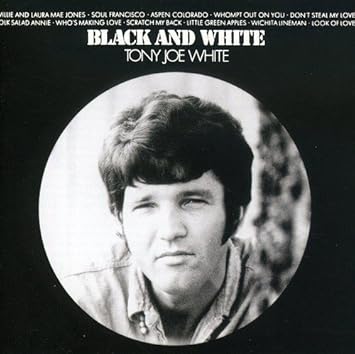
Black and White - Tony Joe White

Provenance: The origins of where and how I first encountered Tony Joe White are now obscured by the mists of time.

I can definitely state that I was aware of the man and his music before September 2010, which I spent in the USA. Here's why:

a) I vividly recall hearing a god-awful song chronicling the downfall of some poor southron maiden or other set to the music of 'Willie and Laura Mae Jones' on the radio. I was near Nashville at the time.

b) I managed to finagle my way into a private function at Graceland, and the Elvis tribute band (no pressure there, lads) played 'Polk Salad Annie'.

c) I met a guy in Louisiana who claimed to have known Tony Joe White a little in his youth.

Don't get me wrong, my road trip around the Deep South wasn't some kind of extended Tony Joe White-themed promenade, he just happened to crop up a fair amount. I wish I hadn't encountered that re-write of 'Willie and Laura Mae Jones' though, because it was like an ice-pick to the ears. I've tried to locate it for this review but no dice, so if anybody knows what I'm talking about, please get in touch.

Review: Mere words are inadequate to describe how much I fucking love this album. Yet I also find that words are hard to come by in articulating why Tony Joe White's debut had such a profound impact on me; a clear-eyed (or clear-eared?) reviewer would no doubt highlight the flaws and half-developed ideas littered throughout the album. I, however, don't fall into the clear-eyed category; in fact, I was not a little lachrymose when I finally saw 'the Swamp Fox' himself in London last year with my friend Rachael.

(Can I just add something about the TJW live experience? White played a guitar plugged directly into an onstage amp, with precisely two pedals at his disposal - a wah-wah and a deafeningly loud overdrive, which transformed his music into proto-metal garage rock every time it was activated. His only accompaniment was a drummer, which meant the sound could sometimes feel a bit empty when TJW played lead breaks. Yet he could be absolutely mesmerising, even when he talked to the audience in his indecipherable molasses-thick drawl).

Listening to it again now, I still feel both comforted and excited by the sounds coming from my speakers. Firstly, that voice. That drawling, cool, subterranean baritone is absolutely perfect. It's not particularly well-recorded, and sometimes distorts when he fails to moderate his volume. Yet this is precisely why I love it - unlike so many modern recordings where a vocal is tracked numerous times, levelled out and compressed, this is an unadorned and honest record of one man's utterly peculiar instrument. It also helps that White possess a collection of weird vocal tics, smattering his performances with lusty grunts and non-lexical vocables.

All this is performed over what can be described as country-funk, at least on the originals that make up just over half the album. When it hits its stride, Black and White really cooks. Aforementioned opener 'Willie and Laura Mae Jones' is a fine example. Covered by Clarence Carter, Brook Benton and Dusty Springfield amongst others, it's a soulful and powerful little fable about race relations between poor blacks and whites. 'Aspen Colorado' is a quietly poignant story vignette about a young man trying to make his own way in the world, and the famous 'Polk Salad Annie' (a staple in Elvis Presley life performances) is belting rocker about an indigent girl and her 'no account' family. In all these instances, White proves to be a deft caricaturist, able to breathe life into his subjects with his wry, nuanced eye for detail.

There's a fair amount of sex on offer too. 'Whompt Out On You' portrays White as a callous lothario, and contains a drum break every bit as funky as 'Amen, My Brother' by the Winstons. 'Who's Making Love' is a soul-power cautionary tale to every dude stepping out with a side-slurp, and he even imbues the Bacharach standard 'Look of Love' with a breathy, languid eroticism. In fact, for such a good and prolific songwriter, White is a very able interpreter, showcasing his ability to inhabit a song on both 'Little Green Apples' and 'Wichita Lineman', the latter possibly just outflanking the Glen Campbell version (heresy!) in my estimation (burn him!).

Deep, seductive, slow and loose, Black and White is a quirky yet colourful slice of downhome escapism. White's idiosyncratic singing only serves to make this a more affecting collection, and Rachael can no doubt attest to my fondness for White's turn of phrase (we still text each other references to 'corn pone', mentioned in 'Willie and Laura Mae Jones' every now and again). Essential listening, y'all.