Showing posts with label judas priest. Show all posts

Sunday, 16 October 2022

Screaming For Vengeance - Judas Priest


Provenance: My ownership of this album is most likely due to the fact that I'm, uh, a massive Judas Priest fan.

Review: When I first got into Priest, they were in the career doldrums. In fact, for those who only consider Halford-fronted albums as canonical (such as I), they weren't even a proper concern.

Fast forward to my first year of university - and the Priest are back, baby! And to top it off, I had a ticket for Arrow Rock Festival in the Netherlands, at which a reunited Painkiller-era lineup were due to headline. 

To prepare, I shaved my head and grew a goatee, just like Rob. I endured a yomp through the Dutch countryside, Hell's Angels who insisted on listening to AC/DC's 'Cover You In Oil' on repeat, Golden Earring and a Tannoy that played 24/7 hard rock (and Van Morrison's 'Moondance') in the festival campgrounds so I could see the Metal Gods. And hey, I made some Dutch friends, drank some Gouden Zegel beer and discovered the joys of mayonnaise on fries (the cheapest food at Arrow Rock).

And, of course, I saw Judas Priest - a live music experience that remains one of my favourites to this day. First song in the set? 'Hellion/Electric Eye', from today's album, Screaming For Vengeance. I've since seen Priest a number of times, but for me, this bad boy - almost precision-designed to be an opener - is their hottest out of the traps. (I should add that in the summer of 2004 Judas Priest had nothing to promote, so their seventeen-song set at Arrow was a virtual greatest hits parade - sixteen belters and 'United'.)

Is Screaming For Vengeance the best Judas Priest album? I think it has the best title. and arguably the best artwork (vying with Painkiller in sheer over-the-top ridiculousness). The best music? Possibly. I have a sweet spot for both Painkiller, being my first; and delving further backwards, I really rate Killing Machine (another great album title, come to think of it) as a cohesive, consistent and badass collection of songs. I think Screaming... just about wins, though, by a nose. Priest have been reasonably chameleonic throughout their career, but as a statement and summation of classic British heavy metal, this feels like a biggie. Other bands had speed, theatrics, guitar pyrotechnics, aggression, songcraft - but rarely did it come together as consistently as it ever did on today's platter.

I'll register a minor gripe - the production sounds expansive compared to earlier Priest albums, but can also sound a tiny bit messy. This could just be me and my warped perceptions of what sounds pleasant, aware as I am that I tend to like the relatively tight, dry sound of a lot of 1970s rock. Still, this is small beer, and in any case when you've got the volume pumped and 'Electric Eye' is ripping out of the speakers, you simply don't give a shit.

Speaking of 'Electric Eye', it's right up there in terms of my tip top Priest ditties. For a band whose songwriting can be wobbly, to pick the sinister, antiseptic menace of remote surveillance as the lead-off to the album is an incredibly badass choice. Halford sounds imperious, the embodiment of some digital panopticon as cymbals clash and guitars howl around him. It's about as metal as metal gets, frankly. 

Nonetheless, having tasted some commercial success in the recent past, there's a rich seam of melody throughout, and the chorus of 'You've Got Another Thing Coming' even veers towards stadium rock. Not a bad thing, really, to mix sugar in with the spice. In fact, Screaming... is a remarkably balanced album in terms of sequencing, gallopers like 'Electric Eye', 'Riding On the Wind', and the title track being broken up with prowlers like 'Bloodstone', 'Fever' and sneaky fave 'Pain and Pleasure'. The latter song really should be considered throwaway compared to the rest of the menu but I find Halford's yelping irresistible, especially when he's hamming it up with stuff like "You've got me tied up / Dog upon a leash." I respect anyone who commits to the bit as much as Halford does. Incidentally, he sounds great throughout, sounding as if he's constantly teetering on the edge of lunacy. Few do 'wound up aggro' like the big man.

I don't really know what else to say; it's brilliant, it's raucous, it's catchy. Once upon a time I attended a Paul Gilbert guitar masterclass. Gilbert lamented that he had a 'Dave Jones from the Monkees' voice, and that he always wanted to sound much more metal, and to illustrate his point he busted out the first verse of 'Devil's Child'. I don't remember anything from that evening other than Gilbert chugging out some Priest. Pretty potent stuff, I say. Anyway, stop reading this bilge and go listen to Judas Priest.


Sunday, 22 May 2022

Angel Witch - Angel Witch


Provenance: The song 'Angel Witch' by Angel Witch appeared on a heavy metal compilation I was gifted during my teen years. Not long afterwards I bought a second hand copy of the album, Angel Witch.

Review: Angel Witch by Angel Witch kicks off with a track called 'Angel Witch', the chorus of which (witch?) goes "You're an angel witch / You're an angel witch." Suffice to say, you're going to see the words 'angel' and 'witch' crop up fairly regularly in this review.

For the uninitiated, Angel Witch fall squarely into the New Wave of British Heavy Metal, who can count as their London-based contemporaries Iron Maiden and Praying Mantis. One of the bands to haunt the Soundhouse in its heyday, Angel Witch released their debut album (this one 'ere) in 1980 and then took their sweet time following up with 1985's Screamin' and Bleedin', by which time the NWOBHM had, bar its big beasts, largely run out of puff. 

Was it this gap between releases that meant Angel Witch were never destined for the big leagues? Within that same span, Saxon managed six albums, Iron Maiden five, and even the largely ponderous Def Leppard managed three. Meanwhile, three-piece Angel Witch managed to sack their drummer, split up, re-form with an entirely different lineup (excepting main man Kevin Heybourne), split up again, re-form with the sacked drummer, finally record the tricky second album - oh, and sack the drummer again. In a scene reasonably infamous for the shifting sands of band membership, Angel Witch seemingly took it upon themselves to show their competitors how to truly meltdown.

A shame, because Angel Witch is a classic of NWOBHM. Never mind that it sounds like it was recorded in the back of a meat truck - never an impediment in the genre - the songs and performances shine through. Or, should I say, Kevin Heybourne's talents shine through; which is no disserve to Kevin Riddles (bass) and P45 addict Dave Hogg (drums), but this album is all about guitar and vocals, which are Heybourne's department. 

There are a few bands who can lay claim to foundations of thrash metal - Judas Priest, Motorhead and Venom all fed into the sound - but I have rarely heard its precedent articulated so clearly as it is on tracks like 'Angel Witch' (yes, that phrase again), 'Atlantis', 'Sweet Danger' and the outro section of 'Sorcerers' (which sounds a bit like speeding up a cool Uriah Heep track). All of these examples push tempos into the red and are underscored with imaginative lead playing, that frequently breaks off into hot-fingered fret-worrying solos.

Interestingly, you can see the joins - inasmuch as, considering how forward-looking Angel Witch is, the voice of its ancestors ring through loud and clear. I mention Uriah Heep - well, 'Gorgon' (on my version of the album, misprinted as 'Gordon') is essentially the midpoint between 'Easy Livin'' and, say, one of the heavier numbers off Thin Lizzy's Jailbreak. Elsewhere, its possible to make out Rainbow, the Judas Priest of 'Exciter' and 'Hell Bent for Leather' and the Scorpions (the intro to 'Free Man', especially). It's all good though, Angel Witch borrow from the best and synthesize their influences with their own trademark sound. This is, namely, Heybourne's haunted yelp and the superior guitar playing he brings to the party. I don't think there was a better musician in the NWOBHM mix than Heybourne.


Nothing strikes fear into the heart like 'Gordon'

Were Angel Witch able to avoid the tumult that occasioned their frequent implosions, they could have been contenders. Angel Witch is now seen as a classic NWOBHM release, and with its combination of skill, melody and aggression it's not hard to see why. The only oddity is the rather beery, terrace-chant backing vocal on the title track - it almost sounds like, for a brief moment, Cock Sparrer or Sham 69 had gatecrashed the studio. It breaks the spell for a moment, removing you from the atmosphere of darkness and occult mystery that Heybourne so adroitly infuses the rest of the album with. Three years later, Mercyful Fate would release an album - Melissa - which is very similar to Angel Witch, but at no point does it take the listener to the Shed End on a Saturday afternoon.

Maybe I'm reaching, but perhaps here was the seed of discord - the esoteric Heybourne versus his more prosaic bandmates? Nonetheless, an excellent collection of distinctive metal that has weathered the test of time. Now, time to give that 'Gordon' another listen...

Sunday, 13 February 2022

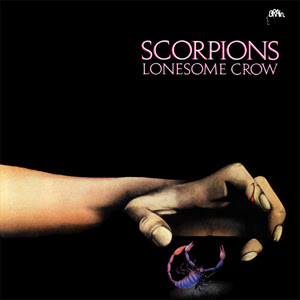
Lonesome Crow - Scorpions


Provenance: Got this as a part of a 'twofer' deal along with Lovedrive, which was the album I was actually after. I did something similar with Gerry Rafferty as I had coveted City To City, but ultimately found myself enjoying Night Owl more. 

The packaging for this collection only depicts the original album cover artwork on the inner sleeve, which in Lovedrive's case is just as well (albeit it's not the most flagrant crime committed by the band in this department).

Review: The version of Scorpions I'm most familiar with spans the era from Lovedrive through to Love At First Sting - an era where the band had turned into a chrome-plated hard rock machine, albeit with the ability to throw the odd curveball every now and again. Klaus Meine's idiosyncratic yelp may take some getting used to, but the riffage served up by Rudolf Schenker, his brother Michael and latterly Matthias Jabs was often of the highest order.

However, Lonesome Crow was the debut, and although it features a sixteen year-old Michael Schenker, this release came about prior to his elevation as one of the more melodically astute hard rock soloists of the era. The younger Schenker would depart for UFO, paving the way for headband, Hendrix and moustache aficionado Uli Jon Roth to join the band, remaining until Lovedrive. At this point, Michael Schenker makes a brief return, long enough to play on Lovedrive before flouncing off to form the Michael Schenker Group. I saw MSG supporting the Scorpions once - Michael had a strop, stopped playing and then tried to attack his brother with a guitar.

Ah, where was I? Oh yes, Lonesome Crow. I'm expecting this to be a bit of a formative stab, and early indications are that this isn't going to be the piston-pumpin' headbanger's ball of their prime years. First impressions are that it's a bit hippie-dippie, closer to the heavy psychedelia of, say, Edgar Broughton Band or early Alice Cooper. Though, it has to be said, not quite as accomplished. Opener 'I'm Going Mad' is mostly a Michael Schenker guitar showcase, which I don't mind one bit, plus there's a little taste of the famous Meine wail on display; but its successor, 'It All Depends', already sounds quite dated for the early 1970s. Perhaps because Cream got there first with 'SWLABR'?

I shouldn't be too harsh, as plenty of bands go through the kind of metamorphosis that the Scorps would go on to do. Contemporaries UFO and Status Quo would begin as space-rock and psychedelic bands respectively before going on to toughen up their sound - and the gulf between Judas Priest's bluesy debut Rocka Rolla and the thrash metal insanity of Painkiller just sixteen years later is quite something to behold.

(I also happen to think Rocka Rolla is quite crap - sample lyric: "She's a classy flashy lassy / Imitation sapphire shine" - in contrast to the affection for Quo's early stuff I possess for material like 'Pictures of Matchstick Men', 'Ice In The Sun' and such. Nonetheless, Judas Priest are pretty cool inasmuch as they just seem to get harder and heavier, the obverse of the journey taken by most metal acts).

So it begs the question - what exactly were Scorpions attempting with Lonesome Crow? Judging by the phasing, flanging and wah-wah that abounds, I reckon we're looking at one of those joints that's meant to be deep, man. It's heavy on the atmospherics and wig-outs, every tom-tom sounding like it was recorded from the back of a cave. Are we meant to think of Scorpions as a troupe of mysterious psychedelic goblins? Because that's the overall vibe. If you encountered Lonesome Crow era Scorpions, you'd half expect to come away with a quest involving potions or amulets.

Do I hate this? No. Yes. Bits of it, certainly. I think 'Action' is about the clumsiest thing they ever committed to tape. It's like listening to a Wishbone Ash track from Argus, but it's shit. By the time one gets to the 'creepy' birdsong effects in the intro to the title track, I think one has probably had quite enough. Little of Lonesome Crow is outright terrible, but by the same token there's little to charm or wow the listener. A curio, a line in the sand, the genesis of a band that would go on to do bigger and better things - but no more than that.

Sunday, 3 October 2021

Point Of Entry - Judas Priest


Provenance: As a dyed-in-the-wool Judas Priest fanatic I own every one of their albums (except the pair of Ripper Owens releases - no Halford, no Priest).

Review: Eh, this is a funny one.

It's as if Priest tried to analyse what made British Steel such a roaring success and alighted upon a) more commercial-sounding tunes and b) a stripped back sound as the two key components, when really the answer was always c) damn good heavy metal songwriting.

Consequently, we are presented with a sleek product with, at the time, the poppiest incarnation of Judas Priest on record - but it's all a bit lightweight. And that's coming from a guy who thinks Turbo is absolutely smashing.

There are, admittedly, a few moments where Point Of Entry does take flight. Opener 'Heading Out to the Highway' has a big anthemic feel to the chorus, married to some punchy verses; 'Hot Rockin'' is Priest doing that fascinating metal tautology better than anybody, a hard rockin' track about how hard you rock (other notable entries into this subgenre: 'Rock You Like a Hurricane' by the Scorpions, 'We Rock' by Dio); and best of all is the widescreen road movie 'Desert Plains'. This last example is majestic, expansive and frankly tickles the imagination in a way that nothing else on Point... manages to do.

Them's the three highlights. Ach, it's not as if everything else is rammel, it's just that it feels half-considered or hurriedly executed, and thus a bit frustrating. The chorus to 'Don't Go' is good in a brassy, hooky way, but why is it welded to such a faltering, unsatisfying verse? 'Solar Angels' is quite intriguing and has potential as a weird, spacey number (which, to my mind, is an approach Priest have rarely explored in their career - most of their tracks are dense, closed-fist little nasties) but the rather minimalist production lets it down. I actually like 'Turning Circles', which is almost the inverse to 'Don't Go', sporting a fantastically chunky, descending riff in the verses but an irritating chorus.

There is, alas, some stuff that is just crap. What the fuck was going on when 'Troubleshooter' and 'You Say Yes' were dreamed up? 'Troubleshooter' has a lyric that could be improved simply by ceasing to exist; meanwhile, 'You Say Yes' is simply dogshit, on a par with some of the most miserable Priest material to make it onto vinyl (what is the worst? I reckon 'Rock You All Around the World' on the aforementioned Turbo is about as rancid as it gets).

One element that puzzles me is that, in Rob Halford, you have one of the most unique weapons in metal - by which I mean his ability to sustain screams at such a pitch that it feels like a hot syringe to the ears. I suppose it was used sparingly on British Steel, and here it makes a fleeting appearances, most notably in closer 'On The Run', but c'mon fellas - this is literally one of your band's defining qualities! Fortunately, Priest would get the memo for subsequent releases, but sticking to Halford's mid-range, characterful as it is, only adds to the notion that the handbrake was on during the making of Point Of Entry.

How to sum up? A bit of a stop-gap, really. Almost anything sandwiched between British Steel and the incandescent Screaming For Vengeance is likely to appear a little pastel-coloured, but even out of context it's a bit of a weird, underpowered stab at the charts. Good news - better albums were to come, but to quote Kirstie Alley's tribute to Prof. Stephen Hawking upon his passing, "You had a good go at it...thanks for your input."

Sunday, 31 January 2021

Horror Show - Iced Earth


Provenance: Another £1 bargain from the internal message board at a former job. I didn't really know a huge amount about Iced Earth at the time, but the chance to acquire some metal in exchange for a very small sum of metal proved irresistible.

I feel like Iced Earth are a band I've seen at some festival or another in a mid-to-late afternoon slot but my brain has been pounded into slurry by pandemic lockdowns, so who knows? I'm beginning to doubt I ever enjoyed seeing live music, once upon a time.

Review: So here we have it, Horror Show, each track taking its cue from a scary movie or historical personage, with the exception of 'Ghost of Freedom', which comes from the head of lead squealer Matt Barlow, plus a cover of the Iron Maiden instrumental 'Transylvania'. Iced Earth's main man and sole constant, guitarist Jon Schaffer, is responsible for writing virtually all the music and most of the lyrics throughout. 

I have a soft spot for anyone who indulges in these kind of monster-based shenanigans, ranging from Bobby 'Boris' Pickett through to Lordi and Ghost, so we're off to a good start. It's not always successful - observe Judas Priest's paean to Loch Ness and its resident cryptid features lyrics that straddle the Spinal Tap 'fine line between stupid and clever' divide (but also, crucially, an indestructible guitar riff). However, when it comes off, it's cool as fuck - the aforementioned Priest with 'The Ripper', Blue Oyster Cult cranking out 'Godzilla' and 'Nosferatu' on the same goddamn album, a whole bunch of Rob Zombie stuff - hell, I'll even allow Alice Cooper's 'Feed My Frankenstein', Elvira cameo 'n' all. The Venn diagram between fans of scary movies and heavy metal must be pretty chunky, so it's a good bet.

Thus, we've got musical tributes here to the Wolf Man, The Omen movies, Jack the Ripper (fertile ground, evidently), the Mummy, The Strange Case of Dr Jekyll and Mr Hyde, The Creature from the Black Lagoon, Frankenstein, Count Dracula and The Phantom of the Opera. This should be a lot of fun!

And, yeah, it is. The music itself isn't much more than rather decent power metal, though I found the mostly acoustic balladry of 'Ghost of Freedom' quite affecting alongside being a welcome change of pace. Matt Barlow - or Sergeant Matthew Barlow of the Georgetown Police Department, to give you some colour as to his current activities - is vocally a good fit, his delivery belying an obvious Geoff Tate (Queensryche) influence. My biggest bugbear with a lot of bands in the thrash and power-metal is that the drumming production sounds piss-weak. Somewhere along the line the rolling thunder of early metal became replaced with the impotent pitter-patter of double-bass pedals and a tinny, clattery quality to the rest of the kit. 

However, there's plenty of schlock to make up for this, including the wonderfully devilish incantations on 'Damien', hokey vocal effects on 'Jekyll & Hyde' (yes, of course, the two 'characters' speak to each other) and a suitably melodramatic finale in 'The Phantom Opera Ghost'. Bonus points, too, for doing a song called 'Frankenstein' which is about the doctor, not his monster, though it challenges us to ponder as to 'Who's the monster? Who's the victim?'. Hello, has anybody considered that, uh, maybe society is the monster in all this? Anyway, 'Frankenstein' is the highlight of Horror Show for me, though its Maiden-esque successor 'Dracula' runs it close. Hey buddy, have you ever wondered if society is the vampire?

My own personal gripes with the percussion aside, everything sounds pretty great on Horror Show without quite having the requisite sizzle or magical spark to elevate the album to the A-list. What could do it, I wonder? A spot of narration by Sir Christopher Lee, per Manowar? Perhaps a spot of narration from Orson Welles, per Manowar? Maybe, just being Manowar? I kid, not even Manowar want to be Manowar these days. Besides, whilst Iced Earth might not have been able to call upon the talents of Lee or Welles, the wonderfully-named Yunhui Percifield provides co-lead vocals on 'The Phantom Opera Ghost' and she does a top job, so that's something to be celebrated. Entertaining stuff, then, rammed to the rafters with all manner of ghouls 'n' ghosts - but whatever did happen to the 'Transylvania Twist'?

Sunday, 8 November 2020

License To Kill - Malice


Provenance: Another present, either birthday or Christmas (one arrives hot on the heels of the other, alas), but not anything out of the blue. I had included this on some list or another. Why, I'm not so sure, but it's called License To Kill and the band's name is Malice, all of which is suitably metal.

Having said that, what a bait 'n' switch it is to call yourself Poison, a very cool name, only to dribble out crap like 'Unskinny Bop'. Any other examples spring to mind? If you were going solely on the cover art, you'd expect Molly Hatchet to sound like Manowar instead of workaday southern boogie. Meat Loaf falls into this category a little, doesn't he? Quite metal album art, songs that sound like showtunes. 

Incidentally, if you're stuck with buying me a gift, an album or two always does the trick. Not hinting at anything, but yeah, just think about it.

Review: Thank fuck Malice don't sound like Poison.

Thank fuck, instead, that License To Kill sounds like a cross between Riot, Ratt, Y&T and especially Killing Machine era Judas Priest. In fact, on opener 'Sinister Double' I felt compelled to (sinister) double check the liner notes to make sure Priest main man Rob Halford didn't have a hand in any of the wailing. This is meant as nothing other than a compliment to actual vocalist James Neal (Halford is my favourite metal vocalist), and his performances throughout are consistently excellent.

More good news - License To Kill is fat free, coming in at a taut thirty-nine minutes-and-change; it's nine tracks of beefy heavy metal with nary an acoustic moment or prog flourish to be seen. It's a diesel-charged, palm-muted chuggathon with all the elements for a rollicking good time present and correct: sticky hooks, laser-cut guitar soloing and positively brobdingnagian power chords festoon the nine tracks on offer here.

If I could offer the most muon-sized criticism, it's that Malice, on the basis of License To Kill at least, sound so comfortable because they remind you of other bands you probably also like. I've already mentioned how close Neal cleaves to Halford in the screaming stakes; in addition, some of the guitar tones resemble those of Dokken's George Lynch; and there's a moment in the intro to 'Chain Gang Woman' where the whole package comes together to sound like vintage Motley Crue. (Incidentally, 'Chain Gang Woman' features backing vocals by Daves Mustaine and Ellefson of Megadeth fame, alongside Jaime St. James(!) and Jeff Warner(!!) from Black 'N' Blue(!!!!), and current Kiss guitarist / Easter Island head life model Tommy Thayer - wowza!).

The star of the show is the title track, 'License To Kill', which could have easily been one of the stronger cuts on Priest albums like Point of Entry or even Screaming For Vengeance. See what I mean? Even when praising them, I can't help but slip into comparisons with other, better known, acts. Failure to establish a distinct identity may have been what ultimately holed Malice below the waterline, because on the basis of License To Kill alone they should've been a force. Nonetheless, it's 2020 and here I am thoroughly enjoying the whip-crack riffage of 'Breathin' Down Your Neck', so by no means can we consider this enterprise a failure.

Frankly, any metalhead worth his, her or their salt should own a copy of License To Kill. It combines so many classic and recognisable aspects of what built the genre in the first place, and executes them with aplomb and no little flair. In addition, unlike many metal releases of the era, there's simply no filler to be found. Tight songwriting, good singing, good playing - what more could one want? Perhaps they could've upped the Black 'N' Blue quotient a little?

Lastly, I've just tweaked something in my neck nodding along to 'Breathin' Down Your Neck'. Irony aside, 'License To Kill' failed to injure me, so I'm declaring the former song to be the strongest joint on the album. That's how it works with metal - I don't make the rules! (But yes, 'Breathin...' is probably the better track thanks to its neat chorus and the fact that bits of it sound like a good UFO number.)

Sunday, 30 August 2020

Over The Top - White Wizzard


Provenance: Another one bought solely due to a rave review in Classic Rock magazine.

Review: I feel like you're off to a good start if the figure of a leather-'n'-studs clad goat/skeleton/demon hybrid adorns the front cover of your album. No matter how much the actual music stinks, that's a statement of intent I can get behind. Plus the dude looks like he's enjoying himself, and I want to enjoy the White Wizzard experience too.

I feel like calling your album Over The Top is a smart move too, not only invoking a quality Motorhead track but also promising an embarrassment of headbanging riches. When compared with most other genres, heavy metal stands out due to its excesses - the extremes of speed and volume, the flamboyance of costumery, guitar solos spilling over into the realms of the ridiculous - so it feels as if the Wizzard are consciously tapping into that tradition of 'more is more'. Well, I had my fill of intimate minimalism last week - time for some all-guns blazing metal mayhem! Or so I hope...

I don't know what I was worried - the singer's name is Wyatt 'Screaming Demon' Anderson, fercrissake. About four different people are credited with taking lead guitar spots at various times. The songs have names like 'Iron Goddess of Vengeance', 'Strike of the Viper' and 'Death Race'. All of which, really, is a lot of shilly-shallying about to say that Over The Top properly whips ass.

I didn't know that the world needed tributes to Grim Reaper or Malice, but thanks to White Wizzard we've got them anyway. This album is the sound of people locked in a prison cell for ten years with only those aforementioned bands, the first three Iron Maiden albums and a smattering of Angelwitch, Riot, Dio and Tygers of Pan Tang to keep them company as their minds slowly sloughed off any and all residual notions of the 21st century. On Over The Top it is permanently 1983, everyone lives at Castle Donnington and the only materials available to mankind are denim, leather and chrome.

Which, by the way, sounds fucking sweet.

But of what experience do these minstrels hymn? Well, there's your demons of course, plus paeans to heavy metal (after rap, possibly the most self-reflexive genre?), the devil himself, travelling at high speeds, lightning, iron and a whole mess of fire (mostly rhyming the latter with 'desire', natch). More than once, the names of iconic metal tracks are tossed in there, such as the reference to Black Sabbath's 'Neon Knights' in 'Live Free Or Die', and the winking nod to 'Ride the Lightning' in 'Iron Goddess of Vengeance'. I see nothing cynical in this, nor any other endeavour on Over The Top. Rather, these guys just love classic metal, and take every available moment to celebrate the fact.

When I was at school, my Latin teacher (yes, yes...) once remarked that the great poets would pepper their works with allusions to myth and history as a way of flattering their patrons. If you were refined enough to spot them, you were 'in with the in crowd' as Bryan Ferry once crooned. I am choosing to also acknowledge each and every glimpse of Rainbow and Judas Priest in Over The Top in much the same way, greeting each one with a crinkling of the eyes and a knowing, beneficent smile. No, I am not reclining in my triclinium eating sparrow hearts and guzzling down garum like nobody's business, but I do have a pack of Maltesers and a Diet Coke, so the resonances can be felt, for sure.

Finally, I know that production is something I harp on about, but my poor sensitive ears have been assailed by too much mush in their time. You know what I mean - "quiet" songs that are never quiet, zero dynamics, clipping (one of the reasons I haven't reviewed Rush's Vapor Trails yet is that I don't want a headache); happily, this bad boy doesn't suffer from any of that. Firstly, there are no quiet songs - White Wizzard come hot out of the traps and don't let up, which is a-okay in my book. Secondly, in keeping with their fealty to the era of NWOBHM, I can actually hear separation in the voices and instruments! Yeah, it's loud and there's a touch of modern compression applied to the sound, but otherwise it's a pleasingly comforting old school racket these lads brew up.

Conclusion - Over The Top smokes, pretty much every track is a winner and if you like any of the bands mentioned in this review you'd be a dummy not to part with your geld. It's tough to pick a highlight,  but pumping my fist (typing with one hand, of course) to the "Six! Six! Six!" chorus of 'Strike of the Viper' feels mighty fine. On this release, White Wizzard innovate precisely nothing, but when your homage to a particular moment is so spot on, so lovingly rendered, and with such expertise, who cares? Old school for life. Take it eass'.

Sunday, 12 July 2020

British Steel - Judas Priest

Provenance: Having been inducted into the cult of Judas Priest by way of Painkiller, this way my second album. I guess I got this because it's considered a landmark album, containing as it does the relative commercial successes of 'Breaking The Law' and 'Living After Midnight'.

Review: I've spent much of the past week reading Rob Young's excellent chronicle of British folk music (and its mutations) Electric Eden, for which an attendant compilation was put together. Through this, and the magick of Spotify, I've been conducting something of a listen-along, and frankly I need a palate cleanser. I never need much prodding to revisit Fairport Convention's Liege and Lief album, but my patience has been worn thin by the likes of Oberon, the Round Table, John Renbourn and Dr Strangely Strange.

It's all fun and games for a while, and it has certainly enhanced my experience of the book; but there's a point where the tablas and sitars start to grate, and you're listening to yet another lysergically-tinted version of 'Nottamun Town'. Once they fey warbling and brushed acoustic guitars begin to fug your mind like a cloud of dragon's blood incense, you know it's time for a palate cleanser.

Thus, British Steel, an album that couldn't be more diametrically opposed to The Hangman's Beautiful Daughter (good album) if it tried. Instruments are wielded like power tools, and in place of lilting, amorphous minstrelsy is a clenched ripsnorter of an album, delivered by men with ice chips for eyes and molten iron for blood. Spawned from the dark heart of the industrial Midlands, this album spews smoke and diesel as guitars and drums pound away to the jackhammer of beat of heavy machinery. The imagery is right there in the heads-down charge of opener 'Rapid Fire', with talk of furnaces, anvils and corrosion; the iron giant of technology sung into being. Also, the first lines sung (spat?) on British Steel are the following - "Pounding the world / Like a battering ram", a statement of intent that I don't think has ever been bettered.

In fact, so much of this album has the timbre and texture of heavy metal and heavy industry, you wonder why it took so long for Judas Priest to put it all together - it's more or less the same bunch of guys responsible for the cookie-cutter psych-blooz of Rocka Rolla after all. Certainly, Priest would toughen up their sound almost immediately - within a few albums they'd be onto the razor-sharp brilliance of Stained Class and Killing Machine, but British Steel is a different proposition altogether. Here, the songs are shorn entirely of any filigree or flourish, stripped back to the essential constituent elements of heavy metal, bar the odd siren ('Breaking The Law') or clanking of cutlery (yep, that's what provides the robotic stomp late on in 'Metal Gods'). Perhaps it was the back-to-basics kick-up-the-arse courtesy of punk that inspired this approach. Whatever it was, it's one tuff sounding record - no romance, no wistfulness, no wizards or demons; just laser-cut stompers with names like 'Steeler', 'The Rage' and 'Grinder'.

There's one fly in the ointment - 'United'. A friend of mine was once serenaded with 'United' from a toilet cubicle by the Viking Skull drummer as an example of why Judas Priest suck. Well, you can't blame Priest for trying for a big anthemic hit, having managed a top twenty with 'Take On All The World', a recent track in a similar vein. But, my friends, it blows chunks. 'United' slows the pace, and its rather sunny message of togetherness is at odds with the four blasts of pure aggression that precede it. However, in 2004, seeing Judas Priest in the Netherlands (Rob Halford having just returned to the fold) I sang along to 'United' like every other heavy metal maniac in that crowd. Apparently 'United' had been a minor hit in some parts of mainland Europe, and that's mercifully the only time I've seen them perform it live.

One interesting choice is that the greatest metal frontman ever, Rob Halford, hardly deploys his trademark banshee scream. It's hinted at towards the end of 'Rapid Fire', and he bothers the dogs now and again during 'You Don't Have To Be Old To Be Wise', but that's it. I wonder whether this was a conscious choice to fit in with the mid-range punch of British Steel's overall dynamics? I'm sure I can find it out via a quick Google, but it's Sunday afternoon and I can't be arsed. Anyway, as a consequence most of the vocals are delivered in a kind of mad-eyed bark, which resonates perfectly with British Steel's testosterone-to-the-gills, pedal-to-the-metal, she-cannae-take-any-more-captain ambience.

British Steel is by no means my favourite Priest album. Over-familiarity with some tracks, the lack of sonic variety and fucking 'United' all add up to a collection that's a notch or two below perfection. But when it does land its haymakers, boy does it connect. A consequence of Priest's back-to-basics approach makes the whole album very easy to play on guitar, and that's precisely what I did before sitting down to crap up this review. There's an unfettered joy to be had hammering out the power chords (the dominant sound on British Steel) to the likes of 'Breaking The Law', 'YDHTBOTBW' and my personal favourite, 'Grinder' - three minutes of gritted teeth and straining sinew distilled into song form, each note of the riff feeling like the winding of a clockwork mechanism already vibrating with tension. What a track. What an experience. And the guy who played bass in my last band has the temerity to call it boring!

So - compared with the likes of Screaming For Vengeance, Killing Machine or even later efforts such as Firepower, British Steel may sound a little monochrome. On the other hand, it possesses a focus and purity that is hard to deny, plus a boatload of excellent songs. Sure, a couple have been on every dad rock drivin' compilation for two decades now; but can you truly resist when Halford is stood there, bedecked in chrome and leather, revving the crowd up, bellowing into the microphone - "it's time that we were breaking the - what?! BREAKING THE FUCKING WHAT?!" Magic!!

Sunday, 14 June 2020

Dopethrone - Electric Wizard

Provenance: Local heroes, innit? I've seen Jus Oborn at a few gigs in the Bournemouth area. One of my best friends was the one to really turn me onto 'the Wizard' though. Incidentally, he's had Jus in his garden (at a barbecue) and I haven't, so that's 1-0 to him.

Review: When listening to music of this kind, I often think of Rob Halford's claim that Judas Priest were the first metallers: "We were the first heavy metal band. Black Sabbath were before us, but there was always something of a dilemma about whether or not Sabbath were a heavy metal band" - a sentiment that Sabs bassist Geezer Butler agrees with.

In my estimation, Black Sabbath were the first heavy metal band - or at least, were responsible for the first fully realised heavy metal album. But that's not to dismiss Halford's assertion entirely; there is an intelligent case to be made for Sabbath as a continuation of a ponderous, doomy sub-psychedelic rock that first slithered into public view via the likes of Iron Butterfly or Blue Cheer's Vincebus Eruptum album. Meanwhile, Priest took the snap and aggression of Led Zeppelin's 'Immigrant Song' and Deep Purple's 'Fireball' and toughened them up with steelier guitars and banshee screaming. Inevitably over time these approaches would interact and cross-pollinate; probably the most perfect synthesis of both approaches, oddly, is a Black Sabbath album - Heaven and Hell - which saw Ronnie Dio fronting the band, his baleful roar energising the music much in the same way as he did on some of Rainbow's proto-power metal cuts.

All of which brings us on to Electric Wizard. If you're looking for synthesis on Dopethrone, buddy, you're out of luck. These fools are unreconstructed Sabbathists, taking the template of that august band's first three albums as the basis for their entire approach. Of course, there's a few tweaks made here and there - most notably the excising of the jazz 'n' folk interludes that Sabbath would indulge in - plus the addition of the occasional interstitial from some ghastly Amicus horror flick, much like fellow Sabbathists Uncle Acid & the Deadbeats. It's all of a piece, all the same aesthetic.

Where Electric Wizard distinguish themselves, however, is sheer enormity. Dopethrone doesn't so much emanate from your speakers as it does crawls from them, moving with the same pace and indomitability as a lava flow edging slowly towards the village in its path. I listen to every one of my albums I review for this blog at the same (reasonable) volume, but the sound conjured up here by Oborn and company is so overpowering that my stereo struggles to cope. Dopethrone is an album of extremes, and all the better for it.

Some bands, when they slow it down, plod. It's a demerit - I often think of the likes of Uriah Heep or Cream lapsing every now and again into a ponderousness masquerading as heaviness. Electric Wizard never fall into that trap, simply because what they're selling is true heaviness; it's the real deal. Every riff is the size of a house, every vocal distorted to remove any sense of sweetness, every bass note flanges off into a seismic white noise. Another great quality that Dopethrone exhibits is that noise is wielded as a weapon. This is truly music one submits to, whether it's the pounding opening of 'Vinum Sabbath' or the agonising, endless feedback drone that acts as a coda to the fourteen minute-plus 'Weird Tales'.

This is doom par excellence. There are bands that are slower (the dull Sunn O))) for one) and countless acts in the margins of the umbrella genre of metal who claim to go blacker, bleaker, perhaps even louder. Yet none have quite met the quaalude-shuffle weight of Dopethrone, at least not yet. Plus, any album with a track listing containing ditties such as 'Funeralopolis', 'I, Witchfinder', 'We Hate You' and 'Mind Transferral'. If this is the soundtrack to the end of the world, I want to be there.

Sunday, 19 April 2020

Fire Down Under - Riot

Provenance: No big story behind this purchase, I just happened to read about this album and it sounded up my street.

Review: Before anything else is said, can I please ask what the fuck that abomination on the front cover is supposed to me? It appears to be some kind of ghastly Dr Moreau hybrid man-seal, but for the life of me I can't fathom why it's gracing the cover of a hard rock album. I'm not the only one affronted by this abortion. This is worse than Y&T's stupid robot, and has possibly edged it ahead of Iron Maiden's incompetent Dance of Death artwork to be the worst album cover of any I've reviewed so far.

However - starting off your album with a track called 'Swords and Tequila' is dope as fuck, a completely alpha move that almost excuses the fact that you've put a baby fur seal on your album cover. It matters little that Fire Down Under sounds as if it's been recorded inside a shipping container, or that the lyrics are so mind-bendingly on-the-nose that you're weeping for a simile or metaphor by the last few tracks; you start a rockin' album with a track called 'Swords and Tequila' and you're cooking with gas, baby.

There's something extremely lovable about Fire Down Under that cloaks it's myriad demerits. Never mind the fact that this is metal as written by people who palpably haven't ever looked into a book that doesn't possess illustrations. Ignore the fact that the influences begin at track one of Judas Priest's Killing Machine and end at track eleven of Judas Priest's Killing Machine. Don't sweat that every guitar solo sounds the same. Try to drink yourself into such a stupor that you forgot you ever saw that crime against nature on the album cover.

See, what Fire Down Under has is guts, sincerity and an all-in, gonzo belief that rocking hard is the apogee of human experience. Seeing as an actual Nazi has laid claim to the expression I would use to describe why this album works, I'll settle with stating that this is a victory due to nothing less than bloody-minded and blinkered commitment. Passion and sincerity can take you a long way when some of the subtler arts employed by most artists are absent.

Besides, there's a base level of competence here - everyone can play, the vocals are appealing enough if generic - which means that Fire Down Under keeps its head above water where it matters. On top of that, although I did mention that every solo sounds the same, that's no bad thing because that one solo fucking smokes. The aforementioned artlessness that went into the creation of Fire Down Under works in its favour, as it's absolutely free of pretensions towards anything other than sending the dandruff flying. So, whilst 'Outlaw' has a chorus that is - literally - about playing roulette, it's certainly the best heavy metal roulette song I've ever heard.

The sheer joy in Fire Down Under is that it creates a feedback loop of adrenaline, each subsequent track galvanised by the momentum of what came beforehand (that is, until 'Altar of the King', which takes inspiration both in name and ponderous intro from Rainbow, before morphing into some tight shit that could've graced the first three Saxon albums). I feel it's impossible to not be caught up in the clattery stampede, and I couldn't guarantee you that I wouldn't be bellowing "swords, and tequila, carry me through the night!" once I got a few Peronis in me. Just imagine how much adrenaline you'd have pumping through you when you're down bowling alley and you've got 100mph tracks like 'Fire Down Under', 'Don't Hold Back' or 'Run For You Life' running walloping through your cerebral cortex - you'd be windmilling those balls at the skittles overarm.

To sum up, then, Riot's Fire Down Under works for me because it appeals to every weekend warrior who picks up a guitar and bashes out Foghat covers to sparse, drunken crowds. There's no cynicism behind that kind of slog - there's a purity of purpose (sheer love of rock music) that is reflected in the almost naïve thump and rumble of this album. It possesses an intangible quality that might be best described as 'spirit' - and no matter how clumsy the execution, that spirit shines through. Wonderful! Ditch the seal though, lads.

Sunday, 30 September 2018

When The Kite String Pops - Acid Bath

Provenance: A recommendation from the music message board I used to contribute to. I was subsequently bought this as a Christmas present by my parents.

Review: My default position on 'long' albums is to bitch about them for either unspooling the same goddamn idea for an hour or jumping about the place stylistically so as to justify the run time. The former tend to be boring and the latter can be an exercise in frustration as a band or artist, in an attempt to demonstrate versatility, fail to land a knockout punch.

At one hour and nine minutes, When The Kite String Pops is a long album. It is also a rara avis in the sense that it is diverse - even sprawling - but never dull. A bubbling stew of Sabbath-inspired doom, hardcore, groove metal and skeletal balladry, its disparate textures are shot through with a grim, unrelenting focus on the darker side of the human condition. Curiously, the length of WTKSP might actually be one of its most powerful tools.

It's perfectly normal for musicians to use dynamics, tempo, rhythm, melody and harmony to all convey certain moods - so why not time? Taking a considered approach to the actual amount of time allotted to a work is common in ambient and avant-garde composition, and probably in some of the more oblique ends of the extreme metal spectrum. Of course, concept albums and live compositions frequently stretch out, often to provide space for narrative to unfold or to provide a degree of verisimilitude to a performance, but here it's something a bit more nuanced. On WTKSP the sensation is like that of a journey through the bleaker reaches and shades of a netherworld.

Of course, all this could've been disastrous if Acid Bath couldn't whistle a tune, but even at their thrashiest there's still a powerful subtlety at work in their songwriting. Inevitably this comes to the fore when they turn down the amps a bit - 'Scream of the Butterfly' is astonishing, even if Dax Riggs' clean vocals sound ever so slightly like a cross between Chris Cornell and the actor Tony Curtis. Riggs' abilities to deliver convincing performances with both clean and screamed vocals - an ability he shares with Opeth's Mikael Akerfeldt - means that songs like 'Dope Fiend', where he switches between the two, are suffused with a deliriously split personality.

It's a queasy, push-pull ride to the bottom - and it never lets up. I know I said exactly the same about Judas Priest's Painkiller but whilst Halford and co. exist in a shiny, technicolour comic book universe, WTKSP is a Hieronymus Bosch hellscape rendered in monochrome. I'm also well aware that straining hard on the pathos can lead to bathos, but on this cut Acid Bath never come close to lapsing into unintentional comedy. There is a deadly seriousness - emphasis on the deadly - to tracks like 'Tranquilized' and 'God Machine' that allows for no chink of hope.

Finally, a word on the musicianship. It's as tasteful as you're going to experience in the genre. These guys know when to step on the gas, and when to ease up. Too often in metal I think that bands confuse busy drumming - especially the flavour of skinsmanship that relies on the double bass pedal - with aggression. It is to Acid Bath's credit that they know exactly how to create a sense of controlled tension, and then how to release it in a furious gale of punches to the ears and gut. Head-snapping guitar is paired with big, washy swathes of feedback much in the same way as, per my earlier mention, clean and distorted vocals combine, all to stunning effect. You can't really call it 'light and dark' though, just different shades of black (not to get too Spinal Tap about things).

For those who would seek to mock metal, WTKSP is a serious rejoinder. It is both a showcase for fine musicianship and as a primal howl of despair, but furthermore it makes demands on the listener to step wholly into an uncomfortable and disconcerting place. It's strong medicine, and repeat listening is an exercise in masochism, but all the better for it. One for the ages. 

Sunday, 12 August 2018

Firepower - Judas Priest

Provenance: I have every goddamn Judas Priest album so I was always going to get this bad boy the day it came out.

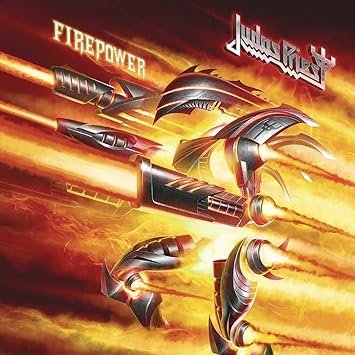
Review: There's no two ways about this, Firepower is fucking sick. Although it sports the worst album cover since Painkiller I would happily frame this and stick it in the Louvre. Why? Because it's a piece of Judas Priest ephemera and therefore in my desiccated pea brain is automatically elevated to the status of high art.

However, at the very least it gives you a flavour of what Firepower is all about, i.e., indomitable mecha-monster war machines kicking the entire world's ass. This odd strain particular to Priest - like that of Saxon's obsession with public transport, or Iron Maiden's godforsaken attempts to ram imperial history down one's throat - began by my estimation on 1978's Stained Class (coincidentally, the album that debuted their current logo) with 'Exciter' and has continued via 'Grinder' and 'The Sentinel' before reaching its apogee on the incredible Painkiller, which positively swarmed with these hellbeasts. You know where else you'll find another menagerie of the infernos? Right here on Firepower, muthas.

Whilst I'm a big fan of predecessor Redeemer of Souls, with the growing influence of newest band member Richie Faulkner (who replaced founder KK Downing) this is a far more focused collection. It starts off as every Priest album should - a dirty great riff and a Rob Halford scream - and barely lets up for a moment over the ensuing 58 minutes (another trait it shares with Painkiller).  The one-two punch of the title track and the gloriously bonkers 'Lightning Strike' ranks up their as my favourite Priest opening salvos.

Of course, this is still a Judas Priest album and so the lyric sheet is the usual casserole of bogglesome ineptitude, but it doesn't really matter. Even though little makes sense from one line to the next, it's all suitably pumped-up and aggressive. A good Priest album does not invite the listener to embark upon close textual analysis; instead, it invites the listener to punch things. If your fist doesn't reflexively clench during the choruses of 'Children of the Sun' (which may or may not be about conflict in the Middle East) or 'Flame Thrower', then I can't help you, son.

Speaking of 'Flame Thrower' - "You're on the run / From the stun / Of the flamethrower!" - that's the chorus, genuinely. Looks stupid upon the page? Cool, because it also sounds stupid coming out of my stereo, but it's also perfect. I wouldn't replace a single word because it sounds totally bad-ass in Rob Halford's hands (or mouth, to be more accurate), peculiar inflections and all. Honestly, although he's mostly sacked off the screaming these days, Halford's still an absolute force. He brings an entirely unearned authority and gravitas to songs about robots having a pagga with mankind.

And look - although I'm clowning on some aspects of the Priest experience, it's done from a place of affection. It's taking longer than usual to type out this review as I've frequently paused to air-guitar or headbang to my favourite passages, which are legion. There's true craft on display here; 'Lightning Strike', 'Necromancer' and 'Children of the Sun' are magnificent stompers from the first half of the album; on the home straight you've got 'Flame Thrower' and 'Lone Wolf', which would be highlights on any album, along with the mighty 'Spectre'. Although Richie Faulkner has made a point of calling Firepower a forward-thinking album, some of the best bits here are redolent of past triumphs - 'Spectre' being a case in point. A nasty prowler with chewy guitar, thematically it's a direct descendent of 'The Ripper' from second album Sad Wings of Destiny and is all the more enjoyable for it.

I don't really know what more there is to say. If you love heavy metal, Firepower is a distillation of all that was fun and magnetic from its classic era, wrapped up in crisp modern production. If metal is a genre you don't care for, it'll come across as exactly the kind of leather 'n' rhinestone clad nonsense you're no doubt striven to avoid. More fool you, in my not so humble opinion - go listen to Father John Misty or just fuck off, whatever.

Sunday, 23 April 2017

Can't Buy A Thrill - Steely Dan

Provenance: I heard a Steely Dan song or two on the radio and liked them. Consequently, I went and bought their first album. It's that simple.

Or, rather, it isn't. See, I don't just 'like' the music of Steely Dan - I am a swivel-eyed zealot, a slobbering devotee, a man for whom little else matters except the cool embrace of jazz-inflected, complex (but accessible!) soft rock. In short, I'm a fanboy.

For too long the Roman Catholic Church has held a monopoly on holy trinities. Subsequent to the crushing of the fourth-century Arian heresy, a few worthy challengers have appeared; Larry, Moe and Curly; Crosby, Stills and Nash; and of course, the adamantine and ever-victorious troika of McDonald's, Burger King and KFC. Well, here's another for the pantheon - Blue Oyster Cult, Judas Priest and Steely Dan. A triumvirate I esteem above all others.

Review: I don't listen to Steely Dan - I eat, sleep, breathe and shit Steely Dan. As with every album I review for this blog I have it playing as I write, but I don't need to. I know each and every word, the cues for all the instruments, the name of who plays what. I am a tiresome individual to be around, peppering my conversation with references to Steely Dan and acting with exasperation when my interlocutors haven't yet been exposed to the genius of Walter Becker and Donald Fagen. I drive my friends crazy. I don't have many friends.

If I am to find fault, it's that Can't Buy A Thrill has a supremely ugly album cover. Like, what else is wrong? The songs are brilliant. The performances are virtuosic. The production is crystalline (and this on their first album; the quest for sonic perfection has come to define Steely Dan to a great degree. When did they reach their apogee? Aja for my money, though some argue that Fagen's solo outings The Nightfly and Morph The Cat push the envelope further).

Do I love Steely Dan, or do I need Steely Dan? Certainly, I'm not the only person who considers 'the Dan' a lifestyle choice. I too want to drink fruity cocktails, roll out world-weary witticisms in sparkling company, wear rollnecks or floral shirts and leave parties early. I want my Nathaniel West cynicism delivered in gnomic couplets and wrapped around a saxophone solo. I want jazz chords, but not too many. I don't own a yacht but I live on the coast and see many go by my window.

Let's be serious for a moment (because one should not be too fatuous about Steely Dan, you'll never win); Can't Buy A Thrill is a stunner, and if it receives fewer accolades than it should it's because it shares the limelight with Aja, Katy Lied, Countdown To Ecstasy and the rest. The two most recognisable cuts here are FM staple 'Reelin' In The Years', tripping along like an urbane Wishbone Ash, and the filmic 'Do It Again', a series of hard-luck vignettes accompanied by organ and electric sitar. In fact, it strikes me that much of Steely Dan's work is in thrall to the silver screen, either employing recognisable motifs or even terminology in their lyrics that is borrowed from cinema. Someone should write an essay on it, so long as it's not me.

Then you have the rueful, crumbs-from-the-king's-plate grooves of 'Dirty Work' and 'Brooklyn (Owes The Charmer Under Me)'. Both seem to speak of a demimonde possessing a kind of flaccid, played-out glamour. It all sounds ineffably decadent, but remember kids, to be decadent you must first be civilised. That's the real secret to Can't Buy A Thrill - it's all so effortlessly cool. And as the 1970s wore on, Steely Dan would just continue to get cooler. Whilst other bands gurned and grunted their way through the most rudimentary riff-rock and catpiss guitar soloing, Steely Dan would be playing something miles more sophisticated, by the best musicians in the business, and it would sound great on the radio.

The thing is, it was never effortless. Becker and Fagen were martinets in the studio, demanding endless takes from their hired guns until it met their standards. Famously, there's a scene in The Shining where a slow zoom of Scatman Crothers took over sixty takes before Stanley Kubrick was satisfied (as legend has it, Crothers wept with joy and relief in a subsequent filming when the director called his scene a wrap within three takes). The appearance of serenity and the state of serenity are two very different things, and so Steely Dan, like Kubrick, split the difference and opted for the former. It's partly why Can't Buy A Thrill is such a full-bodied, kaleidoscopic success.

I've never seen Steely Dan and would drag my dick through broken glass in order to do so. The closest I came was one evening in Boston. I'd had a great time watching the Blue Man Group with my then-girlfriend - hell, I'd even participated in the show and had a fresh smudge of paint on my cheek as a memento - but emerging from the theatre I happened to glimpse the marquee opposite. It said STEELY DAN and I don't think I spoke another word that evening.  

Wednesday, 8 March 2017

Ballbreaker - AC/DC

Provenance: In the sultry summer of 2004 I lit out with two other splendid fellows to the now-defunct Arrow Rock Festival held at Lichtenvoorde, in the Netherlands. I shaved my head clean and grew a goatee so I would resemble Rob Halford, who had very recently rejoined Judas Priest and were to headline the second night.

I had the time of my life at Arrow Rock, meeting some good folk, braving the weather to see some surprisingly good bands (Ten Years After and Golden Earring exceeded expectations), learning that mayonnaise is the only thing one should put on one's fries...

...and enduring the oddly dystopian setup whereby music was being played through scaffold-mounted speakers in the campsite all night and day. The one song I remember playing incessantly was 'Moondance' by Van Morrison. But that was nothing compared to our neighbouring camper. He roared in early on the second day with his motorcycle club and set up camp next door. We learnt from him that he was unable to buy an Iron Maiden album as he kept asking music store owners for 'ee-ron may-ee-den'. We learnt that he was in "one of the biggest" Creedence Clearwater Revival tribute acts in the Netherlands.

And we learnt that he really liked 'Cover You In Oil' from AC/DC's 1995 album Ballbreaker. Really, really liked it. To the exclusion, or so it seemed, to any other music. He would sit on his deckchair, can of Gouden Zegel in hand, CD player in his lap, listening to 'Cover You In Oil' over and over again. It would reach the end and he would skip back to the start. Sometimes, when he was drunk or slow we'd get a couple of seconds of the next track, but his fingers would find the skip backwards button and we'd be back on 'Cover You In Oil'. This went on for three days straight.

Later that summer, I imagine, I was going around my parents' place singing 'Cover You In Oil' as some kind of ironic joke to myself which backfired when they in turn bought me parent album Ballbreaker for Christmas.

Review: AC/DC are one of those acts that loom large over the rock landscape. They've got their superfans, they've got those who love their big albums (I fall into this category), and you've got those who may not even like Acca Dacca but feel obliged to profess a nodding acquaintance and approbation of their major works. It just doesn't do to profess to be a rock fan and be dismissive of AC/DC - like long-dead playwrights or ageing matinee stars, they are accorded an almost automatic respect for their achievements. Certainly, in this writer's opinion, at their best they were (are?) electric - but as with Iron Maiden (or Ee-ron May-ee-den), I'm minded to say that AC/DC have too much filler in their catalogue to be considered the creme de la creme.

So to Ballbreaker, which I haven't listened to in a long time. I admit that because of my prejudice about AC/DC's uneven output I was worried that this would be a grind. On that count, I have been pleasantly surprised. Producer Rick Rubin has the right idea at keeping arrangements sparse and stripped down - guitars sound like guitars, drums sound like drums and Brian Johnson's helium 'n' leather vocals sound ripe and lusty.

What about the songs? They're...not bad, in the main. Here's my main gripe with Johnson-era AC/DC - everything is done at a fairly stately processional. Many of these songs are fine in isolation, but nothing grabs you by the throat or induces a bout of self-administered whiplash as 'High Voltage' or 'Riff Raff', for example, do. As such, everything on Ballbreaker takes a little bit of huffing and puffing before it gets going. I don't mind it at all if it takes a while for a big old hunk of rock to get revved up, but this album screams out for song that socks you with a haymaker at the outset.

Happily, then, if you like mid-paced blues-rock, you'll be thrilled with Ballbreaker. 'Hard As A Rock' is catchy and fun, even if by this stage AC/DC were trading on single entendres for their yucks. My Dutch friend should've been a bit slower off the mark when skipping back to his favourite ditty because 'The Furor' has a tasty, minor-key descending chord progression that is possibly the most interesting thing on the album. 'Boogie Man' is 'Night Prowler' 2.0 but, again, taken on its own merits a decent tune. The quality dips a little on the second half of the album, and I find something vaguely annoying about 'Hail Caesar', but not enough that I would hit the shuffle button if it came on in the car.

Now for a minor gripe, one which I have alluded to already. AC/DC's lyrics have never aspired to poetry, but in the early days their sleazy doggerel held a similar appeal to the priapic doublespeak found in a Carry On... film. Alas, there is little here that Sid James would cackle over, so obvious are the sex metaphors. Obvious, and tired. Listening to 'Love Bomb' and 'Caught With Your Pants Down' actually shaved a few points off my IQ (and the latter isn't helped by straining to sound like 'Whole Lotta Rosie' without an ounce of the original's manic energy). But for all my complaints, the sound coming out of my speakers is tough and lean, and whilst unambitious, the songs are hooky enough to maintain interest for the most part. It's not brilliant, but Ballbreaker really isn't too bad at all.

I'd be remiss if I didn't mention 'Cover You In Oil' again. It's an early track, so once I'd listened to the album all the way through, in homage to my Dutch biker acquaintance I skipped back and gave it another listen. It's punchy, possesses a swagger that's not so evident on the rest of Ballbreaker and has a chorus that is dopey enough to sing along to. I've now heard 'Cover You In Oil' more than almost any other person on the planet. Almost. I truly hope that somewhere in the Low Countries, a man with a greasy mullet and a luxurious moustache is sat in a Laz-E-Boy, supping on a Gouden Zegel and hitting the 'back' button at the first hint that 'The Furor' might start playing.

Sunday, 26 June 2016

Painkiller - Judas Priest


Provenance: My friend the musician Ollie Hannifan recommended this back when he was the schoolboy Ollie Hannifan. I clearly recall Ollie tempting me in to the purchase by suggesting that, on this album, "they just don't stop."

Review: The first thing that needs to be said is that Ollie was wrong, as Painkiller stops at around the 46 minute mark. I get what Ollie meant though. Before its even cued up on the stereo your eyes are bleeding because the cover art work is so elite. A muscle-bound silver Corinthian warrior is riding a half-motorbike half-dragon contraption (in the sky), whilst below tower blocks are being engulfed in lava. You're sweating before you've even hit the play button.

It gets better. New drummer Scott Travis is immediately showcased with a pummelling intro to the title track, which duly explodes into some of the most full-on metal madness ever captured on tape. Nothing is left on the table. Lead-wailer Rob Halford (probably my favourite vocalist of all time) often uses his piercing falsetto as embellishment, but here he kicks off somewhere just inside the hearing range of canines and never lets up. He relents only in the pre-solo(s) mid-section but that's only so us mere mortals can hear him intoning 'Faster than a laser bullet / Louder than an atom bomb / Chromium plated boiling metal / Brighter than a thousand suns.' Bob Dylan this ain't (though Judas Priest take their name from a Dylan lyric), but I can't recall His Bobness ever dealing with mankind's destruction by alien cyborg monsters.

First track down and you're crying out for relief. No mate, because up next is 'Hell Patrol', then 'All Guns Blazing', then 'Leather Rebel'. Every single one of these rattles your skull, snaps your neck and boils your blood until you're left a limp bag of bones and, uh, anhydrous plasma (I'd guess). Hearing this power-metal-on-steroids sound is even more remarkable given that when Priest began at the dawning of the 1970s they happily sat alongside bands like Spooky Tooth and Atomic Rooster. Guitarist Glenn Tipton, who began playing guitar when the Beatles were a going concern, pulls off swept arpeggios like a player twenty years his junior - the sheer amount of practice required to operate at this level, put in by guys who could've rested on their laurels by the time this was released, is astounding. So, time for a respite and, perhaps a blood transfusion?

No chance - next up is 'Metal Meltdown', Halford screaming like a stuck pig before the song crashes into a grinding, fist-clenching chorus (which I can assure you does feature the phrase 'metal meltdown'). Another absolute juggernaut up next with 'Nightcrawler', one of those songs about indomitable hellbeasts that litter the Judas Priest back catalogue. Here, a bunch of people hide in the cellar from some bloodsucking anthracite menace, but...ah, I won't spoil the ending (but it doesn't end well! Everyone dies!). Then it's 'Between the Hammer and the Anvil', which is a gently whispered acoustic number with a strong Joni Mitchell influence. Not really! It fucking slays too.

You're pretty much on the home stretch before the pace abates somewhat with 'A Touch of Evil', which would sound heavy on any other album, but serves as Painkiller's ballad. For some peculiar reason I always get this confused with Defender of the Faith song 'Love Bites' when it's played live. I first saw Priest in 2004 when they headlined Arrow Rock Festival in Lichtenvoorde in the Netherlands. This was their first tour reunited with Halford and I had shaved my head and grown a beard so I could look just like him. They were amazing, but when the first bass note of 'A Touch of Evil' rang out, I was a lone voice in the crowd yelling "Yeaaaahh! LOVE BITES!", a mistake I doubled down on three years later. Can't see me ever getting this right to be truthful.

After a short instrumental called 'Battle Hymn' we're onto the final track, the valedictory 'One Shot At Glory', a track that wouldn't be out of place on a top quality Hammerfall or Helloween release. By the way, you're dead at this point, or comatose, or your blood has just turned into mercury. Different from anything else in the Priest catalogue, Painkiller is gloriously over-the-top, fun, intense, stupid and brilliant. It marked a fine conclusion to the first Rob Halford era.