Showing posts with label rockabilly. Show all posts

Sunday, 14 November 2021

Best Of The Stray Cats: Rock This Town - Stray Cats


Provenance: Yet another from my Toronto haul. Never been a huge fan of Stray Cats but this was cheap and I'm partial to a little rockabilly now and then.

Review: Stray Cats fall into that weird category of purist revivalist music that saw acts like Sha Na Na and Showaddywaddy gain footholds in the culture at various times, despite no real explanation for it. True, the 1980s did see some of the OG rock 'n' rollers hit chart gold as their music was exhumed for movies and adverts; am I underestimating the power of nostalgia?

Unlike their near contemporaries The Cramps, Stray Cats play it straight. Which, on the one hand, is admirable, but on the other makes for a fairly monochrome listening experience. The vast majority of the tracks on Best of... are built from a foundation of bass, drums and guitar; I almost punched the air when, two-thirds of the way through, I heard a fucking saxophone. Oh, and Slim Jim Phantom (top tier name by the way) plays a drum kit consisting of snare, bass, hi-hat and crash cymbal, a minimalist approach that no doubt played well to the greasers and ensured no Neil Peart style histrionics.

This short, ten track compilation kicks off with the Stray Cats' most recognisable, and arguably best, song, 'Rock This Town', which is a genuine shack-shaker that makes all the right moves. The next track though - '(She's) Sexy & 17' (gender in parentheses, presumably so nobody gets the wrong idea) is a little noncey, in a Chucky Lee Byrd way. Also, two tracks in and I'm bored of Brian Setzer's weedy voice. I'm almost bored by his guitar playing, which trades creativity for period fidelity. Luckily, numero tres is a great doo-wop number called 'I Won't Stand In Your Way', which reveals that Setzer is much better playing the sap than the tough.

A shame, then, that a chunk of the Stray Cats oeuvre which appears here is predicated on them being a bunch of flick-knife wielding alley bruisers. Setzer's lapdog yelp doesn't cut it on 'Stray Cat Strut' or 'Rumble In Brighton', not even when backed up by his two goons, who look like they have acromegaly or rickets or perhaps both. 

The collection reaches a nadir on 'Gene & Eddie' (that's Gene Vincent and Eddie Cochrane to you plebeians), a song that both quotes from and utterly mangles the work of those two doomed genii. It's the kind of concept I tend to despise, with the exception of ABC's 'When Smokey Sings' and maybe Nils Lofgren's 'Keith Don't Go' (depending on which way the wind is blowing at the time). Both hagiographic and tautological, just once I'd like one of these 'tribute' songs to give their subject a proper shoeing. Actually, Stray Cats shouldn't have bothered at all, considering that a few years beforehand, Ian Dury & the Blockheads had produced the far superior 'Sweet Gene Vincent', which deals with the legend in a much more interesting and playful way.

There's not a huge amount that's wrong with this, especially if you like wearing leather jackets, fashioning your hair like a duck's arse and pretending that slapback echo is the pinnacle of music production. Sure, at one point they nick a line from a Lazy Lester tune, but that's the business. Sometimes Lee Rocker walks up the neck of his upright bass, sometimes down it. Slim Jim speeds it up and slows it down. Brian Setzer plays his Cliff Gallup and Scotty Moore riffs with aplomb. The Best of... is a slick, adroit bit of graverobbing, which has its moments but is too in thrall to rock 'n' roll's golden age to be more than a curio.

Sunday, 22 March 2020

Texas Flood - Stevie Ray Vaughan

Provenance: Back in the mists of time, long before your Facebooks and Tweet-O-Grams, people did things like collect stuff, get drunk, and attempt to master an instrument. Yes, your humble scribe did some of the former (Panini football stickers, matchboxes) and much of the latter (guitar, a bit of mandolin). As for the drinking? I couldn't possibly say! [Insert winking emoji here.]

My parents very kindly paid for a guitar teacher to do things like point out the wiry bits were called strings, and that it would help if I used both hands. Once basics had been raised to a level of competence, he was keen that I learn to improvise - in essence, to hold enough theory in my head that I was able to react and adapt lead playing, in real-time, to musical structures. A good foundation for this is blues music, which uses the minor pentatonic scale extensively (the bedrock for most rock music) and which often relies on familiar chord progressions.

So, how do you engage a teenage classic rock and metal fanatic with the blues? Give him something suitably rocky and pyrotechnic to aspire towards - and thus, the first blues I ever played was Stevie Ray Vaughan's 'Pride and Joy', which appears on today's album, Texas Flood. I loved it, even the tricksy turnarounds and unfamiliar shuffle feel. Plus it proved to be a watershed moment, as I am now a fully-fledged blues fan; my favourite players are people like Mississippi Fred McDowell and especially the merciless Lightnin' Hopkins, but I'll always retain a soft spot for SRV for providing me with the gateway drug.

Review: Stevie Ray Vaughan came to prominence during the 'blues boom' of the 1980s, which saw the emergence of artists like Robert Cray and the resurrection of others like John Lee Hooker, whose star-studded 1989 album The Healer won a Grammy award. So what was SRV's contribution to the genre? One could argue, nothing new. There are parallels to be drawn between Vaughan and the British guitarist Alvin Lee, who was similarly lionised for his hyperkinetic rhythm 'n' blues playing. An argument could be made that Vaughan was an improvement - defter, more accurate, a better songwriter and, crucially, in possession of a genuine grit 'n' diesel Texas drawl, as opposed to the dorky facsimile that Lee (and, in fairness, many others) tried to conjure up. Unlike Lee, Vaughan didn't stray far from the blues either; yes, he made a cameo on a Bowie album, but his own material was locked down, and when he did interpret the music of others, it was to emphasise its bluesiest elements (his take on Jimi Hendrix's 'Little Wing' being a prime example). There was no meandering into psychedelia with Vaughan, which cannot be said for Alvin Lee and his band Ten Years After.

Let's start off with my own personal bone that requires picking with regards to Texas Flood; 'Pride and Joy' and 'I'm Cryin'' are the same freaking song. I get that the first is celebratory and the latter strikes a more consolatory tone, but dude, write some new music. It's a ten track album that doesn't even top forty minutes and yet here are a couple of 'companion pieces', I guess. A bit of a 'fuck you' to the blues buying public, but I must admit a sneaking respect for this approach. It's like writing a song for your girlfriend, and when she dumps you trying to fit the name of the new squeeze into the melody. Writing the same song for when you're both happy and sad about your partner is, upon reflection, quite an alpha move.

Duplication issues aside, this is a quality slice of 1980s rock-influenced blues. The clean production sound works when recording what is a small combo - Vaughan is backed by bass and drum-mongers Double Trouble throughout - as it brings his ultra-precise lead playing to the fore. Remarkably, for such a polished product I was later to learn that the entirety of Texas Flood was recorded in two days and features no overdubs. Give or take some messing around with the levels, what you're hearing is the live band, it's extraordinarily tight. The vocal performances are fantastic too, and it's boggling to try and comprehend how SRV managed to wring such impassioned performances from both hands and larynx without any need to go back and fix anything.

All the hallmarks of Vaughan's playing are there from the get-go, too; heavy vibrato on bent notes, daggerish little single-fret slides and almost percussive use of double stops. The latter is especially evident on 'Love Struck Baby', a twitchy, fidgety shuffle blues that begins more like the commencement of a boxing bout than a blues song. The most comprehensive displays of SRV's guitar trick-bag are to be found on the instrumentals 'Testify' and Stray-Cats-on-amphetamines rockabilly whirlwind 'Rude Mood', although the dizzying 'Mary Had a Little Lamb' runs them close; and that aforementioned deftness comes to the fore on the closer 'Lenny', another instrumental, in this instance an glimmering, iridescent tribute to Vaughan's partner Lenora Bailey (she thought 'Pride and Joy' had been written for another woman, so SRV wrote her a brand new song - wise man).

And yet.

I can't claim to hold too many original opinions on music; I think my takes on most of these albums resonate with the critic pool at large, albeit not as well written. I do adhere to the odd heresy, like my belief that Neil Young's Trans is misunderstood and ZZ Top's Recycler is not devoid of merit, but by and large I'm reasonably vanilla. Thus, here's my lukewarm take on Texas Flood that anyone familiar with SRV has probably seen ambling over the horizon for a while now - it sacrifices soul at the altar of technical ecstasy.

The problem is probably me and my relation to blues music. When I interrogate my own feelings about Stevie Ray Vaughan and the blues I feel a bit queasy, to say the least; am I like the martinet Ewan MacColl, insistent on "authenticity" above all else? Would I have pulled the plug on Dylan? I've been a good boy, I read Elijah Wald's Escaping the Delta and feel clued up enough not to fall into the authenticity trap (I've written about this before now), so why do I have such a problem with Texas Flood? Is it merely because this is tagged as a blues album, and so I'm bringing a whole mess of expectations to the table that really shouldn't be there? How come I can enjoy the 'newgrass' movement begun in the 1970s (which sought to fuse bluegrass to styles such as jazz - and this has just reminded me to go and listen to some David Grisman Quintet) without my appreciation of bluegrass colouring the experience? Perhaps because my knowledge of bluegrass is dwarfed by what I (think I) know about blues music, and is unencumbered by those strange gatekeeper tendencies that can sometimes evolve alongside a burgeoning personal passion.

Sadly, I must conclude that I'm simply too smart to properly appreciate Stevie Ray Vaughan.

Genuinely, though, I really must stop sorting things into boxes and weighing up their merits accordingly. Because taken at face value, Texas Flood is a rollicking good time. It's an album full of good singing, good playing and lots of whizzy guitar licks, and so in the future I'm going to endeavour to meet the album on these terms alone. Even if 'Pride and Joy' and 'I'm Cryin'' are the same freaking song, goddamn.

Sunday, 6 October 2019

A Rockin' Decade - Sleepy LaBeef

Provenance: I first heard about Sleepy LaBeef in Peter Guralnick's Lost Highway, a highly readable survey of what could loosely be described as Americana. LaBeef stood out on the page; an interpreter rather than a writer, and something of a human jukebox (claiming to know roughly 6,000 songs by heart) which is impressive enough before you even reach the voice. In his prime the 6'7" native of Smackover, Arkansas must've been an impressive presence merely entering stage left, but what happens when he opens his mouth is something else. His is a clear, generous, country-bred baritone that has an almost physical quality to it - big, wide, deep, indomitable.

However, I never really imagined I would own any LaBeef recordings; he was too cult, too obscure to find without breaking sweat. If he had had anything released on CD, I figured it would be one of those eBay jobs that go for about fifty quid plus. I was therefore pleasantly surprised to find this collection of Sun Records sessions from the 1970s lurking in the late-lamented Eastbourne HMV's bargain racks. Guess I underestimated the thirst for rockabilly in south-east England, eh?

Review: There is nothing original on this album, nothing. Not a single note was penned by LaBeef on A Rockin' Decade, and the 26 tracks that make up the compilation never stray far from the traditional rock 'n' roll template. In compositional terms there are zero surprises, and even the choice of covers cleaves very much to what could be considered a canon of the genre; 'Boom, Boom, Boom', 'Roll Over Beethoven', 'Mystery Train', 'Milk Cow Blues' and 'Blue Moon of Kentucky' all make appearances. The playing is competent and uninspired, the musicians sounding like what I imagine them to be - accomplished meat 'n' potatoes barroom pros.

So, seasoned readers of this blog won't be at all taken aback by the fact that I love this album. Love it, love it, love it.

Why? Well, before getting onto LaBeef's individual gifts, I should point out that a lack of originality in rockabilly is pretty much what I hanker for. It is one of those genres that doesn't benefit at all from tinkering with the formula. I don't want some pointy-head turning 'Roll Over Beethoven' into a raga, I want it neat, all three goddamn chords of it, swinging like Tarzan on methamphetamine at shack-shaking volumes. That fairly sums up my attraction to lots of American roots music - be it rhythm and blues, country or rock 'n' roll; the basic ingredients don't change much, giving plenty of opportunity for the performer to stamp their personality on proceedings. This, LaBeef does with aplomb.

I love Chuck Berry as a songwriter and innovator but LaBeef's version of 'Too Much Monkey Business' absolutely smokes the original. As mentioned before, LaBeef's is a huge voice, so it's a delight to hear him negotiating a tricky little number with such nimbleness. It evokes the same joy as watching a burly centre-half tiptoeing his way through an opposition's defence before chipping the keeper. He does the same thing on Willie Dixon's 'You Can't Judge a Book By Its Cover', with the additional achievement of rhyming 'cane' with 'man' (though Bo Diddley also did a very decent job with the same lyric).

I recall reading a biography of Orson Welles written by David Thomson, in which he employed a rather striking metaphor to describe Welles' voice during his days as a radio star. He described it as possessing the same qualities as a heavy dinner or of chocolate, somehow made incarnate by Welles, the richness, slightly cloying excesses of the voluptuary coming through over the airwaves. Let me try to do something similar for LaBeef; his is the voice of a lonely honky-tonk, of flickering neon lights, of liquor consumed straight and smalltown boastfulness. There's a brashness there, but it's offset by a complete lack of guile, which equates to a queer kind of charm. There's a couple of times where on 'Blue Moon of Kentucky' LaBeef is a step outside of his usual comfort zone, and it only serves to make him sound all the more honest.

A Rockin' Decade is a pretty lengthy document for such a monochrome palette as adopted by LaBeef and his buddies, so tossing it down in one go is not advisable unless you're hosting a sock hop or whatever the fuck people did for fun back then. I almost want to slap myself for advocating shuffle play, but it's the best way to enjoy the album, especially if it's stirred in with a bunch of other stuff. Just imagine getting hit between the eyes with 'Big Boss Man' or 'Flying Saucers Rock 'N' Roll'(!!) after wading through a load of Yes, Rush or Porcupine Tree. Blessed relief, one should think. Sleepy LaBeef is living history, and has greater claim to being part of what makes America great than a slew of more spurious claimants.

Tuesday, 24 October 2017

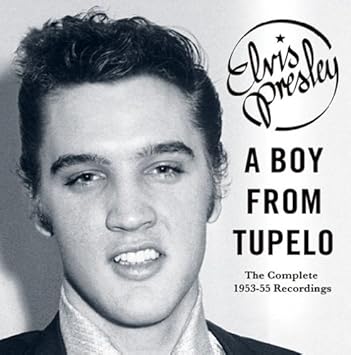
A Boy From Tupelo - Elvis Presley

Provenance: I've been to Graceland, you know. It's the roughly seven-year anniversary of the road trip I took around the Deep South of the USA, during which I met the person who I would later go on to marry.

That journey proved to be the catalyst for me to fall in love with a whole bunch of things, aside from another human being. There's New Orleans, and fried catfish, zydeco and the Great Smoky Mountains, the Arkansas State Fair and Twelve Bones BBQ, small town hospitality and the alluvial expanse of Mississippi's Delta Region. I know, I've reeled off a bunch of cliches - and I stand by them all. For a dumb, wide-eyed young'un from Bournemouth, it was something the hell else.

Rather unexpectedly, I also found myself falling in love with a certain Elvis Aaron Presley. I'm driving down the highway in my rental, destination Memphis. I want to be the biggest tourist around, see Beale Street and the Stax Museum and, of course, take a pipe at Graceland. I've got a passenger with me, a large raw-boned chap called Tommy, a former Aussie Rules player I picked up in Nashville. He's here on business, but taking some time out to travel a bit. About twenty miles out of Memphis and fiddling with the satellite radio I get an Elvis station - live from Graceland - on Sirius XM. (Closer into town and I'm on the newly-christened Isaac Hayes Boulevard, which is nice because it wasn't named after a racist.) W head south toward the airport, hang a right and we're almost there.

Graceland isn't a place for the fainthearted. It's a monument to both a great artist and to folly. It is excessive, tacky, a glittery testimony of all that is crass. To stumble around this bejewelled carbuncle is almost nausea-inducing, and one has to consciously remind oneself that actual human beings dwelt in this funfair house of mirrors. And you think, yes, the star of such cinematic triumphs as Clambake and It Happened at the World's Fair would live in such a place. Yet on the ride in, you heard something pulsing on the radio, something vital...

We got into Graceland fairly late, and as Tommy and I were leaving we noticed trestle tables being set up and barbecues being lit. So we decided to do what any two folk in our position would do - don our suits (don't ask why I packed one, but a great call), hustled our way into the function and spent the evening partying on the verandah, food and drink courtesy of the Tennessee Department of Tourism. We even witnessed what must've been the most high-pressure gig for an Elvis impersonator to perform. Yet even in that pale imitation, there's a whisper of something great...

Review: This handsome three-CD (and book) box-set contains every recording of Elvis spanning the period 1953-55, including service acetates, radio performances, studio takes and singles. I'm only reviewing disc one, containing the acetates, the RCA masters and those immortal Sun masters that cemented Elvis' early reputation.

Nick Tosches is a man who can spin a yarn, the kind of guy whom I imagine considers the gospel truth to be a minor inconvenience when there's a good story to be told. His biography of Jerry Lee Lewis, Hellfire, might be based in part on speculation and hearsay but it's also scintillating. Similarly, there's some tall tales told in Country: the Twisted Roots of Rock 'n' Roll but amidst the mythologising there's some important history on the genealogy of American country music (spoiler: it's all British, and often very old). The book also takes a stand for white hillbilly music's influence in the formation of rock 'n' roll; if not a wholly equal partner with black rhythm 'n' blues, Tosches nevertheless states a strong case - citing plenty of evidence - to suggest that a) there's a clear and obvious country ancestry to rock 'n' roll that's deeper than white performers appropriating black musical forms and b) that blues and country music were cross-pollinating each other for decades anyway. All this is worth holding in mind with regards to A Boy From Tupelo.

From the collection of early acetates you can hear why Sam Phillips initially didn't think he had much on his hands. In a restrained, slightly quavery voice Elvis sings a few torch songs accompanied by his own rudimentary guitar playing. Nothing here for Tosches, or anybody else, to write home about. Even the first couple of Sun masters are on the soporific side. And then, all of a sudden - magic, pure magic, as rockabilly bursts forth from the speakers in full colour. Elvis, along with guitarist Scotty Moore and stand-up bass player Bill Black, tear into Arthur 'Big Boy' Crudup's 'That's All Right' with a wild assurance. Gone is the thin reticence that defines Elvis' sophomore efforts; instead, he meets the percussive thump of Black's bass with a swaggering, swooning brilliance. If ever a recording sounded white hot it's this bad boy, people, it's this one.

There's so, so much more to come; Bill Monroe's waltz 'Blue Moon of Kentucky' whipped up into a 4/4 country-blues; the supreme cover of Roy Brown's jump blues 'Good Rockin' Tonight'; a crackling 'I Don't Care if the Sun Don't Shine'; and possibly Elvis' most potent two and a half minutes ever committed to wax, his cover of Junior Parker's 'Mystery Train' (Scotty Moore is sublime on this cut). Even here, in this formative (and utterly electric) period, Tosches was able to muster up a moue of disappointment; he pinpoints the false start of 'Milkcow Blues Boogie' ("hold it fellas, that don't move me - let's get real, real gone for a change") as the moment Elvis first demonstrates his own awareness as a commercial performer, effecting a compromise that would forever taint the rest of his artistry. Well, it's an interpretation, and from a man who certainly knows his onions.

Given the technological and stylistic(?) advances(?) that have been made since Elvis started stirring things up in a small room in Memphis it can, at times, be hard to see past this compilation as a collection of historical curios. Certainly, for ears attuned to popular music created a bit later - say, from The Beatles onwards - it can sound a bit primitive. I recall a conversation with a friend where he spoke approvingly of rockabilly revivalist fashion but said he couldn't fully dig the whole package because of the limited sonic palette the music drew from. I grok. I'd flip that around and say that Elvis, and a whole bunch of contemporaries (and near contemporaries) coupled simple music to simple instrumentation and created some of the most exciting and life-affirming music of the last century. Sinuous, dangerous, slinky, sexy, sweaty, belligerent and beguiling - that first flush of rock 'n' roll was where it was at, folks. Let's get real, real gone, for a change.