Thursday, 28 June 2018

Pretzel Logic - Steely Dan

Provenance: I became familiar with two Steely Dan songs right around the same time - 'Do It Again' from Can't Buy a Thrill and 'Rikki Don't Lose That Number' from this bad boy, and I bought both albums close together.

Review: I struggle, sometimes. The easiest reviews to write, or so it seems, are those where I find some little scab to pick at, such as an undertow of misogyny; and goodness knows I enjoy giving a band a good shoeing every now and again. The tough ones are when I'm confronted with something I unabashedly love and, furthermore, take seriously. Case in point - Pretzel Logic.

I remember reading stories about how Persian carpet makers would deliberately introduce a single flaw into their otherwise expert designs. This was done to assert that only God's creations could be considered perfect, and that no man should get ideas about his station in life. Well, if there's a Persian Flaw in Pretzel Logic I'll be damned trying to find it. The first two Steely Dan albums were - are - superb, but here they shift gears into another realm altogether. Everything here is fine-tooled, finessed, wrought so delicately that the music itself seems to glint and gleam in a kind of audio pearlescence.

Attempting to play advocatus diaboli for a moment here, I'll try to level a charge or two against the album whilst giving it a listen. For one, it doesn't exactly throb with a primal swamp rhythm. It's certainly not shack-shaking primitivism of the stripe one would encounter with Jerry Lee Lewis, Little Richard or even Motorhead. This is music that wipes it feet before entering, for sure. It's an accusation heard often against Steely Dan - that in attempting to achieve technical ecstasy the finished product ends up rather bloodless. I get it. I'm not going to psyche myself up before playing sport by blasting 'Any Major Dude Will Tell You'. Of course not.

And hey, some people just plain don't like the Dan. And those people are wrong.

I'm not going to talk about key changes or thirteenth chords, though as my music professor father-in-law would assert, those things are totally legit to consider when unpacking why Steely Dan (and Pretzel Logic in particular) are so good. I will say that having so many jazz elements bubbling away underneath the surface of eminently hummable and hooky pop songs is a tough thing to pull off, however. And I guess this is why I take Steely Dan seriously, because hearing such consideration and sophistication in popular music is rare (and, I would argue, increasingly so).

Take, for example, the wonderfully kinetic 'Parker's Band'. As a tribute to Bird it's a canny and multifaceted little gem, one in which we don't even hear a snippet of Parker-inspired music until the cavalcade of horns ushering in the end of the track. The lyrics, meanwhile, begin on the same declarative note as music labels adopted to advertise their wares at the time - "Savoy Sides presents a new saxophone sensation!" Just how immersive is that! It's a small detail, no doubt, but exactly the kind of thing that Becker and Fagen agonised over to ensure that their music hit all the marks. Plus the middle eight is perfect:

We will spend a dizzy weekend
Smacked into a trance
Me and you will listen to
A little bit of what made preacher dance

In four lines we get a nod to Dizzy Gillespie, a nod to nodding out and the merest equation of jazz as a surrogate spiritualism. It's true that Steely Dan's lyrics can often seem elliptical to the point of opacity, but my counter to that would be what's the problem? Does everything need to be so literal? Is it not metonym, metaphor, allusion and the rest that work as the very stuff of poetry? Don't get me wrong, I'm not ordaining Steely fucking Dan as the inheritors of James Joyce's mantle. What I'm groping towards is that sometimes the hazy, ill-defined mirages conjured up on Pretzel Logic are perhaps more effective than a more prolix versifying at creating mood. It asks the listener to bring something to the game. I'm pretty sure Edgar Allan Poe was thinking of 'Charlie Freak' when he wrote "music, when combined with a pleasurable idea, is poetry."

(I should add, for the uninitiated, that Steely Dan is anything but hard to get into. Even the most teasingly obscure lyrics are wrapped up in the chewiest, sweetest jazz-rock you're likely to hear. Plus, if you watch movies there's always an olive branch to grab hold of - "If the dawn patrol gotta tell you twice / They're gonna do it with a shotgun" crops up in the flinty 'Night By Night', for example. I've mentioned before now the massive influence of cinema I have perceived in Fagen's songwriting.)

As someone who grew up away from American classic rock radio I don't have the ubiquity of Steely Dan to process. When I first became conscious of the fact I was listening to Steely Dan I was already (in law, if not in spirit) an adult. Thus, to a guy who had gorged on all the lumpen blooz-rock the 1970s had to offer, Steely Dan sounded fresh, curious and fizzing with musical ideas. A few years on, and now as the owner of their entire discography, nothing's changed. To me, Steely Dan represent the apogee of what popular music can be, which is a technicolour meld of virtuosity, wit and a blue flame of emotion. The only thing left to add is that, despite lacking the Persian Flaw, I don't even regard Pretzel Logic as their best work. That's for another day...

Tuesday, 12 June 2018

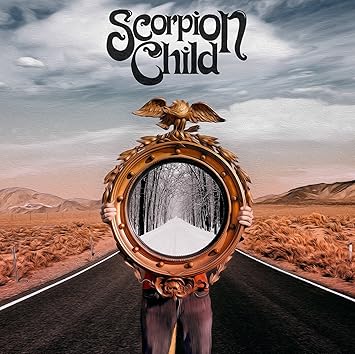
Scorpion Child - Scorpion Child

Provenance: Another overheated review by Classic Rock magazine led me to making this purchase.

Review: There's a reason why, when my Classic Rock subscription lapsed last month, I haven't exactly jumped to renew. Whilst the featured articles are pretty good (when they're not 'listicles' - do I really give a fig about the '50 greatest guitar solos in rock history'? The answer is no I don't) the reviews section is full of shit. True, if it weren't for glowing write-ups of early Ultravox or Robin Trower's Go My Way I probably wouldn't have rolled the bones, but for every Ha! Ha! Ha! there's been a We're Here Because We're Here (NB: this corpulent monstrosity of an album garnered a '9/10' review from the pie-dribbler on prog duty that month).

Yet here I am again, failing to learn my lesson. I'm worse than those Sonic the Hedgehog man-children whose entire lives are spent whining about bad computer games on YouTube. At least those fellows possess some kind of fealty, albeit to anthropomorphic road-kill. I have no excuse, my ambivalence towards Classic Rock's reviews section was crystallised many moons ago and yet I still return to drink from the well. And thus, Scorpion Child.

Let's start with their name, as it sets the tone for everything else. Like everything else associated with this band it feels derivative, like a muffled echo of something infinitely better. You can imagine a band called Scorpion Child playing gigs at the local rugby club, and they'll even throw in a Bon Jovi cover just to keep everyone happy. And the songs? They've got names like 'Salvation Slave', 'Liquor', 'In the Arms of Ecstasy', 'Paradigm' and, er, 'Polygon of Eyes'. Aside from that last one (what the hell?) they must've taken all of two freaking minutes to come up with. 'Salvation Slave'?? Puhhh-leazzze. Utterly cringeworthy.

Still, you'll be relieved to know that Scorpion Child, at least on the basis of this self-titled nugget (of what, you may ask) do indeed sound like a competent bar band who have struck upon the idea of "playing badass hard rock, like Led Zep or Deep Purple, but with a modern twist", the latter meaning that the production is loud and clippy. Scorpion Child is a bunch of riffs bolted together underneath the interminable wailing of a guy who, one suspects, imagines himself to be a latter day Glenn Hughes, albeit if the Voice of Rock possessed an irritating Roger Chapman bleat to his vibrato and also sucked a bit.

Don't misunderstand me, these guys can play. They're perfectly adept at playing riffy heavy rock, and I'm sure they'd be fine as the backdrop to a few cold ones. A bit sluggish, a tad pedestrian in places, rather too familiar overall, but it's fine. It's fine. And that's the problem. Nothing grates on me more, musically speaking, than bang average. I've got time for virtuosity, I love a glorious failure, god knows I love a trier; and by all means, do something creepy and weird in your basement, I'll lap it up. But if there's no craft, no spark, no inspiration (in whatever form that might take) then I struggle to maintain interest. The guys in Scorpion Child are no doubt committed and passionate about what they do, yet I can't help but feel that instead of a fire-breathing demon of an album, they've created a facsimile of one.

Stale, predictable and one-pace - all words you can use to describe my blog, but applicable to this album too. And yet whilst I struggle to delineate any real plus points (I guess the Geddy Lee impression on 'Antioch' is pretty good), there are others who really dig what Scorpion Child are serving up. Like, really dig it. Good for them, but not really my cup o' char, I'm afraid.

Tuesday, 5 June 2018

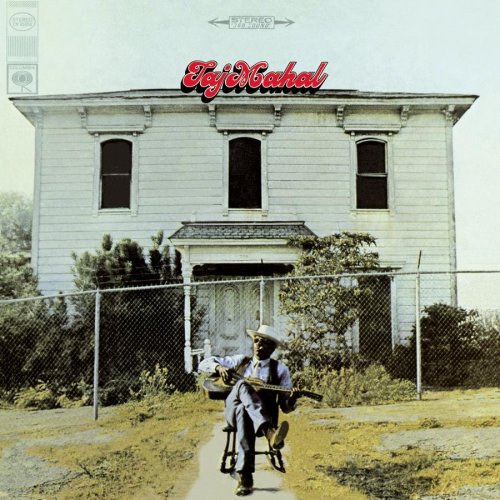
Taj Mahal - Taj Mahal

Provenance: From the moment I picked up a guitar I was interested in the blues. When it came to learning riffs or copping licks, the pentatonic scale seemed to be all-pervasive, looming as it does to this day over a century's worth of popular music. For a while, I was just all about cats like Stevie Ray Vaughan, guys who could shift around the fretboard. Yet even then I was dimly aware of names like BB King, Muddy Waters, Howlin' Wolf, Robert Johnson. These days each one, coming from different times, places and styles of the blues as they do, sound utterly distinctive - but at the time they were old blues guys.

So whilst learning 'Pride and Joy' and 'Crossfire', I was delving backwards and finding some awesome, overpowering stuff. Mississippi John Hurt and Blind Willie McTell became favourites, as did Clarence 'Gatemouth' Brown (whose birthday, I distinctly recall, was marked on a Simpsons calendar our family once had), Son House, Fred McDowell, Pinetop Perkins, Sonny Terry and Brownie McGhee, and of course the incredible Lightnin' Hopkins. Man, you can put 'Lonesome Dog Blues' on right now and I'll still reflexively crack a grin at Lightnin's "po' dog" aside during the first verse.

Later on at university my housemate Ben and I devoured the Martin Scorsese-produced series of documentaries on blues music and that's when I first encountered Taj Mahal. Later, for my birthday, Ben bought me the Taj Mahal 'best of' that accompanied the series and I was away. That was it - I was a Taj Mahal guy from then on.

Now, my partner credits me with hepping my father-in-law to Taj Mahal - which is cool, because if I did, I'm indirectly response for the fact that he's now writing a biography of the man. Coming full circle, it was thanks to him that I was able to go backstage after Taj's show in London last year. He's a man who, I suspect, meets scores of people every night on the road, but he took one look at me and already knew my name, who I was and my backstory. I, a fairly insignificant cog in the grand scheme of things, was impressed, surprised and humbled. We had a good chat, incidentally, about Cool John Ferguson, who is another guy you need to check out. Oh, and at the same time I also met a true broadcasting hero of mine, Dotun Adebayo (he was a prince, by the way, making a mockery of the adage that one should never meet one's idols).

Review: This is where it all began - almost. Here is Taj Mahal, taking his first solo strides after playing with the Rising Sons (who also featured Ry Cooder and future Spirit drummer Ed Cassidy), with a self-titled straight shot of the blues. At a shade over half an hour it's a tight little collection but across the eight tracks Mahal roams around the blues landscape, executing everything from electrified rock to gutbucket country. With a crack band featuring his erstwhile Rising Sons colleagues, it's every bit as impressive as it is eclectic.

Dig this, too - the opening harmonica trill on 'Leaving Trunk' is lodged firmly in my top five ways to start an album. It's startling and joyous, acting almost as a heraldic fanfare or a clarion call to arms, before locking in with a funky, choppy rhythm that causes one's thighs to twitch involuntarily. All this and Mahal hasn't even started shouting the blues in a voice that contains all the grime and passion you could ask for. Yes, yes, yes.

One thing that I have omitted to suggest so far is this album's importance. I genuinely think that without Taj Mahal and a few other American electric blues releases of the era, the renaissance the genre enjoyed in the 1980s wouldn't have happened. Here was an African-American artist contemporaneous with the Rolling Stones, Canned Heat and the rest, creating music at once so recognisable yet so vital as to be quietly revolutionary. Despite the fact that almost every song is a cover Mahal's arrangements sound fresh, injecting fire into the veins of hoary old favourites such as 'Dust My Broom' and 'Statesboro Blues' (NB: the latter is excellent but, alas, my third-favourite rendition of the song; the best being by Blind Willie McTell and the runner-up emanating from the Rising Sons, whose clattery breakneck version is a revelation).

I suppose that's the genius of Taj Mahal - it straddles old and new without ever seeming to compromise or accommodate. There are no swirling Hammond organs or phased drums here - you've got drums, bass, guitar, harmonica, piano; we could be talking the same kind of setup that Muddy Waters was using when storming the clubs and cutting heads in Chicago a decade or more before. The closest Taj Mahal comes to anything that has an obvious genesis in the 1960s is 'E Z Rider', which has a couple of chord changes in the turnaround that Jimmy Rodgers probably wouldn't have put together; and the Sleepy John Estes number 'Diving Duck' gets the same hard-hitting, funky treatment that would come to characterise the best-known version of Albert King's seminal 'Born Under a Bad Sign'.

There's space for one more, and perhaps the most important, song on the album. Mahal stretches out 'The Celebrated Walkin' Blues' to almost nine minutes long, building a slow song slowly. In doing so, room is provided for some dirty slide guitar, keening harmonica and a mandolin counterpoint that serves to remind the listener that blues may live in the city but was born in the country. It lollops along methodically, hypnotically, voice and instruments weaving in and out of the unceasing plod of the bass and drums. It's masterful in its simplicity and stateliness, and served notice on all the British guys trying to sound like Jeff Beck or Alvin Lee. It says: this is the blues served neat, and you boys aren't getting close. I love it.

Later on the scholar and restless spirit that is Taj Mahal would seek out common threads between African-American folk cultures and those of both sub-Saharan Africa and Hawaii, recording some of the most startling collaborations I've been privileged to hear. And it's all there - even when he's rocking out in Zanzibar or Honolulu, that blues root that is so firmly delineated on Taj Mahal is always pulsing away in the background. To the novice Taj Mahal listener: start here, push forward and, as the man himself does, keep pushing - you'll be rewarded.

Sunday, 20 May 2018

Sonic Temple - The Cult

Provenance: I heard 'Fire Woman' on the radio one time and really liked it.

I've always been irked by the very existence of The Cult as it's prevented me from referring to the superior Blue Oyster Cult as anything other than 'B-O-C'. That, and that stupid 'She Sells Sanctuary' song.

Review: Emblazoned on the back of the album, in a typeface barely smaller than that used for the track listing, is notice that Sonic Temple is produced by Bob Rock. More commonly associated with Metallica's breakthrough into the commercial stratosphere, Sonic Temple almost feels like a warm-up to the monster albums Rock would helm (before, latterly, riding the desk for much of Michael Buble's career).

Although Metallica was a massive seller, metal fans are still torn over its merits and demerits. I've heard it dismissed variably as lightweight, mid-paced and aimed squarely at the casual listener, none of which I can particularly disagree with. But, as in the classic job interview scenario, it's exactly those seeming weaknesses that Metallica parlayed into strengths. I still don't rate it much as an album, but I can see clearly why it still pumps out of the car stereos of soccer moms the length and breadth of the Midwest.

But what's all this got to do with Sonic Temple? Well, because to these ears it sounds like a blueprint for Rock's approach with Metallica. A thick sound, big basic riffs, nothing sounding too busy or elaborate, songs all played at a mid-paced tempo. It's as if the lessons about producing an expansive, back-of-the-hall sound from Simple Minds' 'Don't You (Forget About Me)' were coupled with Mutt Lange's insistence that Def Leppard stripped down their riffs to the bones on Hysteria. The result is something that is digestible, radio friendly, chunky and, dare I say it, a touch cynical.

That's not to say Sonic Temple doesn't feature some good music. The opening one-two punch of 'Sun King' and 'Fire Woman' is pretty spectacular. These two songs loom out of the speakers, huge slabs of stadium rock with insanely catchy hooks. 'Fire Woman' in particular is an absolute stomper. This approach is also evident on cuts like 'Sweet Soul Sister' and 'New York City', where any pretence towards sophistication is sacrificed on the altar of simplicity. There's always been a place for big dumb rawk, as AC/DC could attest to, but here the grit and grime has also been cleared away in favour of a polished, layered sheen. And it mostly works. Hell, 'Soul Asylum' even gets away with a single note intro, that sounds like someone attempting to play Led Zeppelin's 'Kashmir' for the first time, and it still works.

However, Sonic Temple is only a qualified success. Let's revisit 'Soul Asylum', because after it actually does develop into a crappy version of 'Kashmir', things get even worse when Ian Astbury, hitherto one of rock's most preposterous popinjays, opens his fucking mouth. "Who - would break - a butterfly - on the wheel?" he emotes, before beginning another verse with "Who - would crush - this woman - underfoot?" Give me a fucking break, dude. I actually like Astbury's voice - it's distinctive, with a bit of yelp and swagger to it, but his delivery can certainly tip over into the histrionic and hammy (which is precisely why he fronted a latter-day version of The Doors, right guys?). But goodness me, some of those 'yeah-yeahs' he uses as punctuation get old fast.

The other big criticism I have is that Sonic Temple is two songs too long. Had the album stopped after 'Soldier Blue', I would've been much more hearty in my acclaim. "It's only two songs, you jabroni" I hear you say and yes, I dig, but in this instance it's more than a minor hitch. Given the absolutely unvarying tempo of the album, that final eight or nine minutes slides the experience over from rather enjoyable to a bit fatiguing. It's not that either 'Wake Up Time For Freedom' or 'Medicine Train' are bad songs per se, (though they both teeter close to the edge of acceptability), but these two constitute the sequencing equivalent of the mid-gig drum solo; you're looking at your watch and waiting for something more interesting to kick into gear, which in this case means putting on another album. Christ, 'Soldier Blue' is perfect to end on; ever since I read Simon Reynolds' (excellent) Shock and Awe I've been listening out for glam's influence on the rock music that came afterwards, and the mighty Glitter Band style drumming on this track is a prime example. Compared to the rest of Sonic Temple it even does something slightly different with the rhythm! Call it a day when you're on top!

Listening to this album for this blog has been fun, yet I genuinely had to blow dust off the CD box. I think I know why. Although I'm the mad king howling on the moor about the devilry of shuffle play, this is the perfect album to be mixed in to playlist. A lone track here and there, especially if it's 'Fire Woman', sound stunning. Two or three together are cool, you can drive to the supermarket to that kind of jive. The entirety of Sonic Temple in one sitting is, alas, a bit too much. It commits a cardinal sin of popular music, which is through precision-engineering and a dearth of variety, it becomes a wee bit boring. Oh, and that hokey blues intro to 'Medicine Train' is so bad as to be funny, worse than the bluegrassy bit that kicks off Warrant's 'Uncle Tom's Cabin', and that's saying something.

Sunday, 29 April 2018

Brown Acid: The First Trip - Various Artists

Provenance: I can't quite remember where I read about this collection, but the concept behind it intrigued me: once the Summer of Love had petered out into paranoia and ennui, darker, bleaker sounds started to permeate the counter-culture. The rise of bands like Blue Cheer, Steppenwolf and Iron Butterfly in the USA (and Deep Purple, Black Sabbath in the UK) heralded a turn inwards; pain, confusion and angst bubbled away under thick slabs of Hammond organ and fuzzed-up bass. As you can imagine, most of this was very cool.

However, not every band was destined to enjoy the success of the aforementioned artists. Hell, many didn't even get to release a full-length album (though Night Sun did, and that's some shit you need to check out). It doesn't necessarily mean they sucked, however.

As somebody who is well, well into the original Nuggets compilation (the greatest ever compilation album?) I am the perfect rube for a collection of obscurities from the hard rock / heavy psych scene. Fortunately, the good folk at RidingEasy Records have got me covered with their lovingly curated Brown Acid series. Not only do I get to listen to bands with hip names like Raw Meat, Bacchus, Snow and Josefus, but the label ensure that all the artists featured get paid for their efforts. I'm all for fair-trade downer rock 'n' roll. I got the first four instalments for Christmas last year, so without further ado let's take the first trip together...

Review: I think the highest compliment that can be paid to Brown Acid: the First Trip is that each and every track has made me want to crank my amp, plug in my wah and wail away with pentatonic abandon. As the liner notes state, some of the cuts here are not much more than demo recording quality, but Steely Dan aside, since when has perfection begat true genius?

That's why I'd rather listen to the slightly out-of-tune stun guitar on Snow's 'Sunflower' pummelling my ears into submission than the pabulum served up on top forty radio. I can't be sure as I wasn't there, but songs of this ilk sound like they were played by people who gave two damns about rocking out, or perhaps just wanted to impress the local girls; either way, two noble ambitions.

There's no little ability here either, though if I was going to try making comparisons with better-known artists, I'd be hard-pressed to veer from Uriah Heep. In a good way, most every band on Brown Acid I sounds like Uriah fucking Heep. If David Byron sang on Zebra's 'Wasted' and you told me it was Uriah Heep, I would've believed you. I guess some songs sound like early Edgar Broughton Band, and Bob Goodsite's quirky instrumental 'Faze 1' could be a funky Groundhogs album cut, but listen; if you like bell-bottoms, Les Pauls, the Open Mind's 'Magic Potion', patchouli and lava lamps, absolutely nothing on this collection is going to disappoint you. Absolutely nothing.

Still, me being the contrarian I am, the cut that really stands out for me is the most atypical of the bunch. Fizzing with the kind of upbeat groove that powered Edgar Winter's 'Free Ride', Texan band Josefus' 'Hard Luck' is perfect road trip fodder. A significant element of the pure enjoyment this song engenders comes from the hyperactive, elastic vocal performance by Pete Bailey. It's difficult to describe, but if you can imagine if Arthur Brown (he of 'Fire' fame) was born west of the Mississippi you'd be in the right ballpark. Approximately.

If any of what I've written has sparked an interest I'd urge you to head on over to RidingEasy and drop some notes on Brown Acid: the First Trip. For that matter, just in case I don't get around to reviewing the subsequent albums in this series, I can recommend trips one through four. Whether it's the bludgeon of Zekes' 'Box', the witchiness of Lenny Drake's lo-fi swamp-psych 'Love Eyes (Cast Your Spell On Me') or the Todd's (great name) lysergic tub-thumper 'Mystifying Me', there's something for all the family!

Sunday, 22 April 2018

Alice - Tom Waits

Provenance: This was one of the ten Tom Waits albums my wonderful partner Sea got me one Christmas. Thought it about time I reviewed another of these buggers.

Review: I don't have many albums comprised of music written specifically for plays - by my estimation, two, both of which are by Tom Waits. One is The Black Rider, and the other is this darkly shining shard of anthracite, Alice. God damn, this is good. But then again, so much of his 'latter period' stuff is. That he hasn't released an album since 2011 is a minor crime - to paraphrase Alan Partridge, "come back on, Tom Waits, and play some more."

For the record, I've never seen the play Alice, so I don't have any real sense of narrative on which to hang this song cycle on. There's a part of me that dearly wishes I do get to see a production one day and another part, the one that enjoys the play of the imagination when it's coupled with music, that does not. Waits' music on Alice conjures up vivid moods and atmospheres at every turn; and maybe I don't want the innerspace universe I've built around it to be disturbed.

On Alice, Waits visits many different styles and switches masks with ease, but there's always a unifying element that is hard to define. Whether he is bellowing out angular Beefheartian rollickers replete with junkyard percussion, or tentatively nosing his way through a torch song, it's indelibly Waits. Which is what? A kind of Pop High Gothic, a kind of Low Jazz and a relish for the macabre every bit as full-blooded as Edgar Allan Poe. He's a barroom versifier, sweeping profundities from the floor 'round 'bout closing time, but also able to fashion a song about fictional 19th century nobleman Edward Mordake that is wrapped in the faded, crumbling elegance of Grey Gardens. About the only time I was transported from my reverie during the first half of the album came during the early stages of 'Kommienezuspadt', purely because Waits sings in a voice that sounds uncannily like that of Herve Villechaize, he of Fantasy Island fame.

(NB: I would be the first in line if Tom Waits were to release a song that consisted of him screaming 'ze plane, ze plane' whilst, in the background, a honky-tonk piano fell down a flight of stairs.)

The other element that I think has percolated to the surface throughout Waits' career, and is in evidence here, is a clear love of acoustic instrumentation that is warm and wobbly. There are dashes of electric guitar here and there, and sometimes Waits does use a Mellotron (one of the most underrated - and underused - instruments in popular music?), but my goodness, one has to just stand back in admiration at his dedicated to the fucking pump organ. What a wonderfully asthmatic sound it has though! Any song it features on thus sounds like a tuberculosis-wracked cabaret has-been, desperate for one final turn in the limelight. Glorious.

Located somewhere between Nat King Cole, Captain Beefheart, Lou Reed, Kurt Weill, nursery rhyme, Cormac McCarthy, late era Scott Walker and Jimmy Webb; that's where you'll find the Tom Waits of Alice. Hell, there are even faint echoes of post-millenium Bob Dylan, with Alice acting as the drunken, perverted uncle to Love and Theft and Modern Times. It's a disconcerting, seductive, sad, wry (someone should write something in-depth about Waits' sense of humour - just not me), startling journey, but one of the most rewarding ways to spend fifty minutes of your life. Immense.

Thursday, 5 April 2018

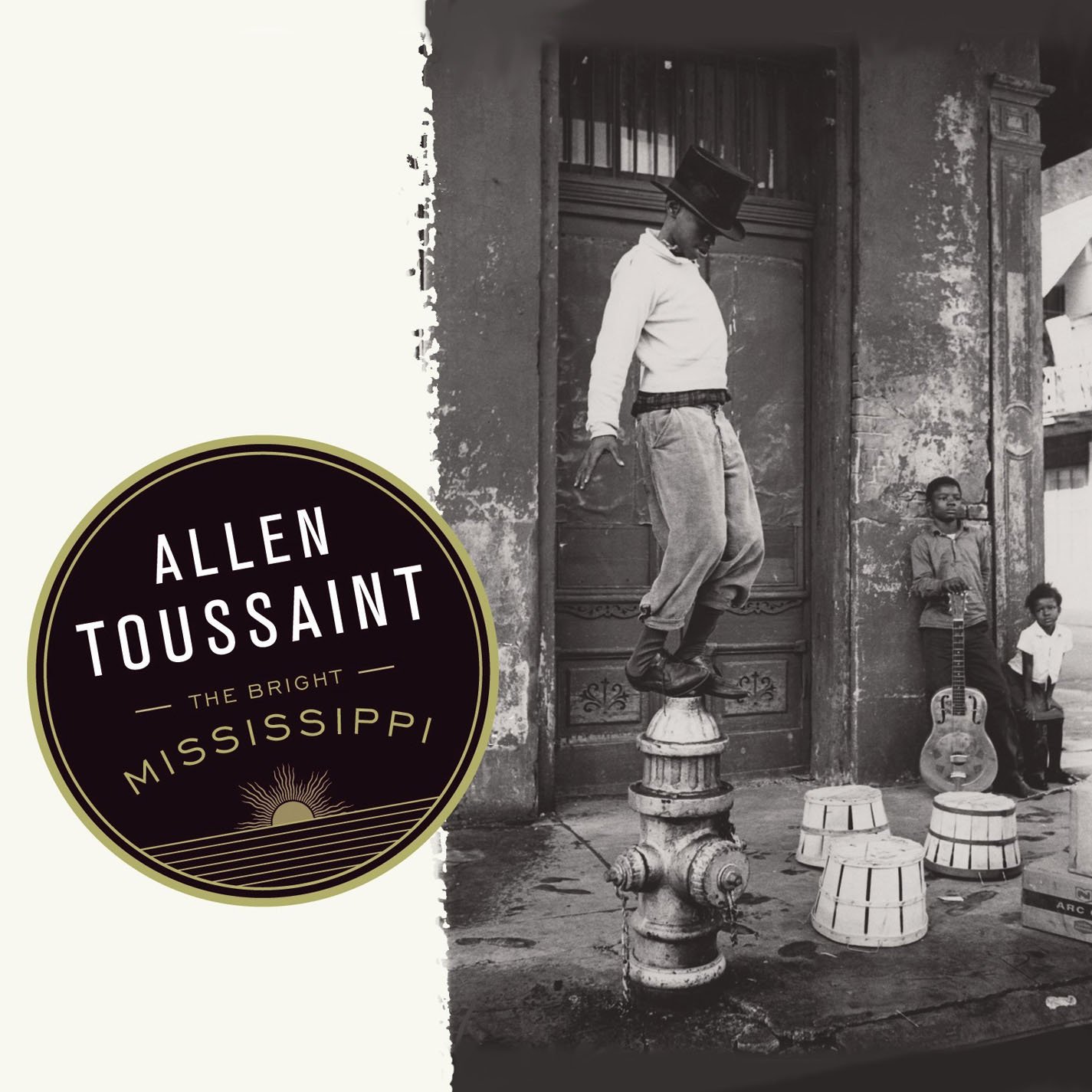
The Bright Mississippi - Allen Toussaint

Provenance: There's three things I am sure of in life; I want my coke to be diet, my football to be catenaccio, and my piano players to come from New Orleans. Just take a look at some of the luminaries to come from the Crescent City - Dr John, Professor Longhair, James Booker, Fats Domino and Allen Toussaint.

When I was in New Orleans (my favourite American city - and the least American city?) I was fortunate enough to catch the Preservation Hall Jazz Band, playing the trad stuff unamplified in a small room. It's rare, I think, to see musicians of that calibre performing without any kind of PA in such an intimate venue; and from the moment they kicked into 'Sheik of Araby' I was captivated.

When I heard that Allen Toussaint had decided to make a jazz album that honoured the legacy of New Orleans I didn't need any more encouragement to go out and buy it.

Review: Sheer, unadulterated joy.

It genuinely feels like a privilege to hear the ensemble of crack musicians Toussaint gathered for this album to perform with such casual virtuosity. What could have been a tired jog through a clutch of musty old standards instead feels like a vital, ebullient celebration of a city and the music to which it is umbilically linked. It's both remarkable that The Bright Mississippi took a mere four days to record, and yet totally believable, as the sound is so organic that one imagines the band all set up in the room together, running through two or three takes and picking the best of the bunch. If there are overdubs to the live sound, my guess is that they are minimal.

From the very first bar of Sidney Bechet's 'Egyptian Fantasy' one can sense magic swirling around, but for me the album really moves into the realms of the sublime during 'St James Infirmary', a song I've heard many different times in various iterations but rarely does it reach such a degree of majesty as it does here. From then on, everything is immaculate - whether it's a sleepy-eyed rendition of 'Winin' Boy Blues' from jazz's ur-pianist Jelly Roll Morton, an iridescent 'Day Dream' (Duke Ellington) or my personal highlight, a languid interpretation of Django Reinhardt's already wonderful 'Blue Drag'. It might even top any version I've ever heard played by the Belgian master.

Every performer on The Bright Mississippi acquits themselves superbly, though I feel special mention should go to both trumpeter Nicholas Payton and clarinettist Don Byron. The contributions they make to each song on which they feature elevate each piece, with Payton playing some especially imaginative solos. However, the name on the CD is Allen Toussaint, and so it's only fair to pay attention to what he's playing.

Fortunately, Toussaint rises to the occasion splendidly. His playing is light and supple, hands moving across the keyboard with the twinkling grace of Fred Astaire in motion. Toussaint rarely elects to bang out big meaty solos, instead accenting his stylish playing with clusters of dancing notes, little trilling figures that complement the more sinuous sounds of the trumpet and liquorice stick (check me out using that hepcat jazz lingo, daddy-o). However, for all his panache Toussaint is also a two-fisted New Orleans piano player, and that generous, wide-open easy-rolling blues sound is given voice on King Oliver's 'West End Blues' and the traditional number 'Just A Closer Walk With Thee'; and I wouldn't want it any other way.

In every sense The Bright Mississippi is a triumph. The sound is such that it almost feels tactile - can you taste that thick Gulf air on your tongue as you luxuriate in the music? Do your eyes prick at a hint of cayenne pepper and onion? It is, of course, illusory; the jumbled symptoms of an imagination stirred by aural stimuli. But goodness me, what stimuli! I find in such situations that it's best just to sit back, pour a measure of something expensive and laissez le bon temps rouler.

Tuesday, 27 March 2018

Night Songs - Cinderella

Provenance: When I was eighteen I went to see Blue Oyster Cult at The Brook in Southampton. I distinctly recall seeing a rather statuesque young lady alone in the crowd, and being both a) a bit cocky and b) entirely oblivious to the notion that she might not want to speak to me, I went over and introduced myself. She was a first-year student at the local university and, as it turned out, welcomed a chat as none of her peers had answered the call to see 'the Cult' live. We talked music, and it turned out she was especially enthused on a band called Cinderella, particularly a chap called Eric Brittingham.

I didn't get anywhere beyond talking about our mutual enjoyment of rock music as I suspect that sharing the same number of syllables in our names was about the only thing I and Mr Brittingham had in common.

Wind the tape forwards a few years and you'll find me sat in my tent checking the schedule at Sweden Rock Festival. Ahoy hoy, what's this? Cinderella playing a late afternoon 'cold beer' slot? Was I going to check them out? Too bloomin' right! And yeah, Cinderella were cool even though Tom Keifer had a goddamn baby voice.

Review: From looks alone one would reflexively lump Cinderella in with the spandex 'n' Aquanet glam metal mob. And indeed, there are certainly a few signifiers of that era present on Night Songs - noise-gated drums, trebly guitars, wailin' vocals. Yet that only tells half the story - because on this album, you can hear the serious intent of solid blues-rock musicians trapped within the glittery carapace of butt-rock dandies.

Unfortunately, this is the album's fatal flaw. Although Night Songs contains some great songs and sterling performances, it is hamstrung by a gauzy production job courtesy of Andy Johns. It's not as if Johns is a bad producer - he helmed the desk on Television's Marquee Moon after all - but I can only conclude that here he was making a misguided attempt to keep up with the zeitgeist. A strange decade, the 1980s; you had albums that sound immaculate - better than anything being produced in the present day (Sade's Diamond Life, Donald Fagen's The Nightfly, hell let's thrown ABC's Lexicon of Love into the mix too) - but for every bejewelled wonder you also had about three albums that sound like a clutch of synthesizers rattling around the bottom of a shipping container.

The good news is that the rather enervated production can't hide the quality of tracks like the rambunctious 'Shake Me' ("aaaAAAalll night!") and the monumental 'Nobody's Fool'. It's interesting to note that instead of a shack-shaker to kick off the collection, whoever sequenced Night Songs opted for the moody prowler 'Night Songs', a track very much in the mould of AC/DC's 'Hell's Bells'. A freaking bell even chimes during the intro, and it doesn't escape notice that Keifer is singing in the same range of a certain Brian Johnson of, er, AC/DC; shurely shome coincidensh?

It sags a little in the middle with 'Once Around the Ride' and 'Hell On Wheels', two generic rockers that would've sounded more than passable if they had some balls. Was glam metal one big emasculation fever dream? Lots of castrati-high vocalising and gender-bending raiment all in the service of men aggressively asserting their masculinity via some of the most sexist lyrics ever yelped into a microphone? I don't know where I'm going with this.

If you aren't disposed to like either heavy rock or freeze-dried production jobs you're not going to find Night Songs particularly palatable, but you might be able to look past its obvious faults and glimpse the promise of something quite wonderful. Also, when I mentioned 'blues-rock' in the fourth paragraph, I am of course talking about blues rock in its whitest iteration; there's nary a whiff of the Mississippi Delta about Night Songs. But an album that burns down the home stretch with pulsing dandruff-looseners like 'Somebody Save Me', 'In From the Outside' and the mighty 'Push Push' deserves respect. Good stuff all in all, but Eric Brittingham can do one.

Sunday, 18 March 2018

Helen's favourite songs - part two

Last time out I rather optimistically said that they'd be a regular review or two between part one of this round up and the following installation. That was before I went away to Germany, came back and got lazy. However, a good session with the new Judas Priest album (Firepower, it's magnificent) helped me to regain my mojo and so here are five more of my friend Helen's favourite songs.

I Left My Heart In San Francisco - Tony Bennett


Going by the first five songs, and now this one, I feel Helen has a real affinity for the bittersweet side of life. Languid yet impassioned, '...San Francisco' is a perfect example of Tony Bennett's immaculate, effortless style. Starting off small and perhaps even intimate, the song crescendoes into a widescreen celebration of the city; you can almost picture the fireworks popping over the horizon as Bennett finishes up. This subgenre of jazz has never really been my thing at all, but this is enjoyable and eminently listenable.

Kiss Me - New Found Glory


Ah, now this is strange. As opposed to most of the picks that Helen and I swapped, this is one I remember contemporaneously. I must admit to having very ambivalent feelings around the whole latter day pop-punk scene. On the one hand, lots of my friends were big into it, and it was agreeably rackety. On the other, I didn't like its bland chugging efficiency, inclusive of instrumentation and singing. Nevertheless, this is a pretty fun rendition of the Sixpence None The Richer track, melodically faithful but with an alt-rock breakdown or two thrown in to placate the moshpit. Eh, not my favourite.

Pull Shapes - The Pipettes


The Pipettes - hitherto, my familiarity with them extended purely to their existence, which is to say, I don't recall ever hearing a note of their music. Coincidence is a funny thing, however, and it was only recently that I read an article in the Guardian about member Gwenno Saunders, who has been releasing music in the Welsh and Cornish languages. Colour me intrigued. What an odd song! It falls somewhere between the Ronettes and Steps! I'm rather smitten with how quirky and guileless it is, and in spirit it does seem to be recovering some of that bubblegum naivete of the best 1960s pop. I do find the modern production a bit stifling for what should be a riot of jubilance, but perhaps the marriage of the two period is the point? Maybe I should just shut my mouth, eh?

Don't Worry Baby - The Beach Boys


Now for an echt 1960s experience, the Beach Boys! This is glorious. As someone who has listened to a lot of this kind of music, I can tell you that absolutely nothing about this song comes as a surprise. You can almost anticipate the chord changes, and even the melody, before you've heard the song. It dips into plaintive longing when you expect it to, it soars with a kind of serene radiance when you expect it to. So what? When it's done this beautifully, so what? The different voices weave in and out of each other like spring butterflies. The Beach Boys were, for me, the epitome of post doo-wop, pre-Beatles pop-making, and aside from dorky numbers about being cool to your school, you can stick a pin in their catalogue from around this time and alight upon a gem. This song clouds the eyes and slows the heart, so why wouldn't it be on a 'best of' list somewhere? I kiss each fingertip in turn!

Stand By Me - Ben E King


I don't really feel any requirement to talk about this. It is perfection writ large, the gold standard of popular soul. It exists in the stratosphere, breathing the same thin air as 'I Heard It Through the Grapevine', 'Respect', 'My Girl' and others of that calibre. The bass riff that introduces the song is immediately recognisable, and instantly hummable. Instead of winding up throughout the track, King bites down on the first lyric, managing to tread a path that both manages to be imperious and yearning at the same time. Speaking of the lyrics, they are both simple and yet universal, underscored by strong images of a faintly apocalyptic nature. But the malt-shop eschatology doesn't sound hokey; it only serves to provide a backbone to the ardour professed by King. Three minutes that will leave you staggered.

That was fun! I would like to finish up with a few final thoughts. Ultimately, although we gave critical appraisals of each other's lists, there was a shared sense that the exercise went beyond merely talking about music. Indeed, I felt a little bit exposed, because whilst I'm happy talking about music, to say 'these are my ten favourite songs' can be quite an intimate thing to reveal. When I was younger, a mixtape was both a gift to someone who had feelings for but also both a shorthand way of demonstrating good taste and a discrete way of hinting that, perhaps, still waters run deep. As it so happened, we did indulge in a bit of cod-psychology; I found Helen's list to have a seam of melancholy running through much of it, whilst she identified a very off-brand sexiness to a few of my picks. Helen's feedback, incidentally, was both thoughtful and insightful; I should also add she has a great ear for music she's not necessarily familiar with. I'm glad we did this.

Anyway, back to talking about some overheated guitar crap next time out!

Sunday, 25 February 2018

Helen's favourite songs - part one

I imagine that we've all been asked for our top five - or ten - favourite songs at one point or another. It's a fun, twisty little question that allows you to reveal something about yourself by degrees. It's also one that I associate with my younger days, simply because I haven't been asked that question for years. That is, until my friend Helen put it to me this week.

Although we have convergent tastes in the realm of rock 'n' roll and 1960s pop, Helen and I seemingly differ on a whole lot. So, in order to really dig into what tickles each other's vental tegmental areas we swapped our favourite five (soon expanded to ten) songs and agreed to listen to them critically. Now, we all know that ten 'favourite' songs is an impossibility, as environment, mindset and memory all come to bear on making one's choices. Nevertheless, a selection of ten or so well-regarded songs is, in my estimation, more than a glimpse through the window to a person's soul - so without further ado, here are the first five tracks Helen chose, and my commentary.


Smile - Nat King Cole


I was more familiar with this song's backstory - that the music was written by Charlie Chaplin, and it was one of Michael Jackson's favourites - than the tune itself. The first thing to say is that it is the perfect match for Nat King Cole's effortless crooning, his warm, sad voice perfectly matching the bittersweet lyrics. In that sense, 'Smile' is a triumph - the concept being matched exquisitely by its execution.

To modern ears the instrumentation might sound a bit slushy, but to me it evokes a golden age where it was commonplace for three-minute pop to be treated with the utmost care and respect. So strings swell, woodwinds trill and swoon and a drummer brushes away unobtrusively in the back, providing Cole with a lush backdrop for his inimitable baritone. Sumptuous.

You Don't Know Me - Ray Charles


On to the second song of Helen's selection, and there are similarities with 'Smile' inasmuch as it features yet more baroque orchestration, this time with the addition of a mixed-voice choir. An unhurried torch song, 'You Don't Know Me' is distinguished from Cole's song by the vocal delivery. Where Cole's voice, untutored as it was, nevertheless came from the jazz clubs, Charles' vocals went to church (NB: it's never that simple though, is it? Cole's father was a Baptist minister).

As with much of Charles' oeuvre, that standout element of 'You Don't Know Me' is the barely restrained passion in the delivery of the lyrics. Despite being written by outside writers, the way Charles is able to get inside the viscera of the song is a minor marvel in itself.

George On My Mind - Ray Charles


Wow - even better than the other Ray Charles song in this list. It's one of those tracks, like those cut by Brooke Benton, Glenn Campbell and latterly Tony Joe White, that feel so big and widescreen that you're surprised to find it's only three or four minutes long.

That easy roll of the piano, the way he switches moves between major and relative minor keys, the vocals cracking with emotion - let's just say this is how the big boys do it. The string arrangement in 'George On My Mind' is something else too, intricate without being fussy, blossoming in peaks of high emotion one moment, dying down to allow the piano to breathe in the next. Pop music has rarely sounded this sophisticated since.

Runaround Sue - Dion


If your hearing faculuties are fine and you don't like this crackerjack my suspicions are that you don't possess a pulse. It's got all the stuff I like - five fucking chords, saxophone squalling away in the background, backing vocals that take a cue from doo-wop and a guy that knows how to belt it out. Helen called this a 'slut-shaming classic' half-jokingly, and I imagine if it were released today there'd be an article on medium.com within five minutes decrying it as 'problematic'.

I don't care. Songs like 'Runaround Sue' form one of the main arterial routes away from the beating heart of rock 'n' roll; the smoother, citified version hustled away from its southron birthplace by a bunch of inner-city punk Italian kids. It's an absolute gas. The opening lines speak of a story "sad but true", but nothing sounds further from the truth, given the sheer, giddy ecstasy of its delivery. 'Runaround Sue' is scintillating. 

Breaking Up Is Hard To Do - Neil Sedaka


Oh, I know this one! Yeah, this is cool. 'Breaking Up Is Hard To Do' adheres to a template for a certain kind of song produced during this era - speed it up and there's 'The Night Has a Thousand Eyes' by Bobby Vee, slow it down and beef up the strings and there's Gene Pitney's 'Something's Gotten Hold Of My Heart'. Like 'Runaround Sue', 'Breaking Up...' glories in a doo-wop schooled backing vocal that's every bit as irresistible as it is moronic. The handclaps that accentuate the rhythm are delicious, and herald the latter-day self-conscious bubblegum of a song like 'Sugar, Sugar' by the Archies.

For all the crushing heaviness of Electric Wizard or Sleep, I'm never not going to be a sucker for the unadulterated head-rush of 1960s pop music. I can see why 'Breaking Up...' would be on a list of favourites - it does nothing particularly brilliantly, and does it brilliantly. There's a strange kind of virtuosity in turning out a song so simple and yet so addictive. If this is the musical equivalent of junk food, I want to gorge until I get a coronary.

Well, that's the first five! I'll probably do another album review or two before I tackle the second half of Helen's selections. I've enjoyed this so far, and I look forward to - let me just get my phone out - New Found Glory and, er, McFly, amongst others!