Showing posts with label zz top. Show all posts

Wednesday, 29 December 2021

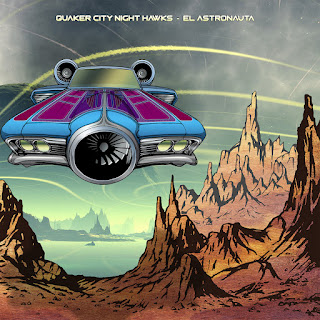
El Astronauta - Quaker City Night Hawks


Provenance: A Christmas present from my partner! Who, in turn, heard Quaker City Night Hawks on Spotify and thought that I'd enjoy what they had to offer. Let's see...

Review: Despite providing me with one of the most underwhelming live experiences of my life, I remain staunch in my love of ZZ Top. Every era had something to sink one's teeth into, whether it was their early psychedelic rhythm 'n' blues, the world-conquering techno-boogie most people are familiar with or even their greasy latter day scuzz-rock. I am one of the faithful where the Church of ZZ Top are concerned - and so, it seems, are Quaker City Night Hawks.

Like the boys with the beards, QCNH are unabashedly Texan, with songs that tell of oil fields and goin' down Mexico way. Then there's the title of the album itself, El Astronauta, taking its cues from Tex-Mex Top nomenclature such as Tres Hombres, Deguello and Mescalero (a naming convention that was never adhered to rigidly, though Billy F Gibbons has more than once suggested that their eighth album might be reconsidered as El Iminator, the sly old dog!). But most of all, the kinship is there in the boogie, swagger and desert-fried weirdness that both bands revel in.

After some roaring numbers to start the album - 'Liberty Bell 7' being a particular favourite - things start to get a little spacey on 'Something To Burn', a slow funk jam laced with a spooky vocals and soulful electric piano. Changing pace again, 'Beat The Machine' is up-tempo acoustic rock that could almost be described as summery, reminiscent of the cruisin' good-time tracks that peppered the albums of another Texan, Edgar Winter (when he wasn't laying the smack down over gnarly riffs with his saxophone, natch).

In fact, over the course of thirty-seven minutes 'n' change, there's a nice variety within the QCNH sound - from the more stoner-influenced stuff like 'Mockingbird', 'Good Evening' and 'Medicine Man' through to the toe-tap shuffle of 'Duendes' or the atmospheric Rio Grande mindbender 'The Last Great Audit', plus the aforementioned switches in gear. Also keeping things interesting are the little filigree touches throughout, whether it's a burble of weird synth here or a glissando of prepared piano there; clearly this is a band with an expansive vision for how rock music can sound. For a moment I thought my speakers would implode at the finale of 'The Last Great Audit', which is of course very satisfying.

It's rare that I review an album on the first pass, but fortunately there's an immediacy and vibrancy to El Astronauta that gives me confidence to scribble down some thoughts. Fortunately, QCNH have produced something that I'll be spinning again and again - and maybe I'll be moved to revise my opinions in the future? Hey, this is the internet, and this is my blog, I can do what I like. For now, though, I'm more than happy with this festive treat and I'll certainly be delving deeper into the Quaker City Night Hawks catalogue. 

Sunday, 15 November 2020

La Futura - ZZ Top


Provenance: By the time I wound up getting this album I was already a hardcore ZZ Top fan. Big into the albums and a few years away from being thoroughly disappointed by a lacklustre live performance at Wembley Arena.

(The Wembley gig, which I attended with my friend Sandy, sucked. The Arena a bit of a pain to get to on public transport, isn't it? Once there, I went through a screening process more rigorous than at most international airports and then spent £14 on two beers.

Jimmy Barnes from Cold Chisel was the support act, and although his ragged bellowing was fun for a while, he failed to do 'Seven Days', his best solo track. ZZ Top were worse; Billy Gibbons can move about but can't sing, whilst Dusty Hill can sing but can barely move.

After little over an hour, including covers of 'Sixteen Tons' and 'Jailhouse Rock' - a song that nobody ever needs to cover, ever again - the Top shuffled off stage and the lights came on. Sandy hoped that the second half would be better, but it was clear to me that they'd stuck a fork in it. Sixty-five, seventy minutes at a push? Eye-watering ticket prices and untold hassle? Cheers guys. Frustrated, we headed to the much-missed Big Red bar, saw a cracking metal act for free, and were able to get a pint under a fiver.)

Review: I don't know what everybody else was expecting from ZZ Top in 2012 but kicking off La Futura with a cover of a 1989 Houston hip-hop track possibly wasn't one of them. Yet ZZ Top have never been afraid to go off-piste, from individual oddities such as 'Manic Mechanic' from Deguello right the way through to fusing synthesizers and drum machines with southern boogie, practically inventing their own genre with Eliminator. So repurposing DJ DMD and the Inner Soul Clique's '25 Lighters' into 'I Gotsa Get Paid' - a nice nod to 'Just Got Paid', no? - shouldn't really set any eyebrows heading north. 

In fact, if one wasn't aware of its background, you'd just think it was another great raging slab of ZZ Top's smoke 'n' chrome hard rock that's been their hallmark since Rhythmeen. Crucially, both 'I Gotsa Get Paid' and the chugging blueser 'Chartreuse', tracks uno y dos, are simply better than anything from previous album Mescalero; an album that had its charms, not least the preponderance of Spanglish in the lyrics, but was ultimately too sprawling, flabby and unfocused for its own good.

Here, though, ZZ Top have enlisted Rick Rubin, which means two things - no excess, and a back-to-basics sound. So, aside from a few guitar overdubs, what one hears on La Futura is the basic rock combo formula of guitar, bass, drums and voice. There's the odd extra flourish here and there - the rather ponderous ballad 'Over You' fleshes out its sound with a much needed keyboard, for example - but insofar as these elements are used sparingly, it's a strikingly similar setup to that of ZZ Top's best album, Tres Hombres.

Accommodations have been made for time passed, however. Billy Gibbons, one of the more instantly recognisable guitarists out there, plays with gusto in that choppy, greasy style that makes ZZ Top records so goddamn fun, but he's quite obviously close-mic'd to allow for deficiencies in the voice department. But it's good! In fact, the additional sandpaper to a voice already coloured with road rash makes everything sound ten percent meaner and sleazier than would otherwise be the case. Sticking with performances, my only real bugbear is that Frank Beard still demonstrates some tasty stick work but it's nowhere near as creative as the rhythms he was banging out before Eliminator. Go back and give those old platters a spin and you'll hear some chewy, fiddly drum figures. Beard was (is?) a superb drummer with a great pocket feel. On La Futura the latter is in evidence, but it lacks finesse.

(I remember playing 'Just Got Paid' with my former band, and easily the most taxing aspect of recreating the feel of the original was getting the drum pattern right. Fortunately, that's nothing to do with me, guv!)

If one or two numbers can be a bit samey - just how many times can you chop and change the blues? - it's alright, there's enough variety elsewhere to maintain interest, and at a hair under forty minutes La Futura is well-paced. I was surprised a couple of times - 'Flying' High' had an almost power-pop feel to it, and the best track was a little unexpected. I've often been underwhelmed when ZZ Top slow things down, yet the molasses-crawl of 'It's Too Easy Manana' possesses an authoritative, anthemic quality and one of the more characterful vocal deliveries on the joint. Mescalero was rotten with these songs, which, when coupled with its hour plus run time, dragged the thing into a swamp. Here, the two strollers act as welcome interludes.

All things said and done, La Futura isn't going to cause ships to capsize, but it's a very good addition to the ZZ Top canon. Stripping back their sound exposes the dirty innards of the engine, and they sound all the better for doing so; I don't think there's a skeevier intro around than the sound of Gibbons' guitar revving up on 'I Don't Wanna Lose, Lose You'. A triumph, then - and certainly more rewarding than the live experience. 

Sunday, 22 March 2020

Texas Flood - Stevie Ray Vaughan

Provenance: Back in the mists of time, long before your Facebooks and Tweet-O-Grams, people did things like collect stuff, get drunk, and attempt to master an instrument. Yes, your humble scribe did some of the former (Panini football stickers, matchboxes) and much of the latter (guitar, a bit of mandolin). As for the drinking? I couldn't possibly say! [Insert winking emoji here.]

My parents very kindly paid for a guitar teacher to do things like point out the wiry bits were called strings, and that it would help if I used both hands. Once basics had been raised to a level of competence, he was keen that I learn to improvise - in essence, to hold enough theory in my head that I was able to react and adapt lead playing, in real-time, to musical structures. A good foundation for this is blues music, which uses the minor pentatonic scale extensively (the bedrock for most rock music) and which often relies on familiar chord progressions.

So, how do you engage a teenage classic rock and metal fanatic with the blues? Give him something suitably rocky and pyrotechnic to aspire towards - and thus, the first blues I ever played was Stevie Ray Vaughan's 'Pride and Joy', which appears on today's album, Texas Flood. I loved it, even the tricksy turnarounds and unfamiliar shuffle feel. Plus it proved to be a watershed moment, as I am now a fully-fledged blues fan; my favourite players are people like Mississippi Fred McDowell and especially the merciless Lightnin' Hopkins, but I'll always retain a soft spot for SRV for providing me with the gateway drug.

Review: Stevie Ray Vaughan came to prominence during the 'blues boom' of the 1980s, which saw the emergence of artists like Robert Cray and the resurrection of others like John Lee Hooker, whose star-studded 1989 album The Healer won a Grammy award. So what was SRV's contribution to the genre? One could argue, nothing new. There are parallels to be drawn between Vaughan and the British guitarist Alvin Lee, who was similarly lionised for his hyperkinetic rhythm 'n' blues playing. An argument could be made that Vaughan was an improvement - defter, more accurate, a better songwriter and, crucially, in possession of a genuine grit 'n' diesel Texas drawl, as opposed to the dorky facsimile that Lee (and, in fairness, many others) tried to conjure up. Unlike Lee, Vaughan didn't stray far from the blues either; yes, he made a cameo on a Bowie album, but his own material was locked down, and when he did interpret the music of others, it was to emphasise its bluesiest elements (his take on Jimi Hendrix's 'Little Wing' being a prime example). There was no meandering into psychedelia with Vaughan, which cannot be said for Alvin Lee and his band Ten Years After.

Let's start off with my own personal bone that requires picking with regards to Texas Flood; 'Pride and Joy' and 'I'm Cryin'' are the same freaking song. I get that the first is celebratory and the latter strikes a more consolatory tone, but dude, write some new music. It's a ten track album that doesn't even top forty minutes and yet here are a couple of 'companion pieces', I guess. A bit of a 'fuck you' to the blues buying public, but I must admit a sneaking respect for this approach. It's like writing a song for your girlfriend, and when she dumps you trying to fit the name of the new squeeze into the melody. Writing the same song for when you're both happy and sad about your partner is, upon reflection, quite an alpha move.

Duplication issues aside, this is a quality slice of 1980s rock-influenced blues. The clean production sound works when recording what is a small combo - Vaughan is backed by bass and drum-mongers Double Trouble throughout - as it brings his ultra-precise lead playing to the fore. Remarkably, for such a polished product I was later to learn that the entirety of Texas Flood was recorded in two days and features no overdubs. Give or take some messing around with the levels, what you're hearing is the live band, it's extraordinarily tight. The vocal performances are fantastic too, and it's boggling to try and comprehend how SRV managed to wring such impassioned performances from both hands and larynx without any need to go back and fix anything.

All the hallmarks of Vaughan's playing are there from the get-go, too; heavy vibrato on bent notes, daggerish little single-fret slides and almost percussive use of double stops. The latter is especially evident on 'Love Struck Baby', a twitchy, fidgety shuffle blues that begins more like the commencement of a boxing bout than a blues song. The most comprehensive displays of SRV's guitar trick-bag are to be found on the instrumentals 'Testify' and Stray-Cats-on-amphetamines rockabilly whirlwind 'Rude Mood', although the dizzying 'Mary Had a Little Lamb' runs them close; and that aforementioned deftness comes to the fore on the closer 'Lenny', another instrumental, in this instance an glimmering, iridescent tribute to Vaughan's partner Lenora Bailey (she thought 'Pride and Joy' had been written for another woman, so SRV wrote her a brand new song - wise man).

And yet.

I can't claim to hold too many original opinions on music; I think my takes on most of these albums resonate with the critic pool at large, albeit not as well written. I do adhere to the odd heresy, like my belief that Neil Young's Trans is misunderstood and ZZ Top's Recycler is not devoid of merit, but by and large I'm reasonably vanilla. Thus, here's my lukewarm take on Texas Flood that anyone familiar with SRV has probably seen ambling over the horizon for a while now - it sacrifices soul at the altar of technical ecstasy.

The problem is probably me and my relation to blues music. When I interrogate my own feelings about Stevie Ray Vaughan and the blues I feel a bit queasy, to say the least; am I like the martinet Ewan MacColl, insistent on "authenticity" above all else? Would I have pulled the plug on Dylan? I've been a good boy, I read Elijah Wald's Escaping the Delta and feel clued up enough not to fall into the authenticity trap (I've written about this before now), so why do I have such a problem with Texas Flood? Is it merely because this is tagged as a blues album, and so I'm bringing a whole mess of expectations to the table that really shouldn't be there? How come I can enjoy the 'newgrass' movement begun in the 1970s (which sought to fuse bluegrass to styles such as jazz - and this has just reminded me to go and listen to some David Grisman Quintet) without my appreciation of bluegrass colouring the experience? Perhaps because my knowledge of bluegrass is dwarfed by what I (think I) know about blues music, and is unencumbered by those strange gatekeeper tendencies that can sometimes evolve alongside a burgeoning personal passion.

Sadly, I must conclude that I'm simply too smart to properly appreciate Stevie Ray Vaughan.

Genuinely, though, I really must stop sorting things into boxes and weighing up their merits accordingly. Because taken at face value, Texas Flood is a rollicking good time. It's an album full of good singing, good playing and lots of whizzy guitar licks, and so in the future I'm going to endeavour to meet the album on these terms alone. Even if 'Pride and Joy' and 'I'm Cryin'' are the same freaking song, goddamn.
Sunday, 3 November 2019

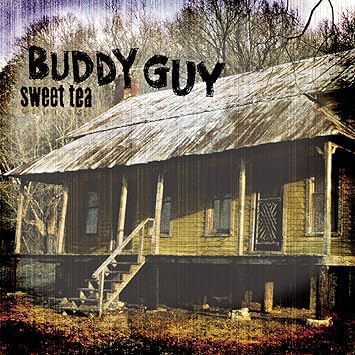
Sweet Tea - Buddy Guy

Provenance: I think anyone with a more than passing interest in the electric blues knows who Buddy Guy is. Still kicking, still playing, with a slew of solo releases and guest appearances to his name, Guy is considered a living legend.

I also have one of the most distant personal connections imaginable. My partner's stepdad's sister married one of Buddy Guy's sons. So, yeah, usual caveats apply when reviewing the work of a close family member.

Review: I pointedly mentioned the electric blues in my introduction, because this is what Guy is most famous for. And on Sweet Tea, fans of his spiky, fluid playing have got more than enough to chew on. Most tracks are over the five minute mark, with 'I Gotta Try You Girl' stretching its legs for well over twelve minutes. You wanna hear some electric guitar, friend? You got it.

So it's strange that the most arresting track on the whole album - the opener, 'Done Got Old' - is a relatively concise three-and-change minutes long, and consists of a close-miked Guy and sparse acoustic guitar. It's a weird song, too - because many of Guy's direct influences would flip their dotage on its head, bragging about their experience or ability to keep up with the youngbloods. Think Muddy Waters with 'Young Fashioned Ways' - "there may be snow up on the mountain, but there's fire down under the hill". 'Done Got Old', however, is a straightforward lament - no braggadocio, machismo or defiance, just a quiet sadness that his body is giving up on him. It's a sombre introduction.

And maybe it's supposed to be the banner that hangs over proceedings, a memento mori to accompany the startlingly vital racket he conjures up on Sweet Tea. 'Baby Please Don't Leave Me' has a title that sounds like a Chess cut from the 1950s, but the clattering drums and skronky overdriven bass makes it sound, early doors, more like a particularly sludgy desert rocker. The guitar riff, when it kicks in, sounds like one of the blues tracks that Led Zeppelin stole, if it was played on high-tensile cables. It's a noise you might expect more from All Them Witches than a guy who literally played with Muddy Waters and Junior Wells.

The highlight of Sweet Tea is 'Stay All Night', another relatively short number. It stalks, it prowls, it rumbles; and a flint-eyed Guy doesn't so much ask for love as commands it. It's down-low and nasty, lower than a snake's belly. At this juncture, I should mention that, aside from the quavering opener, Guy sings wonderfully, with a similarly strained, edgy style as Elmore James, albeit dialled down a notch or two. He was still hitting some impressive high notes at the age most people this side of the Atlantic anticipate receiving free bus passes.

Production is a factor that can make or break a record. As much as I love the bells and whistles approach on albums by the Beatles, Jellyfish, Pink Floyd and other studio cosmonauts, most blues music is served by the KISS maxim; keep it simple, stupid. Going back to Chess, some of those Muddy joints are raw as hell; there's a 1951 cut called 'She Moves Me' where Leonard Chess himself provides inexpert but effective backing on a bass drum to accompany Mud's elastic guitar. Back in the twenty-first century, Dennis Herring has kept some of that magic alive, whilst compensating for advances in technology. You can hear amps humming, snares rattling and the odd clam or two from Guy. It doesn't matter; this is more about capturing a mood and a moment than technical ecstasy (Joe Bonamassa and Kevin Shirley, take note). To these untrained ears, it also sounds like the instrumentals were performed live-in-studio.

The overall effect is very in-your-face, and all the better for it. The guitar isn't overly processed; a dab of echo here and there, but otherwise letting an overdriven tube amp, and of course Guy's expert fingers, do the heavy lifting tone-wise. On 'Tramp', cleaving the old soul classic with an arrangement that sounds like ZZ Top circa the kooky Deguello, Guy bends those strings so aggressively you can hear the muscle and blood through the speaker; the same can be said for the portentous closer 'It's A Jungle Out There'. Meanwhile, on 'Look What All You Got' and 'Who's Been Foolin' You', it sounds like Buddy Guy is fronting Dr Feelgood. It's a genuine pleasure to hear the greatest living exponent of the Chicago blues reminding us all why Clapton, Richards, Beck and the rest bend the knee.

I hear two Kings in the way Guy plays; he's got the pyrotechnic flair of Freddie but hits his bends like Albert (a fellow who, at his best, sounded like he was bending the very molecules of existence). There's something else there, though - a simmering malevolence that gives his every solo or interpolation that bit more bite and excitement. Perhaps 'Done Got Old' was a trickster move, a little juke to throw us off guard before proving, over and over, that he's still got the fire burning down below.

Sunday, 21 January 2018

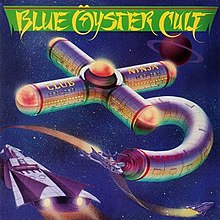
Club Ninja - Blue Oyster Cult

Provenance: I'm one of the biggest Blue Oyster Cult fans under pensionable age in the UK. I've got all the albums, hit up their shows, and I even used to pester them via email.

NB - this is my second BOC review and I feel I've hardly touched my music collection. However, if I did a different band every week, by the end I'll just be down to a rotation of Blue Oyster Cult / Steely Dan / Tom Waits (no bad thing, right?). For the sake of variety, I'll be sprinkling in the 'big boys' from now on, so you might get two or three BOC reviews before you encounter Atomic Rooster or Electric Wizard. Lucky you.

Review: In this guy's opinion the classic era of Blue Oyster Cult stretches from their self-titled debut (1972) through to Spectres (1977). One could therefore surmise, on that basis alone, that the 1985 album Club Ninja is not a classic - and one would be correct in doing so. However, just because a band is no longer in their pomp doesn't necessarily mean they aren't capable of pulling out the stops - witness Ratt in 2010 with Infestation, Cheap Trick's clutch of post-2005 releases or even Bob Dylan's sublime Love and Theft and Modern Times releases. Hell, I'd settle is this was Blue Oyster Cult's Get A Grip.

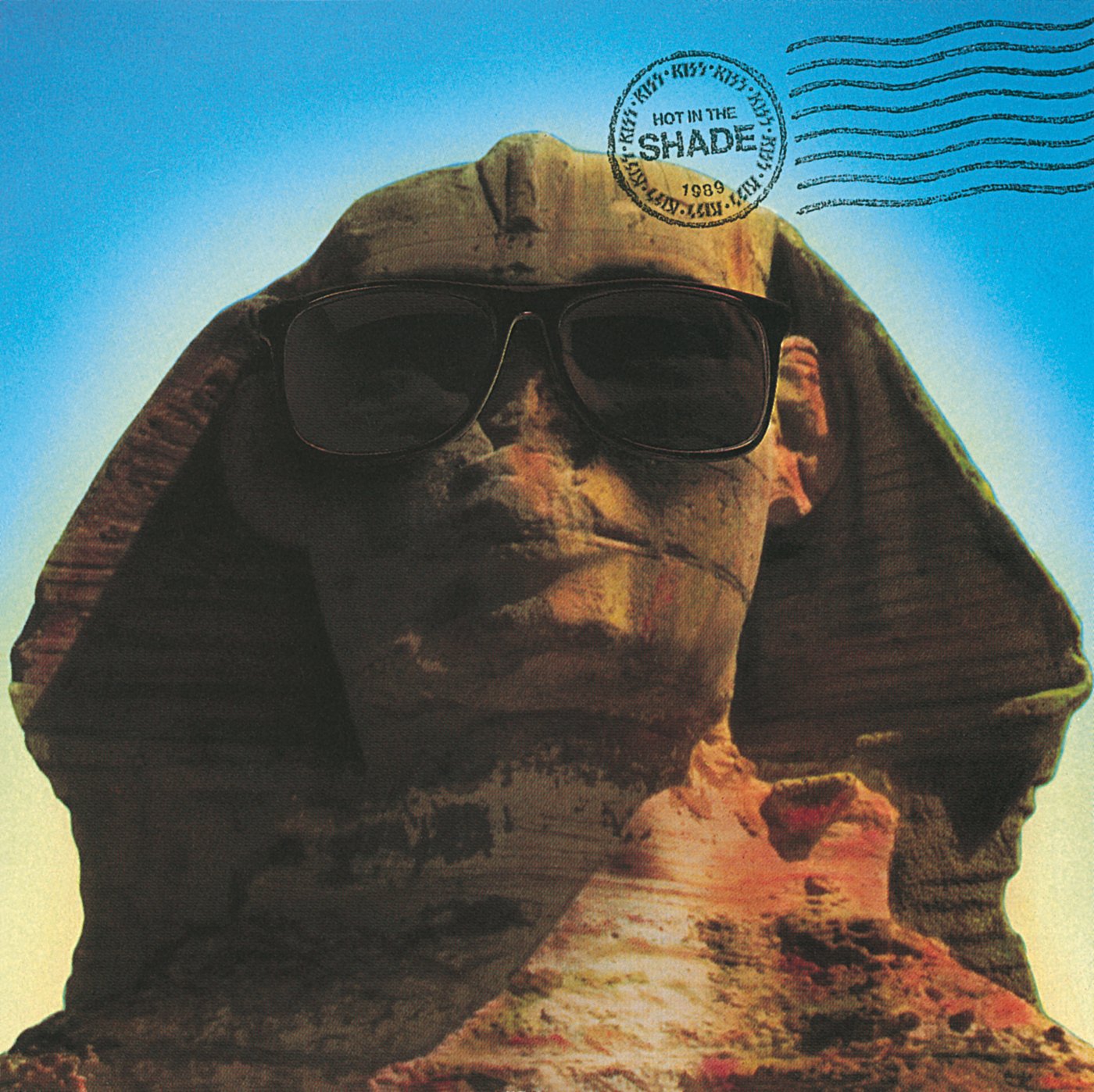
Well, Get A Grip it ain't. As was the case with last week's Hot In The Shade, Club Ninja features awful cover art, compounded by an absolutely dire name. [Adopting Jerry Seinfeld voice] And what's the deal with ninjas anyway? There was, of course, the execrable Michael Dudikoff vehicle American Ninja, a Cannon Films release from the same year as Club Ninja. You've got the Teenage Mutant Ninja Turtles, who made their first comic book appearance in 1984. The geekiest explanation involves the track 'Shadow Warrior', which doesn't mention ninjas explicitly but was co-written by thriller / fantasy novelist Eric Van Lustbader, who did write a 1980 novel called The Ninja. Your guess is as good as mine.

Another common factor with Hot In The Shade is songwriter Bob Halligan Jr. He wrote some cool stuff for Judas Priest like 'Take These Chains' and 'Some Heads Are Gonna Roll'. On his one outing with Kiss he penned 'Rise To It' (the song where Paul Stanley brags about maintaining an erection) and the crapfest 'Read My Body'. Here he's responsible for similarly cerebral cuts such as 'Make Rock Not War' and 'Beat 'Em Up'. Halligan now plays in a band who advertise themselves as a fusion of rock, Celtic and contemporary Christian music.

By this point in time BOC had sloughed off original members Albert Bouchard (drums / vocals) and Allen Lanier (keyboard / guitars), and had also long abandoned their creepy psychedelic proto-metal in favour of a more 'commercial' synth rock sound. Given all that Club Ninja is, in places - frustratingly - quite good. However, those two or three inspired tracks can't make up for the remainder on offer here, because when Club Ninja is bad, it's horrible. Brutally, irredeemably horrible.

The album starts promisingly enough, with Eric Bloom delivering a delightfully hammy vocal performance on the propulsive 'White Flags'. Buck Dharma (both an underrated guitarist and singer) is up next on 'Dancin' In The Ruins', which if anything is even better. I should point out that anything that works on Club Ninja does so either because of the music or the conviction of the vocal performances, because the lyrics are uniformly bobbins. The only track that gets close to resembling the golden years of Blue Oyster Cult is the sumptuous, shimmering 'Perfect Water', once again sung by Dharma, who also brings some questing guitar work to the table. These songs are really, really decent and could quite easily feature on 'best of' compilations without appearing out of place.

The rest, alas, is drivel. The aforementioned 'Make Rock Not War' and 'Beat 'Em Up' are as boneheaded and uninspired as the titles suggest. 'Spy In the House of the Night' has a stadium-sized chorus and a kicky riff to commend it, but that's about it. The final three tracks - 'When the War Comes', 'Shadow Warrior' and 'Madness To the Method' - all exist within a lacuna of their own; competently played, slickly produced but otherwise devoid of anything interesting. One exception - Dharma's guitar solo on 'When the War Comes' is much better than the track deserves. It's a song that floats by without leaving a mark, despite a voice-over from shock-jock Howard Stern (who was, I believe, married to Eric Bloom's cousin at the time) and, unaccountably, lifting the 'ooga-chu-ka' chant from Blue Swede's version of 'Hooked On A Feeling'. That sounds like something you'd want to be hepped to, right? Be my guest.

There's also not enough Joe Bouchard on this album. One of the defining elements that made Blue Oyster Cult brilliant was the interplay between the Bouchard brothers, Joe's freewheeling bass weaving around Albert's skittering jazz-influenced drumming. Jimmy Wilcox, the drummer on this album, played it straight, giving Joe little room for manoeuvre. And he's given, what, half a song to sing? Screw that. Joe Bouchard is a good dude, not least because he gave me an interview for my school magazine back in 2002 and answered all my dumbass questions with grace and patience. Did I really imply he might've been a Nazi sympathiser? Jeez Louise.

To sum up - Club Ninja was not the disaster it's sometimes made out to be. Indeed, Blue Oyster Cult followed a trend of 70s bands trying to update their sound to stay relevant. The gold standard for this approach will always be ZZ Top's Eliminator, which worked only due to the rarest of alchemy. Instead, this represented the terminus point of BOC's slide towards anonymity - where once they were the 'red and the black', now they were the dull and the bland. At least this didn't represent the end of their story...

Thursday, 11 January 2018

Hot In The Shade - Kiss

Provenance: Another piece of shit I paid a quid or two for.

Review: This is rancid even by Kiss' standards. No mucking around this week with some convoluted preamble about how Bruce Kulick got me dumped or whatever, I'm going straight in on this abomination. I realise now that at the time I should've taken one look at that dorky sphinx and spent my money on a can of Pepsi.

I've been suckered by Kiss before now. I got their Double Platinum greatest hits collection as a teenager, which is bulging with catchy, if clunky, nuggets of escapist rock 'n' roll. A band that can come up with glorious trainwrecks like 'Detroit Rock City' and 'Black Diamond' had to be worth a deeper dive, right?

Eh, perhaps not. Certainly not, on the basis of Hot In The Shade (ooh, look, when you make an acronym of the title it spells 'hits' - clever boys! It's also an anagram of 'shit').

Now, even thought Hot In The Shade is an absolute goat rodeo for the most part, there are a couple of songs that aren't as unlistenable as the rest. The opener - 'Rise To It' - is serviceable single-entendre stadium fodder (the gag is that Paul Stanley can maintain an erection) and 'Hide Your Heart' is a hysterical slice of melodrama with a lyric that would embarrass a pre-verbal child, but gets by on conviction and a chorus. That's it. And those are tracks number one and three on a fifteen song slalom down Mt. Shitass. It's January, I've got the heating on low but this album has got me sweating like I'm allergic to it.

Speed up the opening riff to 'Black Diamond', tack on a terrible chorus and complain about paying taxes and you've got the essence of 'Betrayed'. I suppose it would be passable if you've never heard rock music before, or indeed, any music, ever. Try to imagine a song considered too dumb for ZZ Top's Recycler but have Gene Simmons sing it instead, and voila! You've conjured up 'Prisoner of Love'. Can it get worse? Yes. If you've ever wondered what Kiss what sound like if they did a cover of Def Leppard's 'Pour Some Sugar On Me', but somehow made that wretched ditty even more pathetic, then look no further than 'Read My Body'.

It goes on. Hitherto I've been running down the tracks in order, but really once you're past the relative highlight of 'Hide Your Heart' you can pick a song at random and I guarantee you that it'll be so bad that you will feel your IQ dropping in real time. 'Boomerang'? 'Cadillac Dreams'? 'Somewhere Between Heaven and Hell'? 'The Street Giveth and the Street Taketh Away' (yes, really)? This is the kind of music that drives people otherwise disposed towards guitar or drums to rediscover the lost art of mime.

It's not as if Kiss ever did anything revolutionary in their career - musically speaking, that is. 'I Was Made For Loving You' was a bit of a curio as a disco-rock fusion that actually works, but the real genius of Kiss lay in their onstage presentation and the way this was subsequently monetised. Chalk that up to the naked avarice of Gene Simmons and the sheer bloody-mindedness of Paul Stanley, the combination of which ensures Kiss chug on profitably to this day. Yet even though their paleo-rock of the 1970s was derivative and silly, it was distinctive. Probably the biggest crime of Hot In The Shade is that Kiss stopped playing Kiss songs and instead churned out bad parodies of songs whose formulae had proved successful for other bands. I've already mentioned Def Leppard and ZZ Top, but 'Love's A Slap In The Face' could be a Ratt outtake and 'Forever' is, ahem, "inspired" by Cheap Trick's 'The Flame'.

Alright, I've had enough. If I'm going to be charitable, I didn't cringe too much at 'Little Caesar' and whilst 'Silver Spoon' is mostly bobbins I cracked a smile at the "whoa-oh-a-whoah" chorus. If earlier in the decade (Hot In The Shade came out in 1989) Kiss revived flagging interest in their career by unmasking, this is the album that should've seen them committed to a witness protection scheme.  Hot In The Shade saw Kiss trying to play catch-up with the hairspray crowd - a mob that they could legitimately claim to have inspired - and failing miserably, depressingly. Alice Cooper pulled off this ruse (and pretty much everything else, come to think of it) much better. Utterly charmless.

Wednesday, 5 October 2016

Recycler - ZZ Top

Provenance: When I was in my teens my mum worked in a local library. Every now and again she would bring home a cassette tape that had been removed from the collections because they had some minor damage (but were otherwise listenable). One such tape was ZZ Top's 1990 album Recycler, and if I recall correctly there was a second or two worth of 'Burger Man' that had been chewed up. I found this tolerable.

Review: This is a peculiar one, because I find Recycler - as a collection of music - to be a mildly entertaining rock album. However, in a wider context, this could be the madeleine cake of my mid-teen years - a time where I played football everyday, played computer games with friends whilst sat on inflatable chairs and dreamed of one day being able to play '20th Century Boy' on guitar. Recycler may be a strange avatar for a very happy time of my life, but it's impossible to divorce the music from the moment, so attempting anything like a fair-handed stab at a review is unlikely.

A constant and welcome part of my life at the time was my pal Chris, who lived down the road from me. We walked home from school together, played in the same Sunday league side, and would watch WWF wrestling - followed by VH1's rock show - round his place on a Friday night. I'm dragging Chris into discussion of this album, because at the time he was probably the world's biggest Metallica fan, a band I can't help but think of when considering where ZZ Top were in their career when Recycler was released.

Firstly, ZZ Top and Metallica both enjoyed early acclaim with distinctive genre albums - Tres Hombres and Deguello for the former, Kill 'Em All, Ride the Lightning and Master of Puppets for the latter. Both then made a big play for commercial success with idiosyncratic and innovative-sounding albums that alienated the hardcore but scored big on sales - Eliminator for the Top, Metallica for, well, take a guess. On that basis, in terms of popularity and career trajectory, Recycler is ZZ Top's Reload. Even the names are faint echoes of each other. But is that fair?

On the one hand, Reload doesn't contain anything like one of my top five Metallica songs, but I'm an absolute sucker for Recycler's lead-off, 'Concrete And Steel'. As a statement of intent, it's a doozy - slabs of guitar, throbbing bass and a fat, chunky sound, the aural equivalent of a coal-rolling monster truck. And it's not that 'Lovething', the next song, is too bad either, probably because its electro-chug hasn't quite worn out its welcome. Unfortunately, that can't be said for succeeding tracks, with ZZ Top wedded to the sequencer to such an extent that you're dying for some kind of rhythmic variation. It's a straight four to the floor, mostly mid-paced (yes, they speed it up! And slow it down!) and devoid of any frills or, indeed, fills. I'm not expecting a polka or what-have-you, but would it have killed them to have done something in shuffle time?

The overall effect is that Recycler becomes a bit of a trudge. With such little variation in either conception or execution, I find that an album central to my formative years is inescapably, and regrettably, a bit boring. Yet I played the shit out of this.

There are tantalising glimpses of an album that is much better than the Recycler that saw the light of day. 'My Head's In Mississippi' is a nasty boogie pitched somewhere between George Thorogood's 'Bad To The Bone' and ZZ Top's own 'Tush', but lacks both the dirt and vitality that drive those two - superior - precursors. 'Burger Man' bounces along nicely enough but is full of lazy, crap innuendoes neither inventive or weird enough by ZZ Top's standards to pass muster. '2000 Blues' sounds like another run at the formula that worked on Eliminator's 'I Need You Tonight'. Again, whereas the earlier track was a slow-burn, neon-flecked ode replete with sadness and regret, '2000 Blues' is just a slow song featuring some Miami Vice blues-bends.

At least the album finishes on a high - we're at 'Doubleback', and it sounds like the guys have snapped out of a collective bout of somnambulism. It's the cousin to 'Concrete And Steel', and has a real humdinger of a chorus, even if it doesn't quite carry the same heft. However, common with all the tracks on Recycler, is that there's not a single memorable Billy Gibbons guitar solo. Gibbons is one of my favourite stylists on the six-string and, especially during the 1970s, would squeeze out some of the smuttiest, sleaziest sounding lead breaks. He had the best guitar tone, too. The best. Here, it's dulled, processed, covered up with whizzbangs and altogether too mannered for it's own good. This element of the music alone stands as an avatar for my wider impressions, which is that Recycler represents both a missed opportunity and an inability to exploit what made ZZ Top so damn listenable in the first place.

Still a hundred times better than Reload though.