Showing posts with label dr feelgood. Show all posts

Sunday, 28 November 2021

Hoodoo Man Blues - Junior Wells


Provenance: I'm still chugging through my Toronto thrift store purchases.

Review: As a long-time blues aficionado this album should be catnip, putting the spotlight on estimable harmonica-jockey Junior Wells, and featuring my close relative Buddy Guy as a sideman.

I have had more than one friend complain that blues music doesn't feature enough variety to hold the attention, and I can grok that. Formally, most blues music (with notable exceptions) follows a few set templates in terms of chord progressions, scales and even subject matter. How many times have you heard trains a-rollin' or a woman stepping out on her man?

That being the case, I think one of the keys to creating memorable blues music is the way you play the damn thing. Muddy Waters imbued his with an irresistibly sly boastfulness, Freddie King aimed for the bleachers with buzzsaw guitar soloing and Howlin' Wolf sounded like a one-man demolition team; seriously, his opening cry to 'Smokestack Lightning' sounds like a cave-in at a coal mine. Like any pursuit with a set of rules to be observed, the joy can be found in the manner with which the game is played, or subverted. 

So now we come to Hoodoo Man Blues, the first solo album credited to Junior Wells. Already a veteran sideman, having replaced Little Walter in Muddy Waters' band in the 1950s, Wells assembled a crack band in an attempt to recreate the hot sound of an electric Chicago blues band. In doing so, he birthed a masterpiece, echoes of which could be heard in popular music for decades to come.

Firstly, it must be said that Wells is not the greatest vocalist around; he's probably not even the best singer in the band (that accolade, aka 'The Michael Anthony Award', going to Buddy Guy); but he was no slouch on the blues harp. It's a testament to the supreme level of musicianship that the whole confection was recorded in two days, and that takes into account amplifier issues that led Guy to playing some of his guitar parts through a Leslie organ speaker. Can you imagine that happening today? Ain't it wild that some bands, not too further down the line, would spend a week in the studio trying to capture a decent snare sound only to release a load of old pony?

As a consequence, Hoodoo Man Blues has an electrifying live sound to it. Stylistically it treads the fine line between sophisticated and tough (like the best Chicago blues does), Guy's lacework guitar sparking against Wells' rough-house harmonica. Which, by the way, isn't to say that Guy couldn't land a few stingers himself; a couple of his licks in 'Hoodoo Man Blues' and 'We're Ready' are as sharp and clean as a wet shave from a Turkish barber. I think it needs to be emphasised just how good the playing is here; pocket drumming, locked-in bass and guitar work that possesses the neatness of prestidigitation. 

So how influential was this joint? The ripples can be heard in acts like The Paul Butterfield Blues Band, Canned Heat, Stevie Ray Vaughan, Rory Gallagher, early J Geils Band and, especially to my set of lugholes, Dr Feelgood. The combination of lean orchestration, musical adroitness and aggression would solidify (and perhaps, falter) in the blues-rock sound of the late 1960s into the 1970s; a good example is Ten Years After's supersonic take-off of the Wells' band's version of 'Good Morning Schoolgirl', which booms with a proto-metal heaviness but also contains the seeds of self-indulgence that would lead to dead-ends and sclerosis. None of that is evident on Hoodoo Man Blues - a smoky, punchy, vital testament.

Sunday, 3 November 2019

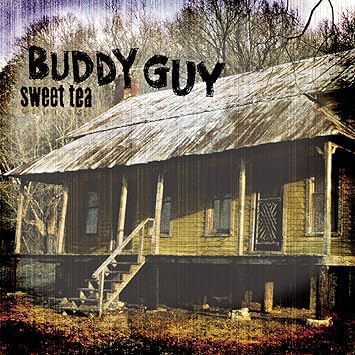
Sweet Tea - Buddy Guy

Provenance: I think anyone with a more than passing interest in the electric blues knows who Buddy Guy is. Still kicking, still playing, with a slew of solo releases and guest appearances to his name, Guy is considered a living legend.

I also have one of the most distant personal connections imaginable. My partner's stepdad's sister married one of Buddy Guy's sons. So, yeah, usual caveats apply when reviewing the work of a close family member.

Review: I pointedly mentioned the electric blues in my introduction, because this is what Guy is most famous for. And on Sweet Tea, fans of his spiky, fluid playing have got more than enough to chew on. Most tracks are over the five minute mark, with 'I Gotta Try You Girl' stretching its legs for well over twelve minutes. You wanna hear some electric guitar, friend? You got it.

So it's strange that the most arresting track on the whole album - the opener, 'Done Got Old' - is a relatively concise three-and-change minutes long, and consists of a close-miked Guy and sparse acoustic guitar. It's a weird song, too - because many of Guy's direct influences would flip their dotage on its head, bragging about their experience or ability to keep up with the youngbloods. Think Muddy Waters with 'Young Fashioned Ways' - "there may be snow up on the mountain, but there's fire down under the hill". 'Done Got Old', however, is a straightforward lament - no braggadocio, machismo or defiance, just a quiet sadness that his body is giving up on him. It's a sombre introduction.

And maybe it's supposed to be the banner that hangs over proceedings, a memento mori to accompany the startlingly vital racket he conjures up on Sweet Tea. 'Baby Please Don't Leave Me' has a title that sounds like a Chess cut from the 1950s, but the clattering drums and skronky overdriven bass makes it sound, early doors, more like a particularly sludgy desert rocker. The guitar riff, when it kicks in, sounds like one of the blues tracks that Led Zeppelin stole, if it was played on high-tensile cables. It's a noise you might expect more from All Them Witches than a guy who literally played with Muddy Waters and Junior Wells.

The highlight of Sweet Tea is 'Stay All Night', another relatively short number. It stalks, it prowls, it rumbles; and a flint-eyed Guy doesn't so much ask for love as commands it. It's down-low and nasty, lower than a snake's belly. At this juncture, I should mention that, aside from the quavering opener, Guy sings wonderfully, with a similarly strained, edgy style as Elmore James, albeit dialled down a notch or two. He was still hitting some impressive high notes at the age most people this side of the Atlantic anticipate receiving free bus passes.

Production is a factor that can make or break a record. As much as I love the bells and whistles approach on albums by the Beatles, Jellyfish, Pink Floyd and other studio cosmonauts, most blues music is served by the KISS maxim; keep it simple, stupid. Going back to Chess, some of those Muddy joints are raw as hell; there's a 1951 cut called 'She Moves Me' where Leonard Chess himself provides inexpert but effective backing on a bass drum to accompany Mud's elastic guitar. Back in the twenty-first century, Dennis Herring has kept some of that magic alive, whilst compensating for advances in technology. You can hear amps humming, snares rattling and the odd clam or two from Guy. It doesn't matter; this is more about capturing a mood and a moment than technical ecstasy (Joe Bonamassa and Kevin Shirley, take note). To these untrained ears, it also sounds like the instrumentals were performed live-in-studio.

The overall effect is very in-your-face, and all the better for it. The guitar isn't overly processed; a dab of echo here and there, but otherwise letting an overdriven tube amp, and of course Guy's expert fingers, do the heavy lifting tone-wise. On 'Tramp', cleaving the old soul classic with an arrangement that sounds like ZZ Top circa the kooky Deguello, Guy bends those strings so aggressively you can hear the muscle and blood through the speaker; the same can be said for the portentous closer 'It's A Jungle Out There'. Meanwhile, on 'Look What All You Got' and 'Who's Been Foolin' You', it sounds like Buddy Guy is fronting Dr Feelgood. It's a genuine pleasure to hear the greatest living exponent of the Chicago blues reminding us all why Clapton, Richards, Beck and the rest bend the knee.

I hear two Kings in the way Guy plays; he's got the pyrotechnic flair of Freddie but hits his bends like Albert (a fellow who, at his best, sounded like he was bending the very molecules of existence). There's something else there, though - a simmering malevolence that gives his every solo or interpolation that bit more bite and excitement. Perhaps 'Done Got Old' was a trickster move, a little juke to throw us off guard before proving, over and over, that he's still got the fire burning down below.

Sunday, 14 July 2019

J Geils Band - J Geils Band

Provenance: During Sixth Form I formed a group, to play at our school band bash, called Centerfold. The ostensible reason for doing so was to play stuff that wasn't punk or metal (the two flavours of music available at the band bash), but really it was so I could play the J Geils Band song 'Centerfold' to a large-ish audience.

In that respect it was a success, but in most others the performance was not just an abject failure, but a litany of failures. Nevertheless, today I am able to battle through the still-present fug of embarrassment to get back on the J Geils Band horse. Here's their first album, and won't you just look at these cool rockin' daddies - hotcha! Hotcha!

Review: Basically, I became mildly obsessed by the song 'Centerfold' after hearing it at a pub quiz. Not long after this revelation, I learned that the band once invited Lester Bangs onstage to play a typewriter solo. A band worth following up with, you'd think - and I duly did, a mere sixteen years later. Other stuff got in the way I guess. Anyway, I had come to be aware of the fact that early on, the J Geils Band were more a gritty R&B band than the slightly New Wavey 'Centerfold' would suggest. That's fine, as my tastes certainly skew towards gritty R&B, plus they had a harmonica player called Magic Dick, which frankly ticks a lot of boxes.

I'm partial to a spot of roughhouse blooz 'n' roll, and that's essentially what this is. Somewhere west of Dr Feelgood and north of Albert King circa his Born Under a Bad Sign Stax release, it's unpretentious, knockabout fun with not a little craft. I like the fact that vocalist Peter Wolf doesn't confuse histrionics with expression, and I'm delighted by Magic Dick's fluid, buzzy interpolations. He even gets his own showcase of his own called 'Ice Breaker', which has hints of Booker T & the MGs. It's a bit odd to sequence this in at track two, though. Was Magic Dick their big selling point? He certainly blows a good harp.

Despite J Geils Band scoring precisely nul points in the originality stakes, it's testament to the band's facility with a twelve-bar that their original compositions stack up well to their interpretations of others. The gear-jamming anthem 'Hard Drivin' Man' (gotta drop that 'g', baby) is the highlight of side one, and has a suitably top-down, open-highway feel to it. It is, however, run quite close by the crawlin' king snake strut of 'Serves You Right to Suffer', and it's nice to hear John Lee Hooker done well in a band setting. Part of JLH's charm was his looseness, which was often the first thing that bands covering his songs would discard. It's great to hear the J Geils Band have the confidence in the material to stretch out and keep proceedings simmering away at the right temperature.

However, having praised the songcraft evidently in existence within the J Geils Band, the true standout of the whole album is the cut that gets side two cooking. I already loved the Otis Rush original of 'Homework', but this hard-charging, snakey version is solid gold. To follow it up with a bippin' and boppin' version of 'First I Look at the Purse' (a hit in 1965 for The Contours) is pure filth. The start of side two of J Geils Band can go toe-to-toe with anything. Likewise, when you decide to round off proceedings with the Albert Collins instrumental cut 'Sno-Cone' (according to the liner notes here, co-written with The Big Bopper - helloooooo baaaaaaby!) you could've packed the intervening ten minutes like a sock of shit and I'll still be giving this disc a rave. Okay, so 'On Borrowed Time' might not be the greatest blue-light ballad ever written, but it's a welcome change of pace. I love everything else.

As I mentioned before, there is nothing new under the sun here, but when it's this muscular, unpretentious and tightly arranged (all words that can describe me, incidentally) there's nothing to do other than sit back and admire a job well done. The J Geils Band might sound like a bar band, but it's the best damn bar band west of the Danube. Buy this album.