Provenance: I think anyone with a more than passing interest in the electric blues knows who Buddy Guy is. Still kicking, still playing, with a slew of solo releases and guest appearances to his name, Guy is considered a living legend.
I also have one of the most distant personal connections imaginable. My partner's stepdad's sister married one of Buddy Guy's sons. So, yeah, usual caveats apply when reviewing the work of a close family member.
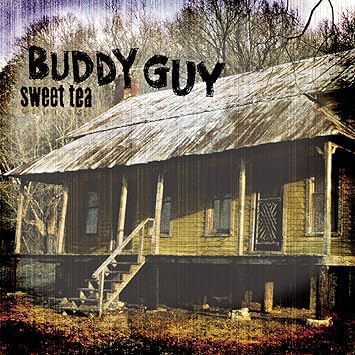
Review: I pointedly mentioned the electric blues in my introduction, because this is what Guy is most famous for. And on Sweet Tea, fans of his spiky, fluid playing have got more than enough to chew on. Most tracks are over the five minute mark, with 'I Gotta Try You Girl' stretching its legs for well over twelve minutes. You wanna hear some electric guitar, friend? You got it.
So it's strange that the most arresting track on the whole album - the opener, 'Done Got Old' - is a relatively concise three-and-change minutes long, and consists of a close-miked Guy and sparse acoustic guitar. It's a weird song, too - because many of Guy's direct influences would flip their dotage on its head, bragging about their experience or ability to keep up with the youngbloods. Think Muddy Waters with 'Young Fashioned Ways' - "there may be snow up on the mountain, but there's fire down under the hill". 'Done Got Old', however, is a straightforward lament - no braggadocio, machismo or defiance, just a quiet sadness that his body is giving up on him. It's a sombre introduction.
And maybe it's supposed to be the banner that hangs over proceedings, a memento mori to accompany the startlingly vital racket he conjures up on Sweet Tea. 'Baby Please Don't Leave Me' has a title that sounds like a Chess cut from the 1950s, but the clattering drums and skronky overdriven bass makes it sound, early doors, more like a particularly sludgy desert rocker. The guitar riff, when it kicks in, sounds like one of the blues tracks that Led Zeppelin stole, if it was played on high-tensile cables. It's a noise you might expect more from All Them Witches than a guy who literally played with Muddy Waters and Junior Wells.
The highlight of Sweet Tea is 'Stay All Night', another relatively short number. It stalks, it prowls, it rumbles; and a flint-eyed Guy doesn't so much ask for love as commands it. It's down-low and nasty, lower than a snake's belly. At this juncture, I should mention that, aside from the quavering opener, Guy sings wonderfully, with a similarly strained, edgy style as Elmore James, albeit dialled down a notch or two. He was still hitting some impressive high notes at the age most people this side of the Atlantic anticipate receiving free bus passes.
Production is a factor that can make or break a record. As much as I love the bells and whistles approach on albums by the Beatles, Jellyfish, Pink Floyd and other studio cosmonauts, most blues music is served by the KISS maxim; keep it simple, stupid. Going back to Chess, some of those Muddy joints are raw as hell; there's a 1951 cut called 'She Moves Me' where Leonard Chess himself provides inexpert but effective backing on a bass drum to accompany Mud's elastic guitar. Back in the twenty-first century, Dennis Herring has kept some of that magic alive, whilst compensating for advances in technology. You can hear amps humming, snares rattling and the odd clam or two from Guy. It doesn't matter; this is more about capturing a mood and a moment than technical ecstasy (Joe Bonamassa and Kevin Shirley, take note). To these untrained ears, it also sounds like the instrumentals were performed live-in-studio.
The overall effect is very in-your-face, and all the better for it. The guitar isn't overly processed; a dab of echo here and there, but otherwise letting an overdriven tube amp, and of course Guy's expert fingers, do the heavy lifting tone-wise. On 'Tramp', cleaving the old soul classic with an arrangement that sounds like ZZ Top circa the kooky Deguello, Guy bends those strings so aggressively you can hear the muscle and blood through the speaker; the same can be said for the portentous closer 'It's A Jungle Out There'. Meanwhile, on 'Look What All You Got' and 'Who's Been Foolin' You', it sounds like Buddy Guy is fronting Dr Feelgood. It's a genuine pleasure to hear the greatest living exponent of the Chicago blues reminding us all why Clapton, Richards, Beck and the rest bend the knee.
I hear two Kings in the way Guy plays; he's got the pyrotechnic flair of Freddie but hits his bends like Albert (a fellow who, at his best, sounded like he was bending the very molecules of existence). There's something else there, though - a simmering malevolence that gives his every solo or interpolation that bit more bite and excitement. Perhaps 'Done Got Old' was a trickster move, a little juke to throw us off guard before proving, over and over, that he's still got the fire burning down below.
A blog about one man and his stupid music collection. Mainly about the music, though the man intrudes now and again.
Showing posts with label albert king. Show all posts
Sunday, 3 November 2019
Sunday, 14 July 2019
J Geils Band - J Geils Band
Provenance: During Sixth Form I formed a group, to play at our school band bash, called Centerfold. The ostensible reason for doing so was to play stuff that wasn't punk or metal (the two flavours of music available at the band bash), but really it was so I could play the J Geils Band song 'Centerfold' to a large-ish audience.
In that respect it was a success, but in most others the performance was not just an abject failure, but a litany of failures. Nevertheless, today I am able to battle through the still-present fug of embarrassment to get back on the J Geils Band horse. Here's their first album, and won't you just look at these cool rockin' daddies - hotcha! Hotcha!
Review: Basically, I became mildly obsessed by the song 'Centerfold' after hearing it at a pub quiz. Not long after this revelation, I learned that the band once invited Lester Bangs onstage to play a typewriter solo. A band worth following up with, you'd think - and I duly did, a mere sixteen years later. Other stuff got in the way I guess. Anyway, I had come to be aware of the fact that early on, the J Geils Band were more a gritty R&B band than the slightly New Wavey 'Centerfold' would suggest. That's fine, as my tastes certainly skew towards gritty R&B, plus they had a harmonica player called Magic Dick, which frankly ticks a lot of boxes.
I'm partial to a spot of roughhouse blooz 'n' roll, and that's essentially what this is. Somewhere west of Dr Feelgood and north of Albert King circa his Born Under a Bad Sign Stax release, it's unpretentious, knockabout fun with not a little craft. I like the fact that vocalist Peter Wolf doesn't confuse histrionics with expression, and I'm delighted by Magic Dick's fluid, buzzy interpolations. He even gets his own showcase of his own called 'Ice Breaker', which has hints of Booker T & the MGs. It's a bit odd to sequence this in at track two, though. Was Magic Dick their big selling point? He certainly blows a good harp.
Despite J Geils Band scoring precisely nul points in the originality stakes, it's testament to the band's facility with a twelve-bar that their original compositions stack up well to their interpretations of others. The gear-jamming anthem 'Hard Drivin' Man' (gotta drop that 'g', baby) is the highlight of side one, and has a suitably top-down, open-highway feel to it. It is, however, run quite close by the crawlin' king snake strut of 'Serves You Right to Suffer', and it's nice to hear John Lee Hooker done well in a band setting. Part of JLH's charm was his looseness, which was often the first thing that bands covering his songs would discard. It's great to hear the J Geils Band have the confidence in the material to stretch out and keep proceedings simmering away at the right temperature.
However, having praised the songcraft evidently in existence within the J Geils Band, the true standout of the whole album is the cut that gets side two cooking. I already loved the Otis Rush original of 'Homework', but this hard-charging, snakey version is solid gold. To follow it up with a bippin' and boppin' version of 'First I Look at the Purse' (a hit in 1965 for The Contours) is pure filth. The start of side two of J Geils Band can go toe-to-toe with anything. Likewise, when you decide to round off proceedings with the Albert Collins instrumental cut 'Sno-Cone' (according to the liner notes here, co-written with The Big Bopper - helloooooo baaaaaaby!) you could've packed the intervening ten minutes like a sock of shit and I'll still be giving this disc a rave. Okay, so 'On Borrowed Time' might not be the greatest blue-light ballad ever written, but it's a welcome change of pace. I love everything else.
As I mentioned before, there is nothing new under the sun here, but when it's this muscular, unpretentious and tightly arranged (all words that can describe me, incidentally) there's nothing to do other than sit back and admire a job well done. The J Geils Band might sound like a bar band, but it's the best damn bar band west of the Danube. Buy this album.
In that respect it was a success, but in most others the performance was not just an abject failure, but a litany of failures. Nevertheless, today I am able to battle through the still-present fug of embarrassment to get back on the J Geils Band horse. Here's their first album, and won't you just look at these cool rockin' daddies - hotcha! Hotcha!
Review: Basically, I became mildly obsessed by the song 'Centerfold' after hearing it at a pub quiz. Not long after this revelation, I learned that the band once invited Lester Bangs onstage to play a typewriter solo. A band worth following up with, you'd think - and I duly did, a mere sixteen years later. Other stuff got in the way I guess. Anyway, I had come to be aware of the fact that early on, the J Geils Band were more a gritty R&B band than the slightly New Wavey 'Centerfold' would suggest. That's fine, as my tastes certainly skew towards gritty R&B, plus they had a harmonica player called Magic Dick, which frankly ticks a lot of boxes.
I'm partial to a spot of roughhouse blooz 'n' roll, and that's essentially what this is. Somewhere west of Dr Feelgood and north of Albert King circa his Born Under a Bad Sign Stax release, it's unpretentious, knockabout fun with not a little craft. I like the fact that vocalist Peter Wolf doesn't confuse histrionics with expression, and I'm delighted by Magic Dick's fluid, buzzy interpolations. He even gets his own showcase of his own called 'Ice Breaker', which has hints of Booker T & the MGs. It's a bit odd to sequence this in at track two, though. Was Magic Dick their big selling point? He certainly blows a good harp.
Despite J Geils Band scoring precisely nul points in the originality stakes, it's testament to the band's facility with a twelve-bar that their original compositions stack up well to their interpretations of others. The gear-jamming anthem 'Hard Drivin' Man' (gotta drop that 'g', baby) is the highlight of side one, and has a suitably top-down, open-highway feel to it. It is, however, run quite close by the crawlin' king snake strut of 'Serves You Right to Suffer', and it's nice to hear John Lee Hooker done well in a band setting. Part of JLH's charm was his looseness, which was often the first thing that bands covering his songs would discard. It's great to hear the J Geils Band have the confidence in the material to stretch out and keep proceedings simmering away at the right temperature.
However, having praised the songcraft evidently in existence within the J Geils Band, the true standout of the whole album is the cut that gets side two cooking. I already loved the Otis Rush original of 'Homework', but this hard-charging, snakey version is solid gold. To follow it up with a bippin' and boppin' version of 'First I Look at the Purse' (a hit in 1965 for The Contours) is pure filth. The start of side two of J Geils Band can go toe-to-toe with anything. Likewise, when you decide to round off proceedings with the Albert Collins instrumental cut 'Sno-Cone' (according to the liner notes here, co-written with The Big Bopper - helloooooo baaaaaaby!) you could've packed the intervening ten minutes like a sock of shit and I'll still be giving this disc a rave. Okay, so 'On Borrowed Time' might not be the greatest blue-light ballad ever written, but it's a welcome change of pace. I love everything else.
As I mentioned before, there is nothing new under the sun here, but when it's this muscular, unpretentious and tightly arranged (all words that can describe me, incidentally) there's nothing to do other than sit back and admire a job well done. The J Geils Band might sound like a bar band, but it's the best damn bar band west of the Danube. Buy this album.
Sunday, 28 April 2019
New Orleans Heat - Albert King
Provenance: Yeah, I picked this up for a fiver somewhere. I'm a big blues fan, and I've a solid regard for New Orleans musicianship, so this one seemed like a slam dunk.
Review: When people talk about superstar producers, names like Mutt Lange, Joe Meek, George Martin, Phil Spector, Quincy Jones and Rick Rubin readily come to mind. Now, it's possible that he's over-represented in my music collection because of the direction in which my tastes skew, but I'd include Allen Toussaint in that crowd. In my mind, he is the central figure of 20th century New Orleans R&B, acting as a triple threat of songwriter, performer and producer. It's no surprise, then, that when Albert King pitched up in the Crescent City to try to inject a new lease of life into some of his classics that we find Toussaint producing, arranging and playing on New Orleans Heat.
As one of the 'Three Kings' of the blues, Albert can sometimes find himself lost in the shuffle. Way out in front is the late B.B. King, a man who came to signify the blues for many, even if his sleek, city-sophisticate take on the genre never quite jived with purists. Then you had the volcanic talent of Freddie King; a big man with a gritty soul voice and a flamboyance on stage that was only matched by his scintillating guitar playing. Then you had the six-and-a-half-feet of Albert King, pinging needly guitar bends around an upside-down Flying V, cooing his songs in a warm, keening moan. Maybe he didn't quite have B.B.'s versatility, nor Freddie's chops, but to me Albert thoroughly deserves his place in the pantheon if only for 1967's Born Under a Bad Sign, recorded with Booker T and the MGs and pound-for-pound one of the greatest rhythm and blues albums, period.
However - despite the marriage of two colossal talents in Albert King and Allen Toussaint, New Orleans Heat doesn't really click. Why so? Well, I think Allen Toussaint's work with soul, funk and even jazz musicians eclipses his production of blues artists; his tendency is to deliver something smooth and sly, whilst King thrives with a more knockabout backing. Perhaps it's King's mellow voice that gulls one into thinking that he can fit in with the Toussaint template, but opener 'Get Out Of My Life Woman' can't hold a candle to Lee Dorsey's version (which was, of course, both written and produced by Allen Toussaint). The next track fares no better - the immortal 'Born Under a Bad Sign' brought to heel by Toussaint's tendency to smooth out rough edges.
Sounds like I've got some real beef with Allen Toussaint, huh? Think again. His work with Lee Dorsey in the mid-1960s is sublime (he wrote 'Working in the Coal Mine', fercrissakes) and in Life, Love and Faith and especially Southern Nights he wrote and performed two of the most remarkable funky New Orleans soul albums of all time. At his best, Allen Toussaint could be untouchable; but New Orleans Heat isn't anywhere near his best. It's simply a bad pairing, with some unfortunate results such as the insipid 'The Very Thought of You' and the embarrassing funk of 'We All Wanna Boogie' (though artists who started off in the blues certainly could produce very credible funk records - King's near-contemporary Johnny 'Guitar' Watson springs to mind).
On a few occasions the King-Toussaint collaboration hits the mark. Despite sounding a little neutered, 'Born Under a Bad Sign' is too good a song to ruin; 'I Got the Blues' has a sinuous minor-key groove running through it and leaves enough room for King's guitar to stretch out; and Leo goddamn Nocentelli's chanky rhythm playing injects some spice into 'I Get Evil', in spite of its too-glossy horn arrangements.
One final thought - despite the lead guitar work all being very idiosyncratic to Albert King's wavy, elastic attack, his guitar tone is dogshit. Pure dogshit. In an ill-advised attempt to sound contemporary, I guess, it's got some kind of horrible phasing effect all over it. The one track where they seemed to have forgotten to plug the fucking pedal in, 'Angel of Mercy', coincidentally happens to be the most straightforward blues number of the bunch, and - lo and behold - the guitar playing absolutely cooks. Oh well, it was 1978; in any case, it's not the disaster that Electric Mud was (yeah, some disaster - it sold a quarter of a million copies, but it's a mess).
Review: When people talk about superstar producers, names like Mutt Lange, Joe Meek, George Martin, Phil Spector, Quincy Jones and Rick Rubin readily come to mind. Now, it's possible that he's over-represented in my music collection because of the direction in which my tastes skew, but I'd include Allen Toussaint in that crowd. In my mind, he is the central figure of 20th century New Orleans R&B, acting as a triple threat of songwriter, performer and producer. It's no surprise, then, that when Albert King pitched up in the Crescent City to try to inject a new lease of life into some of his classics that we find Toussaint producing, arranging and playing on New Orleans Heat.
As one of the 'Three Kings' of the blues, Albert can sometimes find himself lost in the shuffle. Way out in front is the late B.B. King, a man who came to signify the blues for many, even if his sleek, city-sophisticate take on the genre never quite jived with purists. Then you had the volcanic talent of Freddie King; a big man with a gritty soul voice and a flamboyance on stage that was only matched by his scintillating guitar playing. Then you had the six-and-a-half-feet of Albert King, pinging needly guitar bends around an upside-down Flying V, cooing his songs in a warm, keening moan. Maybe he didn't quite have B.B.'s versatility, nor Freddie's chops, but to me Albert thoroughly deserves his place in the pantheon if only for 1967's Born Under a Bad Sign, recorded with Booker T and the MGs and pound-for-pound one of the greatest rhythm and blues albums, period.
However - despite the marriage of two colossal talents in Albert King and Allen Toussaint, New Orleans Heat doesn't really click. Why so? Well, I think Allen Toussaint's work with soul, funk and even jazz musicians eclipses his production of blues artists; his tendency is to deliver something smooth and sly, whilst King thrives with a more knockabout backing. Perhaps it's King's mellow voice that gulls one into thinking that he can fit in with the Toussaint template, but opener 'Get Out Of My Life Woman' can't hold a candle to Lee Dorsey's version (which was, of course, both written and produced by Allen Toussaint). The next track fares no better - the immortal 'Born Under a Bad Sign' brought to heel by Toussaint's tendency to smooth out rough edges.
Sounds like I've got some real beef with Allen Toussaint, huh? Think again. His work with Lee Dorsey in the mid-1960s is sublime (he wrote 'Working in the Coal Mine', fercrissakes) and in Life, Love and Faith and especially Southern Nights he wrote and performed two of the most remarkable funky New Orleans soul albums of all time. At his best, Allen Toussaint could be untouchable; but New Orleans Heat isn't anywhere near his best. It's simply a bad pairing, with some unfortunate results such as the insipid 'The Very Thought of You' and the embarrassing funk of 'We All Wanna Boogie' (though artists who started off in the blues certainly could produce very credible funk records - King's near-contemporary Johnny 'Guitar' Watson springs to mind).
On a few occasions the King-Toussaint collaboration hits the mark. Despite sounding a little neutered, 'Born Under a Bad Sign' is too good a song to ruin; 'I Got the Blues' has a sinuous minor-key groove running through it and leaves enough room for King's guitar to stretch out; and Leo goddamn Nocentelli's chanky rhythm playing injects some spice into 'I Get Evil', in spite of its too-glossy horn arrangements.
One final thought - despite the lead guitar work all being very idiosyncratic to Albert King's wavy, elastic attack, his guitar tone is dogshit. Pure dogshit. In an ill-advised attempt to sound contemporary, I guess, it's got some kind of horrible phasing effect all over it. The one track where they seemed to have forgotten to plug the fucking pedal in, 'Angel of Mercy', coincidentally happens to be the most straightforward blues number of the bunch, and - lo and behold - the guitar playing absolutely cooks. Oh well, it was 1978; in any case, it's not the disaster that Electric Mud was (yeah, some disaster - it sold a quarter of a million copies, but it's a mess).
Friday, 19 May 2017
Danzig - Danzig
Provenance: For many a year, Glenn Danzig seemed an enigmatic figure, someone who lurked around the periphery of the stuff I enjoyed without ever taking centre stage. Through friends I was dimly aware that his work was worth considering; he cropped up as an influencer in magazine articles; and of course, he was once knocked out cold by the frontman of a support act, which handily for us was caught on video.
This all changed in 2010 when I saw him at Sweden Rock Festival, a performance seared into my memory. Firstly, it should be said that the erstwhile Misfit is a strange looking fellow. Squat, lantern-jawed, top-heavy and bordered by lank, black hair, his general mien is that of a gone-to-seed gothic prop-forward. His arrival on stage was comical - a middle-aged whirling mass of kung-fu kicks and karate chops, performed with such gusto that he was winded throughout the first two songs. Thereafter he recovered his composure and delivered a blistering set.
That being said, the first chord that heralded 'Mother' sent the crowd into a frenzy, to which Danzig responded by reprising his energetic Chuck Norris routine, and thus relegating the vocals to a Vic Reeves 'club singer' rendition. Gloriously funny.
Review: How did Danzig manage to mangle his vocals even further than one night in Norje? Because one of the most striking aspects of this album is that wobbly baritenor of his, like a pissed-up Thursday night Elvis impersonator, utterly unique and instantly identifiable. It really shouldn't work but somehow - somehow - it sounds totally cool.
Another aspect of the sound readily apparent to the attentive listener is the no-frills, unadorned production. Consequently, drums sound like drums, guitars sound like guitars, Danzig sounds like someone who's kicked in the mouth a few times. This is undoubtedly due to Rick Rubin's unfussy recording techniques. The odd instrument is double-tracked here and there and one can discern a slight delay on the snare, but overall Danzig is mercifully free of bells and whistles (opener 'Twist of Cain' aside, which literally does feature a bell).
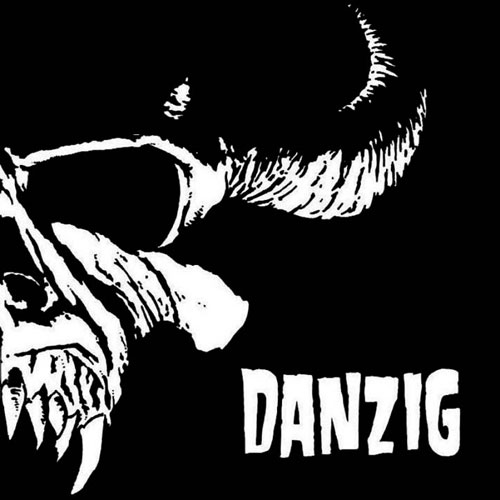
Looking at both the album artwork and Glenn Danzig himself, I was expecting a skull-crushingly heavy outing bursting with detuned guitar and thrashy drums. Instead, what we're presented with here is a kind of skeletal, melodic hard rock shot through with an anthracite blackness. Lyrically, it's every bit as bad-ass as can be imagined, Satan and his sulphurous crew liberally invoked. It's also catchy as hell, especially the dark strut of 'Twist of Cain' and the Tipper Gore-baiting, face-smashing classic 'Mother'. It is, however, a touch rum to see 'The Hunter' credited solely to Glenn Danzig in the CD liner notes when it is so obviously a re-write of the Albert King song popularised by Free (which was, if memory serves correctly, written by members of Booker T and the MGs. Oh well.)
In fact, nothing on this album sucks. From start to finish, it shines blackly as a tight, conceptually coherent collection of bluesy proto-metallic hell-hymns. What does it sound like? Well, the chugging guitars (all guitars on Danzig are overdriven) and rudimentary production puts one in mind of the better New Wave of British Heavy Metal bands like Angel Witch. However, the idiosyncratic singing that dominates the album pushes it more towards someone like Mercyful Fate - the singing styles are different, but the shock one receives when first exposed to the vocals of either band is comparable.
In summation, Danzig is an top-tier album and listening to it just once will make you feel one thousand percent more diabolical. But you know what, kids? It's all fun and games saying 'hail Satan' and the like, but what's truly elite and cult is sitting down to a good book:
No wonder he's topless - the silly beggar seems to have put his library right next to the swimming pool!
This all changed in 2010 when I saw him at Sweden Rock Festival, a performance seared into my memory. Firstly, it should be said that the erstwhile Misfit is a strange looking fellow. Squat, lantern-jawed, top-heavy and bordered by lank, black hair, his general mien is that of a gone-to-seed gothic prop-forward. His arrival on stage was comical - a middle-aged whirling mass of kung-fu kicks and karate chops, performed with such gusto that he was winded throughout the first two songs. Thereafter he recovered his composure and delivered a blistering set.
That being said, the first chord that heralded 'Mother' sent the crowd into a frenzy, to which Danzig responded by reprising his energetic Chuck Norris routine, and thus relegating the vocals to a Vic Reeves 'club singer' rendition. Gloriously funny.
Review: How did Danzig manage to mangle his vocals even further than one night in Norje? Because one of the most striking aspects of this album is that wobbly baritenor of his, like a pissed-up Thursday night Elvis impersonator, utterly unique and instantly identifiable. It really shouldn't work but somehow - somehow - it sounds totally cool.
Another aspect of the sound readily apparent to the attentive listener is the no-frills, unadorned production. Consequently, drums sound like drums, guitars sound like guitars, Danzig sounds like someone who's kicked in the mouth a few times. This is undoubtedly due to Rick Rubin's unfussy recording techniques. The odd instrument is double-tracked here and there and one can discern a slight delay on the snare, but overall Danzig is mercifully free of bells and whistles (opener 'Twist of Cain' aside, which literally does feature a bell).
Looking at both the album artwork and Glenn Danzig himself, I was expecting a skull-crushingly heavy outing bursting with detuned guitar and thrashy drums. Instead, what we're presented with here is a kind of skeletal, melodic hard rock shot through with an anthracite blackness. Lyrically, it's every bit as bad-ass as can be imagined, Satan and his sulphurous crew liberally invoked. It's also catchy as hell, especially the dark strut of 'Twist of Cain' and the Tipper Gore-baiting, face-smashing classic 'Mother'. It is, however, a touch rum to see 'The Hunter' credited solely to Glenn Danzig in the CD liner notes when it is so obviously a re-write of the Albert King song popularised by Free (which was, if memory serves correctly, written by members of Booker T and the MGs. Oh well.)
In fact, nothing on this album sucks. From start to finish, it shines blackly as a tight, conceptually coherent collection of bluesy proto-metallic hell-hymns. What does it sound like? Well, the chugging guitars (all guitars on Danzig are overdriven) and rudimentary production puts one in mind of the better New Wave of British Heavy Metal bands like Angel Witch. However, the idiosyncratic singing that dominates the album pushes it more towards someone like Mercyful Fate - the singing styles are different, but the shock one receives when first exposed to the vocals of either band is comparable.
In summation, Danzig is an top-tier album and listening to it just once will make you feel one thousand percent more diabolical. But you know what, kids? It's all fun and games saying 'hail Satan' and the like, but what's truly elite and cult is sitting down to a good book:
No wonder he's topless - the silly beggar seems to have put his library right next to the swimming pool!
Labels:
albert king,
angel witch,
danzig,
free,
glenn danzig,
hard rock,
mercyful fate,
metal,
NWOBHM,
sweden rock
Sunday, 13 November 2016
Funk Beyond The Call Of Duty - Johnny 'Guitar' Watson
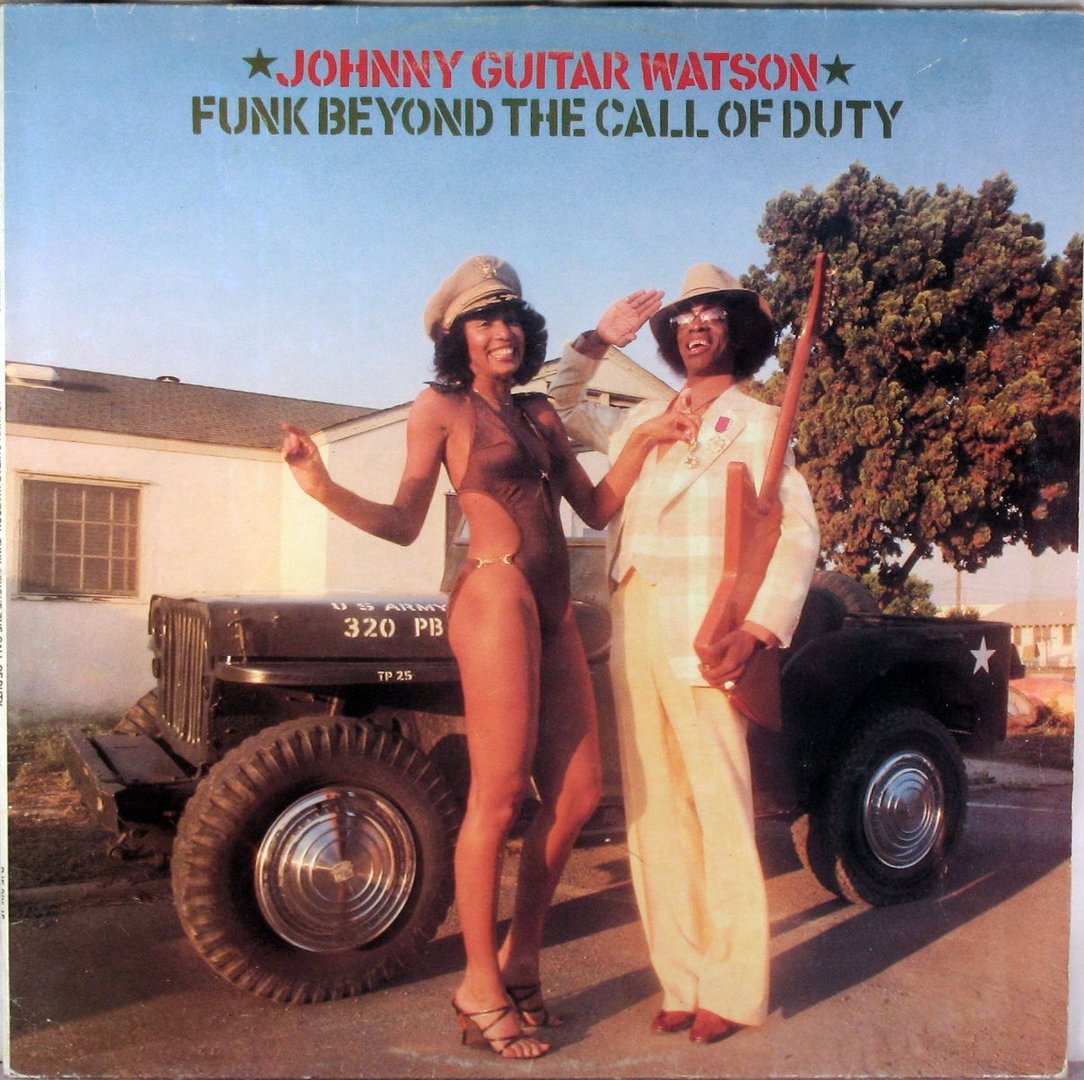
Provenance: I'm fairly sure it would've come through hearing Watson on one of my Dad's Frank Zappa records. You can hear him on 'Andy' and 'In France' (most prominently in the latter). It's also possible I heard him on one of the many blues compilations I bought as a teenager; he's certainly on a couple I own. I can't even remember the impetus behind buying this particular album. There's a (very) good chance I just liked the cover.
Review: Here's a guy. Johnny 'Guitar' Watson started his career playing jump blues in the 1950s. Later in the decade he recorded a riot in reverb and feedback called 'Space Guitar', and a personal favourite, 'Three Hours Past Midnight', featuring Watson's curious clucking guitar riding atop a sophisticated urban blues backing.
But Watson was never one to stick with a tried and tested formula, and so by the mid 1970s he's traded in the pompadour for an Afro, paid a visit to Iceberg Slim's outfitter and switched up his R&B sound for a sleek soul-funk. Such a wholesale reboot can often seem like a desperate betrayal of artistic principals in order to maintain a foothold on the contemporary scene, and it's traditionally been tricky for blues musicians. Here I'm thinking of Muddy Waters' 'psychedelic' adventure with Electric Mud, or Albert King's marginally more listenable I Wanna Get Funky, neither of which will go down in the annals as classics (though I recall a documentary made by Chuck D of Public Enemy wherein he declared Electric Mud to be a favourite; and I've already fessed up to being a big fan of Neil Young's Trans, so I've got form in the contrarianism department too).
Happily, Johnny 'Guitar' Watson and funk were made for each other. It probably helps that he was an active and willing agent in this change of direction. Watson's natural facility for the genre suggests he actually listened to and appreciated the music, as opposed to being shoehorned into performing it by record label suits. It's also unsurprising that a man who was so pioneering with guitar sounds twenty years before Funk Beyond The Call Of Duty would relish the chance to play around with the expanded palette of sounds that funk orchestration afforded.
In terms of the sound, FBTCOD is closer to the lighter, lush funk of the Cate Brothers than the wigged out bass-heavy Parliament P-Funk noise. Alongside guitar, Watson helms a variety of keyboards and synthesizers, and these tend to operate as a bed for his singing and the unobtrusive horn arrangements. But what Watson really brings to the table is a huge dollop of personality. Every track is imbued with the irresistible Watson chutzpah; sly, bantering and humorous, it's hard to reach any other conclusion that he's having a shit ton of fun making this record, and as a listener you really want to join in.
The other joy is that FBTCOD is shot through with Watson's trademark guitar sound. You could put him through a barrage of amplifiers and effects pedals and he'd still be identifiable. His attack gives the game away; wiry, itchy, staccato, bereft of sustain, never staying in one place. There's also a quirky lyricism about his solos, guitar acting as proxy to the human voice - and on 'It's A Damn Shame' as if to hammer it homes, Watson scats along with his own playing (it's glorious).
Watson is good as a soul troubadour on 'Give Me My Love', but even better as a rueful, witty street philosopher on 'It's A Damn Shame', 'Barn Door' and the superb 'It's About The Dollar Bill' ('If you wanna buy chinchilla / It's a pocket killer-diller' is advice I'll treasure for the rest of my days). Whilst FBTCOD isn't an album that will be top of anybody's list (aside from Chuck D's, perhaps), it's never failed to tug on the corners of my mouth whenever it gets an airing. Billion dollar idea: the next title in the Call of Duty video games series should be called Funk: (Beyond the) Call of Duty. That's as far as I've got in terms of detail, but it's surely got to be better than larking around in space like Roger Moore's stunt double in Moonraker, right?
Review: Here's a guy. Johnny 'Guitar' Watson started his career playing jump blues in the 1950s. Later in the decade he recorded a riot in reverb and feedback called 'Space Guitar', and a personal favourite, 'Three Hours Past Midnight', featuring Watson's curious clucking guitar riding atop a sophisticated urban blues backing.
But Watson was never one to stick with a tried and tested formula, and so by the mid 1970s he's traded in the pompadour for an Afro, paid a visit to Iceberg Slim's outfitter and switched up his R&B sound for a sleek soul-funk. Such a wholesale reboot can often seem like a desperate betrayal of artistic principals in order to maintain a foothold on the contemporary scene, and it's traditionally been tricky for blues musicians. Here I'm thinking of Muddy Waters' 'psychedelic' adventure with Electric Mud, or Albert King's marginally more listenable I Wanna Get Funky, neither of which will go down in the annals as classics (though I recall a documentary made by Chuck D of Public Enemy wherein he declared Electric Mud to be a favourite; and I've already fessed up to being a big fan of Neil Young's Trans, so I've got form in the contrarianism department too).
Happily, Johnny 'Guitar' Watson and funk were made for each other. It probably helps that he was an active and willing agent in this change of direction. Watson's natural facility for the genre suggests he actually listened to and appreciated the music, as opposed to being shoehorned into performing it by record label suits. It's also unsurprising that a man who was so pioneering with guitar sounds twenty years before Funk Beyond The Call Of Duty would relish the chance to play around with the expanded palette of sounds that funk orchestration afforded.
In terms of the sound, FBTCOD is closer to the lighter, lush funk of the Cate Brothers than the wigged out bass-heavy Parliament P-Funk noise. Alongside guitar, Watson helms a variety of keyboards and synthesizers, and these tend to operate as a bed for his singing and the unobtrusive horn arrangements. But what Watson really brings to the table is a huge dollop of personality. Every track is imbued with the irresistible Watson chutzpah; sly, bantering and humorous, it's hard to reach any other conclusion that he's having a shit ton of fun making this record, and as a listener you really want to join in.
The other joy is that FBTCOD is shot through with Watson's trademark guitar sound. You could put him through a barrage of amplifiers and effects pedals and he'd still be identifiable. His attack gives the game away; wiry, itchy, staccato, bereft of sustain, never staying in one place. There's also a quirky lyricism about his solos, guitar acting as proxy to the human voice - and on 'It's A Damn Shame' as if to hammer it homes, Watson scats along with his own playing (it's glorious).
Watson is good as a soul troubadour on 'Give Me My Love', but even better as a rueful, witty street philosopher on 'It's A Damn Shame', 'Barn Door' and the superb 'It's About The Dollar Bill' ('If you wanna buy chinchilla / It's a pocket killer-diller' is advice I'll treasure for the rest of my days). Whilst FBTCOD isn't an album that will be top of anybody's list (aside from Chuck D's, perhaps), it's never failed to tug on the corners of my mouth whenever it gets an airing. Billion dollar idea: the next title in the Call of Duty video games series should be called Funk: (Beyond the) Call of Duty. That's as far as I've got in terms of detail, but it's surely got to be better than larking around in space like Roger Moore's stunt double in Moonraker, right?
Subscribe to:
Posts (Atom)


:format(jpeg):mode_rgb():quality(90)/discogs-images/R-1264898-1353101379-4668.jpeg.jpg)