Showing posts with label live. Show all posts

Sunday, 1 August 2021

Jazz På Svenska - Jan Johansson


Provenance: In a Classic Rock article about the music that influenced them, one of the members of Opeth mentioned Jazz På Svenska. The concept behind it - Swedish folk music played on piano and double bass in a jazz idiom - intrigued me, so I bought it.

Review: I like jazz, I like Sweden, I like the piano. What I don't tend to like is minimalism, particularly. Or, to be more accurate, its sparseness that tends to turn me off. I've bought music, damn it - so why would I be content paying for the gaps in between?

Of course, those gaps are as integral to the sound as all the noisy bits I treasure so dearly. Nonetheless, I would guess there is an impatience lurking within my heart that finds most music that is meditative and ruminative in nature to be lacking. It's not quite the "don't bore us, get to the chorus" celebration of hooks, melodies and concision that admittedly has worked as a formula for much superb pop music; rather, I think I just like stuff to happen. As much as I clowned Gryphon for their strange an unaccountable pretensions, at least their music constantly shifted and probed, at times to bamboozling effect. Fundamentally, I could tolerate being guided through a maze of keyboards and krumhorns due to the energy and propulsion that went into their dizzying souffle of sound.

Here, on Jazz På Svenska, we are presented with a very different proposition; Jan Johansson on piano, Georg Riedel on double bass and...that's it. Two guys playing jazzy folk music, with no virtuoso moments or dazzling solos. Or vocals. It's the most barebones sounding thing I own, because as far as I can tell everything is done live with nary a hint of an overdub or any other production wizardry. There isn't even a producer listed on the liner notes, just a recording engineer (shout out to my boy, Olof Swembel).

In the past I've made much of how I love the sound of jazz albums of a certain vintage - essentially, that the music lives and breathes through all ensemble members being in one room and playing with each other, as music has been performed for millennia. As basic a concept as this is, it's unlikely to feature on any music that makes it to the charts. As such I cannot help but feel that huge swathes of modern audiences are missing out on the pure and crystalline beauty of hearing music played without stultifying layers of studio 'magic' mediating the experience between performer and listener.

Of course, there's plenty of music that relies on this membrane of teases and tweaks to achieve the intended result, but there's a small thrill in hearing music being played the way its done on Jazz På Svenska. And hey, you could argue that I'm cheating, what with volume knobs, stereo equalisation, even the concept of microphones. "Listen Swinetunes," I hear you say, "why don't you just go and listen to some fucker playing a flute in the woods if you think it's so great?" and yeah, I won't do that. But I did see - before buying this album, incidentally - the Preservation Hall Jazz Band in New Orleans. Some might find their strictly trad repertoire hokey, but hearing it being played in a small room, with the musicians almost at arm's length, with zero by way of amplification, really brought home to me just how distorting a lens technology can be when in the service of music.

However, I'm not about to become the music blogosphere's version of the Unabomber (on this issue, at least); rather, this perspective on the creation and playback of music has, I feel, given me a greater appreciation for Jazz På Svenska as a work of art. Next to the congested sound of rock, pop and the rest, it's a lovely, refreshing thing, redolent of clear mountain springs and wide blue skies. One could quite easily have this playing at a dinner party or a dentist's waiting room, sure - but that's only because its understated, unobtrusive charm lends itself to such settings. Active listening is advised.

On a couple of numbers, such as 'Berg-Kirstis polska', there are echoes of Brubeck's playfulness with tricky time signatures in Johansson's playing. In the main, however, Johansson relies on the tasteful lyricism of interspersing the sparse arrangements with jazzy little touches, such as diminished and minor seventh chords that were unlikely to have existed in the original folk songs. Nonetheless, the playing is deceptive, with even a novice pianist such as myself being gulled into thinking I could replicate much of the right-hand work on tracks like 'Visa Från Utanmyra' or 'Gammal Brollopsmarsch' until I listen again. Combined with the strolling bass of Riedel, there's more going on than is obviously apparent in these sweet, mournful little songs.

Despite being recorded at the dawn of the post-bop era, there is nothing exploratory, swinging or dissonant on Jazz På Svenska; on that basis, one could charge it with being perhaps too polite and conservative. No matter - mood, subtlety and elegance are the watchwords here. A peculiar album in relation to the rest of my collection, but one I treasure immensely. 

Sunday, 6 September 2020

Good Bye - Flied Egg


Provenance: The ol' noggin ain't what it used to be, so no amount of staring into the black depths of this slightly forbidding album cover will lead to an eureka moment, I fear. However, it's certainly a pre-Spotify purchase, which leads me to two hypotheses:

1. Some random shit I heard on YouTube

2. (The most likely) I read about a band called Flied Egg and thought "I'd better get a piece of this".

It's a strange name for a band, right? Flied Egg. It turns out they were a Japanese outfit from the early 1970s, so it's either with a degree of irony or defiance that they took their language's difficulty with distinguishing between 'l' and 'r' and flipped it into a quirky handle. One feels that in our more enlightened (I say, the day after hordes of people marched in London against a make-believe Satanic cannibal paedophile (or should that be paedophile cannibal?) cabal) age such a name might be consigned to the 'bad idea' pile fairly swiftly, but who knows? If anybody has the right to lampoon Japanese speech patterns it's Japanese people themselves, and to me it feels like a nice mixture of absurdity, self-deprecation and spikiness. Is that reflected in the music, eh?

Review: Here's one of those curios that seem to have gone extinct, alongside 'hidden tracks' and CDs that you could turn over to the watch a music video - the half live, half studio effort. Good Bye starts with a bit of a bummer, as an MC announces that 'this show is going to be recorded, and will appear on the final LP this band will be released'. Yeah mate, not quite 'you wanted the best?! You got the best!' or 'on your feet - or on your knees!', but I should mark it up for being factually correct (this was Flied Egg's second - and final - album) and creating a sense of occasion.

Unfortunately, the first couple of tracks aren't anything special - aside from some peculiar wailing in the backing vocals department, it's fairly pedestrian 'eavy blooz rock in the same vein as Bachman-Turner Overdrive or Grand Funk Railroad. A fairly pointless cover of B.B. King's 'Rock Me Baby' follows - I already have superior versions by King, Robin Trower and myself playing into a dictaphone to fall back on. The soloing is energetic enough but quite generic; it has none of the identifiable quirkiness of King's restrained, vibrato-rich style or the artistry of Trower's mind-bending, feedback-soaked real-time deconstruction of the blues.

Another fairly muddy track closes out side A, but this time we're treated to a boring drum solo and some meandering nonsense on guitar. It's all very 1972 - an era where bands seemed to confuse lengthy jamming with fun, interesting music. Nothing to me sounds more brain-achingly langweilig than watching Jimmy Page stumble over his fretboard for half an hour in some godforsaken concert arena in the Midwest, but apparently people went nuts for this kind of bullshit. At least on studio albums, bands like Zep and the Allmans were largely constrained by the format, but you check out something like Deep Purple's Made In Japan and see twelve and a half minutes of 'Child In Time' or, heaven forbid, twenty minutes of 'Space Truckin'' and your fucking spider senses are tingling so hard that the structural integrity of your body is compromised and you become a puddle of goo. Which, I should add, is preferable to listening to Made In Japan.

Side B is the studio stuff! On Alive II, possibly the best album KISS ever put out, you've got a very solid studio side - 'All American Man' (despite being unintentionally funny, it's a corker), 'Rockin' in the USA' and the splendid Space Ace fronted number 'Rocket Ride'. Good Bye doesn't quite scrape the firmament in the same way, alas. More production line hard rock with 'Before You Descend', which then gives way to a genuinely nice moment called 'Out To The Sea', sporting a fairly grand arrangement underscored by swelling Hammond organ surges.

The next track is the one that set me off, though - Flied Egg totally bin off all the rawk for a bizarre interlude called 'Goodbye My Friends', which feels like nothing more than a prank. Played on what might be a clavinet or electric harpsichord, it's like someone decided that what Good Bye really needed was a tribute to Engelbert Humperdinck or Tony Orlando and Dawn. Chintzy, schmaltzy, out of tune, it comes across like a Sacha Baron Cohen bit being played out for some hicktown unsuspecting rubes, but I think it's entirely done in earnest. It's altogether quite charming as a consequence.

Of course, Good Bye doesn't actually sign off with the 'so long, adieu!' ditty, because this ain't the summer of love, pal, so instead we're left with the '521 Seconds Schizophrenic Symphony' to remember Flied Egg by. It's divided into four movements, just like the most tedious Kansas tracks (or entire Gryphon albums), which each have their own flavour, I suppose. There's a quiet bit (nice acoustic guitar work, I concede), the bit with some cod-Bach organ work and a predictably pompous, bathetic conclusion, fizzy with the crash of cymbals and, called the 'Finale'. If you've ever seen the likes of Mountain work themselves up into a froth, you know exactly what this sounds like.

What else can I say? Flied Egg sound like they're going to be fun, but they're not. There's one good track on Good Bye ('Out To The Sea') and one very, very bad track influenced equally by Eurovision and your local supermarket's cheese aisle ('Goodbye My Friends'), and that's it. Don't buy this album, I won't enrich your life in any way. There's nothing more that needs saying, really. Good bye.

Sunday, 8 July 2018

Too Many Snakes in the Road - Kent DuChaine

Provenance: Kent DuChaine is a real one. He's played tens of thousands of gigs and, by his own estimation, has travelled somewhere between two and a half and three million miles as a consequence (after all, what's a spare half a million when you're grinding away on the road?). I've seen him play five times now, and the deal has been the same every time - it's Kent, his 1934 National Steel guitar 'Leadbessie' and a peck of the blues. Never once has he disappointed.

The first time I saw him was at the Lansdown Arms in Lewes. A couple of friends of mine recommended it as a good night out, knowing I was a blues fan. They also mentioned his absolutely bonkers tour schedules, which are a work of art in themselves worth checking out. I had grown to expect blues gigs to be a bit mannered, perhaps a little tame - but a Kent DuChaine gig is nothing of the sort. In a packed sweatbox of a venue he hammered away with a hard-driving attack that instantly got people up on their feet. It was one of the most boisterous and joyous shows I had witnessed in a long while.

I suppose it shouldn't come as a surprise that DuChaine is able to move a crowd - he's been doing it for years, and has honed his craft to an expertly-paced set liberally sprinkled with anecdotes and tall tales. I'm sure he'll be back soon, criss-crossing the country and playing to rooms large and small; go see him if you get the chance.

Review: As I mentioned before, Kent DuChaine has been a consistently excellent live act so I've bought a couple of his CDs at gigs I've been to. After all, a guy who gets by primarily by touring can't survive on applause alone. The double album Too Many Snakes in the Road is interesting because not only are the tracks recorded live, many of them are preceded by the stories that DuChaine tells to introduce them to his audience. A pretty cool twist, but does it work?

In a word, yes. To develop it further, I think it's worth digressing a little to talk about how blues music is treated - namely with the kind of reverence usually reserved for museum exhibits or particularly long-lived politicians. Lots of ink has been spilled about blues music as a genre born out of African-American suffering, which is absolutely not incorrect, but with that has come an attendant solemnity that simply does not fit. By focusing on the bleaker end of the spectrum there's been a tendency to ignore or downplay the bawdier, funnier, lighter side to the music, which if anything was predominant. By trapping it within the amber of authenticity and gravitas, I fear many historians and critics also deny its power as a live phenomenon. This wasn't music you were supposed to scratch your chin too!

Whether consciously or not, Kent DuChaine grasps both of these issues. He doesn't omit to retell the odd myth about luminaries such as Robert Johnson, but then there's also stories of going fishing with Johnny Shines, playing Bukka White's guitar and sharing reefer and champagne with Muddy Waters. Furthermore, when he's playing 'Little Red Rooster' he's not expecting his audience to sit in rapt silence - he's asking them to howl along with him. Hell, the first time I saw him he had people on tables throwing beer around and belting out 'When the Saints Go Marching In'. In DuChaine's hands, the blues is a vital, muscular music.

As he demonstrates on Too Many Snakes... he's also a mean, mean player. Eschewing flashiness, instead he plays with a heavily percussive approach, hammering away on the strings with his right hand whilst slashing away on slide with his left. Nowhere is this better exemplified than on his version of 'Aberdeen Mississippi Blues', which features a bludgeoning intro that sounds like nothing other than the clattering of a freight train, that old favourite avatar of the blues. Elsewhere, DuChaine's full-blooded approach breathes new life into old bones; the popular standards 'Fever' and 'Summertime' are not so much reinvigorated as given a total blood transfusion and a side order of monkey glands to boot.

Given the richness of the blues tradition, and DuChaine's obvious affection for its greatest exponents, it's unsurprising that most of the songs on Too Many Snakes... are covers. However, a true highlight for me is an original composition that is preceded by a wonderful story; '16 Gauge Steel' is a tribute to Johnny Shines, who underwent something of a renaissance after DuChaine himself got him back recording and touring, acting as his sideman until his death. Every time I hear the verse "I have stood in the Georgia pines / With the legendary Johnny Shines" I'm not embarrassed to say that I catch my breath a bit. So simple, yet so evocative.

By his own admission DuChaine is not the best singer out there, but as he advised your author, "you just gotta go for it" and that's what you hear. It honestly doesn't matter though, not at all, when his right arm is pumping up and down like a steam piston and he's chugging his way through 'Rock Island Line'. Kent DuChaine is a superb emissary for the blues as a music that is both varied and vital, and Too Many Snakes... is a very fine testimony to the fact. Now go see the man perform!

Sunday, 23 October 2016

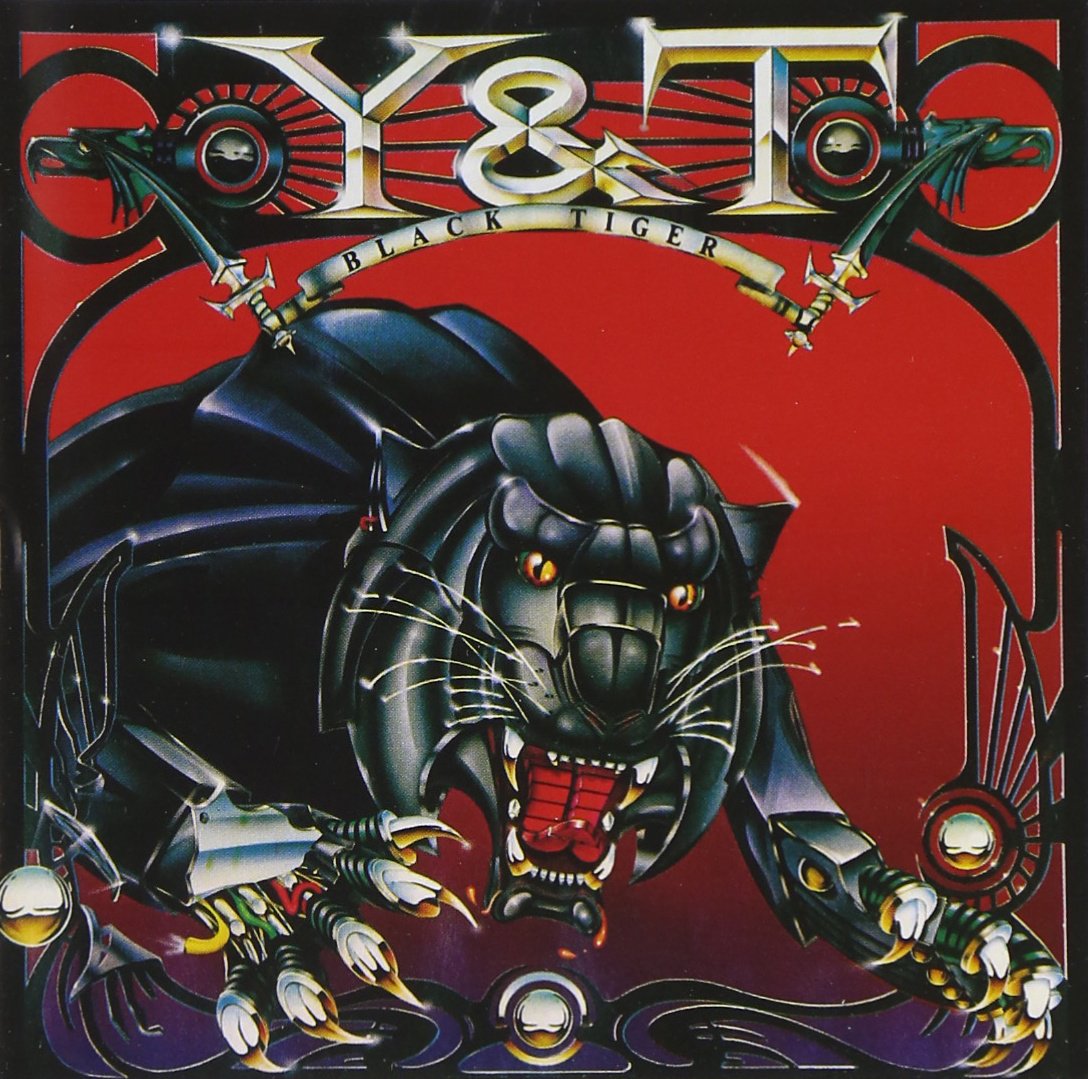
Black Tiger - Y&T

Provenance: It's May 2003, my brother and I are at the Monsters of Rock concert at the Bournemouth International Centre. Headlining is Whitesnake, Gary Moore is also there with his power trio but the first band on is a bit of a mystery to us. Who are Y&T? Neither of us were even alive the last time they had played in the UK.

Suffice to say that Y&T answered the 'who' question emphatically with a blistering set. During 'Open Fire' I recall turning to my brother and seeing him give a little nod and a smile. I nodded back. No words needed. We both knew it meant that these hombres were the real deal.

Thirteen years later I'm about to go and see Y&T play in London for what is maybe the tenth time, spread out over three countries, taking in festival shows and their now-frequent European tours. I go back (dragging along friends and family alike) because not once have they ever put on a bad show. The energy has never dipped. I've seen them play mid-afternoon in bucketing rain (Sweden Rock Festival) and deliver the same performance as they did at my favourite ever Y&T show (since you asked, 2009 at The Brook in Southampton; intimate venue, great sound, vocal crowd and we were right down the front). Go see them if you ever get the chance.

Review: More hard rock bands should do the whole 'bombastic instrumental intro' thing. It worked for Judas Priest on Screaming For Vengeance and it works here on Black Tiger. On record it's pretty cool, but live it's a cue for everyone to lose their shit because they know a) Y&T are about to hit the stage and b) you're about to hear 'Open Fire', one of the great full-tilt hard rockers. Everyone should hear it live at least once in their life.

Y&T began in the mid 1970s but by the time 1982's Black Tiger rolled around they had perfected the sleek, high-energy stadium rock sound that became their calling card. The ace in the hole was frontman Dave Meniketti, a true triple threat as singer, lead guitarist and latterly principal songwriter (all songs on Black Tiger are credited to the four band members). Although a fine vocalist with the ability to holler above the maelstrom of noise, Meniketti is one of the forgotten guitar heroes of the era. Pitched somewhere between the aggression of Riot's Mark Reale and the melodic approach of Journey's Neal Schon, Meniketti's soloing throughout the album is always a joy to behold, by turns lyrical and pyrotechnic.

And then you've got a clutch of songs that could define early 1980s hard rock. Alongside 'Open Fire' there's the grooving 'Don't Wanna Lose', live staple 'Forever', the crunching title track and the anthemic 'My Way Or The Highway'. The cumulative impression is of a band all pulling in the same direction, creating a remarkably balanced and consistent set of songs that could've easily been played front to back in a live setting. Oh yeah, they've also got a ballad called 'Winds Of Change' that's better than the one put out by the Scorpions.

In short, Black Tiger is a very good album. They also play half this stuff live and do it very, very well. As enjoyable as their material is when listened to in private, for me it really comes to life after a few beers in a room full of punters with the amps up high. Yes, another call to go see Y&T live - because if any band deserves your bunce, it's these chaps.

It is slightly sobering to look at the credits and realise that half of the lineup that recorded Black Tiger are no longer with us. Hearing of Phil Kennemore's passing in 2011 was a real shock to me. He had been, alongside Meniketti, an original member and looked every inch the rock star - legs akimbo, shirt unbuttoned to the navel, the man oozed charisma and looked strong as an ox.

Adding to an already crap 2016, last month original tub-thumper Leonard Haze died at the age of 61. I remember him swinging away at the Bournemouth show with fondness, and always appreciated his credits on the Black Tiger album: 'drums, percussion, mayhem'. The best way to remember the man, I should think.

(On a lighter note, I am a fan of non-musical credits. For a very brief moment during my university days I filled in with a black metal band. Their (unlistenable) EP contained the immortal credit of 'keyboards, synthesizers, stewardry of the forest'.)