Provenance: For many years a rather unsettling poster named Yellow Discipline lurked on the music forum I frequented, emerging from the shadows occasionally to communicate something weird or unsettling. The man obviously had some strange peccadilloes, notwithstanding his penchant for giving himself full-body paint makeovers.
Yet it took an original song competition to fully reveal the hidden talents of Dead Billy, Ohio's most infamous son. Poking out like a severed limb amidst the fluff rock and pop-country was 'Lollipop', which wormed its way into your ear with the repeated refrain 'Kissy shy, shy / Oooh, kissy kissy shy'. Sadly the YouTube video is no longer available but you can hear it using Last.fm and I recommend it thoroughly.
If that wasn't enough, shortly thereafter in 2011 Yellow Discipline announced he had finished his first album, Songs About Hatefucking, and that he'd distribute it to his fellow posters upon request for free. The album was great, and three years later he repeated the gesture with his sophomore effort Cunt Machine. Yellow Discipline remains a murky and mysterious figure to many, and even though I think I may know his name, I am both grateful that he's maintained his creepy mystique and that there's an ocean and a great deal of land between us.
Review: One of the defining aspects of outsider music is that it tends to be created by loners, or at the very least, solo performers. Although the Shaggs are a wonderful exception to the rule, most outsider endeavours shine because of the singularity of vision and purpose, irrespective of how odd the execution may be. And here we have one that shines very darkly; one would be careful to throw around a word like 'execution' too carelessly. The liner notes say all songs were written, recorded and performed ("at night") by Yellow Discipline, and instruct us to admire at maximum volume. At least he's moved from Dead Billy (not a real place, by the way) but to Akron, Ohio, albeit the address given is 52 Bukakke Holocaust Drive.
Now, here's the damndest thing. If Yellow Discipline could somehow reign in his unruly id he could be the next Desmond Child. It isn't just hipster contrarianism when I say that Cunt Machine is one of the catchiest albums I've acquired in the last fifteen or so years. The wrinkle here is that instead of sappy love songs, Yellow Discipline writes death disco about setting a girl's face on fire. His songs are better than anything Child or Linda Perry and their ilk have ever been able to conjure up, but their success may partly due to the fact that they don't write songs called 'Rape Whistle' or 'I, Pervert'.
This is as good as it gets for someone toiling alone in their sex dungeon. Yellow Discipline doesn't have a great voice in the traditional sense but treats it with effects to make it sound weird and disembodied. The hooks are massive, courtesy of punchy guitar work and spooky keyboards playing repetitive but catchy riffs that bury themselves into your cerebral cortex like a splatter-movie hatchet. 'Little Girls', 'Cunt Machine' and the aforementioned 'I, Pervert' sound like White Zombie if they were recorded by the ghost of Joe Meek. There is one slow song, 'Naughty Girl', but the almost pastoral tambourine and acoustic guitar are offset by a keening, asphyxiated keyboard riff. Of course, the lyrics are also pretty grim, and just in case you thought you were listening to Caravan for a moment, as the music dies down you're met with a strangulated 'fuck you all', close to the microphone. Close to your ear.
But my goodness, you can even dance to this stuff. 'God's Gift' is the best song Billy Idol never recorded, and will never record, because the chorus is 'Yellow don't fuck me mellow / Yellow pretty please / Turn my pussy to jello'. Almost as brilliant is 'Love Letters In Blood' - a rollicking, slippery horrorcore toe-tapper (sample lyric: 'Every demon in this town / Screams without a sound / Just like our love'). Honestly, it's absolutely fantastic. The whole damn thing is a triumph, a sick, violent, messy triumph, and it's the real thing. We're not talking the sleazy demimonde of early Ultravox! or the writing of Hubert Selby Jr - this is the stuff the guy in the sex shop goes out the back to retrieve. This is the album that's most likely to be called 'exhibit A' in a court proceeding.
Who knows? Perhaps Yellow Discipline is like Alice Cooper, attending Bible study and playing golf on his days off. Very few musical bogeymen endure without the mask slipping - when I was growing up, Marilyn Manson was the ghoul parents were most afraid of, but the God of Fuck turned out to be a geek who couldn't wait to show up in Sons of Anarchy. The truly subversive, it could be argued, never make the mainstream in the first place - and that's why mention of GG Allin will draw blank expressions from most people. As Yellow Discipline chooses to be elusive it is no difficulty to maintain this persona of arch-pervert for his mostly online fanbase - if, indeed, Yellow Discipline is a work. I'm not so sure. If it is, I have to admire his conviction. When he's singing his sado-sexual gutter poetry, there's an evident intensity - almost an ecstasy - in the quavering voice, a palpable relish at enunciating every one of his fell desires.
At one point a fair bit of Yellow Discipline's work was on YouTube, but for one reason or another has been removed. You can, however, hear both Songs About Hatefucking and this one, Cunt Machine, on Spotify [update February 2021: they're gone from Spotify]. Sweet dreams.
A blog about one man and his stupid music collection. Mainly about the music, though the man intrudes now and again.
Sunday, 30 October 2016
Sunday, 23 October 2016
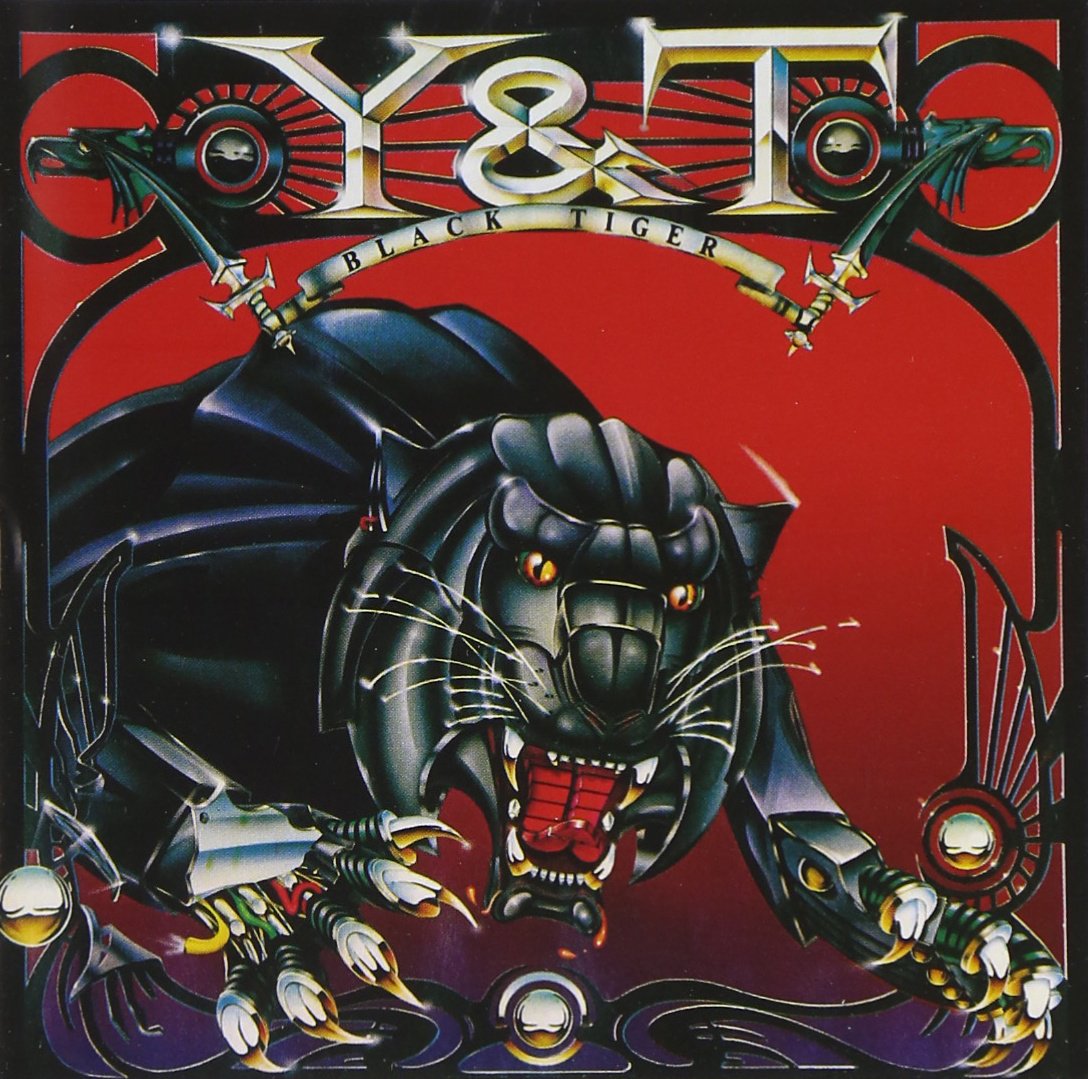
Black Tiger - Y&T
Provenance: It's May 2003, my brother and I are at the Monsters of Rock concert at the Bournemouth International Centre. Headlining is Whitesnake, Gary Moore is also there with his power trio but the first band on is a bit of a mystery to us. Who are Y&T? Neither of us were even alive the last time they had played in the UK.
Suffice to say that Y&T answered the 'who' question emphatically with a blistering set. During 'Open Fire' I recall turning to my brother and seeing him give a little nod and a smile. I nodded back. No words needed. We both knew it meant that these hombres were the real deal.
Thirteen years later I'm about to go and see Y&T play in London for what is maybe the tenth time, spread out over three countries, taking in festival shows and their now-frequent European tours. I go back (dragging along friends and family alike) because not once have they ever put on a bad show. The energy has never dipped. I've seen them play mid-afternoon in bucketing rain (Sweden Rock Festival) and deliver the same performance as they did at my favourite ever Y&T show (since you asked, 2009 at The Brook in Southampton; intimate venue, great sound, vocal crowd and we were right down the front). Go see them if you ever get the chance.
Review: More hard rock bands should do the whole 'bombastic instrumental intro' thing. It worked for Judas Priest on Screaming For Vengeance and it works here on Black Tiger. On record it's pretty cool, but live it's a cue for everyone to lose their shit because they know a) Y&T are about to hit the stage and b) you're about to hear 'Open Fire', one of the great full-tilt hard rockers. Everyone should hear it live at least once in their life.
Y&T began in the mid 1970s but by the time 1982's Black Tiger rolled around they had perfected the sleek, high-energy stadium rock sound that became their calling card. The ace in the hole was frontman Dave Meniketti, a true triple threat as singer, lead guitarist and latterly principal songwriter (all songs on Black Tiger are credited to the four band members). Although a fine vocalist with the ability to holler above the maelstrom of noise, Meniketti is one of the forgotten guitar heroes of the era. Pitched somewhere between the aggression of Riot's Mark Reale and the melodic approach of Journey's Neal Schon, Meniketti's soloing throughout the album is always a joy to behold, by turns lyrical and pyrotechnic.
And then you've got a clutch of songs that could define early 1980s hard rock. Alongside 'Open Fire' there's the grooving 'Don't Wanna Lose', live staple 'Forever', the crunching title track and the anthemic 'My Way Or The Highway'. The cumulative impression is of a band all pulling in the same direction, creating a remarkably balanced and consistent set of songs that could've easily been played front to back in a live setting. Oh yeah, they've also got a ballad called 'Winds Of Change' that's better than the one put out by the Scorpions.
In short, Black Tiger is a very good album. They also play half this stuff live and do it very, very well. As enjoyable as their material is when listened to in private, for me it really comes to life after a few beers in a room full of punters with the amps up high. Yes, another call to go see Y&T live - because if any band deserves your bunce, it's these chaps.
It is slightly sobering to look at the credits and realise that half of the lineup that recorded Black Tiger are no longer with us. Hearing of Phil Kennemore's passing in 2011 was a real shock to me. He had been, alongside Meniketti, an original member and looked every inch the rock star - legs akimbo, shirt unbuttoned to the navel, the man oozed charisma and looked strong as an ox.
Adding to an already crap 2016, last month original tub-thumper Leonard Haze died at the age of 61. I remember him swinging away at the Bournemouth show with fondness, and always appreciated his credits on the Black Tiger album: 'drums, percussion, mayhem'. The best way to remember the man, I should think.
(On a lighter note, I am a fan of non-musical credits. For a very brief moment during my university days I filled in with a black metal band. Their (unlistenable) EP contained the immortal credit of 'keyboards, synthesizers, stewardry of the forest'.)
Suffice to say that Y&T answered the 'who' question emphatically with a blistering set. During 'Open Fire' I recall turning to my brother and seeing him give a little nod and a smile. I nodded back. No words needed. We both knew it meant that these hombres were the real deal.
Thirteen years later I'm about to go and see Y&T play in London for what is maybe the tenth time, spread out over three countries, taking in festival shows and their now-frequent European tours. I go back (dragging along friends and family alike) because not once have they ever put on a bad show. The energy has never dipped. I've seen them play mid-afternoon in bucketing rain (Sweden Rock Festival) and deliver the same performance as they did at my favourite ever Y&T show (since you asked, 2009 at The Brook in Southampton; intimate venue, great sound, vocal crowd and we were right down the front). Go see them if you ever get the chance.
Review: More hard rock bands should do the whole 'bombastic instrumental intro' thing. It worked for Judas Priest on Screaming For Vengeance and it works here on Black Tiger. On record it's pretty cool, but live it's a cue for everyone to lose their shit because they know a) Y&T are about to hit the stage and b) you're about to hear 'Open Fire', one of the great full-tilt hard rockers. Everyone should hear it live at least once in their life.
Y&T began in the mid 1970s but by the time 1982's Black Tiger rolled around they had perfected the sleek, high-energy stadium rock sound that became their calling card. The ace in the hole was frontman Dave Meniketti, a true triple threat as singer, lead guitarist and latterly principal songwriter (all songs on Black Tiger are credited to the four band members). Although a fine vocalist with the ability to holler above the maelstrom of noise, Meniketti is one of the forgotten guitar heroes of the era. Pitched somewhere between the aggression of Riot's Mark Reale and the melodic approach of Journey's Neal Schon, Meniketti's soloing throughout the album is always a joy to behold, by turns lyrical and pyrotechnic.
And then you've got a clutch of songs that could define early 1980s hard rock. Alongside 'Open Fire' there's the grooving 'Don't Wanna Lose', live staple 'Forever', the crunching title track and the anthemic 'My Way Or The Highway'. The cumulative impression is of a band all pulling in the same direction, creating a remarkably balanced and consistent set of songs that could've easily been played front to back in a live setting. Oh yeah, they've also got a ballad called 'Winds Of Change' that's better than the one put out by the Scorpions.
In short, Black Tiger is a very good album. They also play half this stuff live and do it very, very well. As enjoyable as their material is when listened to in private, for me it really comes to life after a few beers in a room full of punters with the amps up high. Yes, another call to go see Y&T live - because if any band deserves your bunce, it's these chaps.
It is slightly sobering to look at the credits and realise that half of the lineup that recorded Black Tiger are no longer with us. Hearing of Phil Kennemore's passing in 2011 was a real shock to me. He had been, alongside Meniketti, an original member and looked every inch the rock star - legs akimbo, shirt unbuttoned to the navel, the man oozed charisma and looked strong as an ox.
Adding to an already crap 2016, last month original tub-thumper Leonard Haze died at the age of 61. I remember him swinging away at the Bournemouth show with fondness, and always appreciated his credits on the Black Tiger album: 'drums, percussion, mayhem'. The best way to remember the man, I should think.
(On a lighter note, I am a fan of non-musical credits. For a very brief moment during my university days I filled in with a black metal band. Their (unlistenable) EP contained the immortal credit of 'keyboards, synthesizers, stewardry of the forest'.)
Labels:
black tiger,
bournemouth,
gary moore,
haze,
kennemore,
live,
mayhem,
meniketti,
southampton,
stewardry,
whitesnake,
Y&T
Sunday, 16 October 2016
Nintendo: White Knuckle Scorin' - Various Artists
Provenance: Reading an article about Roy Orbison, I chanced across a peculiar little factoid: that the first time his version of 'I Drove All Night' appeared on compact disc it was as part of a concept album / compilation put out by Nintendo called Nintendo: White Knuckle Scorin'.
Having investigated further, I felt I had no other recourse than to get hold of a copy. After all, who could resist a 1991 album that strings a Mario 'n' Luigi story together with songs by such hip young gunslingers as Crosby Stills & Nash, Dire Straits, Jellyfish, Flesh For Lulu, Trixter and 'the Big O'?
Review: Before I get going on the music I feel some kind of exposition is necessary. For reasons perhaps known only to executive producers Ken Kushnick and David Passick it was felt necessary to try and mirror the experience of playing the Super NES title Super Mario World through the medium of concept album. And by concept album, I don't mean the stuffy obscurantism of the Alan Parsons Project or David Axelrod; what the kids want is an almost incomprehensible narrative (written in startlingly chauvinistic language) punctuated by ten songs by hair metal bands, a dead man, and your dad's favourite West Coast folk harmonisers, none of which bear any relation to the storyline.
Actually, I'm being slightly unfair as the first track, Jellyfish's 'Ignorance Is Bliss', was written specifically for this project. So that's only nine entirely random tracks. Perhaps the remainder are supposed speak to the rich inner life of the humble plumber Mario?
We live in an age where computer games are played by everyone, on multiple platforms. This being the case, perhaps it was inevitable that debates about portrayals of women within games (and sexism within the industry itself) would occur, and that they were long overdue. Case in point: judging by what was deemed releasable in 1991, I would suggest that the creators of this album guessed that the only people playing computer games at the time were creepy hormonal boys. Barely a reference to Princess Toadstool goes by without mention being made of how 'hot' she is, or how her 'dynamite bod' is being imperilled. Saying that, given the technological limitations of the age I can't decide whether this attitude is more more puzzling than problematic, given that this pre-Lara Croft pixellated lorelei appeared on most screens as an almost amorphous pink blob.
Screw it, let's get back to talking music.
I love Jellyfish but had to face down my own trepidation at how they would handle a commission to write a song about Super Mario World. After all, this kind of thing has hardly been the wellspring for great art. I shouldn't have worried - we're talking about bona fide power-pop genii here, and I can confirm that their madcap polka from the perspective of King Bowser, 'Ignorance Is Bliss', is utterly brilliant. Without resorting to the 8-bit bleep palette of noises it somehow manages to sound in places console music whilst retaining that technicolour baroque flavour unique to Jellyfish.
Subtract the Mario 'n' Luigi caper and the first half of the collection is, in fact, very fun and listenable. Crosby Stills & Nash's 'How Have You Been?' is gorgeous, 'I Drove All Night' is majestic to the point of bombast and features one of Orbison's great late-career vocal performances, and even Bombshell's 'Magic In The Night' holds up well as a relic from the hair metal era, a big ol' chugger that sounds suspiciously like Vixen recording under another name. One of the album's true highlights comes courtesy of Dire Straits with the pensive, minimalist 'Iron Hand'. It's also another head-scratcher as I'm pretty damn certain that it's about the Battle of Orgreave.
However, once we've bypassed the strange meshing of mining strikes and Super Mario the quality dips a little. Alias' 'Into The Fire' is a good take on the arena ballad style perfected by Tesla, whilst 'She Was' by Flesh For Lulu is goth filtered through a Madchester sensibility. However, 'Line Of Fire' by manque hair metallers Trixter could almost serve as a manifesto for why grunge had to come along and drive a stake through the scene's glittery, Aquanet-infected heart. Things pick up with Britny Fox's 'Turn On', a catchy cross between Brian Johnson AC/DC and Judas Priest's 'Wild Nights, Hot Crazy Days' but then take a nosedive into the charnel depths of the Mariana Trench with Sheena Easton's 'Forever Friends'. I can't be bothered to describe the track, save to say that it's shit. Evidence.
I like the fact that somewhere in time, somebody thought this album should exist. I like most of the music. By the same token, I can clearly see why this concept never took off. Who the hell did MCA and Nintendo think this would sell to, other than idiots such as myself? A clue about its conception lies in the sleeve notes, as the album is dedicated to musical agent Bobby Brooks, who died in the same helicopter crash that killed Stevie Ray Vaughan. Was this his last project? Are his idiosyncratic tastes reflected in the song selection? From the sleeve notes alone the answers remain tantalisingly out of reach.
It feels like the fallout from a period where record companies sensed that there was something to be monetised in the world of video games and were throwing mud to see if anything stuck. Still, like I said earlier, it's fun, and there's not enough of that in the world right now (NB: to aliens from the future or whatever who might be reading, and who may not have a sense of Earthling irony, I was joking earlier - 2016 wasn't that great).
Having investigated further, I felt I had no other recourse than to get hold of a copy. After all, who could resist a 1991 album that strings a Mario 'n' Luigi story together with songs by such hip young gunslingers as Crosby Stills & Nash, Dire Straits, Jellyfish, Flesh For Lulu, Trixter and 'the Big O'?
Review: Before I get going on the music I feel some kind of exposition is necessary. For reasons perhaps known only to executive producers Ken Kushnick and David Passick it was felt necessary to try and mirror the experience of playing the Super NES title Super Mario World through the medium of concept album. And by concept album, I don't mean the stuffy obscurantism of the Alan Parsons Project or David Axelrod; what the kids want is an almost incomprehensible narrative (written in startlingly chauvinistic language) punctuated by ten songs by hair metal bands, a dead man, and your dad's favourite West Coast folk harmonisers, none of which bear any relation to the storyline.
Actually, I'm being slightly unfair as the first track, Jellyfish's 'Ignorance Is Bliss', was written specifically for this project. So that's only nine entirely random tracks. Perhaps the remainder are supposed speak to the rich inner life of the humble plumber Mario?
We live in an age where computer games are played by everyone, on multiple platforms. This being the case, perhaps it was inevitable that debates about portrayals of women within games (and sexism within the industry itself) would occur, and that they were long overdue. Case in point: judging by what was deemed releasable in 1991, I would suggest that the creators of this album guessed that the only people playing computer games at the time were creepy hormonal boys. Barely a reference to Princess Toadstool goes by without mention being made of how 'hot' she is, or how her 'dynamite bod' is being imperilled. Saying that, given the technological limitations of the age I can't decide whether this attitude is more more puzzling than problematic, given that this pre-Lara Croft pixellated lorelei appeared on most screens as an almost amorphous pink blob.
Screw it, let's get back to talking music.
I love Jellyfish but had to face down my own trepidation at how they would handle a commission to write a song about Super Mario World. After all, this kind of thing has hardly been the wellspring for great art. I shouldn't have worried - we're talking about bona fide power-pop genii here, and I can confirm that their madcap polka from the perspective of King Bowser, 'Ignorance Is Bliss', is utterly brilliant. Without resorting to the 8-bit bleep palette of noises it somehow manages to sound in places console music whilst retaining that technicolour baroque flavour unique to Jellyfish.
Subtract the Mario 'n' Luigi caper and the first half of the collection is, in fact, very fun and listenable. Crosby Stills & Nash's 'How Have You Been?' is gorgeous, 'I Drove All Night' is majestic to the point of bombast and features one of Orbison's great late-career vocal performances, and even Bombshell's 'Magic In The Night' holds up well as a relic from the hair metal era, a big ol' chugger that sounds suspiciously like Vixen recording under another name. One of the album's true highlights comes courtesy of Dire Straits with the pensive, minimalist 'Iron Hand'. It's also another head-scratcher as I'm pretty damn certain that it's about the Battle of Orgreave.
However, once we've bypassed the strange meshing of mining strikes and Super Mario the quality dips a little. Alias' 'Into The Fire' is a good take on the arena ballad style perfected by Tesla, whilst 'She Was' by Flesh For Lulu is goth filtered through a Madchester sensibility. However, 'Line Of Fire' by manque hair metallers Trixter could almost serve as a manifesto for why grunge had to come along and drive a stake through the scene's glittery, Aquanet-infected heart. Things pick up with Britny Fox's 'Turn On', a catchy cross between Brian Johnson AC/DC and Judas Priest's 'Wild Nights, Hot Crazy Days' but then take a nosedive into the charnel depths of the Mariana Trench with Sheena Easton's 'Forever Friends'. I can't be bothered to describe the track, save to say that it's shit. Evidence.
I like the fact that somewhere in time, somebody thought this album should exist. I like most of the music. By the same token, I can clearly see why this concept never took off. Who the hell did MCA and Nintendo think this would sell to, other than idiots such as myself? A clue about its conception lies in the sleeve notes, as the album is dedicated to musical agent Bobby Brooks, who died in the same helicopter crash that killed Stevie Ray Vaughan. Was this his last project? Are his idiosyncratic tastes reflected in the song selection? From the sleeve notes alone the answers remain tantalisingly out of reach.
It feels like the fallout from a period where record companies sensed that there was something to be monetised in the world of video games and were throwing mud to see if anything stuck. Still, like I said earlier, it's fun, and there's not enough of that in the world right now (NB: to aliens from the future or whatever who might be reading, and who may not have a sense of Earthling irony, I was joking earlier - 2016 wasn't that great).
Sunday, 9 October 2016
Destroyed - Sloppy Seconds
Provenance: I wasted a lot of time on a music forum that is nevertheless indirectly responsible for my marriage. It was also directly responsible for the purchase of this album, based solely upon the passionate advocacy of one board member (sorry, can't remember who) on a thread about greatest punk rock albums.
Review: Destroyed starts with a lengthy quote from a John Waters film which segues into a song called 'I Don't Wanna Be A Homosexual'. It sets the tone for an album whose main concerns are sex, junk food, B-movies, puking and under-age pornographic actresses. That is pulls it off with wit and panache is incredible, considering that almost every song has been fine-tooled into a laser-guided offence missile.
It's also my favourite punk rock album. Ever.
As a left-leaning liberal type (NB: for my American readership, I'm essentially a communist) I feel that I should find kinship with something more progressive, or conscious, or at the very least less puerile. I've tried, believe me. But my iPod, which doubles for my car stereo, tells me that Destroyed is one of my most frequented albums, second only to Accept's Balls To The Walls. I've tried the Clash, the Pistols, X-Ray Spex, Dead Kennedys, Propagandhi and more - and enjoyed them - but nothing has come close to this puke-spattered masterpiece in terms of sheer unadulterated fun. If I'm on a long drive, Sloppy Seconds are my guys.
Why? Because it's great to be speeding along the motorway yelling to the gang vocals of 'So Fucked Up'. Or just waiting for the payoff line about masturbation in 'Runnin' From The CIA'. Even the two covers on my version - John Denver's 'Leavin' On A Jet Plane' and Charlie and the Chocolate Factory's 'The Candy Man' are brilliant shout-alongs. As an added bonus, 'Janie Is A Nazi' is easily my favourite rock song that references National Socialism (it's a short list, but it managed to knock 'Chain Lightning' by Steely Dan off top spot (which is definitely about the Nuremburg rallies, screw any other interpretation)).
Sloppy Seconds do two very simple things very well on Destroyed - marry clever, funny lyrics to instantly hummable melodies. That they achieve the philosopher's stone of pop songwriting on practically every cut is remarkable. And it's not all nihilistic stoopidity; both 'Black Roses' (about abortion) and 'Veronica' (suicide) are surprisingly plaintive, and the latter reveals a degree of pathos and vulnerability not found elsewhere on the album.
The other songs that stem from a wellspring of spite are also interesting - 'Germany' is a bizarre, hilarious revenge fantasy, 'Blackmail' is a decidedly un-PC litany of misdeeds and 'If I Had A Woman' is the snotty cousin to Ian Dury and the Blockheads' splenetic 'If I Was With A Woman'. Incidentally, I don't think either song serves to do anything other than highlight the inadequacy and fragility of male identity, both being so nastily misogynistic in tone that only the most demented Men's Rights Activists could approve.
However, if forced to sum up Destroyed in one word, I'd have to return to a word used earlier on: fun. Every trick bubbles with a lusty vim and gusto, each new depravity or excess gleefully delineated by B.A. (vocalist, credited as 'yells' on the liner notes) over buzzsaw bubblegum guitar (played by the magnificently monikered Ace Hardwhere?). To give you an impression of how addictive and infectious it is, Destroyed is one of the very few albums I can hit replay from the beginning as soon as it's finished.
Probably the most perfect distillation of puerility I've heard on record, and all the better for it. If you agree with me life can all too often resemble a verse from Supertramp's 'The Logical Song', too po-faced and serious by half, then this is your doctor feelgood. You can't convince me that shouting along with 'to stop this pandemonium / We're gonna blow 'em up with sodium' (surf-punk ghoulfest 'The Horror Of Party Beach') while careering down the M27 isn't going to be the highlight of my day, or yours for that matter.
Labels:
abortion,
ace hardwhere?,
b.a.,
destroyed,
germany,
john denver,
misogyny,
nazi,
punk,
sloppy seconds,
steely dan,
suicide
Wednesday, 5 October 2016
Recycler - ZZ Top
Provenance: When I was in my teens my mum worked in a local library. Every now and again she would bring home a cassette tape that had been removed from the collections because they had some minor damage (but were otherwise listenable). One such tape was ZZ Top's 1990 album Recycler, and if I recall correctly there was a second or two worth of 'Burger Man' that had been chewed up. I found this tolerable.
Review: This is a peculiar one, because I find Recycler - as a collection of music - to be a mildly entertaining rock album. However, in a wider context, this could be the madeleine cake of my mid-teen years - a time where I played football everyday, played computer games with friends whilst sat on inflatable chairs and dreamed of one day being able to play '20th Century Boy' on guitar. Recycler may be a strange avatar for a very happy time of my life, but it's impossible to divorce the music from the moment, so attempting anything like a fair-handed stab at a review is unlikely.
A constant and welcome part of my life at the time was my pal Chris, who lived down the road from me. We walked home from school together, played in the same Sunday league side, and would watch WWF wrestling - followed by VH1's rock show - round his place on a Friday night. I'm dragging Chris into discussion of this album, because at the time he was probably the world's biggest Metallica fan, a band I can't help but think of when considering where ZZ Top were in their career when Recycler was released.
Firstly, ZZ Top and Metallica both enjoyed early acclaim with distinctive genre albums - Tres Hombres and Deguello for the former, Kill 'Em All, Ride the Lightning and Master of Puppets for the latter. Both then made a big play for commercial success with idiosyncratic and innovative-sounding albums that alienated the hardcore but scored big on sales - Eliminator for the Top, Metallica for, well, take a guess. On that basis, in terms of popularity and career trajectory, Recycler is ZZ Top's Reload. Even the names are faint echoes of each other. But is that fair?
On the one hand, Reload doesn't contain anything like one of my top five Metallica songs, but I'm an absolute sucker for Recycler's lead-off, 'Concrete And Steel'. As a statement of intent, it's a doozy - slabs of guitar, throbbing bass and a fat, chunky sound, the aural equivalent of a coal-rolling monster truck. And it's not that 'Lovething', the next song, is too bad either, probably because its electro-chug hasn't quite worn out its welcome. Unfortunately, that can't be said for succeeding tracks, with ZZ Top wedded to the sequencer to such an extent that you're dying for some kind of rhythmic variation. It's a straight four to the floor, mostly mid-paced (yes, they speed it up! And slow it down!) and devoid of any frills or, indeed, fills. I'm not expecting a polka or what-have-you, but would it have killed them to have done something in shuffle time?
The overall effect is that Recycler becomes a bit of a trudge. With such little variation in either conception or execution, I find that an album central to my formative years is inescapably, and regrettably, a bit boring. Yet I played the shit out of this.
There are tantalising glimpses of an album that is much better than the Recycler that saw the light of day. 'My Head's In Mississippi' is a nasty boogie pitched somewhere between George Thorogood's 'Bad To The Bone' and ZZ Top's own 'Tush', but lacks both the dirt and vitality that drive those two - superior - precursors. 'Burger Man' bounces along nicely enough but is full of lazy, crap innuendoes neither inventive or weird enough by ZZ Top's standards to pass muster. '2000 Blues' sounds like another run at the formula that worked on Eliminator's 'I Need You Tonight'. Again, whereas the earlier track was a slow-burn, neon-flecked ode replete with sadness and regret, '2000 Blues' is just a slow song featuring some Miami Vice blues-bends.
At least the album finishes on a high - we're at 'Doubleback', and it sounds like the guys have snapped out of a collective bout of somnambulism. It's the cousin to 'Concrete And Steel', and has a real humdinger of a chorus, even if it doesn't quite carry the same heft. However, common with all the tracks on Recycler, is that there's not a single memorable Billy Gibbons guitar solo. Gibbons is one of my favourite stylists on the six-string and, especially during the 1970s, would squeeze out some of the smuttiest, sleaziest sounding lead breaks. He had the best guitar tone, too. The best. Here, it's dulled, processed, covered up with whizzbangs and altogether too mannered for it's own good. This element of the music alone stands as an avatar for my wider impressions, which is that Recycler represents both a missed opportunity and an inability to exploit what made ZZ Top so damn listenable in the first place.
Still a hundred times better than Reload though.
Review: This is a peculiar one, because I find Recycler - as a collection of music - to be a mildly entertaining rock album. However, in a wider context, this could be the madeleine cake of my mid-teen years - a time where I played football everyday, played computer games with friends whilst sat on inflatable chairs and dreamed of one day being able to play '20th Century Boy' on guitar. Recycler may be a strange avatar for a very happy time of my life, but it's impossible to divorce the music from the moment, so attempting anything like a fair-handed stab at a review is unlikely.
A constant and welcome part of my life at the time was my pal Chris, who lived down the road from me. We walked home from school together, played in the same Sunday league side, and would watch WWF wrestling - followed by VH1's rock show - round his place on a Friday night. I'm dragging Chris into discussion of this album, because at the time he was probably the world's biggest Metallica fan, a band I can't help but think of when considering where ZZ Top were in their career when Recycler was released.
Firstly, ZZ Top and Metallica both enjoyed early acclaim with distinctive genre albums - Tres Hombres and Deguello for the former, Kill 'Em All, Ride the Lightning and Master of Puppets for the latter. Both then made a big play for commercial success with idiosyncratic and innovative-sounding albums that alienated the hardcore but scored big on sales - Eliminator for the Top, Metallica for, well, take a guess. On that basis, in terms of popularity and career trajectory, Recycler is ZZ Top's Reload. Even the names are faint echoes of each other. But is that fair?
On the one hand, Reload doesn't contain anything like one of my top five Metallica songs, but I'm an absolute sucker for Recycler's lead-off, 'Concrete And Steel'. As a statement of intent, it's a doozy - slabs of guitar, throbbing bass and a fat, chunky sound, the aural equivalent of a coal-rolling monster truck. And it's not that 'Lovething', the next song, is too bad either, probably because its electro-chug hasn't quite worn out its welcome. Unfortunately, that can't be said for succeeding tracks, with ZZ Top wedded to the sequencer to such an extent that you're dying for some kind of rhythmic variation. It's a straight four to the floor, mostly mid-paced (yes, they speed it up! And slow it down!) and devoid of any frills or, indeed, fills. I'm not expecting a polka or what-have-you, but would it have killed them to have done something in shuffle time?
The overall effect is that Recycler becomes a bit of a trudge. With such little variation in either conception or execution, I find that an album central to my formative years is inescapably, and regrettably, a bit boring. Yet I played the shit out of this.
There are tantalising glimpses of an album that is much better than the Recycler that saw the light of day. 'My Head's In Mississippi' is a nasty boogie pitched somewhere between George Thorogood's 'Bad To The Bone' and ZZ Top's own 'Tush', but lacks both the dirt and vitality that drive those two - superior - precursors. 'Burger Man' bounces along nicely enough but is full of lazy, crap innuendoes neither inventive or weird enough by ZZ Top's standards to pass muster. '2000 Blues' sounds like another run at the formula that worked on Eliminator's 'I Need You Tonight'. Again, whereas the earlier track was a slow-burn, neon-flecked ode replete with sadness and regret, '2000 Blues' is just a slow song featuring some Miami Vice blues-bends.
At least the album finishes on a high - we're at 'Doubleback', and it sounds like the guys have snapped out of a collective bout of somnambulism. It's the cousin to 'Concrete And Steel', and has a real humdinger of a chorus, even if it doesn't quite carry the same heft. However, common with all the tracks on Recycler, is that there's not a single memorable Billy Gibbons guitar solo. Gibbons is one of my favourite stylists on the six-string and, especially during the 1970s, would squeeze out some of the smuttiest, sleaziest sounding lead breaks. He had the best guitar tone, too. The best. Here, it's dulled, processed, covered up with whizzbangs and altogether too mannered for it's own good. This element of the music alone stands as an avatar for my wider impressions, which is that Recycler represents both a missed opportunity and an inability to exploit what made ZZ Top so damn listenable in the first place.
Still a hundred times better than Reload though.
Labels:
billy gibbons,
boogie,
george thorohood,
metallica,
recycler,
reload,
rock,
sequencer,
zz top
Sunday, 25 September 2016
Christopher Cross - Christopher Cross
Provenance: The first time I knowingly encountered the work of Christopher Cross was through a Saxon album that was, somewhat incongruously, for sale at a university bookshop. The song in question was, of course, their cover of 'Ride Like The Wind', which I considered a highlight.
The next time I really zeroed in on a Cross composition was when I encountered 'Sailing' in this episode of the always-excellent Channel 101 series Yacht Rock. For those unaware of Yacht Rock, I urge you leave this blog immediately and do something truly worthwhile, ie, binge watch the series on YouTube from start to finish. Please come back though.
Review: For all my heavy metal posturing (yeah, I saw Steve Grimmett's Grim Reaper this weekend), I really do love a bit of gleam and polish every now and again. I don't mean the flat, clippy, mechanically precise products of the Pro-Tools generation. However, give me a touch of pop sophistication, a dash of craftsmanship and perhaps Michael McDonald doing backing vocals and we're talking. Hall and Oates, Supertramp, Boz Scaggs (come on guy, 'Lido Shuffle' is just about perfect), Cate Brothers, Toto - these are my people. I prostrate myself at the altar of Donald Fagen and Walter Becker, and Steely Dan continuously vie with Blue Oyster Cult for the laurels of the coveted 'my favwite band evah' award.
Oddly, my enjoyment of the yacht rock genre (such as it has been called) means that I might actually be cool for once in my life, as this rather excitable and confused apologia argues. I don't buy it. Virtually every popular music genre undergoes a process of reappraisal at some point or another, with contemporary artists hip to the cause paying tribute in their work. All trends, including those that ride a wave of retro-nostalgia, eventually wane, leaving behind their artefacts for subsequent generations to (re)discover. Put more simply still, there's some enduringly great yacht rock out there. And I reckon that Christopher Cross is amongst the best.
You may have heard the story of how the formerly unheralded Fleetwood Mac roadie came from nowhere to sweep the 1980 Grammy Awards. Have you listened to the album recently? It's disgustingly good. Almost too pretty. There's not a hint of grit or a rough edge in sight. From start to finish it's like gorgeously delicious caramel is dripping from your speakers; you want to gorge on the almost too-rich sound. You've got Cross' soaring, strangely disembodied voice. You've got 'tasteful' brass parts. Lush arrangements. Congas. Hooks. Michael McDonald. Don Henley (the Eagles), J.D. Souther, Larry Carlton (Steely Dan), Victor Feldman (loads of people, plus Steely Dan) and Eric Johnson (Eric Johnson) all lend a hand too but the real mustard, as any fool knows (or believes), is a Michael McDonald backing vocal.
I don't think I'm being unfair when I say that Christopher Cross is a vacuous record. I'm not ascribing any negative connotations to that quality, as this is all surface; a pearlescent, refulgent surface, glowing pink and orange in a Malibu sunset. And that's not to say that Cross is a crap lyricist or anything. In fact, where Cross triumphs is the marriage of some fairly cute, albeit standard, sentiments about love (found, lost or unrequited) with the perfect musical accompaniment. Thus 'Poor Shirley' never sounds mawkish, and 'The Light Is On' is sketched with just enough mystery and apprehension, not to mention a superb chorus, to help it over the line that separates genius from stupidity.
As an aside, I should mention that my CD contains a quote from Mr Cross himself, recreated here in full because of its utter superfluity:
The next time I really zeroed in on a Cross composition was when I encountered 'Sailing' in this episode of the always-excellent Channel 101 series Yacht Rock. For those unaware of Yacht Rock, I urge you leave this blog immediately and do something truly worthwhile, ie, binge watch the series on YouTube from start to finish. Please come back though.
Review: For all my heavy metal posturing (yeah, I saw Steve Grimmett's Grim Reaper this weekend), I really do love a bit of gleam and polish every now and again. I don't mean the flat, clippy, mechanically precise products of the Pro-Tools generation. However, give me a touch of pop sophistication, a dash of craftsmanship and perhaps Michael McDonald doing backing vocals and we're talking. Hall and Oates, Supertramp, Boz Scaggs (come on guy, 'Lido Shuffle' is just about perfect), Cate Brothers, Toto - these are my people. I prostrate myself at the altar of Donald Fagen and Walter Becker, and Steely Dan continuously vie with Blue Oyster Cult for the laurels of the coveted 'my favwite band evah' award.
Oddly, my enjoyment of the yacht rock genre (such as it has been called) means that I might actually be cool for once in my life, as this rather excitable and confused apologia argues. I don't buy it. Virtually every popular music genre undergoes a process of reappraisal at some point or another, with contemporary artists hip to the cause paying tribute in their work. All trends, including those that ride a wave of retro-nostalgia, eventually wane, leaving behind their artefacts for subsequent generations to (re)discover. Put more simply still, there's some enduringly great yacht rock out there. And I reckon that Christopher Cross is amongst the best.
You may have heard the story of how the formerly unheralded Fleetwood Mac roadie came from nowhere to sweep the 1980 Grammy Awards. Have you listened to the album recently? It's disgustingly good. Almost too pretty. There's not a hint of grit or a rough edge in sight. From start to finish it's like gorgeously delicious caramel is dripping from your speakers; you want to gorge on the almost too-rich sound. You've got Cross' soaring, strangely disembodied voice. You've got 'tasteful' brass parts. Lush arrangements. Congas. Hooks. Michael McDonald. Don Henley (the Eagles), J.D. Souther, Larry Carlton (Steely Dan), Victor Feldman (loads of people, plus Steely Dan) and Eric Johnson (Eric Johnson) all lend a hand too but the real mustard, as any fool knows (or believes), is a Michael McDonald backing vocal.
I don't think I'm being unfair when I say that Christopher Cross is a vacuous record. I'm not ascribing any negative connotations to that quality, as this is all surface; a pearlescent, refulgent surface, glowing pink and orange in a Malibu sunset. And that's not to say that Cross is a crap lyricist or anything. In fact, where Cross triumphs is the marriage of some fairly cute, albeit standard, sentiments about love (found, lost or unrequited) with the perfect musical accompaniment. Thus 'Poor Shirley' never sounds mawkish, and 'The Light Is On' is sketched with just enough mystery and apprehension, not to mention a superb chorus, to help it over the line that separates genius from stupidity.
As an aside, I should mention that my CD contains a quote from Mr Cross himself, recreated here in full because of its utter superfluity:
I'm a very nonpolitical and nonintellectual lyricist. But people have so many demands on them already in their lives. I'm just trying to give them a little enjoyment and relaxation.Seriously Christopher, there is nothing - nothing - remotely controversial on the album. Nobody is confusing you with Billy Bragg or Skrewdriver. Nobody is going to start a white supremacist group after listening to 'Sailing'. The only time Cross sounds vaguely pugilistic is on 'Ride Like The Wind', a soft rock classic, featuring the wimpiest man in the world boasting about having a gun and never going to church. The final flourish is the soulful, doleful 'Minstrel Gigolo', sketching a seemingly enviable life of adulation but sung in the manner of a man down to his last pina colada, chalk-blue sports jacket slung over one shoulder. It is, as with everything else on the record, immaculate. Essential.
Sunday, 18 September 2016
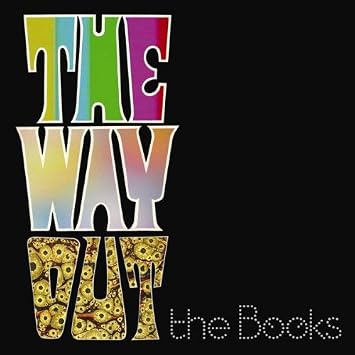
The Way Out - The Books
Provenance: This isn't really my album, but my partner's. However, as with all CDs in our dwelling, it has been subsumed into the collection in much the same way as 'the Blob' enveloped a small town in Pennsylvania. That was a good film, wasn't it? Anyway, as such The Way Out has been deemed a legitimate candidate for review on this blog. By that, I mean in essence that I make the rules up as I go along.
Review: Well. I like it. I've never actually listened to this all the way through until I sat down to write this review, but the few preconceptions I had were based around 'A Cold Freezing Night', a track beloved by my partner, which uses snippets of speech between two young siblings, coupled with a weird, slapstick electronica, to create a heightening sense of anxiety and tension.
This approach, it turns out is pretty par for the course - instruments and samples burst from nowhere, odd but never dissonant, and often delightfully surprising. I imagine Nick Zammuto and Paul de Jong have grown exceedingly bored of being called musical magpies, but it's entirely apt. This disparate grab bag of sound is often welded to guitar and drum machine, giving structure to what could be an unholy mess. In fact, through the uncanny mechanics of synthesis, much of The Way Out sounds like companion pieces to the output of other artists, as if their sweepings from the studio floor had been spliced together to make mutant music.
The most obvious comparison with The Books is the Ghost Box record label, whose stock in trade is 'hauntology', whereby a not wholly benign, atavistic past is summoned up through the sampling of documentary, movie and public information film, set to psychedelic electronica. The Ghost Box sound (what a wonderful name for a record label, by the way - don't you think it's brilliantly evocative?) comes very close to being replicated on 'Group Autogenics I', with its soothing, nonsensical self-hypnosis narrative, and 'Chain Of Missing Links'. Oddly, on 'IDKT' I got a strong whiff of Sex And Religion-era Steve Vai, whilst 'All You Need Is A Wall' could've come straight off Feist's Metals album.
Perhaps that's the point. Without speaking to either guy who constituted The Books (they disbanded in 2012), I would guess that there was a conscious effort to make, through a collage technique, something that sounded familiar without being entirely plausible as mere pastiche. At some point, the music becomes wrinkled, twisted; the sonic equivalent of a shirt that doesn't button up properly. All very clever.
But I like The Way Out without loving it. It's difficult to really explain why. Perhaps it's those rare moments where The Books are aiming for beautiful and instead hit pretty. Perhaps it's because it's just a smidge too self-consciously odd, a somewhat studied exercise in the bizarre. Contrast that with a Daniel Johnston, Wesley Willis or even a Captain Beefheart, from whom weirdness gushes forth as naturally as water from a spigot. Maybe it's just that I get a sneaking sensation that The Way Out is little more than a hauntological re-remembering of White Noise's groundbreaking 1969 album An Electric Storm, which feels simultaneously like a monstrous slur yet not inaccurate.
I want to listen to it again, though. And possibly again after that. Dark room, lava lamp, headphones, The Way Out - an agreeable way to enrich an hour of my existence.
Review: Well. I like it. I've never actually listened to this all the way through until I sat down to write this review, but the few preconceptions I had were based around 'A Cold Freezing Night', a track beloved by my partner, which uses snippets of speech between two young siblings, coupled with a weird, slapstick electronica, to create a heightening sense of anxiety and tension.
This approach, it turns out is pretty par for the course - instruments and samples burst from nowhere, odd but never dissonant, and often delightfully surprising. I imagine Nick Zammuto and Paul de Jong have grown exceedingly bored of being called musical magpies, but it's entirely apt. This disparate grab bag of sound is often welded to guitar and drum machine, giving structure to what could be an unholy mess. In fact, through the uncanny mechanics of synthesis, much of The Way Out sounds like companion pieces to the output of other artists, as if their sweepings from the studio floor had been spliced together to make mutant music.
The most obvious comparison with The Books is the Ghost Box record label, whose stock in trade is 'hauntology', whereby a not wholly benign, atavistic past is summoned up through the sampling of documentary, movie and public information film, set to psychedelic electronica. The Ghost Box sound (what a wonderful name for a record label, by the way - don't you think it's brilliantly evocative?) comes very close to being replicated on 'Group Autogenics I', with its soothing, nonsensical self-hypnosis narrative, and 'Chain Of Missing Links'. Oddly, on 'IDKT' I got a strong whiff of Sex And Religion-era Steve Vai, whilst 'All You Need Is A Wall' could've come straight off Feist's Metals album.
Perhaps that's the point. Without speaking to either guy who constituted The Books (they disbanded in 2012), I would guess that there was a conscious effort to make, through a collage technique, something that sounded familiar without being entirely plausible as mere pastiche. At some point, the music becomes wrinkled, twisted; the sonic equivalent of a shirt that doesn't button up properly. All very clever.
But I like The Way Out without loving it. It's difficult to really explain why. Perhaps it's those rare moments where The Books are aiming for beautiful and instead hit pretty. Perhaps it's because it's just a smidge too self-consciously odd, a somewhat studied exercise in the bizarre. Contrast that with a Daniel Johnston, Wesley Willis or even a Captain Beefheart, from whom weirdness gushes forth as naturally as water from a spigot. Maybe it's just that I get a sneaking sensation that The Way Out is little more than a hauntological re-remembering of White Noise's groundbreaking 1969 album An Electric Storm, which feels simultaneously like a monstrous slur yet not inaccurate.
I want to listen to it again, though. And possibly again after that. Dark room, lava lamp, headphones, The Way Out - an agreeable way to enrich an hour of my existence.
Labels:
blob,
books,
collage,
electric storm,
electronica,
ghost box,
nick zammuto,
paul de jong,
the way out,
vai,
white noise
Sunday, 4 September 2016
Heavy Traffic - Status Quo
Provenance: I like Status Quo. They were the first band I ever saw in a live setting, and it left a profound effect on me. The two most vivid things I remember about that gig was, firstly, the addictive quality of sheer volume; and secondly, my Dad singing along to 'In The Army Now'.
Review: Along with many, many other households in this sceptered isle, I also possess one of the legion Status Quo 'greatest hits' collections. (For my US-based readers, the Status Quo 'best of' is as ubiquitous as Frampton Comes Alive is in the Midwest). That's all the Quo most people require, but I saw them performing 'Jam Side Down' on Top of the Pops and thought it sounded decent enough to drop coin on the parent album.
And you know what? For the most part it is decent enough. Better than that, as it happens. Most of the songs sound a bit like other Status Quo songs, the good ones. We're mostly talking about the sledgehammer boogie sound Quo have almost trademarked since jettisoning their early psychedelic pretensions. In fact, 'All Stand Up', 'Creepin' Up On You', 'Solid Gold' and 'Money Don't Matter' could (and possibly do) sit comfortably with the rest of their material in a live set. The only curveball, sonically speaking, is 'Green', whose inheritance can be traced to 'Gerdundula'. The rest is a bit fillerish but not unpleasant. Except for one track - 'The Oriental'.
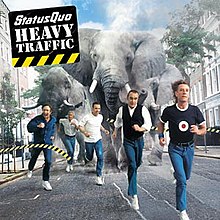
Status Quo don't generally deal in subtleties or finer feelings, so it's apt that they've actually included an elephant on the front cover to symbolise the one that 'The Oriental' introduces into the room. At some point in the writing process, Francis Rossi and John 'Rhino' Edwards (this paragraph is like a safari thus far) presumably thought it'd be a lark to write a tune about mail order Asian brides. Not in a sensitive manner, you understand. The more charitable listener might suggest that it's just a lark, and that half the lyrics are nonsensical. The latter is true - but the sticking point is the other half, replete with pidgin English (ha ha! Because East Asians all speak like that!), lazy cultural stereotyping and the apparent ease in which women can be traded or rented like commodities.
Making play with the perceived exoticism of the Far East has been the stock in trade for many Western musicians. Now, I don't want to be too harsh here because for boys and girls raised in suburban or working class Europe or America, playing somewhere like Japan must've seemed somewhat fantastical. So we get Deep Purple's 'Woman From Tokyo', Y&T's 'Midnight In Tokyo', Krokus' 'Tokyo Nights' and the weird Todd Rundgren song 'Eastern Intrigue' (and, I suppose, Aneka's 'Japanese Boy' or Carl Douglas' 'Kung Fu Fighting'). But that was way back when, and this is a bunch of late-middle aged men in 2002. I just can't find one redeemable or even venial element about 'The Oriental'. It is perhaps apposite that the lineup that recorded this crap actually looks like a bunch of guys who spend their evenings trawling mail order bride websites.
As well as being fairly racist, it's also a monumentally stupid song. There's some lyrics in the middle eight that, I guess, are supposed to convey the sense of a whistle-stop tour of the East. Except that 'and carry on to China / Asia Minor and some more' makes precious little sense, because Asia Minor is most accurately expressed today as the Asian territory of modern day Turkey. It serves to underline the rather parochial reputation that Status Quo have earned for their perceived lack of ambition in territories outside of the UK (whilst boogie contemporaries Foghat and AC/DC set about conquering the US and the world respectively). Perhaps I am expecting too much of poor old Rhino, a man of such delicate sentiment that in 2006 he was moved to write a song about his favourite Brentford FC striker.
Sorry if you expected a more forensic review of the album. Honestly, if you excised 'The Oriental' you have a really punchy, four-to-the-floor rock album. As it stands, its inclusion is as if somebody wiped their shitty ass over your nice new Belgian lace tablecloth. Use the skip function on your stereo, or download Heavy Traffic and delete track three. It's a reasonably lengthy album, you won't miss it. Nobody will miss it.
Review: Along with many, many other households in this sceptered isle, I also possess one of the legion Status Quo 'greatest hits' collections. (For my US-based readers, the Status Quo 'best of' is as ubiquitous as Frampton Comes Alive is in the Midwest). That's all the Quo most people require, but I saw them performing 'Jam Side Down' on Top of the Pops and thought it sounded decent enough to drop coin on the parent album.
And you know what? For the most part it is decent enough. Better than that, as it happens. Most of the songs sound a bit like other Status Quo songs, the good ones. We're mostly talking about the sledgehammer boogie sound Quo have almost trademarked since jettisoning their early psychedelic pretensions. In fact, 'All Stand Up', 'Creepin' Up On You', 'Solid Gold' and 'Money Don't Matter' could (and possibly do) sit comfortably with the rest of their material in a live set. The only curveball, sonically speaking, is 'Green', whose inheritance can be traced to 'Gerdundula'. The rest is a bit fillerish but not unpleasant. Except for one track - 'The Oriental'.
Status Quo don't generally deal in subtleties or finer feelings, so it's apt that they've actually included an elephant on the front cover to symbolise the one that 'The Oriental' introduces into the room. At some point in the writing process, Francis Rossi and John 'Rhino' Edwards (this paragraph is like a safari thus far) presumably thought it'd be a lark to write a tune about mail order Asian brides. Not in a sensitive manner, you understand. The more charitable listener might suggest that it's just a lark, and that half the lyrics are nonsensical. The latter is true - but the sticking point is the other half, replete with pidgin English (ha ha! Because East Asians all speak like that!), lazy cultural stereotyping and the apparent ease in which women can be traded or rented like commodities.
Making play with the perceived exoticism of the Far East has been the stock in trade for many Western musicians. Now, I don't want to be too harsh here because for boys and girls raised in suburban or working class Europe or America, playing somewhere like Japan must've seemed somewhat fantastical. So we get Deep Purple's 'Woman From Tokyo', Y&T's 'Midnight In Tokyo', Krokus' 'Tokyo Nights' and the weird Todd Rundgren song 'Eastern Intrigue' (and, I suppose, Aneka's 'Japanese Boy' or Carl Douglas' 'Kung Fu Fighting'). But that was way back when, and this is a bunch of late-middle aged men in 2002. I just can't find one redeemable or even venial element about 'The Oriental'. It is perhaps apposite that the lineup that recorded this crap actually looks like a bunch of guys who spend their evenings trawling mail order bride websites.
As well as being fairly racist, it's also a monumentally stupid song. There's some lyrics in the middle eight that, I guess, are supposed to convey the sense of a whistle-stop tour of the East. Except that 'and carry on to China / Asia Minor and some more' makes precious little sense, because Asia Minor is most accurately expressed today as the Asian territory of modern day Turkey. It serves to underline the rather parochial reputation that Status Quo have earned for their perceived lack of ambition in territories outside of the UK (whilst boogie contemporaries Foghat and AC/DC set about conquering the US and the world respectively). Perhaps I am expecting too much of poor old Rhino, a man of such delicate sentiment that in 2006 he was moved to write a song about his favourite Brentford FC striker.
Sorry if you expected a more forensic review of the album. Honestly, if you excised 'The Oriental' you have a really punchy, four-to-the-floor rock album. As it stands, its inclusion is as if somebody wiped their shitty ass over your nice new Belgian lace tablecloth. Use the skip function on your stereo, or download Heavy Traffic and delete track three. It's a reasonably lengthy album, you won't miss it. Nobody will miss it.
Labels:
asia,
boogie,
heavy traffic,
oriental,
racism,
rhino edwards,
status quo
Sunday, 28 August 2016
Strikes - Blackfoot
Provenance: This one's a bit murky, but I'm fairly certain I bought this due to Warrant's cover of 'Train, Train'. It wasn't for the awesome sleeve art.
Review: Here's a weird one; quite often, bands of a certain vintage go through many incarnations. Increasingly it seems that you only need one or two original members (Blue Oyster Cult, Deep Purple, Uriah Heep, Y&T, Guns N' Roses) to keep the flame held aloft, with the expectation that a decent number of fans will accept a degree of rock 'n' roll wastage as time ticks by.
So what to make of Blackfoot, who currently boast zero original members? And we're not even talking about a lineup that features any members from a 'classic' era - hell, current Blackfoot look a bit like they still jam Papa Roach covers in the drummer's garage. Here's the kicker - original guitarist and frontman Ricky Medlocke, who plies his trade these days in another substitute-heavy band, Lynyrd Skynyrd, still lurks in the background, acting as a Southern rock svengali to his be-goateed and be-mohawked charges. But can it still really be called Blackfoot?
Fortunately we're on more solid ground with Strikes, released in 1979. Blackfoot's third album, it still featured the 'classic' (that word again) lineup of Medlocke, Jackson Spires (drums), Charlie Hargrett (guitar) and Greg T Walker (bass). So named because Spires, Medlock and Walker all shared a First Nations heritage, Blackfoot took the blues-rock template of Free and Bad Company and imbued it with a degree of soul raunch, courtesy of Medlocke's soulful singing.
In fact, Medlocke's vocals are the standout event in Strikes - that, and the ability to craft punchy, catchy rock, the kind that's suited to a long drive with the windows down. Of the two covers on the album, Spirit's already excellent 'I Got A Line On You' is slowed down, toughened up and deep fried. The other one is a waste of time - Free's 'Wishing Well' is a perfectly good song, and Blackfoot demonstrate they can play it so competently that it's almost redundant. Yes, it plays to all collective strengths, but when the end result is virtually a xerox of the original, what's the point?
The originals are where the real mustard is on this album. 'Road Fever' is a decent mid-tempo opener, but it really catches light at 'Left Turn On A Red Light' - the subtler connotations of which were not revealed to me until I drove around the USA and got in a crash on the second day of my car rental. It feels like it's brooding, building, growing into a full-blown widescreen epic, so it's surprising to see it's a shade over four and a half minutes.
'Pay My Dues' is another solid fist-clencher, after which Blackfoot seem to have their head turned by the FM radio market with both 'Baby Blue' and 'Run And Hide' (which bookend the redundant 'Wishing Well'). I've got nothing against bands striving for a commercial sound - I like Foreigner, for goodness' sake - and although these are tight and hooky, they contain no surprises. Were it not for Medlocke's superlative singing, they'd be pleasantly anonymous. Fortunately, things get back on track (pun unintended) with 'Train, Train', which curiously has its harmonica intro listed separately on the running order. It's cool, though, as its played by the song's writer, Shorty Medlocke, granddad of Ricky (and later covered both by LA glamsters Warrant and Dolly Parton). It chugs along atop its crunchy gutbucket guitar riff and features the lyric 'Well, leavin' here, I'm just a raggedy hobo' so it was always going to score highly from me.
Last up is 'Highway Song'. Now, I don't know whether I should be laying the blame at the feet of the Allman Brothers for their interminable noodling on Eat A Peach, Lynyrd Skynyrd for pub bore favourite 'Free Bird', or whether I need to reach back further to the jam bands of the 1960s, but somewhere along the line it appears that Southern rock bands became infected with a notion that they all had to write a big, long song that starts quietly, picks up the pace and ends with a guitar wig-out. (However, in terms of Southern rock, 'Free Bird' almost seems like the ur-text for this nonsense.) 'Highway Song' is not a particularly bad song, and it contains the blueprints for something that could've been genuinely good - but to my 21st century ears it sounds stale. I imagine it probably stunk a bit even in 1979.
I sense I come across as a tad harsh about Strikes, an album I sincerely enjoy and listen to frequently. Ricky Medlocke is such a factor that he alone elevates much of the material. However, if you are a member of a Southern rock band, or are thinking of forming one, please heed this call from me; stop churning out these naked, unabashed attempts to write your own 'Free Bird'. I don't know, maybe it's part of the Faustian pact Southern rock bands make when they go eat some BBQ chicken wings at a crossroads or whatever, and in return for their smokin' guitar tones and hollerin' vocals, they agree to write at least one ultra-dull piece of shit 'Free Bird' tribute. Resist the urge. Play a cover song. Veer off into techno. Make a cup of tea. But I beseech you, no more 'Free Bird'.
Review: Here's a weird one; quite often, bands of a certain vintage go through many incarnations. Increasingly it seems that you only need one or two original members (Blue Oyster Cult, Deep Purple, Uriah Heep, Y&T, Guns N' Roses) to keep the flame held aloft, with the expectation that a decent number of fans will accept a degree of rock 'n' roll wastage as time ticks by.
So what to make of Blackfoot, who currently boast zero original members? And we're not even talking about a lineup that features any members from a 'classic' era - hell, current Blackfoot look a bit like they still jam Papa Roach covers in the drummer's garage. Here's the kicker - original guitarist and frontman Ricky Medlocke, who plies his trade these days in another substitute-heavy band, Lynyrd Skynyrd, still lurks in the background, acting as a Southern rock svengali to his be-goateed and be-mohawked charges. But can it still really be called Blackfoot?
Fortunately we're on more solid ground with Strikes, released in 1979. Blackfoot's third album, it still featured the 'classic' (that word again) lineup of Medlocke, Jackson Spires (drums), Charlie Hargrett (guitar) and Greg T Walker (bass). So named because Spires, Medlock and Walker all shared a First Nations heritage, Blackfoot took the blues-rock template of Free and Bad Company and imbued it with a degree of soul raunch, courtesy of Medlocke's soulful singing.
In fact, Medlocke's vocals are the standout event in Strikes - that, and the ability to craft punchy, catchy rock, the kind that's suited to a long drive with the windows down. Of the two covers on the album, Spirit's already excellent 'I Got A Line On You' is slowed down, toughened up and deep fried. The other one is a waste of time - Free's 'Wishing Well' is a perfectly good song, and Blackfoot demonstrate they can play it so competently that it's almost redundant. Yes, it plays to all collective strengths, but when the end result is virtually a xerox of the original, what's the point?
The originals are where the real mustard is on this album. 'Road Fever' is a decent mid-tempo opener, but it really catches light at 'Left Turn On A Red Light' - the subtler connotations of which were not revealed to me until I drove around the USA and got in a crash on the second day of my car rental. It feels like it's brooding, building, growing into a full-blown widescreen epic, so it's surprising to see it's a shade over four and a half minutes.
'Pay My Dues' is another solid fist-clencher, after which Blackfoot seem to have their head turned by the FM radio market with both 'Baby Blue' and 'Run And Hide' (which bookend the redundant 'Wishing Well'). I've got nothing against bands striving for a commercial sound - I like Foreigner, for goodness' sake - and although these are tight and hooky, they contain no surprises. Were it not for Medlocke's superlative singing, they'd be pleasantly anonymous. Fortunately, things get back on track (pun unintended) with 'Train, Train', which curiously has its harmonica intro listed separately on the running order. It's cool, though, as its played by the song's writer, Shorty Medlocke, granddad of Ricky (and later covered both by LA glamsters Warrant and Dolly Parton). It chugs along atop its crunchy gutbucket guitar riff and features the lyric 'Well, leavin' here, I'm just a raggedy hobo' so it was always going to score highly from me.
Last up is 'Highway Song'. Now, I don't know whether I should be laying the blame at the feet of the Allman Brothers for their interminable noodling on Eat A Peach, Lynyrd Skynyrd for pub bore favourite 'Free Bird', or whether I need to reach back further to the jam bands of the 1960s, but somewhere along the line it appears that Southern rock bands became infected with a notion that they all had to write a big, long song that starts quietly, picks up the pace and ends with a guitar wig-out. (However, in terms of Southern rock, 'Free Bird' almost seems like the ur-text for this nonsense.) 'Highway Song' is not a particularly bad song, and it contains the blueprints for something that could've been genuinely good - but to my 21st century ears it sounds stale. I imagine it probably stunk a bit even in 1979.
I sense I come across as a tad harsh about Strikes, an album I sincerely enjoy and listen to frequently. Ricky Medlocke is such a factor that he alone elevates much of the material. However, if you are a member of a Southern rock band, or are thinking of forming one, please heed this call from me; stop churning out these naked, unabashed attempts to write your own 'Free Bird'. I don't know, maybe it's part of the Faustian pact Southern rock bands make when they go eat some BBQ chicken wings at a crossroads or whatever, and in return for their smokin' guitar tones and hollerin' vocals, they agree to write at least one ultra-dull piece of shit 'Free Bird' tribute. Resist the urge. Play a cover song. Veer off into techno. Make a cup of tea. But I beseech you, no more 'Free Bird'.
Labels:
blackfoot,
free bird,
lynyrd skynyrd,
ricky medlocke,
southern rock,
strikes,
warrant
Sunday, 21 August 2016
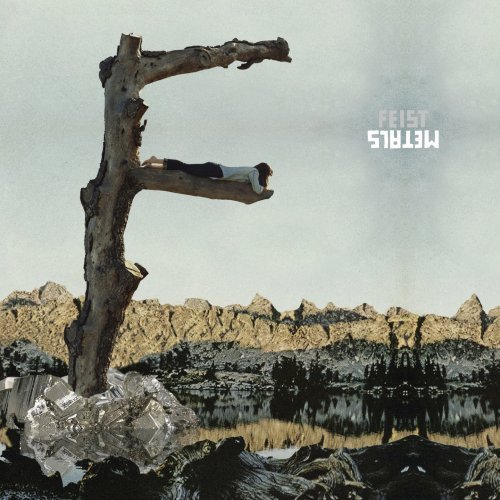
Metals - Feist
Provenance: Isn't it nice when you get turned onto something completely out of the blue? In this instance, this album came as part of a wedding gift from Noam Weinstein and his father Larry, two of the nicest people I think I've ever had the pleasure of meeting. Noam is a pretty fantastic musician himself, and I'm sure it won't be long before I review one of his albums on this blog.
Receiving albums as a wedding present isn't unprecedented in my family; when my parents got married one of their friends gave them a copy of Deep Purple's Stormbringer, Mk. III's inferior sequel to Burn.
Review: Feist is one of those artists I would never have discovered under my own steam. Too contemporary, too hip. I might hear the name in a conversation and I'll nod along affably before consoling myself that, really, I knew best and that it wouldn't be a patch on Jethro Tull. In short, I'm a total idiot under the sway of unshifting prejudices entirely of my own design. However, folk who don't know any better, such as the Weinstein family, chip away at my wall of ignorance and sometimes make small breakthroughs; I am now a confirmed Feist fan.
As for the music itself, I should probably start by saying that 'Graveyard' is one of my favourite songs - ever. Fragile, menacing, elegant and surreal, with an outro that boasts a brass arrangement that sounds as if it came off an early Alan Parsons Project long player. The quality doesn't dip on the next track either, 'Caught In A Long Wind', shimmering and poised, filigreed with oriental violin.
However, it would be wrong to characterise Metals as soporific (a term I don't use negatively, necessarily; I would happily describe John Martyn's Solid Air as soporific, inasmuch as half of the album conveys a sense of waking sleepiness). There are unabashedly quiet and delicate moments here, such as 'Bittersweet Melodies', 'Cicadas and Gulls' and 'Anti-Pioneer', but many of Feist's compositions are bursting with tension, threatening to unravel at the merest tug of the thread. At its most nervy, Metals inhabits that same weird nation of barely constrained emotion occupied by something like Stravinsky's Les noces. That's probably the most pretentious sentence I'm going to write this week.
Something else that stands out is the sound of the recordings themselves. In a world where clipping is a very real and stupid problem with recorded music, Feist and her producers have performed something of a minor miracle. The clarity given to each of the instruments used - and by the sounds of it, we're talking a whole heap of the damn things - gives an almost organic quality to the compositions. I'm especially taken with the percussion - in the best possible sense, the drums sound almost homemade, the bottom end rounded out with some really meaty rattles and clanks. My love for the Alan Parsons Project means that I would almost automatically be attracted by the brass arrangements, but it goes further than my prog predilections; one genuinely gets the impression of a colliery band, so full, so rich is the sound.
What else? One can't forget 'Comfort Me', by turns haunting and powerful, underscored by some swampy bayou guitar. It's such a good piece of music Feist could honestly sing me the words to the instruction manual of my vacuum cleaner and I'd be happy. Feist has a wonderful voice, incidentally - whispery and intimate without ever being truly warm. It sounds like the voice of someone alone, either living in their own head or cut adrift from the solid, mundane world. If, like me, you seek music to gift you that escapism from the quotidian and workaday, you may very well find it in Feist's strange, fractured universe.
Receiving albums as a wedding present isn't unprecedented in my family; when my parents got married one of their friends gave them a copy of Deep Purple's Stormbringer, Mk. III's inferior sequel to Burn.
Review: Feist is one of those artists I would never have discovered under my own steam. Too contemporary, too hip. I might hear the name in a conversation and I'll nod along affably before consoling myself that, really, I knew best and that it wouldn't be a patch on Jethro Tull. In short, I'm a total idiot under the sway of unshifting prejudices entirely of my own design. However, folk who don't know any better, such as the Weinstein family, chip away at my wall of ignorance and sometimes make small breakthroughs; I am now a confirmed Feist fan.
As for the music itself, I should probably start by saying that 'Graveyard' is one of my favourite songs - ever. Fragile, menacing, elegant and surreal, with an outro that boasts a brass arrangement that sounds as if it came off an early Alan Parsons Project long player. The quality doesn't dip on the next track either, 'Caught In A Long Wind', shimmering and poised, filigreed with oriental violin.
However, it would be wrong to characterise Metals as soporific (a term I don't use negatively, necessarily; I would happily describe John Martyn's Solid Air as soporific, inasmuch as half of the album conveys a sense of waking sleepiness). There are unabashedly quiet and delicate moments here, such as 'Bittersweet Melodies', 'Cicadas and Gulls' and 'Anti-Pioneer', but many of Feist's compositions are bursting with tension, threatening to unravel at the merest tug of the thread. At its most nervy, Metals inhabits that same weird nation of barely constrained emotion occupied by something like Stravinsky's Les noces. That's probably the most pretentious sentence I'm going to write this week.
Something else that stands out is the sound of the recordings themselves. In a world where clipping is a very real and stupid problem with recorded music, Feist and her producers have performed something of a minor miracle. The clarity given to each of the instruments used - and by the sounds of it, we're talking a whole heap of the damn things - gives an almost organic quality to the compositions. I'm especially taken with the percussion - in the best possible sense, the drums sound almost homemade, the bottom end rounded out with some really meaty rattles and clanks. My love for the Alan Parsons Project means that I would almost automatically be attracted by the brass arrangements, but it goes further than my prog predilections; one genuinely gets the impression of a colliery band, so full, so rich is the sound.
What else? One can't forget 'Comfort Me', by turns haunting and powerful, underscored by some swampy bayou guitar. It's such a good piece of music Feist could honestly sing me the words to the instruction manual of my vacuum cleaner and I'd be happy. Feist has a wonderful voice, incidentally - whispery and intimate without ever being truly warm. It sounds like the voice of someone alone, either living in their own head or cut adrift from the solid, mundane world. If, like me, you seek music to gift you that escapism from the quotidian and workaday, you may very well find it in Feist's strange, fractured universe.
Labels:
feist,
indie,
metals,
noam weinstein
Subscribe to:
Posts (Atom)


:format(jpeg):mode_rgb():quality(90)/discogs-images/R-1921260-1252592192.jpeg.jpg)
:format(jpeg):mode_rgb():quality(40)/discogs-images/R-5011323-1479390480-6928.jpeg.jpg)