Provenance: When I was eighteen I went to see Blue Oyster Cult at The Brook in Southampton. I distinctly recall seeing a rather statuesque young lady alone in the crowd, and being both a) a bit cocky and b) entirely oblivious to the notion that she might not want to speak to me, I went over and introduced myself. She was a first-year student at the local university and, as it turned out, welcomed a chat as none of her peers had answered the call to see 'the Cult' live. We talked music, and it turned out she was especially enthused on a band called Cinderella, particularly a chap called Eric Brittingham.
I didn't get anywhere beyond talking about our mutual enjoyment of rock music as I suspect that sharing the same number of syllables in our names was about the only thing I and Mr Brittingham had in common.
Wind the tape forwards a few years and you'll find me sat in my tent checking the schedule at Sweden Rock Festival. Ahoy hoy, what's this? Cinderella playing a late afternoon 'cold beer' slot? Was I going to check them out? Too bloomin' right! And yeah, Cinderella were cool even though Tom Keifer had a goddamn baby voice.
Review: From looks alone one would reflexively lump Cinderella in with the spandex 'n' Aquanet glam metal mob. And indeed, there are certainly a few signifiers of that era present on Night Songs - noise-gated drums, trebly guitars, wailin' vocals. Yet that only tells half the story - because on this album, you can hear the serious intent of solid blues-rock musicians trapped within the glittery carapace of butt-rock dandies.
Unfortunately, this is the album's fatal flaw. Although Night Songs contains some great songs and sterling performances, it is hamstrung by a gauzy production job courtesy of Andy Johns. It's not as if Johns is a bad producer - he helmed the desk on Television's Marquee Moon after all - but I can only conclude that here he was making a misguided attempt to keep up with the zeitgeist. A strange decade, the 1980s; you had albums that sound immaculate - better than anything being produced in the present day (Sade's Diamond Life, Donald Fagen's The Nightfly, hell let's thrown ABC's Lexicon of Love into the mix too) - but for every bejewelled wonder you also had about three albums that sound like a clutch of synthesizers rattling around the bottom of a shipping container.
The good news is that the rather enervated production can't hide the quality of tracks like the rambunctious 'Shake Me' ("aaaAAAalll night!") and the monumental 'Nobody's Fool'. It's interesting to note that instead of a shack-shaker to kick off the collection, whoever sequenced Night Songs opted for the moody prowler 'Night Songs', a track very much in the mould of AC/DC's 'Hell's Bells'. A freaking bell even chimes during the intro, and it doesn't escape notice that Keifer is singing in the same range of a certain Brian Johnson of, er, AC/DC; shurely shome coincidensh?
It sags a little in the middle with 'Once Around the Ride' and 'Hell On Wheels', two generic rockers that would've sounded more than passable if they had some balls. Was glam metal one big emasculation fever dream? Lots of castrati-high vocalising and gender-bending raiment all in the service of men aggressively asserting their masculinity via some of the most sexist lyrics ever yelped into a microphone? I don't know where I'm going with this.
If you aren't disposed to like either heavy rock or freeze-dried production jobs you're not going to find Night Songs particularly palatable, but you might be able to look past its obvious faults and glimpse the promise of something quite wonderful. Also, when I mentioned 'blues-rock' in the fourth paragraph, I am of course talking about blues rock in its whitest iteration; there's nary a whiff of the Mississippi Delta about Night Songs. But an album that burns down the home stretch with pulsing dandruff-looseners like 'Somebody Save Me', 'In From the Outside' and the mighty 'Push Push' deserves respect. Good stuff all in all, but Eric Brittingham can do one.
A blog about one man and his stupid music collection. Mainly about the music, though the man intrudes now and again.
Tuesday, 27 March 2018
Sunday, 18 March 2018
Helen's favourite songs - part two
Last time out I rather optimistically said that they'd be a regular review or two between part one of this round up and the following installation. That was before I went away to Germany, came back and got lazy. However, a good session with the new Judas Priest album (Firepower, it's magnificent) helped me to regain my mojo and so here are five more of my friend Helen's favourite songs.
I Left My Heart In San Francisco - Tony Bennett
Going by the first five songs, and now this one, I feel Helen has a real affinity for the bittersweet side of life. Languid yet impassioned, '...San Francisco' is a perfect example of Tony Bennett's immaculate, effortless style. Starting off small and perhaps even intimate, the song crescendoes into a widescreen celebration of the city; you can almost picture the fireworks popping over the horizon as Bennett finishes up. This subgenre of jazz has never really been my thing at all, but this is enjoyable and eminently listenable.
Kiss Me - New Found Glory
Ah, now this is strange. As opposed to most of the picks that Helen and I swapped, this is one I remember contemporaneously. I must admit to having very ambivalent feelings around the whole latter day pop-punk scene. On the one hand, lots of my friends were big into it, and it was agreeably rackety. On the other, I didn't like its bland chugging efficiency, inclusive of instrumentation and singing. Nevertheless, this is a pretty fun rendition of the Sixpence None The Richer track, melodically faithful but with an alt-rock breakdown or two thrown in to placate the moshpit. Eh, not my favourite.
Pull Shapes - The Pipettes
The Pipettes - hitherto, my familiarity with them extended purely to their existence, which is to say, I don't recall ever hearing a note of their music. Coincidence is a funny thing, however, and it was only recently that I read an article in the Guardian about member Gwenno Saunders, who has been releasing music in the Welsh and Cornish languages. Colour me intrigued. What an odd song! It falls somewhere between the Ronettes and Steps! I'm rather smitten with how quirky and guileless it is, and in spirit it does seem to be recovering some of that bubblegum naivete of the best 1960s pop. I do find the modern production a bit stifling for what should be a riot of jubilance, but perhaps the marriage of the two period is the point? Maybe I should just shut my mouth, eh?
Don't Worry Baby - The Beach Boys
Now for an echt 1960s experience, the Beach Boys! This is glorious. As someone who has listened to a lot of this kind of music, I can tell you that absolutely nothing about this song comes as a surprise. You can almost anticipate the chord changes, and even the melody, before you've heard the song. It dips into plaintive longing when you expect it to, it soars with a kind of serene radiance when you expect it to. So what? When it's done this beautifully, so what? The different voices weave in and out of each other like spring butterflies. The Beach Boys were, for me, the epitome of post doo-wop, pre-Beatles pop-making, and aside from dorky numbers about being cool to your school, you can stick a pin in their catalogue from around this time and alight upon a gem. This song clouds the eyes and slows the heart, so why wouldn't it be on a 'best of' list somewhere? I kiss each fingertip in turn!
Stand By Me - Ben E King
I don't really feel any requirement to talk about this. It is perfection writ large, the gold standard of popular soul. It exists in the stratosphere, breathing the same thin air as 'I Heard It Through the Grapevine', 'Respect', 'My Girl' and others of that calibre. The bass riff that introduces the song is immediately recognisable, and instantly hummable. Instead of winding up throughout the track, King bites down on the first lyric, managing to tread a path that both manages to be imperious and yearning at the same time. Speaking of the lyrics, they are both simple and yet universal, underscored by strong images of a faintly apocalyptic nature. But the malt-shop eschatology doesn't sound hokey; it only serves to provide a backbone to the ardour professed by King. Three minutes that will leave you staggered.
That was fun! I would like to finish up with a few final thoughts. Ultimately, although we gave critical appraisals of each other's lists, there was a shared sense that the exercise went beyond merely talking about music. Indeed, I felt a little bit exposed, because whilst I'm happy talking about music, to say 'these are my ten favourite songs' can be quite an intimate thing to reveal. When I was younger, a mixtape was both a gift to someone who had feelings for but also both a shorthand way of demonstrating good taste and a discrete way of hinting that, perhaps, still waters run deep. As it so happened, we did indulge in a bit of cod-psychology; I found Helen's list to have a seam of melancholy running through much of it, whilst she identified a very off-brand sexiness to a few of my picks. Helen's feedback, incidentally, was both thoughtful and insightful; I should also add she has a great ear for music she's not necessarily familiar with. I'm glad we did this.
Anyway, back to talking about some overheated guitar crap next time out!
Labels:
beach boys,
ben e king,
bubblegum,
easy listening,
favourite,
gwenno saunders,
jazz,
new found glory,
pipettes,
pop,
punk,
soul,
tony bennett
Sunday, 25 February 2018
Helen's favourite songs - part one
I imagine that we've all been asked for our top five - or ten - favourite songs at one point or another. It's a fun, twisty little question that allows you to reveal something about yourself by degrees. It's also one that I associate with my younger days, simply because I haven't been asked that question for years. That is, until my friend Helen put it to me this week.
Although we have convergent tastes in the realm of rock 'n' roll and 1960s pop, Helen and I seemingly differ on a whole lot. So, in order to really dig into what tickles each other's vental tegmental areas we swapped our favourite five (soon expanded to ten) songs and agreed to listen to them critically. Now, we all know that ten 'favourite' songs is an impossibility, as environment, mindset and memory all come to bear on making one's choices. Nevertheless, a selection of ten or so well-regarded songs is, in my estimation, more than a glimpse through the window to a person's soul - so without further ado, here are the first five tracks Helen chose, and my commentary.
Smile - Nat King Cole
I was more familiar with this song's backstory - that the music was written by Charlie Chaplin, and it was one of Michael Jackson's favourites - than the tune itself. The first thing to say is that it is the perfect match for Nat King Cole's effortless crooning, his warm, sad voice perfectly matching the bittersweet lyrics. In that sense, 'Smile' is a triumph - the concept being matched exquisitely by its execution.
To modern ears the instrumentation might sound a bit slushy, but to me it evokes a golden age where it was commonplace for three-minute pop to be treated with the utmost care and respect. So strings swell, woodwinds trill and swoon and a drummer brushes away unobtrusively in the back, providing Cole with a lush backdrop for his inimitable baritone. Sumptuous.
You Don't Know Me - Ray Charles
On to the second song of Helen's selection, and there are similarities with 'Smile' inasmuch as it features yet more baroque orchestration, this time with the addition of a mixed-voice choir. An unhurried torch song, 'You Don't Know Me' is distinguished from Cole's song by the vocal delivery. Where Cole's voice, untutored as it was, nevertheless came from the jazz clubs, Charles' vocals went to church (NB: it's never that simple though, is it? Cole's father was a Baptist minister).
As with much of Charles' oeuvre, that standout element of 'You Don't Know Me' is the barely restrained passion in the delivery of the lyrics. Despite being written by outside writers, the way Charles is able to get inside the viscera of the song is a minor marvel in itself.
George On My Mind - Ray Charles
Wow - even better than the other Ray Charles song in this list. It's one of those tracks, like those cut by Brooke Benton, Glenn Campbell and latterly Tony Joe White, that feel so big and widescreen that you're surprised to find it's only three or four minutes long.
That easy roll of the piano, the way he switches moves between major and relative minor keys, the vocals cracking with emotion - let's just say this is how the big boys do it. The string arrangement in 'George On My Mind' is something else too, intricate without being fussy, blossoming in peaks of high emotion one moment, dying down to allow the piano to breathe in the next. Pop music has rarely sounded this sophisticated since.
Runaround Sue - Dion
If your hearing faculuties are fine and you don't like this crackerjack my suspicions are that you don't possess a pulse. It's got all the stuff I like - five fucking chords, saxophone squalling away in the background, backing vocals that take a cue from doo-wop and a guy that knows how to belt it out. Helen called this a 'slut-shaming classic' half-jokingly, and I imagine if it were released today there'd be an article on medium.com within five minutes decrying it as 'problematic'.
I don't care. Songs like 'Runaround Sue' form one of the main arterial routes away from the beating heart of rock 'n' roll; the smoother, citified version hustled away from its southron birthplace by a bunch of inner-city punk Italian kids. It's an absolute gas. The opening lines speak of a story "sad but true", but nothing sounds further from the truth, given the sheer, giddy ecstasy of its delivery. 'Runaround Sue' is scintillating.
Breaking Up Is Hard To Do - Neil Sedaka
Oh, I know this one! Yeah, this is cool. 'Breaking Up Is Hard To Do' adheres to a template for a certain kind of song produced during this era - speed it up and there's 'The Night Has a Thousand Eyes' by Bobby Vee, slow it down and beef up the strings and there's Gene Pitney's 'Something's Gotten Hold Of My Heart'. Like 'Runaround Sue', 'Breaking Up...' glories in a doo-wop schooled backing vocal that's every bit as irresistible as it is moronic. The handclaps that accentuate the rhythm are delicious, and herald the latter-day self-conscious bubblegum of a song like 'Sugar, Sugar' by the Archies.
For all the crushing heaviness of Electric Wizard or Sleep, I'm never not going to be a sucker for the unadulterated head-rush of 1960s pop music. I can see why 'Breaking Up...' would be on a list of favourites - it does nothing particularly brilliantly, and does it brilliantly. There's a strange kind of virtuosity in turning out a song so simple and yet so addictive. If this is the musical equivalent of junk food, I want to gorge until I get a coronary.
Well, that's the first five! I'll probably do another album review or two before I tackle the second half of Helen's selections. I've enjoyed this so far, and I look forward to - let me just get my phone out - New Found Glory and, er, McFly, amongst others!
Labels:
bubblegum,
dion,
doo-wop,
favourite,
jazz,
nat king cole,
neil sedaka,
pop,
ray charles,
rock 'n' roll,
saxophone,
torch song
Sunday, 11 February 2018
Get The Knack - The Knack
Provenance: It's got 'My Sharona' on it.
Review: Hmmm.
Hmmmm.
On the one hand, Get The Knack is a wonderfully hooky power-pop gem, redolent of Cheap Trick, the Raspberries and the first Big Star album. Gorgeous melodies and swooning harmonies wrap around jangly guitar and muscular drumming to superb effect. It's a joy from front to back.
However, it's also incredibly sexist and sleazy. Even the most generous of devil's advocates would struggle to justify the fetishisation of pubescent girls that runs through Get The Knack. I suppose The Knack should be congratulated for their singular ability to take the concept of the male gaze and rendering it in the form of a catchy rock album. It's an uncomfortable listen, and that's coming from someone who owns an album by an artist who calls themselves Mr Yellow Discipline (NSFW, quite obviously).
The apex, or perhaps nadir, of this objectification comes on a jaunty little number titled '(She's So) Selfish.' It's hard to sum up quite how nasty the track is in terms of both a projected fantasy and attitudes towards women, but the lyrics can give you an idea. I've long held an unease at what seems to be a specifically 1970s strain of misogyny in rock music (though not limited to that decade, or the genre for that matter - 1957's 'Boom Boom, Out Go The Lights' by Little Walter is particularly grim) but I can acknowledge that lust is a legitimate and very human feeling, and one which informs a considerable amount of music, art and literature.
My issues here are twofold; one, that this sweaty, glandular lust is so unreflectingly unrelenting. Not only does it never stop, but it never stops to ponder the other side of the coin or to gaze into the mirror. It's wonderfully crafted power-pop, but three-minute cherry bombs are rarely executed with the degree of genius necessary to provide nuance. As I said, this wouldn't be so bad if it weren't for the fact that a good three-quarters of Get The Knack wasn't knuckle-dragging objectification. Whilst the sublime 'Oh Tara' shimmers with a rare gentleness, 'Good Girls Don't', 'Frustrated' and 'That's What The Little Girls Do', er, don't.
The other issue is that, even if one attempts to be aware of the anachronism of grafting modern attitudes towards gender relations onto albums from 1979, Get The Knack still fails the sniff test. It is worth bearing in mind that this souffle of sweaty-palmed teenage frottage was written and performed by a band of men all in their mid- or late-twenties. I didn't let Faster Pussycat off the hook for 'Smash Alley', and though I made a glib reference to Lolita it's worth mentioning that Nabokov's work was a sophisticated serio-comic masterpiece in the 'unreliable narrator' vein of writing. For all its merits, and they are legion (in case this review seems overly damning), Get The Knack never aims for anything beyond a pose of arrested development.
Of course, I may well have just tied myself in knots through my inability to engage with Get The Knack through anything other than a contemporary prism of what could be considered 'problematic'. However, I have certainly enjoyed - and continue to enjoy - books, television and film that certainly wouldn't fit anyone's definition of 'woke'. Furthermore, I do so unapologetically. With that in mind, could it be that Get The Knack is, was, and will continue to be merely a squalid little paean to misogyny, albeit one that from a formal point of view sounds absolutely delicious?
What a shame. There's so much good music on Get The Knack that it's entirely deserving of its platinum status on that criterion alone. And viewed in isolation, 'My Sharona' is dangerously close to being the perfect rock song. It's an angsty, propulsive earworm that features one of the catchiest guitar solos committed to magnetic tape. I love it and it still makes me happy, albeit this is tempered somewhat by the knowledge that Quentin Tarantino wanted to use it for the 'gimp' scene in Pulp Fiction. But you know what? Thank goodness, I say, that my aesthetic tastes align with a great cinematic auteur like Tarantino, and not with some sordid, woman-hating trash-purveyor, eh?
Review: Hmmm.
Hmmmm.
On the one hand, Get The Knack is a wonderfully hooky power-pop gem, redolent of Cheap Trick, the Raspberries and the first Big Star album. Gorgeous melodies and swooning harmonies wrap around jangly guitar and muscular drumming to superb effect. It's a joy from front to back.
However, it's also incredibly sexist and sleazy. Even the most generous of devil's advocates would struggle to justify the fetishisation of pubescent girls that runs through Get The Knack. I suppose The Knack should be congratulated for their singular ability to take the concept of the male gaze and rendering it in the form of a catchy rock album. It's an uncomfortable listen, and that's coming from someone who owns an album by an artist who calls themselves Mr Yellow Discipline (NSFW, quite obviously).
The apex, or perhaps nadir, of this objectification comes on a jaunty little number titled '(She's So) Selfish.' It's hard to sum up quite how nasty the track is in terms of both a projected fantasy and attitudes towards women, but the lyrics can give you an idea. I've long held an unease at what seems to be a specifically 1970s strain of misogyny in rock music (though not limited to that decade, or the genre for that matter - 1957's 'Boom Boom, Out Go The Lights' by Little Walter is particularly grim) but I can acknowledge that lust is a legitimate and very human feeling, and one which informs a considerable amount of music, art and literature.
My issues here are twofold; one, that this sweaty, glandular lust is so unreflectingly unrelenting. Not only does it never stop, but it never stops to ponder the other side of the coin or to gaze into the mirror. It's wonderfully crafted power-pop, but three-minute cherry bombs are rarely executed with the degree of genius necessary to provide nuance. As I said, this wouldn't be so bad if it weren't for the fact that a good three-quarters of Get The Knack wasn't knuckle-dragging objectification. Whilst the sublime 'Oh Tara' shimmers with a rare gentleness, 'Good Girls Don't', 'Frustrated' and 'That's What The Little Girls Do', er, don't.
The other issue is that, even if one attempts to be aware of the anachronism of grafting modern attitudes towards gender relations onto albums from 1979, Get The Knack still fails the sniff test. It is worth bearing in mind that this souffle of sweaty-palmed teenage frottage was written and performed by a band of men all in their mid- or late-twenties. I didn't let Faster Pussycat off the hook for 'Smash Alley', and though I made a glib reference to Lolita it's worth mentioning that Nabokov's work was a sophisticated serio-comic masterpiece in the 'unreliable narrator' vein of writing. For all its merits, and they are legion (in case this review seems overly damning), Get The Knack never aims for anything beyond a pose of arrested development.
Of course, I may well have just tied myself in knots through my inability to engage with Get The Knack through anything other than a contemporary prism of what could be considered 'problematic'. However, I have certainly enjoyed - and continue to enjoy - books, television and film that certainly wouldn't fit anyone's definition of 'woke'. Furthermore, I do so unapologetically. With that in mind, could it be that Get The Knack is, was, and will continue to be merely a squalid little paean to misogyny, albeit one that from a formal point of view sounds absolutely delicious?
What a shame. There's so much good music on Get The Knack that it's entirely deserving of its platinum status on that criterion alone. And viewed in isolation, 'My Sharona' is dangerously close to being the perfect rock song. It's an angsty, propulsive earworm that features one of the catchiest guitar solos committed to magnetic tape. I love it and it still makes me happy, albeit this is tempered somewhat by the knowledge that Quentin Tarantino wanted to use it for the 'gimp' scene in Pulp Fiction. But you know what? Thank goodness, I say, that my aesthetic tastes align with a great cinematic auteur like Tarantino, and not with some sordid, woman-hating trash-purveyor, eh?
Sunday, 4 February 2018
Devaju Retro Gold Collection - Django Reinhardt
Provenance: Back when I was first learning how to play guitar I heard tell of a man who, despite a partially paralysed left hand, could play incredible stuff. This was a time when Napster was in its infancy, so I happily shelled out for this cheap two-disc compilation when I spotted it in HMV one day.
The guitarist, of course, was the Belgian-born Romany jazz legend Django Reinhardt. As such, this is probably the first jazz album I ever purchased.
Review: Bear in mind that at the time of buying this my musical diet was a steady intake of Led Zeppelin, Black Sabbath, Deep Purple and other 'eavy bands of the classic rock era. Through picking up the guitar I was starting to learn about blues through the gateway of Stevie Ray Vaughan, albeit one could probably make the case that SRV was only half a step away from classic 1970s blues rock and thus more palatable to my ears than the likes of Charley Patton or Blind Lemon Jefferson.
Despite being a cloth-eared pithecanthropoid, even back then I knew I was listening to something quite sensational. I was one of those guitarists that went through a phase of equating technical brilliance to musical competence, and I saw Reinhardt through the same lens as Joe Satriani and Steve Vai. Almost twenty years later I barely ever whack Satch on the stereo, and can't recall the last time I gave Vai an outing. Reinhardt endures, however. Why?
For one, he was an incredible musician - not just in a technical sense (but let's not forget he was essentially playing with half the regular number of fingers on his left hand for almost his entire recording career) but also as an improviser. You can hear him lean into a song, strike up the melody and then run with it into new and exciting territories. Blazing virtuosity can work when it's in service to something greater than a demonstration of itself.
Secondly - once where I was fixated on the guitar, now I give equal attention to the other master to feature on these recordings, the violinist Stephane Grappelli. The grace and fluidity of his execution is the perfect complement to Reinhardt's quicksilver trickiness; imagine the bluegrass duels you might have heard between banjo and fiddle players, transplant that to a jazz idiom and you're not far off what's going on here. Although the liner notes don't say as much, I'm quite sure that all the tracks here are from their fruitful time together in the Quintette du Hot Club de France string ensemble.
The third thing to mention is that as I've grown older my sensibilities have changed and evolved. My criteria have expanded from 'heavy riffage' and 'cool fingertapping solos', which I suppose can be a sign of maturation. Anyway, when I was a teenager I didn't have an instinctive feeling for jazz, or more specifically swing. Now I've digested a lot more, I can appreciate just how hard some of this stuff swung, even more remarkable as it was achieved without the aid of brass or percussion. The boys playing rhythm (including Django's brother, Joseph) certainly knew their task but Reinhardt also provides some amazing moment of push-pull, throwing in half-bends and double-stops to add variation and spice.
Two CDs in a row is a bit wearying, as the tracks all possess a similar feel, but played sparingly this Django Reinhardt collection still has the ability to wow over eighty years later. The Quintette's output is still the gold standard by which gypsy jazz and string band swing is held to, and rightly so.
The guitarist, of course, was the Belgian-born Romany jazz legend Django Reinhardt. As such, this is probably the first jazz album I ever purchased.
Review: Bear in mind that at the time of buying this my musical diet was a steady intake of Led Zeppelin, Black Sabbath, Deep Purple and other 'eavy bands of the classic rock era. Through picking up the guitar I was starting to learn about blues through the gateway of Stevie Ray Vaughan, albeit one could probably make the case that SRV was only half a step away from classic 1970s blues rock and thus more palatable to my ears than the likes of Charley Patton or Blind Lemon Jefferson.
Despite being a cloth-eared pithecanthropoid, even back then I knew I was listening to something quite sensational. I was one of those guitarists that went through a phase of equating technical brilliance to musical competence, and I saw Reinhardt through the same lens as Joe Satriani and Steve Vai. Almost twenty years later I barely ever whack Satch on the stereo, and can't recall the last time I gave Vai an outing. Reinhardt endures, however. Why?
For one, he was an incredible musician - not just in a technical sense (but let's not forget he was essentially playing with half the regular number of fingers on his left hand for almost his entire recording career) but also as an improviser. You can hear him lean into a song, strike up the melody and then run with it into new and exciting territories. Blazing virtuosity can work when it's in service to something greater than a demonstration of itself.
Secondly - once where I was fixated on the guitar, now I give equal attention to the other master to feature on these recordings, the violinist Stephane Grappelli. The grace and fluidity of his execution is the perfect complement to Reinhardt's quicksilver trickiness; imagine the bluegrass duels you might have heard between banjo and fiddle players, transplant that to a jazz idiom and you're not far off what's going on here. Although the liner notes don't say as much, I'm quite sure that all the tracks here are from their fruitful time together in the Quintette du Hot Club de France string ensemble.
The third thing to mention is that as I've grown older my sensibilities have changed and evolved. My criteria have expanded from 'heavy riffage' and 'cool fingertapping solos', which I suppose can be a sign of maturation. Anyway, when I was a teenager I didn't have an instinctive feeling for jazz, or more specifically swing. Now I've digested a lot more, I can appreciate just how hard some of this stuff swung, even more remarkable as it was achieved without the aid of brass or percussion. The boys playing rhythm (including Django's brother, Joseph) certainly knew their task but Reinhardt also provides some amazing moment of push-pull, throwing in half-bends and double-stops to add variation and spice.
Two CDs in a row is a bit wearying, as the tracks all possess a similar feel, but played sparingly this Django Reinhardt collection still has the ability to wow over eighty years later. The Quintette's output is still the gold standard by which gypsy jazz and string band swing is held to, and rightly so.
Sunday, 21 January 2018
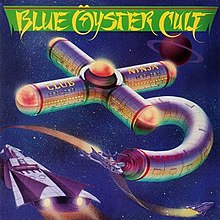
Club Ninja - Blue Oyster Cult
Provenance: I'm one of the biggest Blue Oyster Cult fans under pensionable age in the UK. I've got all the albums, hit up their shows, and I even used to pester them via email.
NB - this is my second BOC review and I feel I've hardly touched my music collection. However, if I did a different band every week, by the end I'll just be down to a rotation of Blue Oyster Cult / Steely Dan / Tom Waits (no bad thing, right?). For the sake of variety, I'll be sprinkling in the 'big boys' from now on, so you might get two or three BOC reviews before you encounter Atomic Rooster or Electric Wizard. Lucky you.
Review: In this guy's opinion the classic era of Blue Oyster Cult stretches from their self-titled debut (1972) through to Spectres (1977). One could therefore surmise, on that basis alone, that the 1985 album Club Ninja is not a classic - and one would be correct in doing so. However, just because a band is no longer in their pomp doesn't necessarily mean they aren't capable of pulling out the stops - witness Ratt in 2010 with Infestation, Cheap Trick's clutch of post-2005 releases or even Bob Dylan's sublime Love and Theft and Modern Times releases. Hell, I'd settle is this was Blue Oyster Cult's Get A Grip.
Well, Get A Grip it ain't. As was the case with last week's Hot In The Shade, Club Ninja features awful cover art, compounded by an absolutely dire name. [Adopting Jerry Seinfeld voice] And what's the deal with ninjas anyway? There was, of course, the execrable Michael Dudikoff vehicle American Ninja, a Cannon Films release from the same year as Club Ninja. You've got the Teenage Mutant Ninja Turtles, who made their first comic book appearance in 1984. The geekiest explanation involves the track 'Shadow Warrior', which doesn't mention ninjas explicitly but was co-written by thriller / fantasy novelist Eric Van Lustbader, who did write a 1980 novel called The Ninja. Your guess is as good as mine.
Another common factor with Hot In The Shade is songwriter Bob Halligan Jr. He wrote some cool stuff for Judas Priest like 'Take These Chains' and 'Some Heads Are Gonna Roll'. On his one outing with Kiss he penned 'Rise To It' (the song where Paul Stanley brags about maintaining an erection) and the crapfest 'Read My Body'. Here he's responsible for similarly cerebral cuts such as 'Make Rock Not War' and 'Beat 'Em Up'. Halligan now plays in a band who advertise themselves as a fusion of rock, Celtic and contemporary Christian music.
By this point in time BOC had sloughed off original members Albert Bouchard (drums / vocals) and Allen Lanier (keyboard / guitars), and had also long abandoned their creepy psychedelic proto-metal in favour of a more 'commercial' synth rock sound. Given all that Club Ninja is, in places - frustratingly - quite good. However, those two or three inspired tracks can't make up for the remainder on offer here, because when Club Ninja is bad, it's horrible. Brutally, irredeemably horrible.
The album starts promisingly enough, with Eric Bloom delivering a delightfully hammy vocal performance on the propulsive 'White Flags'. Buck Dharma (both an underrated guitarist and singer) is up next on 'Dancin' In The Ruins', which if anything is even better. I should point out that anything that works on Club Ninja does so either because of the music or the conviction of the vocal performances, because the lyrics are uniformly bobbins. The only track that gets close to resembling the golden years of Blue Oyster Cult is the sumptuous, shimmering 'Perfect Water', once again sung by Dharma, who also brings some questing guitar work to the table. These songs are really, really decent and could quite easily feature on 'best of' compilations without appearing out of place.
The rest, alas, is drivel. The aforementioned 'Make Rock Not War' and 'Beat 'Em Up' are as boneheaded and uninspired as the titles suggest. 'Spy In the House of the Night' has a stadium-sized chorus and a kicky riff to commend it, but that's about it. The final three tracks - 'When the War Comes', 'Shadow Warrior' and 'Madness To the Method' - all exist within a lacuna of their own; competently played, slickly produced but otherwise devoid of anything interesting. One exception - Dharma's guitar solo on 'When the War Comes' is much better than the track deserves. It's a song that floats by without leaving a mark, despite a voice-over from shock-jock Howard Stern (who was, I believe, married to Eric Bloom's cousin at the time) and, unaccountably, lifting the 'ooga-chu-ka' chant from Blue Swede's version of 'Hooked On A Feeling'. That sounds like something you'd want to be hepped to, right? Be my guest.
There's also not enough Joe Bouchard on this album. One of the defining elements that made Blue Oyster Cult brilliant was the interplay between the Bouchard brothers, Joe's freewheeling bass weaving around Albert's skittering jazz-influenced drumming. Jimmy Wilcox, the drummer on this album, played it straight, giving Joe little room for manoeuvre. And he's given, what, half a song to sing? Screw that. Joe Bouchard is a good dude, not least because he gave me an interview for my school magazine back in 2002 and answered all my dumbass questions with grace and patience. Did I really imply he might've been a Nazi sympathiser? Jeez Louise.
To sum up - Club Ninja was not the disaster it's sometimes made out to be. Indeed, Blue Oyster Cult followed a trend of 70s bands trying to update their sound to stay relevant. The gold standard for this approach will always be ZZ Top's Eliminator, which worked only due to the rarest of alchemy. Instead, this represented the terminus point of BOC's slide towards anonymity - where once they were the 'red and the black', now they were the dull and the bland. At least this didn't represent the end of their story...
NB - this is my second BOC review and I feel I've hardly touched my music collection. However, if I did a different band every week, by the end I'll just be down to a rotation of Blue Oyster Cult / Steely Dan / Tom Waits (no bad thing, right?). For the sake of variety, I'll be sprinkling in the 'big boys' from now on, so you might get two or three BOC reviews before you encounter Atomic Rooster or Electric Wizard. Lucky you.
Review: In this guy's opinion the classic era of Blue Oyster Cult stretches from their self-titled debut (1972) through to Spectres (1977). One could therefore surmise, on that basis alone, that the 1985 album Club Ninja is not a classic - and one would be correct in doing so. However, just because a band is no longer in their pomp doesn't necessarily mean they aren't capable of pulling out the stops - witness Ratt in 2010 with Infestation, Cheap Trick's clutch of post-2005 releases or even Bob Dylan's sublime Love and Theft and Modern Times releases. Hell, I'd settle is this was Blue Oyster Cult's Get A Grip.
Well, Get A Grip it ain't. As was the case with last week's Hot In The Shade, Club Ninja features awful cover art, compounded by an absolutely dire name. [Adopting Jerry Seinfeld voice] And what's the deal with ninjas anyway? There was, of course, the execrable Michael Dudikoff vehicle American Ninja, a Cannon Films release from the same year as Club Ninja. You've got the Teenage Mutant Ninja Turtles, who made their first comic book appearance in 1984. The geekiest explanation involves the track 'Shadow Warrior', which doesn't mention ninjas explicitly but was co-written by thriller / fantasy novelist Eric Van Lustbader, who did write a 1980 novel called The Ninja. Your guess is as good as mine.
Another common factor with Hot In The Shade is songwriter Bob Halligan Jr. He wrote some cool stuff for Judas Priest like 'Take These Chains' and 'Some Heads Are Gonna Roll'. On his one outing with Kiss he penned 'Rise To It' (the song where Paul Stanley brags about maintaining an erection) and the crapfest 'Read My Body'. Here he's responsible for similarly cerebral cuts such as 'Make Rock Not War' and 'Beat 'Em Up'. Halligan now plays in a band who advertise themselves as a fusion of rock, Celtic and contemporary Christian music.
By this point in time BOC had sloughed off original members Albert Bouchard (drums / vocals) and Allen Lanier (keyboard / guitars), and had also long abandoned their creepy psychedelic proto-metal in favour of a more 'commercial' synth rock sound. Given all that Club Ninja is, in places - frustratingly - quite good. However, those two or three inspired tracks can't make up for the remainder on offer here, because when Club Ninja is bad, it's horrible. Brutally, irredeemably horrible.
The album starts promisingly enough, with Eric Bloom delivering a delightfully hammy vocal performance on the propulsive 'White Flags'. Buck Dharma (both an underrated guitarist and singer) is up next on 'Dancin' In The Ruins', which if anything is even better. I should point out that anything that works on Club Ninja does so either because of the music or the conviction of the vocal performances, because the lyrics are uniformly bobbins. The only track that gets close to resembling the golden years of Blue Oyster Cult is the sumptuous, shimmering 'Perfect Water', once again sung by Dharma, who also brings some questing guitar work to the table. These songs are really, really decent and could quite easily feature on 'best of' compilations without appearing out of place.
The rest, alas, is drivel. The aforementioned 'Make Rock Not War' and 'Beat 'Em Up' are as boneheaded and uninspired as the titles suggest. 'Spy In the House of the Night' has a stadium-sized chorus and a kicky riff to commend it, but that's about it. The final three tracks - 'When the War Comes', 'Shadow Warrior' and 'Madness To the Method' - all exist within a lacuna of their own; competently played, slickly produced but otherwise devoid of anything interesting. One exception - Dharma's guitar solo on 'When the War Comes' is much better than the track deserves. It's a song that floats by without leaving a mark, despite a voice-over from shock-jock Howard Stern (who was, I believe, married to Eric Bloom's cousin at the time) and, unaccountably, lifting the 'ooga-chu-ka' chant from Blue Swede's version of 'Hooked On A Feeling'. That sounds like something you'd want to be hepped to, right? Be my guest.
There's also not enough Joe Bouchard on this album. One of the defining elements that made Blue Oyster Cult brilliant was the interplay between the Bouchard brothers, Joe's freewheeling bass weaving around Albert's skittering jazz-influenced drumming. Jimmy Wilcox, the drummer on this album, played it straight, giving Joe little room for manoeuvre. And he's given, what, half a song to sing? Screw that. Joe Bouchard is a good dude, not least because he gave me an interview for my school magazine back in 2002 and answered all my dumbass questions with grace and patience. Did I really imply he might've been a Nazi sympathiser? Jeez Louise.
To sum up - Club Ninja was not the disaster it's sometimes made out to be. Indeed, Blue Oyster Cult followed a trend of 70s bands trying to update their sound to stay relevant. The gold standard for this approach will always be ZZ Top's Eliminator, which worked only due to the rarest of alchemy. Instead, this represented the terminus point of BOC's slide towards anonymity - where once they were the 'red and the black', now they were the dull and the bland. At least this didn't represent the end of their story...
Thursday, 11 January 2018
Hot In The Shade - Kiss
Provenance: Another piece of shit I paid a quid or two for.
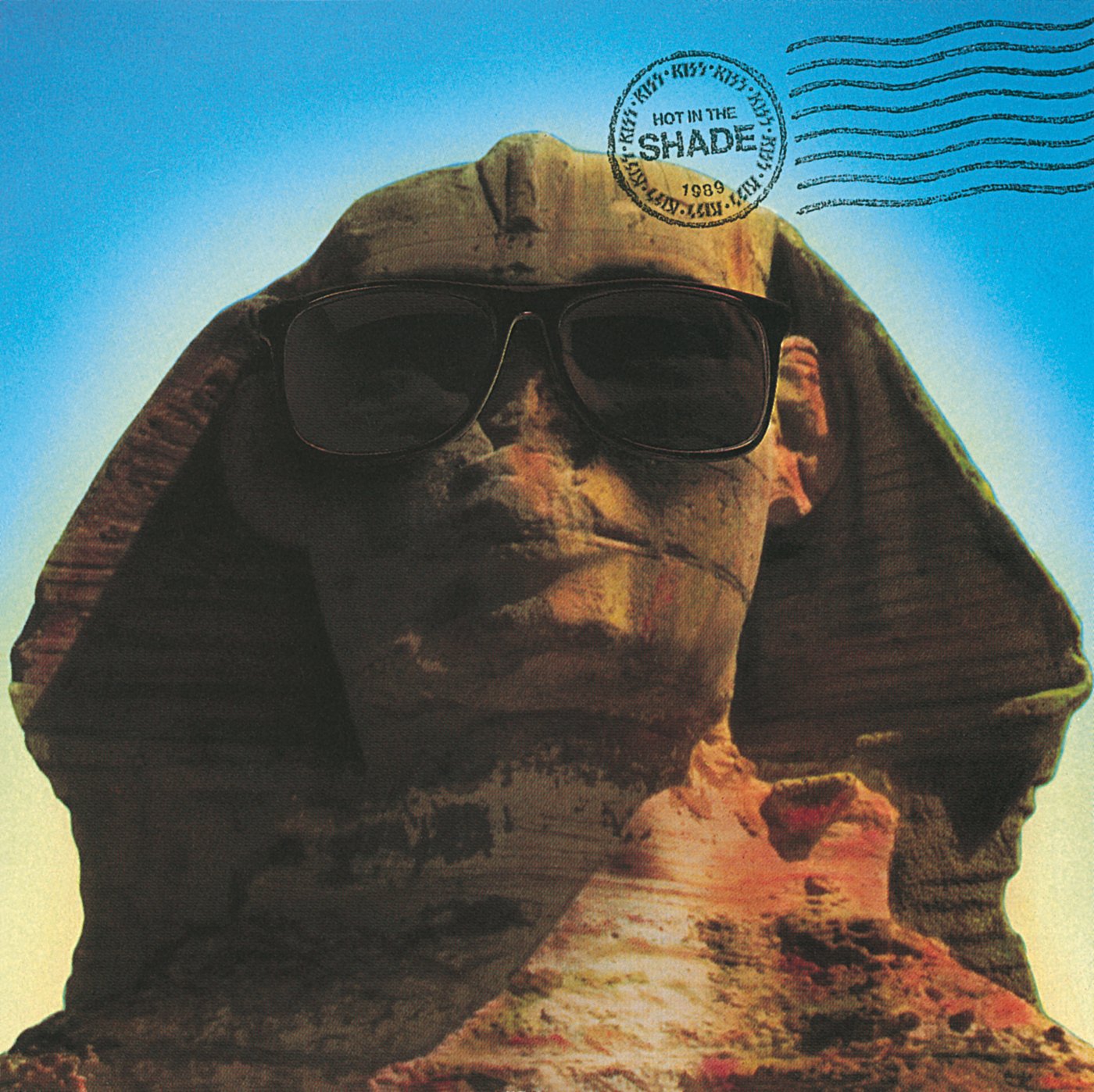
Review: This is rancid even by Kiss' standards. No mucking around this week with some convoluted preamble about how Bruce Kulick got me dumped or whatever, I'm going straight in on this abomination. I realise now that at the time I should've taken one look at that dorky sphinx and spent my money on a can of Pepsi.
I've been suckered by Kiss before now. I got their Double Platinum greatest hits collection as a teenager, which is bulging with catchy, if clunky, nuggets of escapist rock 'n' roll. A band that can come up with glorious trainwrecks like 'Detroit Rock City' and 'Black Diamond' had to be worth a deeper dive, right?
Eh, perhaps not. Certainly not, on the basis of Hot In The Shade (ooh, look, when you make an acronym of the title it spells 'hits' - clever boys! It's also an anagram of 'shit').
Now, even thought Hot In The Shade is an absolute goat rodeo for the most part, there are a couple of songs that aren't as unlistenable as the rest. The opener - 'Rise To It' - is serviceable single-entendre stadium fodder (the gag is that Paul Stanley can maintain an erection) and 'Hide Your Heart' is a hysterical slice of melodrama with a lyric that would embarrass a pre-verbal child, but gets by on conviction and a chorus. That's it. And those are tracks number one and three on a fifteen song slalom down Mt. Shitass. It's January, I've got the heating on low but this album has got me sweating like I'm allergic to it.
Speed up the opening riff to 'Black Diamond', tack on a terrible chorus and complain about paying taxes and you've got the essence of 'Betrayed'. I suppose it would be passable if you've never heard rock music before, or indeed, any music, ever. Try to imagine a song considered too dumb for ZZ Top's Recycler but have Gene Simmons sing it instead, and voila! You've conjured up 'Prisoner of Love'. Can it get worse? Yes. If you've ever wondered what Kiss what sound like if they did a cover of Def Leppard's 'Pour Some Sugar On Me', but somehow made that wretched ditty even more pathetic, then look no further than 'Read My Body'.
It goes on. Hitherto I've been running down the tracks in order, but really once you're past the relative highlight of 'Hide Your Heart' you can pick a song at random and I guarantee you that it'll be so bad that you will feel your IQ dropping in real time. 'Boomerang'? 'Cadillac Dreams'? 'Somewhere Between Heaven and Hell'? 'The Street Giveth and the Street Taketh Away' (yes, really)? This is the kind of music that drives people otherwise disposed towards guitar or drums to rediscover the lost art of mime.
It's not as if Kiss ever did anything revolutionary in their career - musically speaking, that is. 'I Was Made For Loving You' was a bit of a curio as a disco-rock fusion that actually works, but the real genius of Kiss lay in their onstage presentation and the way this was subsequently monetised. Chalk that up to the naked avarice of Gene Simmons and the sheer bloody-mindedness of Paul Stanley, the combination of which ensures Kiss chug on profitably to this day. Yet even though their paleo-rock of the 1970s was derivative and silly, it was distinctive. Probably the biggest crime of Hot In The Shade is that Kiss stopped playing Kiss songs and instead churned out bad parodies of songs whose formulae had proved successful for other bands. I've already mentioned Def Leppard and ZZ Top, but 'Love's A Slap In The Face' could be a Ratt outtake and 'Forever' is, ahem, "inspired" by Cheap Trick's 'The Flame'.
Alright, I've had enough. If I'm going to be charitable, I didn't cringe too much at 'Little Caesar' and whilst 'Silver Spoon' is mostly bobbins I cracked a smile at the "whoa-oh-a-whoah" chorus. If earlier in the decade (Hot In The Shade came out in 1989) Kiss revived flagging interest in their career by unmasking, this is the album that should've seen them committed to a witness protection scheme. Hot In The Shade saw Kiss trying to play catch-up with the hairspray crowd - a mob that they could legitimately claim to have inspired - and failing miserably, depressingly. Alice Cooper pulled off this ruse (and pretty much everything else, come to think of it) much better. Utterly charmless.
Review: This is rancid even by Kiss' standards. No mucking around this week with some convoluted preamble about how Bruce Kulick got me dumped or whatever, I'm going straight in on this abomination. I realise now that at the time I should've taken one look at that dorky sphinx and spent my money on a can of Pepsi.
I've been suckered by Kiss before now. I got their Double Platinum greatest hits collection as a teenager, which is bulging with catchy, if clunky, nuggets of escapist rock 'n' roll. A band that can come up with glorious trainwrecks like 'Detroit Rock City' and 'Black Diamond' had to be worth a deeper dive, right?
Eh, perhaps not. Certainly not, on the basis of Hot In The Shade (ooh, look, when you make an acronym of the title it spells 'hits' - clever boys! It's also an anagram of 'shit').
Now, even thought Hot In The Shade is an absolute goat rodeo for the most part, there are a couple of songs that aren't as unlistenable as the rest. The opener - 'Rise To It' - is serviceable single-entendre stadium fodder (the gag is that Paul Stanley can maintain an erection) and 'Hide Your Heart' is a hysterical slice of melodrama with a lyric that would embarrass a pre-verbal child, but gets by on conviction and a chorus. That's it. And those are tracks number one and three on a fifteen song slalom down Mt. Shitass. It's January, I've got the heating on low but this album has got me sweating like I'm allergic to it.
Speed up the opening riff to 'Black Diamond', tack on a terrible chorus and complain about paying taxes and you've got the essence of 'Betrayed'. I suppose it would be passable if you've never heard rock music before, or indeed, any music, ever. Try to imagine a song considered too dumb for ZZ Top's Recycler but have Gene Simmons sing it instead, and voila! You've conjured up 'Prisoner of Love'. Can it get worse? Yes. If you've ever wondered what Kiss what sound like if they did a cover of Def Leppard's 'Pour Some Sugar On Me', but somehow made that wretched ditty even more pathetic, then look no further than 'Read My Body'.
It goes on. Hitherto I've been running down the tracks in order, but really once you're past the relative highlight of 'Hide Your Heart' you can pick a song at random and I guarantee you that it'll be so bad that you will feel your IQ dropping in real time. 'Boomerang'? 'Cadillac Dreams'? 'Somewhere Between Heaven and Hell'? 'The Street Giveth and the Street Taketh Away' (yes, really)? This is the kind of music that drives people otherwise disposed towards guitar or drums to rediscover the lost art of mime.
It's not as if Kiss ever did anything revolutionary in their career - musically speaking, that is. 'I Was Made For Loving You' was a bit of a curio as a disco-rock fusion that actually works, but the real genius of Kiss lay in their onstage presentation and the way this was subsequently monetised. Chalk that up to the naked avarice of Gene Simmons and the sheer bloody-mindedness of Paul Stanley, the combination of which ensures Kiss chug on profitably to this day. Yet even though their paleo-rock of the 1970s was derivative and silly, it was distinctive. Probably the biggest crime of Hot In The Shade is that Kiss stopped playing Kiss songs and instead churned out bad parodies of songs whose formulae had proved successful for other bands. I've already mentioned Def Leppard and ZZ Top, but 'Love's A Slap In The Face' could be a Ratt outtake and 'Forever' is, ahem, "inspired" by Cheap Trick's 'The Flame'.
Alright, I've had enough. If I'm going to be charitable, I didn't cringe too much at 'Little Caesar' and whilst 'Silver Spoon' is mostly bobbins I cracked a smile at the "whoa-oh-a-whoah" chorus. If earlier in the decade (Hot In The Shade came out in 1989) Kiss revived flagging interest in their career by unmasking, this is the album that should've seen them committed to a witness protection scheme. Hot In The Shade saw Kiss trying to play catch-up with the hairspray crowd - a mob that they could legitimately claim to have inspired - and failing miserably, depressingly. Alice Cooper pulled off this ruse (and pretty much everything else, come to think of it) much better. Utterly charmless.
Thursday, 28 December 2017
Winter Songs - Halford
Provenance: It felt like everybody had some kind of yuletide album or another except for me. I tend to spend Christmas with my parents, who are well-stocked in this regard; this year the more shopworn 'classics' (I use the term advisedly) were sidelined in favour of festive traditional folk.
However, a few years back I was evidently feeling rather deficient in the seasonal spirit, resulting in me buying Halford's Winter Songs, thinking that some metallized Christmas carols would do the trick. I should state now that I normally find this kind of lark annoying; during a winter break in 2016 I was subjected to a Christmas tree in the town square of Manhattan, Kansas that pumped out seemingly unceasing shred-metal versions of 'O Little Town of Bethlehem', 'We Three Kings', et al. I would've happily slit the throat of any nearby reindeer by the time I was able to shuffle off for a well-earned Coors Light (the "World's Most Refreshing Beer").
That being said, my love of Judas Priest overrode my concerns and I made the purchase. I mean, how bad can a Halford album be? Crucible was fucking cool.
Review: I'm guessing that this is better than about 99% of Christmas albums, but that's because 99% of Christmas albums are unmitigated dross. You can't even get away with being hip and cool like Sia, because she did a Christmas album that's like an underdone goose stuffed with dried-up dog turds. In the service of equanimity I should also highlight that Winter Songs comes out of the traps like a three-legged greyhound with dysplasia. It's been a while since Rob's been able to hit those truly near-terrifying screams from his youth and yet he still seems obliged to give the ol' falsetto a bash on every release. Thusly 'Get Into The Spirit' features a vocal that, despite being triple-tracked to hide its deficiencies, still sounds like a poor parody of an actual Rob Halford performance.
But! Next we're onto a brace of traditional carols that have been given the metal treatment and - hallelujah! - these are cracking. 'We Three Kings' is much better than the version I heard in Kansas, and the relative rarity 'Oh Come O Come Emanuel' is an absolute rip-snorter. The carols on Winter Songs actually constitute, collectively, the best portion of the album. It's not as if Halford have done anything especially clever with the arrangements or twisted the lyrics around. Rather, they attack the songs with gusto, which is met with impassioned performances from Rob. Too often, Christmas albums sound like lazy cash-ins; to his credit, Rob Halford sounds like a man who genuinely enjoys the music. I would hazard a guess that he's a fine fellow to share a glass or two of eggnog with.
Now, I have long said that since Rob rejoined Judas Priest in 2003 they've had a knack for balladry. Whereas earlier Priest efforts were replete with vocal histrionics, the latter stuff has had to accommodate the timbre (and limitations) of a more mature voice. Happily, this still extraordinary voice has discovered a real feel for slower, stately material. In fact, I'd say that in this respect Rob has actually improved as a singer, imbuing such tracks as 'Angel' and 'Beginning Of The End' with palpable feeling. That magic is here again on the Sara Bareilles / Ingrid Michaelson track 'Winter Song'. Halford's version is a shivering, shimmering thing of understated beauty and genuinely capable of raising a few hairs.
Sure, there's the odd hokey track here and there - 'Christmas For Everyone', hello? - but overall Winter Songs is an admirable take on a deservedly maligned genre. Plus, it means that I don't feel compelled to buy any more Christmas albums. For goodness' sake, I've also got that one Jethro Tull album with 'Ring Out Solstice Bells', what more does one person need?
However, a few years back I was evidently feeling rather deficient in the seasonal spirit, resulting in me buying Halford's Winter Songs, thinking that some metallized Christmas carols would do the trick. I should state now that I normally find this kind of lark annoying; during a winter break in 2016 I was subjected to a Christmas tree in the town square of Manhattan, Kansas that pumped out seemingly unceasing shred-metal versions of 'O Little Town of Bethlehem', 'We Three Kings', et al. I would've happily slit the throat of any nearby reindeer by the time I was able to shuffle off for a well-earned Coors Light (the "World's Most Refreshing Beer").
That being said, my love of Judas Priest overrode my concerns and I made the purchase. I mean, how bad can a Halford album be? Crucible was fucking cool.
Review: I'm guessing that this is better than about 99% of Christmas albums, but that's because 99% of Christmas albums are unmitigated dross. You can't even get away with being hip and cool like Sia, because she did a Christmas album that's like an underdone goose stuffed with dried-up dog turds. In the service of equanimity I should also highlight that Winter Songs comes out of the traps like a three-legged greyhound with dysplasia. It's been a while since Rob's been able to hit those truly near-terrifying screams from his youth and yet he still seems obliged to give the ol' falsetto a bash on every release. Thusly 'Get Into The Spirit' features a vocal that, despite being triple-tracked to hide its deficiencies, still sounds like a poor parody of an actual Rob Halford performance.
But! Next we're onto a brace of traditional carols that have been given the metal treatment and - hallelujah! - these are cracking. 'We Three Kings' is much better than the version I heard in Kansas, and the relative rarity 'Oh Come O Come Emanuel' is an absolute rip-snorter. The carols on Winter Songs actually constitute, collectively, the best portion of the album. It's not as if Halford have done anything especially clever with the arrangements or twisted the lyrics around. Rather, they attack the songs with gusto, which is met with impassioned performances from Rob. Too often, Christmas albums sound like lazy cash-ins; to his credit, Rob Halford sounds like a man who genuinely enjoys the music. I would hazard a guess that he's a fine fellow to share a glass or two of eggnog with.
Now, I have long said that since Rob rejoined Judas Priest in 2003 they've had a knack for balladry. Whereas earlier Priest efforts were replete with vocal histrionics, the latter stuff has had to accommodate the timbre (and limitations) of a more mature voice. Happily, this still extraordinary voice has discovered a real feel for slower, stately material. In fact, I'd say that in this respect Rob has actually improved as a singer, imbuing such tracks as 'Angel' and 'Beginning Of The End' with palpable feeling. That magic is here again on the Sara Bareilles / Ingrid Michaelson track 'Winter Song'. Halford's version is a shivering, shimmering thing of understated beauty and genuinely capable of raising a few hairs.
Sure, there's the odd hokey track here and there - 'Christmas For Everyone', hello? - but overall Winter Songs is an admirable take on a deservedly maligned genre. Plus, it means that I don't feel compelled to buy any more Christmas albums. For goodness' sake, I've also got that one Jethro Tull album with 'Ring Out Solstice Bells', what more does one person need?
Labels:
carols,
christian,
christmas,
halford,
heavy metal,
ingrid michaelson,
kansas,
metal,
rob halford,
sara bareilles,
winter songs
Sunday, 10 December 2017
Idol Songs - Billy Idol
Provenance: When I was in my mid-teens a girlfriend of mine asked me what I wanted for my birthday. "Oh, I don't know, maybe a Billy Idol 'best of' album?". Instead, she dumped me.
Fast forward to 2010 and I'm stood in a rain-lashed field in Sweden. Billy Idol is finishing up onstage with a version of The Doors' 'LA Woman'. He has replaced Los Angeles with Malmo, despite being 130km away from the latter location. Hitherto in the performance he has treated us to the following:
a) An acoustic version of 'White Wedding'
b) The Allen Toussaint song 'Working In A Coal Mine'
c) A shitty autobiographical song that references 'Hot In The City'; this is further compounded by the fact that he doesn't go on to actually play 'Hot In The City'
It was one of the most depressingly awful experiences of my festival-going life. Nonetheless, I finally got my hands on this doozy - subtitled 11 of the Best - for two quid at a car boot sale in Eastbourne.
Review: On the 29 May 2016 Twitter user @TadKosciuszko had this to say: 'Mt. Rushmore of "punk" - Idol, Ghetto Blaster Guy from Star Trek IV, Adam Ant, & the guy that led the mutant biker gang in Weird Science'. Funny and true. Just as it maddens me that The Tubes are often classified as punk because they used the word in one of their song titles, it boggles my mind that anything Idol did as a solo artist can be remotely considered as belonging to the genre.
Fast forward to 2010 and I'm stood in a rain-lashed field in Sweden. Billy Idol is finishing up onstage with a version of The Doors' 'LA Woman'. He has replaced Los Angeles with Malmo, despite being 130km away from the latter location. Hitherto in the performance he has treated us to the following:
a) An acoustic version of 'White Wedding'
b) The Allen Toussaint song 'Working In A Coal Mine'
c) A shitty autobiographical song that references 'Hot In The City'; this is further compounded by the fact that he doesn't go on to actually play 'Hot In The City'
It was one of the most depressingly awful experiences of my festival-going life. Nonetheless, I finally got my hands on this doozy - subtitled 11 of the Best - for two quid at a car boot sale in Eastbourne.
Review: On the 29 May 2016 Twitter user @TadKosciuszko had this to say: 'Mt. Rushmore of "punk" - Idol, Ghetto Blaster Guy from Star Trek IV, Adam Ant, & the guy that led the mutant biker gang in Weird Science'. Funny and true. Just as it maddens me that The Tubes are often classified as punk because they used the word in one of their song titles, it boggles my mind that anything Idol did as a solo artist can be remotely considered as belonging to the genre.
As it so happened, both Idol and Ant were at the vanguard of the original London punk scene - but neither would make their name playing that music (though I should point out that Simon Reynolds does an excellent job at delineating how punk midwifed Ant's particular style in the superb Rip It Up And Start Again).
Despite retaining the more overt visual trappings of punk, it was Idol that moved further than Ant away from punk's initial art-school leanings. Who knows? Maybe the spiked-peroxide quiff and leather jackets acted as an affirmation to Idol, an aide memoir to himself that, beneath the poppy hooks, the expensive videos and the even more expensive nose candy, he was still a scrappy rabble rouser who dropped out of a Sussex University English degree in 1976. Certainly, in that sodden field in Scandinavia, he made great play (not all of it coherent) about how we all need to return to the roots - and rootsiness - of rock 'n' roll. Curious sloganeering for a man who made his name with a very airbrushed flash-metal sound, and who would later pioneer mixed media releases (yes, really) with his 1993 Cyberpunk album which came packaged with a 3.5" floppy disk.
But let us not judge Idol the man, let us speak of Idol the musician. Here are eleven, count 'em. Of the best. By his, or the record label's estimation, one presumes. Now, as much as I've been down on Idol thus far in this article, let me say this - by my reckoning, there are three tracks on here that are brilliant, and possibly qualify as masterpieces within the realm of pop. This troika of triumph is 'Rebel Yell', 'White Wedding' and, greatest of all, 'Flesh For Fantasy'. The first two rock hard and feature tasty guitar work by the underrated Steve Stevens, but have the kind of precision-tooled studio polish that sounds great on a transistor radio and a melodic sensibility so strong that they grapple your cerebral cortex into submission.
Time for another reference to an ex-girlfriend of mine! This time it's to go on record with an apology to Bianca. Back in the day I'd listen to Spree FM in her kitchen in Berlin, which would play 'Flesh For Fantasy' virtually every day (or so it seemed). Bianca made it known she liked the song; I greeted this opinion with the mockery I believed it deserved, but today I am a changed man and I have this to say: Bianca, if you're reading this, I am sorry - 'Flesh For Fantasy' is incredible, even if lyrically it's mostly gobbledegook. On this issue - and this issue alone - you were right, and I was wrong.
What of the other eight songs that comprise his 'best'? Well, as you can probably guess from my annoyance that Idol forswore 'Hot In The City' back in 2010, I really like that one. Same goes for the mellow, dreamy 'Eyes Without a Face'. These are tier two Billy Idol songs. Then you have the curios like 'To Be A Lover', which contains all the trappings of church-inflected soul - bluesy piano, call-and-response female backing singers, tambourines - but winds up sounding like an ersatz mechanised gospel fever-dream. There's also 'Dancing With Myself' - which was recorded with his previous band, Generation X, and is by far the most 'punk' thing on this collection - and 'Sweet Sixteen', a weird, glabrous, spacey drowning pool of synths and angst.
Pretty much everything else on here is pony. At the very least, it's entertaining crap. I don't skip the clunkers like 'Catch My Fall' or 'Don't Need a Gun' when I give Idol Songs a spin as at the very least they stand as testament to Idol's 'swing-and-a-miss' approach, one that was evident even during his commercial peak. For all his faults, missteps and periods of inactivity I'm a sucker for the leathery old charmer. I'd even take another chance with the live experience on the basis that I'd be treated to (at least) eleven of the best.*
*(I was trying to find a place to include a "mo', mo', mo'" gag but decided it would only cheapen this august and serious blog.)
Despite retaining the more overt visual trappings of punk, it was Idol that moved further than Ant away from punk's initial art-school leanings. Who knows? Maybe the spiked-peroxide quiff and leather jackets acted as an affirmation to Idol, an aide memoir to himself that, beneath the poppy hooks, the expensive videos and the even more expensive nose candy, he was still a scrappy rabble rouser who dropped out of a Sussex University English degree in 1976. Certainly, in that sodden field in Scandinavia, he made great play (not all of it coherent) about how we all need to return to the roots - and rootsiness - of rock 'n' roll. Curious sloganeering for a man who made his name with a very airbrushed flash-metal sound, and who would later pioneer mixed media releases (yes, really) with his 1993 Cyberpunk album which came packaged with a 3.5" floppy disk.
But let us not judge Idol the man, let us speak of Idol the musician. Here are eleven, count 'em. Of the best. By his, or the record label's estimation, one presumes. Now, as much as I've been down on Idol thus far in this article, let me say this - by my reckoning, there are three tracks on here that are brilliant, and possibly qualify as masterpieces within the realm of pop. This troika of triumph is 'Rebel Yell', 'White Wedding' and, greatest of all, 'Flesh For Fantasy'. The first two rock hard and feature tasty guitar work by the underrated Steve Stevens, but have the kind of precision-tooled studio polish that sounds great on a transistor radio and a melodic sensibility so strong that they grapple your cerebral cortex into submission.
Time for another reference to an ex-girlfriend of mine! This time it's to go on record with an apology to Bianca. Back in the day I'd listen to Spree FM in her kitchen in Berlin, which would play 'Flesh For Fantasy' virtually every day (or so it seemed). Bianca made it known she liked the song; I greeted this opinion with the mockery I believed it deserved, but today I am a changed man and I have this to say: Bianca, if you're reading this, I am sorry - 'Flesh For Fantasy' is incredible, even if lyrically it's mostly gobbledegook. On this issue - and this issue alone - you were right, and I was wrong.
What of the other eight songs that comprise his 'best'? Well, as you can probably guess from my annoyance that Idol forswore 'Hot In The City' back in 2010, I really like that one. Same goes for the mellow, dreamy 'Eyes Without a Face'. These are tier two Billy Idol songs. Then you have the curios like 'To Be A Lover', which contains all the trappings of church-inflected soul - bluesy piano, call-and-response female backing singers, tambourines - but winds up sounding like an ersatz mechanised gospel fever-dream. There's also 'Dancing With Myself' - which was recorded with his previous band, Generation X, and is by far the most 'punk' thing on this collection - and 'Sweet Sixteen', a weird, glabrous, spacey drowning pool of synths and angst.
Pretty much everything else on here is pony. At the very least, it's entertaining crap. I don't skip the clunkers like 'Catch My Fall' or 'Don't Need a Gun' when I give Idol Songs a spin as at the very least they stand as testament to Idol's 'swing-and-a-miss' approach, one that was evident even during his commercial peak. For all his faults, missteps and periods of inactivity I'm a sucker for the leathery old charmer. I'd even take another chance with the live experience on the basis that I'd be treated to (at least) eleven of the best.*
*(I was trying to find a place to include a "mo', mo', mo'" gag but decided it would only cheapen this august and serious blog.)
Sunday, 3 December 2017
Aquarium - Aqua
Review: At first glance seeing this nestled alongside genuine classics such as John Martyn's Solid Air, Carole King's Tapestry and Black Sabbath's eponymous debut might seem a bit rum but there you go. As much as I like to see a band like Faust assault my local social club with power tools I also enjoy a good melody, and it's tough to find an album more shamelessly pop than Aquarium.
I don't subscribe to the notion of a 'guilty pleasure' - it's either something you like or you don't. The idea that, within certain company, I'd have to accompany the revelation that I own an Aqua album with knowing winks and ironic snickers makes me want to throw up. In any case, I'd probably be happier spending an evening with a person who enthuses about ABBA or Frankie Goes To Hollywood than some mithering real-ale dimwit muttering into his (always his) beard about Bongo Fury.
Aquarium - twenty years old in 2017, uh huh - straddles a couple of eras. On the one hand, it's a product of snap-to-grid production techniques which means that happy accidents like the telephone ringing at the end of David Bowie's 'Life On Mars', the airplane that invades Led Zeppelin's 'Black Country Woman' or even the squeaking bass drum pedal at the beginning of Robin Trower's 'The Fool And Me' could never happen. On the other hand, the pre-shuffle Aquarium is sequenced like a proper album, eschewing the modern trend of front-loading with the singles. It also occupies a time just prior to the Great Compact Disc Bloat, meaning it clocks in at a brisk forty-one minutes. (Within two or three years it wasn't uncommon for bands to imagine that their fans wanted every half-thought studio jam or bit of inconsequential audio fluff, routinely pushing releases over the hour mark - and let's not even get started with 'hidden' tracks.)
Aqua were Lene Nystrom (vocals), Rene Dif ("vocals"), Soren Rasted (keyboards) and Claus Norreen (possibly the world's most under-employed guitarist) and during the late 1990s were undoubtedly the biggest thing to come out of Denmark since Lego thanks to the international hits 'Barbie Girl', 'Doctor Jones' and 'Turn Back Time', all present on this album. The odd acoustic flourish aside poor Claus seemed to do fuck all, whilst 'good time bald guy' Rene occupied a space somewhere in the realm of Flava Flav (which is a rung up from Bez (Happy Mondays) and Paul Rutherford (the aforementioned Frankie Goes To Hollywood), inasmuch as their contributions are sometimes audible). In fact, Rene does make telling interventions on a number of songs, but these rarely seem to fit in with the overall tone and often come across as peculiarly aggressive.
I really like Lene's singing. I think she's fantastic. And although she occupies a fairly high register on most of Aquarium she is able to demonstrate her depth and range on a couple of the slower numbers. Those aside, everything else is pure, Hi NRG-inspire bubblegum. If you're over the age of twenty-five and ventured into a sticky 'no jeans, no trainers' alcopop-pit you'll recognise the 130-135 bpm Eurobeat that seemed to infect every dance pop hit of the era. Am I getting a touch of the ol' nostalgias listening to this? Just a bloomin' bit!
What sets them apart from the pack is that Aqua had a keen sense of kook. An examination of the lyrical content of 'Barbie Girl' reveals an ambiguity that could be readily interpreted as either a satirical swipe or straight celebration of the values and aspirations represented by the world's most famous doll. 'My Oh My' begins with a whinnying horse and features the slightly odd Rene line "gotta steal from the rich when they don't know I'm coming" - a clear allusion to Robin Hood which has little to do with the rest of the song. It's as if Aqua took a wilfully stupid pick 'n' mix approach to a few tropes around Merrie Olde England and whacked them into a song, which works perfectly.
Not everything works - 'Heat Of The Night' is, alas, nothing to do with the racially-charged Sidney Poitier / Rod Steiger cop drama, instead having more in common thematically with Wham's 'Club Tropicana'; here, Rene does a 'Spanish' accent much like Barry Davies used to when commenting on the World Cup. The next song, 'Be A Man' is a milquetoast attempt at something like 'Eternal Flame', but it doesn't really matter because the next song is the utterly bonkers 'Lollipop (Candyman)' - featuring a great parenthetical subtitle, no? - which ups the tempo and showcases Rene's very best, worryingly intense, gibberish.
Alas, Aqua were so much of their time and it couldn't last. Their next album, Aquarius, did relatively well in Europe but pretty much sucked. By the time of Megalomania Aqua had tried to slough off their cartoonish image, with predictably risible results, and in the process ridding themselves of much of their hyperactive charm. Nevertheless, we'll always have this beautifully off-kilter testament to the joys of unabashed pop. Fifty pence well spent.
Labels:
aqua,
aquarium,
claus norreen,
dance,
denmark,
eurobeat,
europop,
frankie goes to hollywood,
hi nrg,
lene nystrom,
pop,
rene dif,
soren rasted
Subscribe to:
Posts (Atom)


:format(jpeg):mode_rgb():quality(90)/discogs-images/R-131692-1291225661.jpeg.jpg)