Showing posts with label avant garde. Show all posts

Sunday, 7 November 2021

Q: Are We Not Men? A: We Are Devo! - Devo


Provenance: Another one from my Toronto haul. But I've long had a liking for Devo, having owned a 'greatest hits' compilation for a little while now.

Review: I'm going to open this up by stating that I have always felt a little wrong-footed where Devo are concerned. Their absurdist aesthetic and 'zany' music initially persuaded me that we're dealing with some art-house aural commentators-cum-pranksters, along the lines of Frank Zappa or perhaps even Oingo Boingo

However, on the evidence of Q: Are We Not Men? A: We Are Devo, I am convinced that this is a band who uses wackiness to conceal the fact that they're deadly serious.

Although part of the New Wave, Devo's roots pre-date punk and were initially buoyed by the artsy concept that humanity was regressing or de-evolving (hence the band name), a theme that surfaces every now and again on this album. In addition, founding member Gerald Casale was an eyewitness to the Kent State Massacre, where National Guardsmen opened fire on students protesting the Vietnam War, killing four of them. This is some quite heavy material for a joke band, no?

So here we have Q: Are We Not Men?, a title very aptly taken from H.G. Wells' The Island of Doctor Moreau and with an album cover sporting an image not of the band but an airbrushed image of the professional golfer Chi-Chi Rodriguez. The Moreau inference - the creation of animal-man hybrids - fit into the devolution thesis nicely, but golf? Perhaps its emblematic of a culture that is slowly amusing itself to death, the "good walk ruined" being a past-time of the rich, idle and non-productive members of society, sucking up precious resources to keep their wastefully large fairways verdant out in the Arizona deserts. I say all this as a golf fan.

So what does all this blarney sound like when put to music? Pretty great, actually.

My favourite thing about Q: Are We Not Men? is that it's constantly kicking against rock conventions, sometimes by omitting them entirely (overt displays of tasteful technique, emotive singing) but sometimes by warping them out of shape into new and uncanny forms. Take opener 'Uncontrollable Urge', which sounds like the Romantics' 'What I Like About You' with all the groove and swing taken out; in its place are jerky, sped-up rhythms and a singer hooting out 'yeah-yeahs' like a malfunctioning robot. The latter affectation is particularly striking, stripping away the grunts 'n' yelps of innumerable rawkers of any sense of verisimilitude and so amplifying the notion that what you're hearing is artifice, fakery; a sham.

Yet 'Uncontrollable Urge' also explodes out of the speakers despite its stiff-collared discipline, and there's a weird exhilaration to be found within the rush of its motorik rhythms (NB: Alan Myers was one of popular music's great underrated drummers, no?).

Devo repeat the trick on a brilliant deconstruction of '(I Can't Get No) Satisfaction', almost an ur-text of modern rock music, turning it into a jerky android tale of consumerist frustration, complete with babbled 'babybabybaby' chants in place of Jagger's Thames Valley bluesmannery. This, and especially 'Jocko Homo' (which has a kinda, sorta call-and-answer version of the album's title as the chorus), sound not too dissimilar to latter day Captain Beefheart, most notably Bat Chain Puller (Shiny Beast), where recognisable time signatures are thrown out in favour of undanceable and awkward rhythms that nevertheless somehow hang together. It's not easy to listen to, but it's a perverse kind of fun.

Yet how, in 2021, do we parse a song called 'Mongoloid'? It's about an individual with Down's syndrome, but the lyrics are clear that he leads an ordinary life. Devo are always playing tricks on us, though always with serious intent; is their point (very controversially) that modernity has presented wage-slave humanity with an existence that is so flattened that it really doesn't make any difference if its participants possess any kind of developmental disorder? Or is it a commentary on everyone living the western 'bring home the bacon' lifestyle, much as we might be described as 'normies' or 'sheeple'? Nonetheless, the song leaves a slight whiff of distaste, even if the meaning is a little cryptic. (Perhaps that unease was exactly what Devo were aiming to produce?)

Side two of Q: Are We Not Men? possesses some fairly hard-driving music, almost punky in its execution, with Mark Mothersbaugh's garbled hysteria powering 'Gut Feeling (Slap Your Mammy)', 'Sloppy (I Saw My Baby Gettin')' and 'Come Back Jonee', the latter being another dissection of rock 'n' roll, this time Chuck Berry's 'Johnny B. Goode'. Instead of seeing his name in lights, this titular Jonee cuts out on a woman and slams his Datsun into a truck, 'Detroit Rock City' style. 

Beneath all the whizz-bangs and geekery, as mentioned previously, I detect something quite sincere. The subdural content of Q: Are We Not Men? is not light-heartedness or quirkiness but a deep cynicism and pessimism. It's a world of conformity, of angst and of the trauma done to the individual in a post-industrial world. By the same token, spontaneity, emotion and individual expression have all been snuffed out. The universe created by Devo on this album hardly smacks of 'hail fellow, well met' good cheer or merriment. It's bleak.

Maybe Devo lost their way a little later on by using the poetry of would-be Reagan assassin and current Twitter celeb John Hinckley Jr for lyrics? Or, say, when they teamed up with Disney to create a family-friendly version of themselves played by child actors called Devo 2.0? Perhaps these acts were taking Devo's almost nihilistic central theses to their logical conclusions? Perhaps they needed they money? Whatever happened to Devo since they first appeared - and yeah, they probably did soften up somewhat - the music that appears on Q: Are We Not Men feels like an articulation Futurism's proto-fascist politics crossed with a mangled version of Krautrock. Difficult, infuriating, ambiguous - and, at times, brilliant.  

Sunday, 11 August 2019

A Capella - Todd Rundgren

Provenance: My brother bought this for me as part of a three-album set of Todd Rundgren's Warner Brothers releases.

Having dwelt a fair bit on some pretty straightforward classic rock releases, I asked my brother what I should review next. His suggestion was A Capella, which certainly fits the bill of being a wee bit left-field, because...

Review: ...every sound on this album was created using Todd Rundgren's own voice. It's not entirely free of instrumentation - the liner notes of this release note the use of the Emulator sampling keyboard, which was deployed to manipulate those sounds into chords or percussive noises. On the other hand, this was put together back in 1984 and used entirely analogue recording techniques.

Of course, a capella performances are nothing new. The phrase 'capella' derives from the Italian 'chapel', and so the root of unaccompanied singing in western tradition is linked to sacred choral performance. This gives me a good excuse to embed the following video, which I regard as rather remarkable:


In African-American traditions there is, of course, gospel; its own overt religiousness hardly proving a barrier to becoming popular, both in the past and epitomised by modern ensembles such as Sweet Honey in the Rock. (NB - for a provocative take on the origins of gospel, jazz musician and academic Willie Ruff has got you covered, claiming that its roots can be found in Hebridean line-singing.)

Cutting across ethnic lines, although again beginning in African-American communities, the doo-wop explosion of the middle of the 20th century began with corner singing, though instrumentation was often added in the studio. Typically, doo-wop groups would feature a lead tenor taking the melody, a bass voice to provide rhythmic underpinning, and a combination of high tenor leading down to baritone to fill out the backing sound, going 'top to bottom' in range. Hit up groups such as the Orioles, the Moonglows and early Drifters if you want a taste. I haven't even gotten onto barbershop quartets, floor singing in folk music, field hollers, or non-Anglo ensembles such as Ladysmith Black Mambazo - but the world of vocal performance is rich and varied.

However, what Todd Rundgren has done here feels almost ridiculous. My first reaction, when my brother told me about the concept behind A Capella, was "why go to all the bother?". Especially if you're going to mash and twist your vocals through a series of electronics just to produce the desired effect. On reflection, I have an inkling that it was precisely this ability to manipulate sound in such a way that appealed to Rundgren; that, and the sheer challenge of creating such a weird album. For someone who has genre-hopped his entire career, it does seem of a piece.

The best thing about A Capella is how damn fun it is. Opener 'Blue Orpheus' is absolutely stunning; the audacity to produce something that sounds so startlingly odd still has me laughing every time I hit play. I can't easily describe it; perhaps like a cut from Yes' 90125 album, if Trevor Horn made the band ditch their instruments. It's all the more remarkable that it has such a strong melodic sense, the lead vocal soaring over a backing more multi-layered than anything Queen or 10cc ever managed to conjure up.

Indeed, even after repeated listens, the sounds leaping from the speakers can still surprise; the chorus to anti-war paean 'Johnny Jingo', on its last pass, is overwhelming in its immensity. The effect is dimmed a little on the ballad 'Pretending to Care' and the only cover in the collection, if only because it's are the kind of song one can imagine performed on piano in a nightclub or cocktail lounge; low-key, and only a slight shuffle away from being sung unaccompanied. Nonetheless, the curtain of wordless 'oohs' and 'aahs' Rundgren stitches together to recreate what might've been a lush string arrangement is killer.

My personal favourite on A Capella is 'Hodja', a dizzying admixture of doo-wop and gospel, its meticulous creation shot through with a lively sense of spontaneity thanks to some delightful scat singing. Some of the joints on this piece are pretty tough to categorise - 'Lost Horizon' is Sensual World era Kate Bush meeting So's Peter Gabriel crossed with the shiny white soul romanticism of Hall & Oates. Meanwhile, 'Something To Fall Back On' sounds like one of Kenny Loggins' dancier numbers, if he had the Bee Gees backing him up. I'm at a complete loss as to how Rundgren was able to recreate the organ on this track, given the technical limitations he was dealing with at the time (though, of course, actually at the time, Rundgren probably found the Emulator to be an incredible, labour-saving piece of kit).

As each track unrolls, one can't help but be awed at Rundgren's facility and expertise, even if the song doesn't quite strike home. I'm not overly keen on either the Bloody Mary fable 'Lockjaw' or 'Miracle in the Bazaar' and its cod-Orientalism but these are rare moments of filler, and in fairness 'Lockjaw' did sound like fun to put together (but - if it was just a few notches less goofy it could easily have been a cut from a late-era Tom Waits cut). 'Honest Work' is a touching and poignant folk ballad, that's the 'straightest' thing on A Capella and I can't figure out whether it would benefit from a more maximalist approach or whether it would ruin the sentiment. The confection ends on a high, the bouncy, joyous 'Mighty Love' (originally by the Detroit Spinners, the only cover here) taking us home with gospel-inflected soul power.

What a peculiar artefact A Capella is. It certainly stands out as unique in my collection, if only because nobody else that I rate would be bonkers enough to put in the Stakhanovite effort. In any other hands this would be 'experimental' (=unlistenable) but Rundgren has too keen a pop ear to fall into that trap. A dazzling, baffling testament to a singular and restless genius, I can't recommend A Capella enough.

Saturday, 18 August 2018

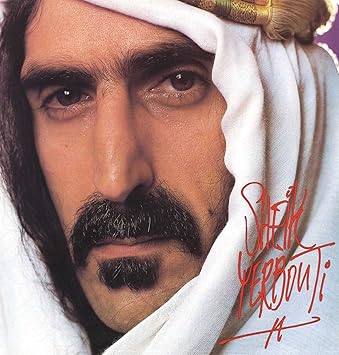
Sheik Yerbouti - Frank Zappa

Provenance: In a not insignificant number of ways I am my father's son, and nowhere is this more evident than my tastes when they edge towards the weirder end of the popular music spectrum. White Noise, Gryphon and today's subject - Frank Zappa - all came into my orbit as a consequence of my dad's listening habits.

In the instance of Sheik Yerbouti, I bought this to signal a small amount of independence. How so? Because dad didn't own this album. I distinctly recall as a youngster being impressed by cover art of both Overnite Sensation and Hot Rats, I thought the guy's name was cool (it sounds like a freakin' laser) and some of the songs made me laugh. Thus when I was older and casting around for my own bit of Zappanalia, I went for an album that was considered one of his more 'hard rock' efforts, as per my own inclinations at the time. Hence Sheik Yerbouti.

May I drift a little here? When it comes to worst fanbases of all time, you have to consider those of the Grateful Dead, Britney Spears and Pantera. They all have their demerits, but for me nothing comes close to being stuck with a Zappa fan when the topic of conversation is Zappa. I've had my head forcibly banged for me watching Iron Maiden, met some Megadeth fans who were happy to show me their Neo-Nazi tattoo collections and saw not one but three fights break out within spitting distance during a Madness gig. I'd happily endure all that again, and then some, if I didn't have to spend another moment in the presence of a Frank Zappa fan (my dad excluded, who is the epitome of the exception that proves the rule).

Review: Well, this is a bit of a disappointment.

I can imagine that, aged sixteen, I found some of this stuff funny. However, I've never found scatalogical humour particularly engaging, and any youthful proclivity I may have had towards it has certainly dimmed with age. In terms of my Zappa listening these days, it tends towards the more instrumental side, Mothers of Invention era cuts or Hot Rats (because 'Willie the Pimp  features the greatest violin riff in rock music). Sheik Yerbouti has slipped to the bottom of the pile, and giving it a listen for this review has done little to rehabilitate it.

You know, 'I Have Been In You' might have elicited the odd yuk back when Peter Frampton was a ubiquitous presence in the homes of Middle America, but pastiche is a dodgy thing to pull off at the best of times. It's saying something that the parodical Bob Dylan harmonica stylings on 'Flakes' is the highlight of 'Flakes'. And revisiting the notion of jokes ageing poorly - whew - 'Jewish Princess' (yep) and 'Bobby Brown (Goes Down)' (a discotheque staple on continental Europe, which is enough to make me a full on Brexiter) would've surely been offensive forty or so years ago. In 2018 they come across as positively Neanderthal with their depictions of Jewish women and homosexuality, respectively. A former English Literature teacher of mine once felt moved to describe Zappa as a 'poet'.

I'm happy to say that, amongst the more overtly comedic songs, one still holds up - 'Dancin' Fool' is a stabby little lampoon of the disco scene that works through a combination of splenetic observational humour and metrical tricksiness, the latter effectively turning it into a disco track that can't be danced to. 'Tryin' To Grow a Chin' is also a lot of fun, drummer Terry Bozzio providing a demented vocal. Plus I like false endings, and this song's got one (sorry to spoil it for you, folks - but are you really going to listen to Sheik Yerbouti any time soon?).

Here's the frustrating part; the first track that appears to privilege musicianship above cheap thrills, the instrumental 'Rat Tomago', hits the mark. The push-pull percussion, jazzy keys and wild guitar improvisations afford a glimpse into realms beyond this album's - consciously applied - limitations. Oh, enjoyed that music, did ya? Never mind, here's some wisecracks about fisting. With Sheik Yerbouti we've reached a point in Zappa's career where he needed to do the stoopid stuff (and take it out on tour) to fund his more serious compositions, which had become prohibitively expensive, especially where recording orchestral works were concerned. At least, that was the line trotted out at the time. Who knows? Maybe that was the case, but then again maybe he just got a kick out of stigmatising homosexuality via the medium of comedy song.

As I have intimated, there are hints of a better (and shorter) album here; all the instrumental cuts are great, with 'The Sheik Yerbouti Tango' coming out on top because it sounds just that little bit out of control. Zappa fans might scream that their formalist hero knew exactly what he was doing, but I think it's sometimes pretty neat to hear the seams of the music. (Isn't this where improvisation becomes truly interesting? When instead of falling back on the rock / jazz / blues playbook of licks, they take their instrument on a journey that teeters between inspiration and failure?). Of the 'straighter' rock stuff, 'Broken Hearts Are For Assholes' has a certain appealing mania to it, even if it does descend into a coda about 'poop chutes'. 'Baby Snakes' is here and gone far too quickly, which is a shame because it's a little gem of hard-edged surrealism. 'City of Tiny Lites' really kicks out the jams - a spacey and strangely soulful number that skips along on busy percussion and a rubbery bass line. The guitar solo is fucking badass too.

I will say this - aside from the more objectionable extremes of Zappa's lyric writing, I enjoyed the experience of revisiting Sheik Yerbouti more than I had expected. It's also told me something about myself, and the ageing process. When I was in my teens, I would often skip the 'boring' instrumental tracks so I could get to the next chucklefest. Now, it would be the other way around. Once upon a time, this would've been my favourite Zappa album because it had some rawk 'n' roll on it, but now I gravitate towards his jazzier output (which coincides with a general awakening to jazz as a genre, I guess). Anyway, Sheik Yerbouti certainly treats the ol' lugholes to some interesting snippets of music, but you have to ask yourself whether it's worth wading through all the snark and calculated dumbassery to reach.