Showing posts with label muddy waters. Show all posts

Sunday, 28 November 2021

Hoodoo Man Blues - Junior Wells


Provenance: I'm still chugging through my Toronto thrift store purchases.

Review: As a long-time blues aficionado this album should be catnip, putting the spotlight on estimable harmonica-jockey Junior Wells, and featuring my close relative Buddy Guy as a sideman.

I have had more than one friend complain that blues music doesn't feature enough variety to hold the attention, and I can grok that. Formally, most blues music (with notable exceptions) follows a few set templates in terms of chord progressions, scales and even subject matter. How many times have you heard trains a-rollin' or a woman stepping out on her man?

That being the case, I think one of the keys to creating memorable blues music is the way you play the damn thing. Muddy Waters imbued his with an irresistibly sly boastfulness, Freddie King aimed for the bleachers with buzzsaw guitar soloing and Howlin' Wolf sounded like a one-man demolition team; seriously, his opening cry to 'Smokestack Lightning' sounds like a cave-in at a coal mine. Like any pursuit with a set of rules to be observed, the joy can be found in the manner with which the game is played, or subverted. 

So now we come to Hoodoo Man Blues, the first solo album credited to Junior Wells. Already a veteran sideman, having replaced Little Walter in Muddy Waters' band in the 1950s, Wells assembled a crack band in an attempt to recreate the hot sound of an electric Chicago blues band. In doing so, he birthed a masterpiece, echoes of which could be heard in popular music for decades to come.

Firstly, it must be said that Wells is not the greatest vocalist around; he's probably not even the best singer in the band (that accolade, aka 'The Michael Anthony Award', going to Buddy Guy); but he was no slouch on the blues harp. It's a testament to the supreme level of musicianship that the whole confection was recorded in two days, and that takes into account amplifier issues that led Guy to playing some of his guitar parts through a Leslie organ speaker. Can you imagine that happening today? Ain't it wild that some bands, not too further down the line, would spend a week in the studio trying to capture a decent snare sound only to release a load of old pony?

As a consequence, Hoodoo Man Blues has an electrifying live sound to it. Stylistically it treads the fine line between sophisticated and tough (like the best Chicago blues does), Guy's lacework guitar sparking against Wells' rough-house harmonica. Which, by the way, isn't to say that Guy couldn't land a few stingers himself; a couple of his licks in 'Hoodoo Man Blues' and 'We're Ready' are as sharp and clean as a wet shave from a Turkish barber. I think it needs to be emphasised just how good the playing is here; pocket drumming, locked-in bass and guitar work that possesses the neatness of prestidigitation. 

So how influential was this joint? The ripples can be heard in acts like The Paul Butterfield Blues Band, Canned Heat, Stevie Ray Vaughan, Rory Gallagher, early J Geils Band and, especially to my set of lugholes, Dr Feelgood. The combination of lean orchestration, musical adroitness and aggression would solidify (and perhaps, falter) in the blues-rock sound of the late 1960s into the 1970s; a good example is Ten Years After's supersonic take-off of the Wells' band's version of 'Good Morning Schoolgirl', which booms with a proto-metal heaviness but also contains the seeds of self-indulgence that would lead to dead-ends and sclerosis. None of that is evident on Hoodoo Man Blues - a smoky, punchy, vital testament.

Wednesday, 24 March 2021

The Essential Collection - Muddy Waters


Provenance: A question to those of you who play musical instruments - when you first started to squeeze out some sounds, what were you attempting to play?

For me, on a Hohner Rockwood Pro RP250 (one of the heaviest guitars I've ever played, incidentally), it was blues music.

Prior to picking up the guitar I had no real regard for blues music, albeit the majority of bands I was listening to at the time played material heavily derivative of the genre. I had - have - no natural musical ability, as friends, bandmates and neighbours can attest to; furthermore, there is a fine balancing act to be performed when learning an instrument relatively late on, inasmuch as the frustrations need to be tempered with the green shoots of progress.

For me, that proved to be blues music - as my guitar instructor showed me, with just three chords and knowledge of the minor pentatonic scale, a beginner can sound halfway accomplished. It worked, and twenty years down the line I still enjoy the simple pleasures of improvising over the three-chord trick, especially as working within such strictures makes you, the player, focus on how you're playing, every bit as much as what you're playing.

So, as a newly-minted bluesman, the future king of the Stour Delta, I needed to do some homework. Boy, did I. I became that most insufferable of individuals, a teenage blues buff. Knowing, at the very least, who Muddy Waters, Howlin' Wolf and BB King were became something of a litmus test (though BB wasn't really my cup of tea, you see - a little too sleek and urbane for this adolescent purist!). I wouldn't even worry my fellow young millennials about the likes of Pinetop Perkins, Mississippi John Hurt, Blind Willie McTell and the rest, however - from my lofty perch, I simply couldn't imagine the hoi polloi were able to tear themselves away from the pabulum of Mogwai, Creed and Linkin Park and join me on the blues highway. Think of the worst kind of black metal gatekeeper, multiply by about six, and you've got me, the 17 year-old blues fan.

Anyway, I obviously had to start somewhere, and I think this followed hot on the heels of Stevie Ray Vaughan's Texas Flood (and there was me chaffing BB King!) as a formative blues purchase.

Review: Well, I suppose the first observation that needs to be made is that this album contains a good number of tracks written by the masterful Willie Dixon, performed by the legendary Muddy Waters, and backed by what is considered to be the greatest Chicago blues backing band ever assembled; Jimmy Rogers on guitar, Little Walter blowing harp, Elga Edmonds on drums and Otis Spann tinkling the ivories. That is, Little Walter of 'Juke' and 'Blues With a Feeling' fame, Jimmy Rogers, who popularised 'That's All Right' and 'Walkin' By Myself', and Otis Spann, who worked with Fleetwood Mac, Eric Clapton, Chuck Berry and John Lee Hooker, to name a few. None too shabby.

But here I am getting ahead of myself - I am already assuming you know these folks, and can nod along with these achievements. For the uninitiated, I'll say this - these guys were giants, backing a colossus. 

I almost feel like ending it here and imploring you - ordering you - to hunt down Muddy tearing through tracks like 'I Got My Mojo Working', 'Baby, Please Don't Go', 'I'm Your Hoochie Coochie Man', 'I Just Want to Make Love to You' and 'Mannish Boy'. It's the kind of canned heat we should be blasting off to Mars and beyond, because if any space aliens found this shit they'd soon a) realise that we're not an entire waste of galactic space and b) give pause about invading us. It'd a pre-emptive strike, folks, and by hittin' em with the low smoke (to borrow a phrase from Joe Frazier) we might just survive unscathed. 

For those of you unaware of the Muddy Waters experience, the man is one of those people - like Howlin' Wolf - who explodes out of the speakers, his singing an extension of his personality. And what a personality! He's already middle-aged by the time he's cutting numbers and heads with Chess Records, but that's entirely to his advantage - the swagger, the virility, the braggadocio is shot through with an effortless authority. His rough, soulful voice would be a great weapon regardless, but for Waters the blues wasn't about keening or moaning; no, for him it was a vehicle for boasting, for tall tales, for hairy metaphors, sawdust on the floor and guaranteed good times. Even when Waters is ostensibly playing the puppy-eyed wooer in 'I Want To Be Loved', it still sounds as if he's already got the hotel room booked and champagne on ice.

However, the rather bargain hodgepodge of The Essential Collection doesn't just focus on what is considered by critics to be his zenith; it also contains tracks from later albums, so we get two from his 'lions-in-winter' album Can't Get No Grindin'; and 'Mannish Boy' from his psychedelic effort Electric Mud, a collection that revels in a one-and-a-half star review on Allmusic but powerful enough a testament for Chuck D of Public Enemy to reassemble some of the session players to re-record the big numbers for a documentary (one I would love to see again, but cannot find online). There are some curios here, too, such as a solo performance of 'Rollin' Stone' and a 'She Moves Me' featuring label boss Leonard Chess accompanying Waters on bass drum with an almost majestic level of incompetence.

What more can I say? It's a 'best of', from one of the bests, whose electric blues was simply tougher, more raucous and, in the toss-up, more exciting than almost anything else going. I don't need to sign off with a 'buy this album' plea, just find any collection of his Chess recordings as a starting point and have yourself a ball.

Sunday, 3 November 2019

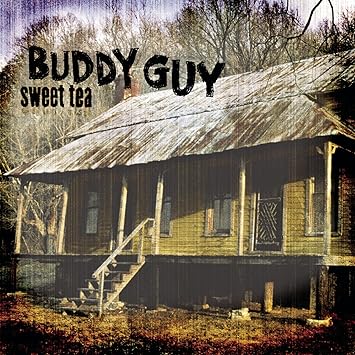
Sweet Tea - Buddy Guy

Provenance: I think anyone with a more than passing interest in the electric blues knows who Buddy Guy is. Still kicking, still playing, with a slew of solo releases and guest appearances to his name, Guy is considered a living legend.

I also have one of the most distant personal connections imaginable. My partner's stepdad's sister married one of Buddy Guy's sons. So, yeah, usual caveats apply when reviewing the work of a close family member.

Review: I pointedly mentioned the electric blues in my introduction, because this is what Guy is most famous for. And on Sweet Tea, fans of his spiky, fluid playing have got more than enough to chew on. Most tracks are over the five minute mark, with 'I Gotta Try You Girl' stretching its legs for well over twelve minutes. You wanna hear some electric guitar, friend? You got it.

So it's strange that the most arresting track on the whole album - the opener, 'Done Got Old' - is a relatively concise three-and-change minutes long, and consists of a close-miked Guy and sparse acoustic guitar. It's a weird song, too - because many of Guy's direct influences would flip their dotage on its head, bragging about their experience or ability to keep up with the youngbloods. Think Muddy Waters with 'Young Fashioned Ways' - "there may be snow up on the mountain, but there's fire down under the hill". 'Done Got Old', however, is a straightforward lament - no braggadocio, machismo or defiance, just a quiet sadness that his body is giving up on him. It's a sombre introduction.

And maybe it's supposed to be the banner that hangs over proceedings, a memento mori to accompany the startlingly vital racket he conjures up on Sweet Tea. 'Baby Please Don't Leave Me' has a title that sounds like a Chess cut from the 1950s, but the clattering drums and skronky overdriven bass makes it sound, early doors, more like a particularly sludgy desert rocker. The guitar riff, when it kicks in, sounds like one of the blues tracks that Led Zeppelin stole, if it was played on high-tensile cables. It's a noise you might expect more from All Them Witches than a guy who literally played with Muddy Waters and Junior Wells.

The highlight of Sweet Tea is 'Stay All Night', another relatively short number. It stalks, it prowls, it rumbles; and a flint-eyed Guy doesn't so much ask for love as commands it. It's down-low and nasty, lower than a snake's belly. At this juncture, I should mention that, aside from the quavering opener, Guy sings wonderfully, with a similarly strained, edgy style as Elmore James, albeit dialled down a notch or two. He was still hitting some impressive high notes at the age most people this side of the Atlantic anticipate receiving free bus passes.

Production is a factor that can make or break a record. As much as I love the bells and whistles approach on albums by the Beatles, Jellyfish, Pink Floyd and other studio cosmonauts, most blues music is served by the KISS maxim; keep it simple, stupid. Going back to Chess, some of those Muddy joints are raw as hell; there's a 1951 cut called 'She Moves Me' where Leonard Chess himself provides inexpert but effective backing on a bass drum to accompany Mud's elastic guitar. Back in the twenty-first century, Dennis Herring has kept some of that magic alive, whilst compensating for advances in technology. You can hear amps humming, snares rattling and the odd clam or two from Guy. It doesn't matter; this is more about capturing a mood and a moment than technical ecstasy (Joe Bonamassa and Kevin Shirley, take note). To these untrained ears, it also sounds like the instrumentals were performed live-in-studio.

The overall effect is very in-your-face, and all the better for it. The guitar isn't overly processed; a dab of echo here and there, but otherwise letting an overdriven tube amp, and of course Guy's expert fingers, do the heavy lifting tone-wise. On 'Tramp', cleaving the old soul classic with an arrangement that sounds like ZZ Top circa the kooky Deguello, Guy bends those strings so aggressively you can hear the muscle and blood through the speaker; the same can be said for the portentous closer 'It's A Jungle Out There'. Meanwhile, on 'Look What All You Got' and 'Who's Been Foolin' You', it sounds like Buddy Guy is fronting Dr Feelgood. It's a genuine pleasure to hear the greatest living exponent of the Chicago blues reminding us all why Clapton, Richards, Beck and the rest bend the knee.

I hear two Kings in the way Guy plays; he's got the pyrotechnic flair of Freddie but hits his bends like Albert (a fellow who, at his best, sounded like he was bending the very molecules of existence). There's something else there, though - a simmering malevolence that gives his every solo or interpolation that bit more bite and excitement. Perhaps 'Done Got Old' was a trickster move, a little juke to throw us off guard before proving, over and over, that he's still got the fire burning down below.

Sunday, 28 April 2019

New Orleans Heat - Albert King

Provenance: Yeah, I picked this up for a fiver somewhere. I'm a big blues fan, and I've a solid regard for New Orleans musicianship, so this one seemed like a slam dunk.

Review: When people talk about superstar producers, names like Mutt Lange, Joe Meek, George Martin, Phil Spector, Quincy Jones and Rick Rubin readily come to mind. Now, it's possible that he's over-represented in my music collection because of the direction in which my tastes skew, but I'd include Allen Toussaint in that crowd. In my mind, he is the central figure of 20th century New Orleans R&B, acting as a triple threat of songwriter, performer and producer. It's no surprise, then, that when Albert King pitched up in the Crescent City to try to inject a new lease of life into some of his classics that we find Toussaint producing, arranging and playing on New Orleans Heat.

As one of the 'Three Kings' of the blues, Albert can sometimes find himself lost in the shuffle. Way out in front is the late B.B. King, a man who came to signify the blues for many, even if his sleek, city-sophisticate take on the genre never quite jived with purists. Then you had the volcanic talent of Freddie King; a big man with a gritty soul voice and a flamboyance on stage that was only matched by his scintillating guitar playing. Then you had the six-and-a-half-feet of Albert King, pinging needly guitar bends around an upside-down Flying V, cooing his songs in a warm, keening moan. Maybe he didn't quite have B.B.'s versatility, nor Freddie's chops, but to me Albert thoroughly deserves his place in the pantheon if only for 1967's Born Under a Bad Sign, recorded with Booker T and the MGs and pound-for-pound one of the greatest rhythm and blues albums, period.

However - despite the marriage of two colossal talents in Albert King and Allen Toussaint, New Orleans Heat doesn't really click. Why so? Well, I think Allen Toussaint's work with soul, funk and even jazz musicians eclipses his production of blues artists; his tendency is to deliver something smooth and sly, whilst King thrives with a more knockabout backing. Perhaps it's King's mellow voice that gulls one into thinking that he can fit in with the Toussaint template, but opener 'Get Out Of My Life Woman' can't hold a candle to Lee Dorsey's version (which was, of course, both written and produced by Allen Toussaint). The next track fares no better - the immortal 'Born Under a Bad Sign' brought to heel by Toussaint's tendency to smooth out rough edges.

Sounds like I've got some real beef with Allen Toussaint, huh? Think again. His work with Lee Dorsey in the mid-1960s is sublime (he wrote 'Working in the Coal Mine', fercrissakes) and in Life, Love and Faith and especially Southern Nights he wrote and performed two of the most remarkable funky New Orleans soul albums of all time. At his best, Allen Toussaint could be untouchable; but New Orleans Heat isn't anywhere near his best. It's simply a bad pairing, with some unfortunate results such as the insipid 'The Very Thought of You' and the embarrassing funk of 'We All Wanna Boogie' (though artists who started off in the blues certainly could produce very credible funk records - King's near-contemporary Johnny 'Guitar' Watson springs to mind).

On a few occasions the King-Toussaint collaboration hits the mark. Despite sounding a little neutered, 'Born Under a Bad Sign' is too good a song to ruin; 'I Got the Blues' has a sinuous minor-key groove running through it and leaves enough room for King's guitar to stretch out; and Leo goddamn Nocentelli's chanky rhythm playing injects some spice into 'I Get Evil', in spite of its too-glossy horn arrangements.

One final thought - despite the lead guitar work all being very idiosyncratic to Albert King's wavy, elastic attack, his guitar tone is dogshit. Pure dogshit. In an ill-advised attempt to sound contemporary, I guess, it's got some kind of horrible phasing effect all over it. The one track where they seemed to have forgotten to plug the fucking pedal in, 'Angel of Mercy', coincidentally happens to be the most straightforward blues number of the bunch, and - lo and behold - the guitar playing absolutely cooks. Oh well, it was 1978; in any case, it's not the disaster that Electric Mud was (yeah, some disaster - it sold a quarter of a million copies, but it's a mess).

Sunday, 8 July 2018

Too Many Snakes in the Road - Kent DuChaine

Provenance: Kent DuChaine is a real one. He's played tens of thousands of gigs and, by his own estimation, has travelled somewhere between two and a half and three million miles as a consequence (after all, what's a spare half a million when you're grinding away on the road?). I've seen him play five times now, and the deal has been the same every time - it's Kent, his 1934 National Steel guitar 'Leadbessie' and a peck of the blues. Never once has he disappointed.

The first time I saw him was at the Lansdown Arms in Lewes. A couple of friends of mine recommended it as a good night out, knowing I was a blues fan. They also mentioned his absolutely bonkers tour schedules, which are a work of art in themselves worth checking out. I had grown to expect blues gigs to be a bit mannered, perhaps a little tame - but a Kent DuChaine gig is nothing of the sort. In a packed sweatbox of a venue he hammered away with a hard-driving attack that instantly got people up on their feet. It was one of the most boisterous and joyous shows I had witnessed in a long while.

I suppose it shouldn't come as a surprise that DuChaine is able to move a crowd - he's been doing it for years, and has honed his craft to an expertly-paced set liberally sprinkled with anecdotes and tall tales. I'm sure he'll be back soon, criss-crossing the country and playing to rooms large and small; go see him if you get the chance.

Review: As I mentioned before, Kent DuChaine has been a consistently excellent live act so I've bought a couple of his CDs at gigs I've been to. After all, a guy who gets by primarily by touring can't survive on applause alone. The double album Too Many Snakes in the Road is interesting because not only are the tracks recorded live, many of them are preceded by the stories that DuChaine tells to introduce them to his audience. A pretty cool twist, but does it work?

In a word, yes. To develop it further, I think it's worth digressing a little to talk about how blues music is treated - namely with the kind of reverence usually reserved for museum exhibits or particularly long-lived politicians. Lots of ink has been spilled about blues music as a genre born out of African-American suffering, which is absolutely not incorrect, but with that has come an attendant solemnity that simply does not fit. By focusing on the bleaker end of the spectrum there's been a tendency to ignore or downplay the bawdier, funnier, lighter side to the music, which if anything was predominant. By trapping it within the amber of authenticity and gravitas, I fear many historians and critics also deny its power as a live phenomenon. This wasn't music you were supposed to scratch your chin too!

Whether consciously or not, Kent DuChaine grasps both of these issues. He doesn't omit to retell the odd myth about luminaries such as Robert Johnson, but then there's also stories of going fishing with Johnny Shines, playing Bukka White's guitar and sharing reefer and champagne with Muddy Waters. Furthermore, when he's playing 'Little Red Rooster' he's not expecting his audience to sit in rapt silence - he's asking them to howl along with him. Hell, the first time I saw him he had people on tables throwing beer around and belting out 'When the Saints Go Marching In'. In DuChaine's hands, the blues is a vital, muscular music.

As he demonstrates on Too Many Snakes... he's also a mean, mean player. Eschewing flashiness, instead he plays with a heavily percussive approach, hammering away on the strings with his right hand whilst slashing away on slide with his left. Nowhere is this better exemplified than on his version of 'Aberdeen Mississippi Blues', which features a bludgeoning intro that sounds like nothing other than the clattering of a freight train, that old favourite avatar of the blues. Elsewhere, DuChaine's full-blooded approach breathes new life into old bones; the popular standards 'Fever' and 'Summertime' are not so much reinvigorated as given a total blood transfusion and a side order of monkey glands to boot.

Given the richness of the blues tradition, and DuChaine's obvious affection for its greatest exponents, it's unsurprising that most of the songs on Too Many Snakes... are covers. However, a true highlight for me is an original composition that is preceded by a wonderful story; '16 Gauge Steel' is a tribute to Johnny Shines, who underwent something of a renaissance after DuChaine himself got him back recording and touring, acting as his sideman until his death. Every time I hear the verse "I have stood in the Georgia pines / With the legendary Johnny Shines" I'm not embarrassed to say that I catch my breath a bit. So simple, yet so evocative.

By his own admission DuChaine is not the best singer out there, but as he advised your author, "you just gotta go for it" and that's what you hear. It honestly doesn't matter though, not at all, when his right arm is pumping up and down like a steam piston and he's chugging his way through 'Rock Island Line'. Kent DuChaine is a superb emissary for the blues as a music that is both varied and vital, and Too Many Snakes... is a very fine testimony to the fact. Now go see the man perform!

Tuesday, 5 June 2018

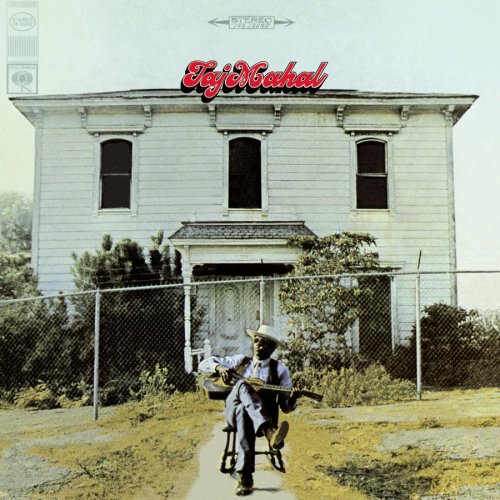
Taj Mahal - Taj Mahal

Provenance: From the moment I picked up a guitar I was interested in the blues. When it came to learning riffs or copping licks, the pentatonic scale seemed to be all-pervasive, looming as it does to this day over a century's worth of popular music. For a while, I was just all about cats like Stevie Ray Vaughan, guys who could shift around the fretboard. Yet even then I was dimly aware of names like BB King, Muddy Waters, Howlin' Wolf, Robert Johnson. These days each one, coming from different times, places and styles of the blues as they do, sound utterly distinctive - but at the time they were old blues guys.

So whilst learning 'Pride and Joy' and 'Crossfire', I was delving backwards and finding some awesome, overpowering stuff. Mississippi John Hurt and Blind Willie McTell became favourites, as did Clarence 'Gatemouth' Brown (whose birthday, I distinctly recall, was marked on a Simpsons calendar our family once had), Son House, Fred McDowell, Pinetop Perkins, Sonny Terry and Brownie McGhee, and of course the incredible Lightnin' Hopkins. Man, you can put 'Lonesome Dog Blues' on right now and I'll still reflexively crack a grin at Lightnin's "po' dog" aside during the first verse.

Later on at university my housemate Ben and I devoured the Martin Scorsese-produced series of documentaries on blues music and that's when I first encountered Taj Mahal. Later, for my birthday, Ben bought me the Taj Mahal 'best of' that accompanied the series and I was away. That was it - I was a Taj Mahal guy from then on.

Now, my partner credits me with hepping my father-in-law to Taj Mahal - which is cool, because if I did, I'm indirectly response for the fact that he's now writing a biography of the man. Coming full circle, it was thanks to him that I was able to go backstage after Taj's show in London last year. He's a man who, I suspect, meets scores of people every night on the road, but he took one look at me and already knew my name, who I was and my backstory. I, a fairly insignificant cog in the grand scheme of things, was impressed, surprised and humbled. We had a good chat, incidentally, about Cool John Ferguson, who is another guy you need to check out. Oh, and at the same time I also met a true broadcasting hero of mine, Dotun Adebayo (he was a prince, by the way, making a mockery of the adage that one should never meet one's idols).

Review: This is where it all began - almost. Here is Taj Mahal, taking his first solo strides after playing with the Rising Sons (who also featured Ry Cooder and future Spirit drummer Ed Cassidy), with a self-titled straight shot of the blues. At a shade over half an hour it's a tight little collection but across the eight tracks Mahal roams around the blues landscape, executing everything from electrified rock to gutbucket country. With a crack band featuring his erstwhile Rising Sons colleagues, it's every bit as impressive as it is eclectic.

Dig this, too - the opening harmonica trill on 'Leaving Trunk' is lodged firmly in my top five ways to start an album. It's startling and joyous, acting almost as a heraldic fanfare or a clarion call to arms, before locking in with a funky, choppy rhythm that causes one's thighs to twitch involuntarily. All this and Mahal hasn't even started shouting the blues in a voice that contains all the grime and passion you could ask for. Yes, yes, yes.

One thing that I have omitted to suggest so far is this album's importance. I genuinely think that without Taj Mahal and a few other American electric blues releases of the era, the renaissance the genre enjoyed in the 1980s wouldn't have happened. Here was an African-American artist contemporaneous with the Rolling Stones, Canned Heat and the rest, creating music at once so recognisable yet so vital as to be quietly revolutionary. Despite the fact that almost every song is a cover Mahal's arrangements sound fresh, injecting fire into the veins of hoary old favourites such as 'Dust My Broom' and 'Statesboro Blues' (NB: the latter is excellent but, alas, my third-favourite rendition of the song; the best being by Blind Willie McTell and the runner-up emanating from the Rising Sons, whose clattery breakneck version is a revelation).

I suppose that's the genius of Taj Mahal - it straddles old and new without ever seeming to compromise or accommodate. There are no swirling Hammond organs or phased drums here - you've got drums, bass, guitar, harmonica, piano; we could be talking the same kind of setup that Muddy Waters was using when storming the clubs and cutting heads in Chicago a decade or more before. The closest Taj Mahal comes to anything that has an obvious genesis in the 1960s is 'E Z Rider', which has a couple of chord changes in the turnaround that Jimmy Rodgers probably wouldn't have put together; and the Sleepy John Estes number 'Diving Duck' gets the same hard-hitting, funky treatment that would come to characterise the best-known version of Albert King's seminal 'Born Under a Bad Sign'.

There's space for one more, and perhaps the most important, song on the album. Mahal stretches out 'The Celebrated Walkin' Blues' to almost nine minutes long, building a slow song slowly. In doing so, room is provided for some dirty slide guitar, keening harmonica and a mandolin counterpoint that serves to remind the listener that blues may live in the city but was born in the country. It lollops along methodically, hypnotically, voice and instruments weaving in and out of the unceasing plod of the bass and drums. It's masterful in its simplicity and stateliness, and served notice on all the British guys trying to sound like Jeff Beck or Alvin Lee. It says: this is the blues served neat, and you boys aren't getting close. I love it.

Later on the scholar and restless spirit that is Taj Mahal would seek out common threads between African-American folk cultures and those of both sub-Saharan Africa and Hawaii, recording some of the most startling collaborations I've been privileged to hear. And it's all there - even when he's rocking out in Zanzibar or Honolulu, that blues root that is so firmly delineated on Taj Mahal is always pulsing away in the background. To the novice Taj Mahal listener: start here, push forward and, as the man himself does, keep pushing - you'll be rewarded.

Sunday, 1 October 2017

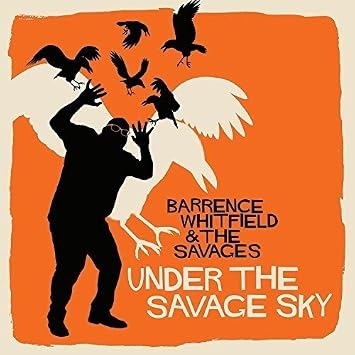
Under The Savage Sky - Barrence Whitfield & The Savages

Provenance: I heard a track from this album, 'The Claw', on a sampler CD from Classic Rock magazine. It really stood out from the crowd, and I'd never heard of Barrence Whitfield nor his troupe of Savages, so decided to take a punt. I am well aware of the 'one good song on an otherwise shit album' issue, and indeed, have fallen victim to that particular pitfall myself before now.

Review: Wow, this is a lot of fun! A no-frills garage rock band fronted by a soulful blues shouter, packing twelve songs into 35 minutes, ensuring nothing outstays its welcome.

Bostonian Barrence Whitfield (real name: Barry White) is now in his 60s but you would've thought that a record this lusty and vital was made by someone half his age. Make no mistake though - this ain't snotty kid music, as is clear from 'I'm A Full Grown Man', which carries on the ripe tradition of grown-ass braggadocio pioneered by the likes of Muddy Waters and Bo Diddley. This is tough, muscular R&B with a punk edge, delivered with the same kind of assuredness and command exhibited by the great soul stirrers of yore.

And 'The Claw'? Check it out:


I don't know about you, but I'm a sucker for that diamond-edged guitar sound and a skronkin' ol Bobby Keys saxophone. It's there on 'Rock 'N' Roll Baby' too, sounding every bit as joyful and demented as the sax on 'Blue Moon'. (The saxophone is the most maligned instrument in rock music - I think I've said it before, but I'll say it until I'm as blue in the face as the aforementioned titular astronomical body; used rightly, whether slinking away sinuously in Steely Dan's 'Doctor Wu' or covering the first row in spit, as in Frankie Lymon and the Teenager's 'Why Do Fools Fall In Love?', it's devastating.)

I'm going to make a criticism, and then proceed to dismiss my own qualm immediately. The criticism? Under The Savage Sky feels as familiar as Arsenal labouring against a team in the bottom three. The dismissal? Who gives a fuck when it's this fun? 'The Wolf Pack' is, as one can deduce before even hearing a solitary note, a tribute to Howlin' Wolf, which in theory could be terrible. However, when the rollicking Hubert Sumlin riff (doubled on saxophone) is met by Whitfield's dead ringer Chester Burnett yodel, it's impossible not to crack a grin.

That's the deal with this unholy collection; every time you detect a hint of The Hives, or a soupçon of Wilson Pickett - perhaps a seasoning of The Seeds, or a suggestion of Sam & Dave - it's like a reward for digging all this sweet ass music, mingled with the reassurance that someone else is still out there, sweating and hollering and keeping the flame alive. About the only time that this magpie attitude towards appropriation oversteps the mark, I think, is on 'Angry Hands', which has a guitar motif that is a near identical twin to that on Alice Cooper's 'I'm Eighteen'.

There's not much left to say. If you like catchy, rough-edged R&B, Under The Savage Sky is the bad boy for you. I haven't investigated any further back just yet (this album came out in 2015) but I get the impression that I won't be disappointed. By the same token, I bet these guys absolutely bring it in a live setting. You can almost see the steam coming off this platter and it's a studio cut, good grief. Just imagine. Just imagine.   

(Oh yeah, I've got one quibble with that Diffuser list I linked to in my first paragraph: Len's 'Steal My Sunshine' always was, and ever shall be, an unmitigated pile of crap.)

Sunday, 13 November 2016

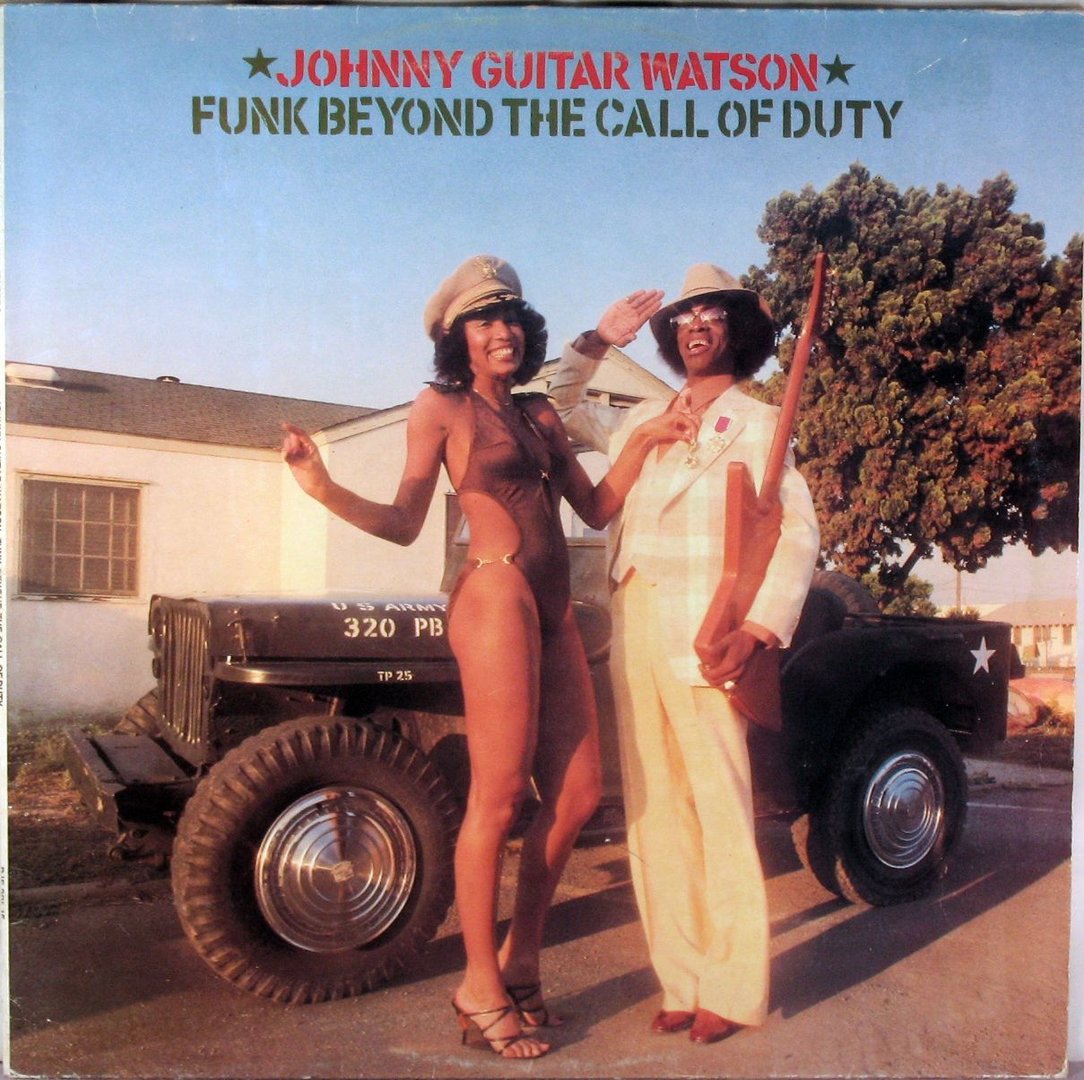
Funk Beyond The Call Of Duty - Johnny 'Guitar' Watson

Provenance: I'm fairly sure it would've come through hearing Watson on one of my Dad's Frank Zappa records. You can hear him on 'Andy' and 'In France' (most prominently in the latter). It's also possible I heard him on one of the many blues compilations I bought as a teenager; he's certainly on a couple I own. I can't even remember the impetus behind buying this particular album. There's a (very) good chance I just liked the cover.

Review: Here's a guy. Johnny 'Guitar' Watson started his career playing jump blues in the 1950s. Later in the decade he recorded a riot in reverb and feedback called 'Space Guitar', and a personal favourite, 'Three Hours Past Midnight', featuring Watson's curious clucking guitar riding atop a sophisticated urban blues backing.

But Watson was never one to stick with a tried and tested formula, and so by the mid 1970s he's traded in the pompadour for an Afro, paid a visit to Iceberg Slim's outfitter and switched up his R&B sound for a sleek soul-funk. Such a wholesale reboot can often seem like a desperate betrayal of artistic principals in order to maintain a foothold on the contemporary scene, and it's traditionally been tricky for blues musicians. Here I'm thinking of Muddy Waters' 'psychedelic' adventure with Electric Mud, or Albert King's marginally more listenable I Wanna Get Funky, neither of which will go down in the annals as classics (though I recall a documentary made by Chuck D of Public Enemy wherein he declared Electric Mud to be a favourite; and I've already fessed up to being a big fan of Neil Young's Trans, so I've got form in the contrarianism department too).

Happily, Johnny 'Guitar' Watson and funk were made for each other. It probably helps that he was an active and willing agent in this change of direction. Watson's natural facility for the genre suggests he actually listened to and appreciated the music, as opposed to being shoehorned into performing it by record label suits. It's also unsurprising that a man who was so pioneering with guitar sounds twenty years before Funk Beyond The Call Of Duty would relish the chance to play around with the expanded palette of sounds that funk orchestration afforded.

In terms of the sound, FBTCOD is closer to the lighter, lush funk of the Cate Brothers than the wigged out bass-heavy Parliament P-Funk noise. Alongside guitar, Watson helms a variety of keyboards and synthesizers, and these tend to operate as a bed for his singing and the unobtrusive horn arrangements. But what Watson really brings to the table is a huge dollop of personality. Every track is imbued with the irresistible Watson chutzpah; sly, bantering and humorous, it's hard to reach any other conclusion that he's having a shit ton of fun making this record, and as a listener you really want to join in.

The other joy is that FBTCOD is shot through with Watson's trademark guitar sound. You could put him through a barrage of amplifiers and effects pedals and he'd still be identifiable. His attack gives the game away; wiry, itchy, staccato, bereft of sustain, never staying in one place. There's also a quirky lyricism about his solos, guitar acting as proxy to the human voice - and on 'It's A Damn Shame' as if to hammer it homes, Watson scats along with his own playing (it's glorious).

Watson is good as a soul troubadour on 'Give Me My Love', but even better as a rueful, witty street philosopher on 'It's A Damn Shame', 'Barn Door' and the superb 'It's About The Dollar Bill' ('If you wanna buy chinchilla / It's a pocket killer-diller' is advice I'll treasure for the rest of my days). Whilst FBTCOD isn't an album that will be top of anybody's list (aside from Chuck D's, perhaps), it's never failed to tug on the corners of my mouth whenever it gets an airing. Billion dollar idea: the next title in the Call of Duty video games series should be called Funk: (Beyond the) Call of Duty. That's as far as I've got in terms of detail, but it's surely got to be better than larking around in space like Roger Moore's stunt double in Moonraker, right?