Provenance: One hundred percent sure that my brother got me into Dr John, although how and when he did remains a mystery. One moment there was no Dr John in the house and then suddenly a 'best of' CD appeared in my brother's room. Anyway, it was very cool.
Happy to say that my brother and I got to see the late Mac Rebennack together at the Barbican Centre, as part of the 2014 London Jazz Festival in a special performance paying tribute to that other favoured son of New Orleans, Louis Armstrong.
Review: There are loads of Dr John albums out there, and I own about four. Why this one? Well, having been stuck in a rut bumping out easy-rollin' rhythm 'n' blues alongside a slew of guest musicians, some bright spark decided that the good doctor needed a bit of lead in his pencil. Enter Dan Auerbach of the Black Keys as producer to stoke the boiler a bit, yet could also be relied upon to be sympathetic towards his subject. Interestingly, Auerbach encouraged Dr John to step away from the piano and onto a range of rather grungy sounding keyboards, whilst he handled guitar duties. Crucially, every song on Locked Down is an original, co-written by Dr John, Auerbach and the band assembled for the album.
As a consequence, Dr John's final studio album of original material sounds fresh, organic, loose and live. Auerbach also gets the production spot on - dusty like the first Wu Tang long player, reverb turned all the way up to spooky, and there's a supreme indifference as to whether instrumental tracks bleed into each other. The end result can only be summed up as sounding downright mean; this is a platter that sounds like it'd beat your granny up for her pension and kick the dog for a laugh. Rather cleverly, it also harks bark to the grimy, indistinct stew (must - not - write - gumbo) of Gris-Gris, the Nite Tripper's very first outing under his own steam.
Whilst this doesn't contain anything quite as weird or demented as 'I Walk On Guiled Splinters' (one of the more disturbing cuts ever committed to tape), Locked Down is dark, swampy and sinister. Dr John spits some surprisingly downbeat, even paranoid, lyrics to the likes of 'Ice Age' (where he compares the CIA to the KKK - nice) and 'Kingdom of Izzness'. I love these songs, with their janky guitars and slightly queasy timekeeping in some quarters, which manage to sound both ramshackle and powerful at the same time.
This sickly, feverish mood persists throughout until the final cut, 'God's Sure Good', at which point the McCrary Sisters come to the fore. On such a necromantic album, it's almost a relief to hear the affirmative, joyous wallop of traditional black gospel, which the sisters provide with gusto at each chorus. Even here, on what should be the most straightforwardly positive song, the denouement morphs into a wild, abandoned jam. Despite the protestations of affinity towards a nominally Abrahamic God, darker forces always seem closer to hand.
In summation, Locked Down is a superb Dr John album - greasy, ugly and shorn of the tameness that had crept into some of his latter-day output. Credit must go to Dan Auerbach. By shutting the door on pipe-and-slippers guest spots and woodshedding a crack band, he managed to coax a set of performances more fiery and vital than anything had sounded in years. Is this Dr John's best album since Goin' Back to New Orleans? Is this Dr John's best since City Lights? You be the judge. Meanwhile, I'm going to skip back to 'Eleggua', which hitches marble-mouthed Nawlins hokum onto a tumbling woodwind riff and rides it all the way home.
Dr John was a big loss. Like his hero Professor Longhair, you knew it was him within seconds; those trilling triplets on the high keys, that entirely unmusical, strangulated rasp that nonetheless sounded perfect atop the jazzy, funky rhythm and blues that was his trademark. I saw him perform twice, and he was spectacular on both occasions. Now all I can do is cue up 'Iko Iko' and daydream about the time I spent back in the Crescent City ten years ago. That's not a bad consolation prize, though, is it?
A blog about one man and his stupid music collection. Mainly about the music, though the man intrudes now and again.
Showing posts with label R&B. Show all posts
Sunday, 29 March 2020
Sunday, 14 July 2019
J Geils Band - J Geils Band
Provenance: During Sixth Form I formed a group, to play at our school band bash, called Centerfold. The ostensible reason for doing so was to play stuff that wasn't punk or metal (the two flavours of music available at the band bash), but really it was so I could play the J Geils Band song 'Centerfold' to a large-ish audience.
In that respect it was a success, but in most others the performance was not just an abject failure, but a litany of failures. Nevertheless, today I am able to battle through the still-present fug of embarrassment to get back on the J Geils Band horse. Here's their first album, and won't you just look at these cool rockin' daddies - hotcha! Hotcha!
Review: Basically, I became mildly obsessed by the song 'Centerfold' after hearing it at a pub quiz. Not long after this revelation, I learned that the band once invited Lester Bangs onstage to play a typewriter solo. A band worth following up with, you'd think - and I duly did, a mere sixteen years later. Other stuff got in the way I guess. Anyway, I had come to be aware of the fact that early on, the J Geils Band were more a gritty R&B band than the slightly New Wavey 'Centerfold' would suggest. That's fine, as my tastes certainly skew towards gritty R&B, plus they had a harmonica player called Magic Dick, which frankly ticks a lot of boxes.
I'm partial to a spot of roughhouse blooz 'n' roll, and that's essentially what this is. Somewhere west of Dr Feelgood and north of Albert King circa his Born Under a Bad Sign Stax release, it's unpretentious, knockabout fun with not a little craft. I like the fact that vocalist Peter Wolf doesn't confuse histrionics with expression, and I'm delighted by Magic Dick's fluid, buzzy interpolations. He even gets his own showcase of his own called 'Ice Breaker', which has hints of Booker T & the MGs. It's a bit odd to sequence this in at track two, though. Was Magic Dick their big selling point? He certainly blows a good harp.
Despite J Geils Band scoring precisely nul points in the originality stakes, it's testament to the band's facility with a twelve-bar that their original compositions stack up well to their interpretations of others. The gear-jamming anthem 'Hard Drivin' Man' (gotta drop that 'g', baby) is the highlight of side one, and has a suitably top-down, open-highway feel to it. It is, however, run quite close by the crawlin' king snake strut of 'Serves You Right to Suffer', and it's nice to hear John Lee Hooker done well in a band setting. Part of JLH's charm was his looseness, which was often the first thing that bands covering his songs would discard. It's great to hear the J Geils Band have the confidence in the material to stretch out and keep proceedings simmering away at the right temperature.
However, having praised the songcraft evidently in existence within the J Geils Band, the true standout of the whole album is the cut that gets side two cooking. I already loved the Otis Rush original of 'Homework', but this hard-charging, snakey version is solid gold. To follow it up with a bippin' and boppin' version of 'First I Look at the Purse' (a hit in 1965 for The Contours) is pure filth. The start of side two of J Geils Band can go toe-to-toe with anything. Likewise, when you decide to round off proceedings with the Albert Collins instrumental cut 'Sno-Cone' (according to the liner notes here, co-written with The Big Bopper - helloooooo baaaaaaby!) you could've packed the intervening ten minutes like a sock of shit and I'll still be giving this disc a rave. Okay, so 'On Borrowed Time' might not be the greatest blue-light ballad ever written, but it's a welcome change of pace. I love everything else.
As I mentioned before, there is nothing new under the sun here, but when it's this muscular, unpretentious and tightly arranged (all words that can describe me, incidentally) there's nothing to do other than sit back and admire a job well done. The J Geils Band might sound like a bar band, but it's the best damn bar band west of the Danube. Buy this album.
Sunday, 28 April 2019
New Orleans Heat - Albert King
Provenance: Yeah, I picked this up for a fiver somewhere. I'm a big blues fan, and I've a solid regard for New Orleans musicianship, so this one seemed like a slam dunk.
Review: When people talk about superstar producers, names like Mutt Lange, Joe Meek, George Martin, Phil Spector, Quincy Jones and Rick Rubin readily come to mind. Now, it's possible that he's over-represented in my music collection because of the direction in which my tastes skew, but I'd include Allen Toussaint in that crowd. In my mind, he is the central figure of 20th century New Orleans R&B, acting as a triple threat of songwriter, performer and producer. It's no surprise, then, that when Albert King pitched up in the Crescent City to try to inject a new lease of life into some of his classics that we find Toussaint producing, arranging and playing on New Orleans Heat.
As one of the 'Three Kings' of the blues, Albert can sometimes find himself lost in the shuffle. Way out in front is the late B.B. King, a man who came to signify the blues for many, even if his sleek, city-sophisticate take on the genre never quite jived with purists. Then you had the volcanic talent of Freddie King; a big man with a gritty soul voice and a flamboyance on stage that was only matched by his scintillating guitar playing. Then you had the six-and-a-half-feet of Albert King, pinging needly guitar bends around an upside-down Flying V, cooing his songs in a warm, keening moan. Maybe he didn't quite have B.B.'s versatility, nor Freddie's chops, but to me Albert thoroughly deserves his place in the pantheon if only for 1967's Born Under a Bad Sign, recorded with Booker T and the MGs and pound-for-pound one of the greatest rhythm and blues albums, period.
However - despite the marriage of two colossal talents in Albert King and Allen Toussaint, New Orleans Heat doesn't really click. Why so? Well, I think Allen Toussaint's work with soul, funk and even jazz musicians eclipses his production of blues artists; his tendency is to deliver something smooth and sly, whilst King thrives with a more knockabout backing. Perhaps it's King's mellow voice that gulls one into thinking that he can fit in with the Toussaint template, but opener 'Get Out Of My Life Woman' can't hold a candle to Lee Dorsey's version (which was, of course, both written and produced by Allen Toussaint). The next track fares no better - the immortal 'Born Under a Bad Sign' brought to heel by Toussaint's tendency to smooth out rough edges.
Sounds like I've got some real beef with Allen Toussaint, huh? Think again. His work with Lee Dorsey in the mid-1960s is sublime (he wrote 'Working in the Coal Mine', fercrissakes) and in Life, Love and Faith and especially Southern Nights he wrote and performed two of the most remarkable funky New Orleans soul albums of all time. At his best, Allen Toussaint could be untouchable; but New Orleans Heat isn't anywhere near his best. It's simply a bad pairing, with some unfortunate results such as the insipid 'The Very Thought of You' and the embarrassing funk of 'We All Wanna Boogie' (though artists who started off in the blues certainly could produce very credible funk records - King's near-contemporary Johnny 'Guitar' Watson springs to mind).
On a few occasions the King-Toussaint collaboration hits the mark. Despite sounding a little neutered, 'Born Under a Bad Sign' is too good a song to ruin; 'I Got the Blues' has a sinuous minor-key groove running through it and leaves enough room for King's guitar to stretch out; and Leo goddamn Nocentelli's chanky rhythm playing injects some spice into 'I Get Evil', in spite of its too-glossy horn arrangements.
One final thought - despite the lead guitar work all being very idiosyncratic to Albert King's wavy, elastic attack, his guitar tone is dogshit. Pure dogshit. In an ill-advised attempt to sound contemporary, I guess, it's got some kind of horrible phasing effect all over it. The one track where they seemed to have forgotten to plug the fucking pedal in, 'Angel of Mercy', coincidentally happens to be the most straightforward blues number of the bunch, and - lo and behold - the guitar playing absolutely cooks. Oh well, it was 1978; in any case, it's not the disaster that Electric Mud was (yeah, some disaster - it sold a quarter of a million copies, but it's a mess).
Thursday, 5 April 2018
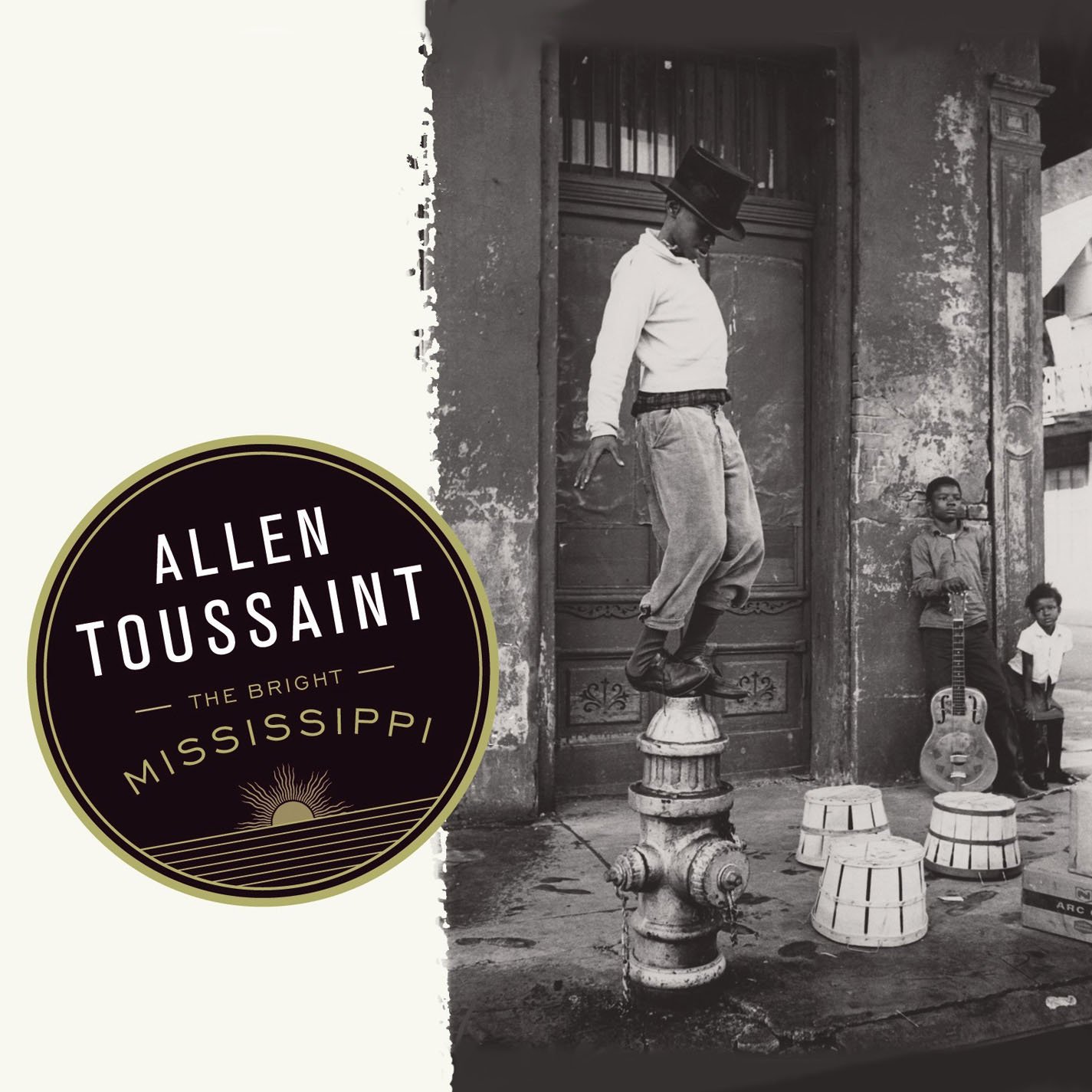
The Bright Mississippi - Allen Toussaint
Provenance: There's three things I am sure of in life; I want my coke to be diet, my football to be catenaccio, and my piano players to come from New Orleans. Just take a look at some of the luminaries to come from the Crescent City - Dr John, Professor Longhair, James Booker, Fats Domino and Allen Toussaint.
When I was in New Orleans (my favourite American city - and the least American city?) I was fortunate enough to catch the Preservation Hall Jazz Band, playing the trad stuff unamplified in a small room. It's rare, I think, to see musicians of that calibre performing without any kind of PA in such an intimate venue; and from the moment they kicked into 'Sheik of Araby' I was captivated.
When I heard that Allen Toussaint had decided to make a jazz album that honoured the legacy of New Orleans I didn't need any more encouragement to go out and buy it.
Review: Sheer, unadulterated joy.
It genuinely feels like a privilege to hear the ensemble of crack musicians Toussaint gathered for this album to perform with such casual virtuosity. What could have been a tired jog through a clutch of musty old standards instead feels like a vital, ebullient celebration of a city and the music to which it is umbilically linked. It's both remarkable that The Bright Mississippi took a mere four days to record, and yet totally believable, as the sound is so organic that one imagines the band all set up in the room together, running through two or three takes and picking the best of the bunch. If there are overdubs to the live sound, my guess is that they are minimal.
From the very first bar of Sidney Bechet's 'Egyptian Fantasy' one can sense magic swirling around, but for me the album really moves into the realms of the sublime during 'St James Infirmary', a song I've heard many different times in various iterations but rarely does it reach such a degree of majesty as it does here. From then on, everything is immaculate - whether it's a sleepy-eyed rendition of 'Winin' Boy Blues' from jazz's ur-pianist Jelly Roll Morton, an iridescent 'Day Dream' (Duke Ellington) or my personal highlight, a languid interpretation of Django Reinhardt's already wonderful 'Blue Drag'. It might even top any version I've ever heard played by the Belgian master.
Every performer on The Bright Mississippi acquits themselves superbly, though I feel special mention should go to both trumpeter Nicholas Payton and clarinettist Don Byron. The contributions they make to each song on which they feature elevate each piece, with Payton playing some especially imaginative solos. However, the name on the CD is Allen Toussaint, and so it's only fair to pay attention to what he's playing.
Fortunately, Toussaint rises to the occasion splendidly. His playing is light and supple, hands moving across the keyboard with the twinkling grace of Fred Astaire in motion. Toussaint rarely elects to bang out big meaty solos, instead accenting his stylish playing with clusters of dancing notes, little trilling figures that complement the more sinuous sounds of the trumpet and liquorice stick (check me out using that hepcat jazz lingo, daddy-o). However, for all his panache Toussaint is also a two-fisted New Orleans piano player, and that generous, wide-open easy-rolling blues sound is given voice on King Oliver's 'West End Blues' and the traditional number 'Just A Closer Walk With Thee'; and I wouldn't want it any other way.
In every sense The Bright Mississippi is a triumph. The sound is such that it almost feels tactile - can you taste that thick Gulf air on your tongue as you luxuriate in the music? Do your eyes prick at a hint of cayenne pepper and onion? It is, of course, illusory; the jumbled symptoms of an imagination stirred by aural stimuli. But goodness me, what stimuli! I find in such situations that it's best just to sit back, pour a measure of something expensive and laissez le bon temps rouler.
Sunday, 1 October 2017
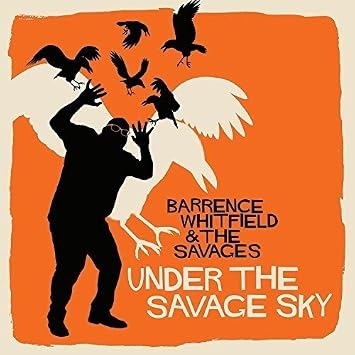
Under The Savage Sky - Barrence Whitfield & The Savages
Provenance: I heard a track from this album, 'The Claw', on a sampler CD from Classic Rock magazine. It really stood out from the crowd, and I'd never heard of Barrence Whitfield nor his troupe of Savages, so decided to take a punt. I am well aware of the 'one good song on an otherwise shit album' issue, and indeed, have fallen victim to that particular pitfall myself before now.
Review: Wow, this is a lot of fun! A no-frills garage rock band fronted by a soulful blues shouter, packing twelve songs into 35 minutes, ensuring nothing outstays its welcome.
Bostonian Barrence Whitfield (real name: Barry White) is now in his 60s but you would've thought that a record this lusty and vital was made by someone half his age. Make no mistake though - this ain't snotty kid music, as is clear from 'I'm A Full Grown Man', which carries on the ripe tradition of grown-ass braggadocio pioneered by the likes of Muddy Waters and Bo Diddley. This is tough, muscular R&B with a punk edge, delivered with the same kind of assuredness and command exhibited by the great soul stirrers of yore.
And 'The Claw'? Check it out:
I don't know about you, but I'm a sucker for that diamond-edged guitar sound and a skronkin' ol Bobby Keys saxophone. It's there on 'Rock 'N' Roll Baby' too, sounding every bit as joyful and demented as the sax on 'Blue Moon'. (The saxophone is the most maligned instrument in rock music - I think I've said it before, but I'll say it until I'm as blue in the face as the aforementioned titular astronomical body; used rightly, whether slinking away sinuously in Steely Dan's 'Doctor Wu' or covering the first row in spit, as in Frankie Lymon and the Teenager's 'Why Do Fools Fall In Love?', it's devastating.)
I'm going to make a criticism, and then proceed to dismiss my own qualm immediately. The criticism? Under The Savage Sky feels as familiar as Arsenal labouring against a team in the bottom three. The dismissal? Who gives a fuck when it's this fun? 'The Wolf Pack' is, as one can deduce before even hearing a solitary note, a tribute to Howlin' Wolf, which in theory could be terrible. However, when the rollicking Hubert Sumlin riff (doubled on saxophone) is met by Whitfield's dead ringer Chester Burnett yodel, it's impossible not to crack a grin.
That's the deal with this unholy collection; every time you detect a hint of The Hives, or a soupçon of Wilson Pickett - perhaps a seasoning of The Seeds, or a suggestion of Sam & Dave - it's like a reward for digging all this sweet ass music, mingled with the reassurance that someone else is still out there, sweating and hollering and keeping the flame alive. About the only time that this magpie attitude towards appropriation oversteps the mark, I think, is on 'Angry Hands', which has a guitar motif that is a near identical twin to that on Alice Cooper's 'I'm Eighteen'.
There's not much left to say. If you like catchy, rough-edged R&B, Under The Savage Sky is the bad boy for you. I haven't investigated any further back just yet (this album came out in 2015) but I get the impression that I won't be disappointed. By the same token, I bet these guys absolutely bring it in a live setting. You can almost see the steam coming off this platter and it's a studio cut, good grief. Just imagine. Just imagine.
(Oh yeah, I've got one quibble with that Diffuser list I linked to in my first paragraph: Len's 'Steal My Sunshine' always was, and ever shall be, an unmitigated pile of crap.)
Tuesday, 4 April 2017
Stronger WithEach Tear - Mary J Blige
I want to preface this by saying that tonight will be the first time I'll have ever listened to this album, and indeed, any Mary J Blige album. To my discredit, my knowledge of Blige and her output could easily be written on a postage stamp, leaving enough room for me to list my favourite Steely Dan songs, which happens to be all of them.
Review: First off, without even hearing a note, what is this horseshit cover art? A nice big picture of the artist, her name's nice and clear, and the album is called Stronger, fine. But what's this? On closer inspection there's a kind of subscript under the word 'stronger' seemingly designed solely for the benefit of amoebas or protozoic lifeforms, and it reads thusly - 'withEach Tear'. Thanks Blige - Stronger withEach Tear looks absolutely stupid and you've given me eye strain.
However - there's a sizeable portion of my album collection that features terrible cover art (mostly in the heavy metal genre) and I still dig the sounds, so let's judge this on the music. 'Tonight' starts off promisingly enough, with a grainy, pulsing Wu-Tang bassline overlain with a shimmering synthesizer borrowed from Fat Larry Band's 'Zoom'. I certainly like Blige's voice, and on this and subsequent track 'The One' it's manipulated with clever production to produce a range of interesting effects. Both are in a minor key and ride atop edgy, tricky beats, generating a skin-tightening tension that I really enjoyed.
It dips a bit on 'Said and Done', as a lubricious synth riff gives way to a fairly bland-sounding chorus; even so, the rather neat darkwave influences make it worthwhile. The next track is where everything turns to moose manure; 'Good Love' is an uptempo frothing fountain of piss, anchored by Club Tropicana brass and a guest verse from T.I. that did negative things to my I.Q. 'I Feel Good' can't be any worse, but it sounds like the Des'Ree / China Black collaboration that nobody asked for.
It becomes uncomfortably clear that on SwET, Blige is far more accomplished with the gritty, sultry or aggressive material than she is with the brighter, shinier gubbins. It's fair to say that the rest of the album plays out this way. Blige's voice is a thing of beauty, possessing clarity in full voice and a hint of bite when in declamatory mode. Her producers (and they are legion) have also used phasing and filtering effects intelligently; on 'I Luv U' for example, the combination is quite subtle, the mixture of natural and robotic voices turning the track into a tour-de-force of wind-tunnel techno-eroticism. It's the last truly great track on the album, but it's a cracker. Closing track 'I Can See In Color' comes close to greatness. Blige puts her full dynamic range on display out in front of the kind of downbeat heavy-lidded soul track that used to cook behind one of those characteristically gargantuan Isaac Hayes slow jams.
I can't say that I've become a fan of Mary J Blige since listening to SwET but I have become an admirer, albeit with qualifications. Blige is certainly a masterful singer, and with sympathetic material is absolutely capable of bashing out a masterpiece. The thing is, I don't know quite which direction would best serve Blige best. On the one hand, I'd love to hear a full album of her duking it out with Daft Punk in futuristic heaven; on the other hand, 'I Can See In Color' hints at the possibilities of Blige looking backwards and recording steamy, funky soul with the Swampers (or whatever their latter-day equivalent is) down at Muscle Shoals. With this much talent, it's perhaps hard to know which way to turn - which is also a reasonable summation of Stronger WithEach Tear (seriously, fuck this album title).
Labels:
darkwave,
isaac hayes,
mary j blige,
R&B,
sea sharp,
soul,
steely dan,
swinetunes,
vincent price
Sunday, 19 June 2016
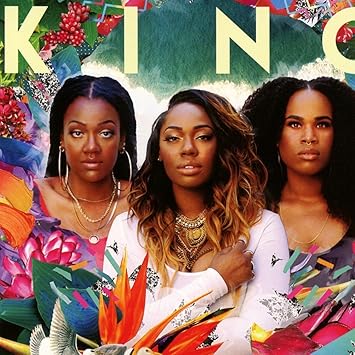
We Are KING - KING
Provenance: You wouldn't guess it to look at me, but when my body isn't being held together by gaffer tape I sometimes go to the gym. Anyway, I heard 'The Greatest' whilst getting ripped and felt compelled to explore further.
Review: Were I to indulge in a conversation with the sixteen-year-old version of myself he'd be incredulous to hear that I consider We Are KING to be the album of the year (so far). Here are a few problems:
1. No guitars
2. No fast songs
3. Not heavy
4. It's R&B
5. No songs about Satan, Wotan, etc
6. No guitars (edited to add: there are some guitars, but we're not talking some sweet-as Steve Vai soloing here).
I was, of course, a rock obsessed idiot back then, but fifteen years later We Are KING is an anomaly in my music collection. It's fair to say that the music I own is overwhelmingly white, male and guitar oriented. My saving grace is that I've become a smidgen more catholic in my tastes and a bit less ideological, inasmuch as I used to write off entire genres due to a lack of 'authenticity' (a concept that mostly stemmed from a perceived ability to play traditional rock band instrumentation).
Thank fuck I grew up and opened my ears a little, as We Are KING is a dreamy joy from beginning to end. Let's start with the single from the album that sucked me in, 'The Greatest', which sounds like a glorious throwback, like TLC's best slow-jam with an 8-bit filigree. It's woozy, weird, affirming and, with its nods to the late Muhammad Ali, poignant.
It also sets the tone for the rest of the album. Very rarely does We Are KING stretch its legs beyond a languid amble; 'Supernatural' is the only track that threatens to break into a sweat but settles into a gentle shuffle. The production matches the pace; liquid, warm and ambient. Regarding the vocals, comparisons with 1990s R&B are inescapable, diva virtuosity largely eschewed in favour of hushed, sensual intimacy. When all the voices are combined and recombined, the effect is not unlike the multi-layered and heavily treated vocals on an Enya album.
Throughout the mood is kept sweet and dreamy - 'Red Eye' exists in the same zone of peculiar half-somnolence one might experience on an transatlantic flight; the outro to 'Hey' dims the instrumentation down to a kind of background radiation, allowing the listener to lie back on a cushion of noise created by the group's whispered singing.
KING are Paris Strother, sister Amber Strother and friend Anita Bias. Paris must be considered the leader here; as well as singing, she plays and produces almost every sound on the disc, collaborated on designing the artwork and also owns a share of the publishing through her own company. We Are KING is totally the baby of a distinctive genius; many of the keyboard and synthesizer sounds Strother employs would sound at home on a 702 or Jade release but the end result comes across more like a knowing wink to that era rather than straight imitation.
It's nice to be blindsided by something that I wouldn't normally give a second thought to. My semi-frequent visits to the gym have yet to yield another doozy (and I might do something I'll later regret if I have Fleur East one more time) but it has reminded me that I shouldn't cocoon myself away in my headphones listening to hoary old favourites like Led Zeppelin and Judas Priest. Next review on Swinetunes: Judas Priest.
Labels:
amber strother,
anita bias,
king,
paris strother,
R&B,
soul,
the greatest,
we are king
Subscribe to:
Posts (Atom)


:format(jpeg):mode_rgb():quality(90)/discogs-images/R-1264898-1353101379-4668.jpeg.jpg)