Showing posts with label elmore james. Show all posts

Sunday, 22 December 2019

Mojo Working: the Best of Ace Blues - Various Artists

Provenance: Learning how to play guitar, blues was almost one of the first things I gravitated towards. The songs largely stuck to a formula I could follow, it gave me the foundations upon which to fumble around with the minor pentatonic, plus it sounded really cool.

I think I picked this little doozy up in my late teens. I definitely had it before university, because I used Little Willie Littlefield's 'Happy Pay Day' on a video project.

Review: Twenty tracks and not a duff amongst them. I must have picked this up because I recognised a few of the names - BB King, John Lee Hooker, Lightnin' Hopkins - but it's the lesser lights who make this interesting. For a genre that is sometimes dismissed as too simplistic for true sophisticates, it also runs the gamut, from the minimalist vamping of Hooker on the immortal 'Boogie Chillen' via the skronkin' sax-fest of Littlefield's jubilant 'Happy Pay Day' to the lamplit comedown blues of Johnny 'Guitar' Watson's wonderful, idiosyncratic 'Three Hours Past Midnight'. The vast majority of this stuff comes from the 1950s but still packs a right ol' wallop in the speaker department, and makes a lot of what was on the pop charts at the time sound insipid and neutered.

Honestly, this collection probably came along at just the right time. Having (somewhat) shaken off my thraldom to Stevie Ray Vaughan, I was dangerously close to becoming that most dreaded specie amongst blues fans, the Purist. Any taint of commerciality, any hint that the guy I was listening to hadn't flogged his soul at the crossroads, and I wasn't interested. For me, half the excitement was the mystery, the notion of singular men "emerging fully-formed from the Delta", as Elijah Wald has it in Escaping the Delta, his excellent deconstruction of the mythology and assumptions made about Robert Johnson, probably the blues' most totemic figure (a book that also ably demonstrates that Johnson was every bit as swayed by his peers, and contemporary tastes, as any other artist). So, for me, the perfect blues artist had an unknown birthdate, a sketchy recording history, and an early, hopefully disputed, and perhaps grisly, death. Oh, and they played solo.

The archetype, then, was someone like Blind Willie Johnson and his 'Cold Was the Night, Dark Was the Ground'; a piece of music so powerful that it was blasted into the galaxy for space aliens to enjoy, performed by an artist who met a suitably gothic demise. Not quite as tragic, but even more haunting was Skip James' breathtaking 'Devil Got My Woman', used to such good effect in the underrated movie Ghost World. You see, it all resonated with that key watchword for me - authenticity.

So, thank goodness for Mojo Working, with its stylistic breadth and judicious choice of cuts. Yes, it still had those choons that got me all shivering and misty-eyed about southron twilights - the spare, sinister 'Lonesome Dog Blues' from Lightnin' Hopkins chief amongst them - but it also opened my ears to the richness and variety not just of the sonic template of the blues, but also its moods. I've already mentioned the knockabout 'Happy Pay Day', but there's also the sly insinuations of Arthur Gunter's chooglin' acoustic number 'Baby Let's Play House' and the more forthright swamp-braggadocio of Slim Harpo's 'I'm a King Bee' (which features a sound used to create the instrumental hook - I'm not even sure whether it's a bass or harmonica - that I'm yet to hear anywhere else).

Mojo Working basically became by blues primer, the springboard for exploration which has led me to buying albums of at least half of the artists that feature on the compilation. Hell, I've even reviewed a couple of them! But the one I want to dwell on just for a moment is an artist who first tasted success with rhythm and blues in the 1950s, and then again during the 1970s. I am, of course, talking about Johnny 'Guitar' Watson. I am actually more familiar with his hepcat funkster output, but the 1956 joint that appears on Mojo Working sounds astonishingly modern. 'Three Hours Past Midnight' is remarkable not only for its pin-sharp production but the tone Watson coaxes out of his guitar. On an album full of distinctive guitar work (from Elmore James's slashing slide playing to Little Johnny Taylor's busy, jazzy runs up and down the fretboard), Watson's lead sounds like it was beamed in from another galaxy. It's utterly strange! A kind of clucking, quacking noise that's accentuated by Watson's staccato attack (apparently using his thumb alone, which boggles my noggin), but something I can't imagine all the available ProTools plugins could ever replicate.

They might get close, but they'll never quite make it. And what is that unassailable quality that cannot quite be replicated, if it isn't that magic notion, authenticity?

Of the hundreds of albums I own, few have burnt themselves into the memory quite like Mojo Working. Every track appears in the mind's eye as distinct and as whole as entire universes. When I give this a spin, I can convince myself that this is the alpha and omega; no other music exists. And for the span of an hour, perhaps, it doesn't.

Sunday, 3 November 2019

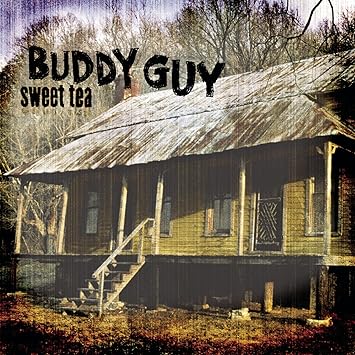
Sweet Tea - Buddy Guy

Provenance: I think anyone with a more than passing interest in the electric blues knows who Buddy Guy is. Still kicking, still playing, with a slew of solo releases and guest appearances to his name, Guy is considered a living legend.

I also have one of the most distant personal connections imaginable. My partner's stepdad's sister married one of Buddy Guy's sons. So, yeah, usual caveats apply when reviewing the work of a close family member.

Review: I pointedly mentioned the electric blues in my introduction, because this is what Guy is most famous for. And on Sweet Tea, fans of his spiky, fluid playing have got more than enough to chew on. Most tracks are over the five minute mark, with 'I Gotta Try You Girl' stretching its legs for well over twelve minutes. You wanna hear some electric guitar, friend? You got it.

So it's strange that the most arresting track on the whole album - the opener, 'Done Got Old' - is a relatively concise three-and-change minutes long, and consists of a close-miked Guy and sparse acoustic guitar. It's a weird song, too - because many of Guy's direct influences would flip their dotage on its head, bragging about their experience or ability to keep up with the youngbloods. Think Muddy Waters with 'Young Fashioned Ways' - "there may be snow up on the mountain, but there's fire down under the hill". 'Done Got Old', however, is a straightforward lament - no braggadocio, machismo or defiance, just a quiet sadness that his body is giving up on him. It's a sombre introduction.

And maybe it's supposed to be the banner that hangs over proceedings, a memento mori to accompany the startlingly vital racket he conjures up on Sweet Tea. 'Baby Please Don't Leave Me' has a title that sounds like a Chess cut from the 1950s, but the clattering drums and skronky overdriven bass makes it sound, early doors, more like a particularly sludgy desert rocker. The guitar riff, when it kicks in, sounds like one of the blues tracks that Led Zeppelin stole, if it was played on high-tensile cables. It's a noise you might expect more from All Them Witches than a guy who literally played with Muddy Waters and Junior Wells.

The highlight of Sweet Tea is 'Stay All Night', another relatively short number. It stalks, it prowls, it rumbles; and a flint-eyed Guy doesn't so much ask for love as commands it. It's down-low and nasty, lower than a snake's belly. At this juncture, I should mention that, aside from the quavering opener, Guy sings wonderfully, with a similarly strained, edgy style as Elmore James, albeit dialled down a notch or two. He was still hitting some impressive high notes at the age most people this side of the Atlantic anticipate receiving free bus passes.

Production is a factor that can make or break a record. As much as I love the bells and whistles approach on albums by the Beatles, Jellyfish, Pink Floyd and other studio cosmonauts, most blues music is served by the KISS maxim; keep it simple, stupid. Going back to Chess, some of those Muddy joints are raw as hell; there's a 1951 cut called 'She Moves Me' where Leonard Chess himself provides inexpert but effective backing on a bass drum to accompany Mud's elastic guitar. Back in the twenty-first century, Dennis Herring has kept some of that magic alive, whilst compensating for advances in technology. You can hear amps humming, snares rattling and the odd clam or two from Guy. It doesn't matter; this is more about capturing a mood and a moment than technical ecstasy (Joe Bonamassa and Kevin Shirley, take note). To these untrained ears, it also sounds like the instrumentals were performed live-in-studio.

The overall effect is very in-your-face, and all the better for it. The guitar isn't overly processed; a dab of echo here and there, but otherwise letting an overdriven tube amp, and of course Guy's expert fingers, do the heavy lifting tone-wise. On 'Tramp', cleaving the old soul classic with an arrangement that sounds like ZZ Top circa the kooky Deguello, Guy bends those strings so aggressively you can hear the muscle and blood through the speaker; the same can be said for the portentous closer 'It's A Jungle Out There'. Meanwhile, on 'Look What All You Got' and 'Who's Been Foolin' You', it sounds like Buddy Guy is fronting Dr Feelgood. It's a genuine pleasure to hear the greatest living exponent of the Chicago blues reminding us all why Clapton, Richards, Beck and the rest bend the knee.

I hear two Kings in the way Guy plays; he's got the pyrotechnic flair of Freddie but hits his bends like Albert (a fellow who, at his best, sounded like he was bending the very molecules of existence). There's something else there, though - a simmering malevolence that gives his every solo or interpolation that bit more bite and excitement. Perhaps 'Done Got Old' was a trickster move, a little juke to throw us off guard before proving, over and over, that he's still got the fire burning down below.