Showing posts with label buddy guy. Show all posts

Sunday, 28 November 2021

Hoodoo Man Blues - Junior Wells


Provenance: I'm still chugging through my Toronto thrift store purchases.

Review: As a long-time blues aficionado this album should be catnip, putting the spotlight on estimable harmonica-jockey Junior Wells, and featuring my close relative Buddy Guy as a sideman.

I have had more than one friend complain that blues music doesn't feature enough variety to hold the attention, and I can grok that. Formally, most blues music (with notable exceptions) follows a few set templates in terms of chord progressions, scales and even subject matter. How many times have you heard trains a-rollin' or a woman stepping out on her man?

That being the case, I think one of the keys to creating memorable blues music is the way you play the damn thing. Muddy Waters imbued his with an irresistibly sly boastfulness, Freddie King aimed for the bleachers with buzzsaw guitar soloing and Howlin' Wolf sounded like a one-man demolition team; seriously, his opening cry to 'Smokestack Lightning' sounds like a cave-in at a coal mine. Like any pursuit with a set of rules to be observed, the joy can be found in the manner with which the game is played, or subverted. 

So now we come to Hoodoo Man Blues, the first solo album credited to Junior Wells. Already a veteran sideman, having replaced Little Walter in Muddy Waters' band in the 1950s, Wells assembled a crack band in an attempt to recreate the hot sound of an electric Chicago blues band. In doing so, he birthed a masterpiece, echoes of which could be heard in popular music for decades to come.

Firstly, it must be said that Wells is not the greatest vocalist around; he's probably not even the best singer in the band (that accolade, aka 'The Michael Anthony Award', going to Buddy Guy); but he was no slouch on the blues harp. It's a testament to the supreme level of musicianship that the whole confection was recorded in two days, and that takes into account amplifier issues that led Guy to playing some of his guitar parts through a Leslie organ speaker. Can you imagine that happening today? Ain't it wild that some bands, not too further down the line, would spend a week in the studio trying to capture a decent snare sound only to release a load of old pony?

As a consequence, Hoodoo Man Blues has an electrifying live sound to it. Stylistically it treads the fine line between sophisticated and tough (like the best Chicago blues does), Guy's lacework guitar sparking against Wells' rough-house harmonica. Which, by the way, isn't to say that Guy couldn't land a few stingers himself; a couple of his licks in 'Hoodoo Man Blues' and 'We're Ready' are as sharp and clean as a wet shave from a Turkish barber. I think it needs to be emphasised just how good the playing is here; pocket drumming, locked-in bass and guitar work that possesses the neatness of prestidigitation. 

So how influential was this joint? The ripples can be heard in acts like The Paul Butterfield Blues Band, Canned Heat, Stevie Ray Vaughan, Rory Gallagher, early J Geils Band and, especially to my set of lugholes, Dr Feelgood. The combination of lean orchestration, musical adroitness and aggression would solidify (and perhaps, falter) in the blues-rock sound of the late 1960s into the 1970s; a good example is Ten Years After's supersonic take-off of the Wells' band's version of 'Good Morning Schoolgirl', which booms with a proto-metal heaviness but also contains the seeds of self-indulgence that would lead to dead-ends and sclerosis. None of that is evident on Hoodoo Man Blues - a smoky, punchy, vital testament.

Sunday, 3 November 2019

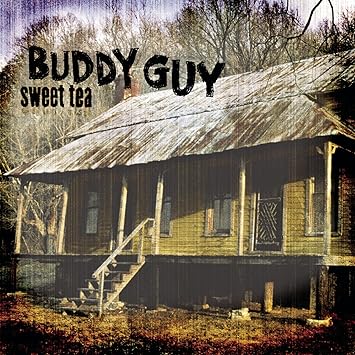
Sweet Tea - Buddy Guy

Provenance: I think anyone with a more than passing interest in the electric blues knows who Buddy Guy is. Still kicking, still playing, with a slew of solo releases and guest appearances to his name, Guy is considered a living legend.

I also have one of the most distant personal connections imaginable. My partner's stepdad's sister married one of Buddy Guy's sons. So, yeah, usual caveats apply when reviewing the work of a close family member.

Review: I pointedly mentioned the electric blues in my introduction, because this is what Guy is most famous for. And on Sweet Tea, fans of his spiky, fluid playing have got more than enough to chew on. Most tracks are over the five minute mark, with 'I Gotta Try You Girl' stretching its legs for well over twelve minutes. You wanna hear some electric guitar, friend? You got it.

So it's strange that the most arresting track on the whole album - the opener, 'Done Got Old' - is a relatively concise three-and-change minutes long, and consists of a close-miked Guy and sparse acoustic guitar. It's a weird song, too - because many of Guy's direct influences would flip their dotage on its head, bragging about their experience or ability to keep up with the youngbloods. Think Muddy Waters with 'Young Fashioned Ways' - "there may be snow up on the mountain, but there's fire down under the hill". 'Done Got Old', however, is a straightforward lament - no braggadocio, machismo or defiance, just a quiet sadness that his body is giving up on him. It's a sombre introduction.

And maybe it's supposed to be the banner that hangs over proceedings, a memento mori to accompany the startlingly vital racket he conjures up on Sweet Tea. 'Baby Please Don't Leave Me' has a title that sounds like a Chess cut from the 1950s, but the clattering drums and skronky overdriven bass makes it sound, early doors, more like a particularly sludgy desert rocker. The guitar riff, when it kicks in, sounds like one of the blues tracks that Led Zeppelin stole, if it was played on high-tensile cables. It's a noise you might expect more from All Them Witches than a guy who literally played with Muddy Waters and Junior Wells.

The highlight of Sweet Tea is 'Stay All Night', another relatively short number. It stalks, it prowls, it rumbles; and a flint-eyed Guy doesn't so much ask for love as commands it. It's down-low and nasty, lower than a snake's belly. At this juncture, I should mention that, aside from the quavering opener, Guy sings wonderfully, with a similarly strained, edgy style as Elmore James, albeit dialled down a notch or two. He was still hitting some impressive high notes at the age most people this side of the Atlantic anticipate receiving free bus passes.

Production is a factor that can make or break a record. As much as I love the bells and whistles approach on albums by the Beatles, Jellyfish, Pink Floyd and other studio cosmonauts, most blues music is served by the KISS maxim; keep it simple, stupid. Going back to Chess, some of those Muddy joints are raw as hell; there's a 1951 cut called 'She Moves Me' where Leonard Chess himself provides inexpert but effective backing on a bass drum to accompany Mud's elastic guitar. Back in the twenty-first century, Dennis Herring has kept some of that magic alive, whilst compensating for advances in technology. You can hear amps humming, snares rattling and the odd clam or two from Guy. It doesn't matter; this is more about capturing a mood and a moment than technical ecstasy (Joe Bonamassa and Kevin Shirley, take note). To these untrained ears, it also sounds like the instrumentals were performed live-in-studio.

The overall effect is very in-your-face, and all the better for it. The guitar isn't overly processed; a dab of echo here and there, but otherwise letting an overdriven tube amp, and of course Guy's expert fingers, do the heavy lifting tone-wise. On 'Tramp', cleaving the old soul classic with an arrangement that sounds like ZZ Top circa the kooky Deguello, Guy bends those strings so aggressively you can hear the muscle and blood through the speaker; the same can be said for the portentous closer 'It's A Jungle Out There'. Meanwhile, on 'Look What All You Got' and 'Who's Been Foolin' You', it sounds like Buddy Guy is fronting Dr Feelgood. It's a genuine pleasure to hear the greatest living exponent of the Chicago blues reminding us all why Clapton, Richards, Beck and the rest bend the knee.

I hear two Kings in the way Guy plays; he's got the pyrotechnic flair of Freddie but hits his bends like Albert (a fellow who, at his best, sounded like he was bending the very molecules of existence). There's something else there, though - a simmering malevolence that gives his every solo or interpolation that bit more bite and excitement. Perhaps 'Done Got Old' was a trickster move, a little juke to throw us off guard before proving, over and over, that he's still got the fire burning down below.