Showing posts with label blue oyster cult. Show all posts

Sunday, 4 December 2022

Go My Way - Robin Trower


Provenance: I know why I bought this album - Classic Rock magazine told me to - but where I bought it is lost to the mists of time. I vaguely recall buying Go My Way at the branch of WHSmith where I held a weekend job, but that seems unlikely. We only stocked the top sixty (nice round number) in the album charts.

Incidentally, I checked the official charts site to see whether there was a chance that Trower snuck into the top sixty in the heady days of summer 2000, I was aghast to see that neither Twice Removed From Yesterday nor the majestic Bridge of Sighs cracked the top forty. Check for yourselves!

Review: If you want me to like your album, do you reckon the opening gambit should be a nine-minuter that mostly consists of wah-guitar going "weow weowoeoowooeoow"? Well buddy I've got great news - that's pretty much exactly what I'm after. For fuck's sake, why else am I buying a Robin Trower album? The percussion? The cover art? (Look at that typeface - is it from Ecco the Dolphin?).

The biggest surprise, if one is allowed to be shocked at the contents of a Robin Trower album, is hearing el jefe stepping up to the microphone for a few numbers. You wonder why he hasn't done it so much before - it's really pleasant, not dissimilar to that of Mark Knopfler's (with the added bonus that Trower doesn't use homophobic slurs on his most beloved songs). Then again, when your vocal foils have included Jack Bruce and the mighty Jimmy Dewar, perhaps it takes time to wind up the courage to give it the tonsils.

I may be committing a heresy here when I say that this might be my favourite Robin Trower album. Better than Twice Removed From Yesterday? I think so! Superior to Bridge of Sighs? Maybe! This does fit in with a pattern of deviancy that considers Trans a stellar Neil Young release, Recycler a worthwhile ZZ Top platter and Love and Theft to be Bob Dylan's finest collection. In some parts of the globe such opinions can have you thrown in jail. But! Listen!!

For a start, the production and musicianship are far sparkier than anything from Trower's 1970s heyday. Normally I'm a sucker for the slightly muddy, claggy atmosphere many records of the era had - it's warm, organic-sounding and tend to make harmony vocals sound amazing - but Trower's guitar playing is such that it works better with a background wrought in sharp contrast. The benefits of the production job are a revelation, revealing ever more shading to Trower's remarkable playing.

You see, I think Go My Way features Trower's best instrumental performances. He blazes through songs like 'This Old World' and 'Run with the Wolves' (the latter of which sounds like an early Blur track, of all things) but it's on the gentler numbers that the guitar work properly shines. 'Into Dust' is a gorgeous thing already, but Trower's playing here is stunning, fragile and aching and kaleidoscopic all at once. In my personal pantheon Trower is right up there with Blue Oyster Cult's Buck Dharma as a stylish, characteristic player anyway, but here it's like someone stuck a rocket up him. His tone is like liquid caramel, and he bends his luminous, fragmentary blues guitar abstractions around these numbers with an understated virtuosity. 

If I could make a guitar sound like anything, and the good Lord knows I've tried, it would be like the guitar on Go My Way.

Is there a weak point here, a moment that drags, any slips into territory filler? Nah. Trower tries on a few different moods, ranging from wistful to hard-nosed but there's a remarkable consistency on Go My Way both in terms of quality and the sound universe the album inhabits. Does it just boil down to sequencing that everything links so neatly together that it can trick the listener into thinking there must be some kind of underlying concept? Perhaps. Am I just over-egging it all because I love Go My Way without reservation? Very possibly.

However, nobody reads this blog for dispassionate perspectives. I likes what I likes, and Go My Way has never long been off my stereo these past twenty years. Anyone who wants to make halfway tasteful noises on guitar should get turned on to some Trower power in any case; and there are few better examples of how to do it than the eleven tracks on Go My Way.

Thursday, 13 January 2022

Rock The World - Various Artists


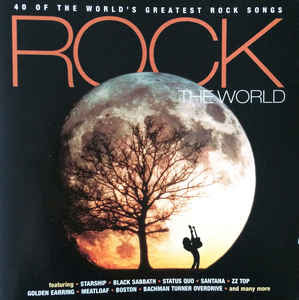
Provenance: Back when I were a lad and finding my feet musically, compilation albums proved a great gateway drug. I look down on them a little these days, and perhaps I should rethink; it is through a compilation album that I got hepped to my favourite band, Blue Oyster Cult. 

Now, Rock The World and I have a history going back many years. My mum used to work in a library, and as such would often bring home tapes and CDs that she thought my brother and I would be into. That way led me to becoming a fan, fairly idiosyncratically, of both ZZ Top's Recycler and Aerosmith's Nine Lives, neither of which would ever be hailed as tree toppers by those bands' fans.

Rock The World was one of these albums mum brought home to us, and we played the shit out of it. I think my brother even obtained a copy. However, like some kind of weird divorce, as we drifted off to university, first me and then my brother, our music collections had a parting of the ways. All of a sudden I was bereft of Van Halen, Ozzy Osbourne and Megadeth; he was left pining for Steve Vai and Motorhead, amongst others. Nonetheless, Rock The World went one way, I went another.

Fast forward to April 2020 and I was idly dicking about on Discogs looking for some eldritch NWOBHM release or another when from nowhere the thought popped into my head: Rock The World! And lo, there it was, with a British seller and a total price (including p&p) of £6.44. Automatic purchase. The transaction was conducted swiftly, buyer 'n' seller gave each other pleasant reviews, and then I waited.

And waited.

And waited.

Until, finally, I contacted the seller to suggest the CD was lost in the Bermuda Triangle of a Royal Mail sorting office. £6.44 duly refunded and I got on with life.

Then, last week, a padded envelope arrived. Not entirely unexpected as this coincided with my birthday, and friends often send me music as a gift. But - you've guessed it - inside was Rock The World a full eight months after I had ordered it. The address was one house number awry, and this was apparently enough to send it into limbo for two-thirds of a year. Still, I have it now, a little piece of my youth. Nice, eh?

Review: What is there to say? It's the kind of rock comp that contains 'Layla' by Derek and the Dominoes (sans Duane Allman outro), '(Don't Fear) The Reaper' by Blue Oyster Cult (retaining Buck Dharma's masterful solo) and other big beasts like 'Bat Out Of Hell', 'Smoke On The Water', 'Born To Be Wild', 'Boys Are Back In Town', 'Hold The Line'...you get the picture. Little you hadn't heard before, one would suspect.

Indeed, the listening experience is like a pleasant stroll through one of the calmer zones in Jurassic Park - imagine each of these songs as peaceful sauropods lumbering around, any threat that their sheer size presents countermanded by their docility. Fuck, there's even a mimetic quality to 'Smoke On The Water', possessing as it does the exact rhythm, one suspects, of a charismatically large dinosaur ambling to a watering hole. 

In fact, this harmlessness is the common characteristic to all the cuts on Rock The World. There's no New Wave spikiness, nor thrashy bite to proceedings, and precious little mystery. Black Sabbath's hoary old workhorse 'Paranoid' is about as occult as things get (though that didn't stop us playing it at Band Bash - our version contained an ill-starred slide guitar solo, performed by yours truly). Saying that, there are a couple of curveballs herein - relatively speaking, of course.

For example, when I first encountered Python Lee Jackson's downbeat beauty 'In A Broken Dream' I was very impressed with how their lead singer could ape Rod Stewart so well (until I discovered it actually was Rod Stewart). Starship's 'Jane' is the only track with a cod reggae section, and Atomic Rooster's brassy 'Devil's Answer' would be partly responsible for my later purchase of their excellent Death Walks Behind You album. Amusingly, as there was about a zero percent chance of licencing a Led Zeppelin track, some jabronis called Black Velvet deliver an admittedly very credible 'Since I've Been Loving You' (were Kingdom Come not available?).

Ultimately, though, the value of Rock The World doesn't stem from the music it contains, though it's a bit of quaint knockabout fun in the age of streaming and shuffle. It doesn't even matter that it's dad rock incarnate, so much so that you can picture it in bootcuts, feigning expertise in single malts and hitting on your girlfriend. No, this album represents something greater - sitting on the battered sofa in my bedroom with my brother and our friends, going nuts at each other over a multiplayer cage match of WWF War Zone on the PS1. Memories of laughing uproariously, dropping the Stone Cold Stunner whilst 'Black Betty' blares away in the background - now, isn't that worth £6.44?

Sunday, 14 February 2021

Curse Of The Hidden Mirror - Blue Oyster Cult


Provenance: I am the world's biggest Blue Oyster Cult fan (fight me), and bought this the very day it came out in the UK.

Review: Coming only three years after Heaven Forbid, I had hoped that Curse of the Hidden Mirror was a continuance of momentum that might see BOC release new studio material at a stately but steady pace. Well, I was wrong on that front - this release, on the final day of my GCSEs, would be their last until The Symbol Remains emerged last year, a gap of almost twenty years.

At the time that Curse... came into my possession I was deep into my BOC obsession; if Eric Bloom farted into a bathtub I would've considered it genius. I also recall defacing my parents' car with a Curse... bumper sticker, much to my dad's chagrin. You must understand, valued reader, that as a daydreaming sixteen year-old Blue Oyster Cult were a galaxy of music unto themselves. I would listen to Secret Treaties or Tyranny and Mutation and imagine myself an inductee into some kind of eldritch confederacy, a cabal of initiates who could tease out dark themes and cryptic signifiers from the music. I now realise how insane this all sounds. However, for a couple of years or so, in my little world, Blue Oyster Cult were The Truth.

Of course, exposure to new people, places, experiences and Steely Dan was to instil a degree of perspective into my worldview but I'm still, by most measures, a fanatic. Alongside the aforementioned Dan and Judas Priest, Blue Oyster Cult constitute the triumvirate of my own personal 'Big Three' artists. Nonetheless, the passage of time has mellowed me, and opened me up to all kinds of sounds I used to disdain (country music, for starters), which should grant me slightly more nuance in my assessments of their output.

The first thing that needs to be said is that, despite a title that acts as a callback to previous albums and the band's 'Imaginos' mythos, the qualities that made BOC so special in the mid-1970s are difficult to discern here (which has been the case, really, since Fire of Unknown Origin). Gone is the twisty, tumbling harmonic minor riffing and the oblique cod-Modernist poetry courtesy of the late Sandy Pearlman and Richard Meltzer. These elements are lamented, and I still don't think BOC ever properly recovered from the firing of drummer Albert Bouchard, their secret weapon with regards to both songwriting and infusing their sound with a light, jazzy sensibility on percussion.

What we do have on Curse... is a slick band of highly talented players who have come up with a diverse and distinctive collection of songs. Yes, horror and fantasy lyrics are still in place, albeit a little more on the nose, less mysterious and arcane, but that's fine. And if the Cult no longer possess the juice that made their early run of releases so damn unique, it's been replaced with a whipcrack sharpness. The best news is that Buck Dharma, one of the most identifiable guitarists of any era, does not miss a beat. I am sure I'm repeating erstwhile Metallica bassist Jason Newstead's impression here, but when he said Dharma's playing "was like hot needles pushed into your ears", I recognised that immediately. Further: Dharma came from a musical background, and there's something of the horn player in his lead work. The pulses, the climbs, the internal rhythms all come from a bop consciousness, even if the modes he typically plays in doesn't (but neither does he really hang around much in the typical rock box of the minor pentatonic). Beautiful.

When it comes to sensibility, it's long been obvious that frontman Eric Bloom favours the heavier material, whilst Buck is the pop guy. That delineation is clear on Curse... with Bloom helming headbangers such as 'Showtime', 'Eye Of The Hurricane' and the excellent, brawling 'The Old Gods Return'. Meanwhile, Buck's sweeter singing style gives a light touch to the almost-power-pop single 'Pocket', lead track 'Dance On Stilts' and 'Here Comes That Feeling', the latter of which could've easily slipped into the Eddie Money catalogue without too many eyebrows being raised.

There are a couple of interesting departures here - Bloom sounds like he's having a whale of a time hamming it up on 'I Just Like To Be Bad', which takes its cues in the verses from mid-period Who; and 'Stone Of Love', a Buck composition that's been knocking around since the early 1980s, has a suggestion of the more Latin-influenced tracks by Love, albeit with resoundingly modern hard rock dynamics. There is, alas, one crap tune here, unfortunately appended to the end of the album - 'Good To Feel Hungry' sounds like an undeveloped studio groove that should've been left on the cutting room floor.

Still - for a band that's been ploughing its own peculiar furrow for the past fifty or so years (a mere forty when this came out), Curse... sounds much hungrier, much livelier than it had any right to do. Okay, so perhaps vampiric skull-grin creepiness remains only in homeopathic memory, but thankfully we've got Ghost, who these days do a fabulous, classic BOC tribute act, so I'm happy. And I'm happy with Curse... too, a superlative hard rock record that crackles with verve, energy and no little craft.

Sunday, 31 January 2021

Horror Show - Iced Earth


Provenance: Another £1 bargain from the internal message board at a former job. I didn't really know a huge amount about Iced Earth at the time, but the chance to acquire some metal in exchange for a very small sum of metal proved irresistible.

I feel like Iced Earth are a band I've seen at some festival or another in a mid-to-late afternoon slot but my brain has been pounded into slurry by pandemic lockdowns, so who knows? I'm beginning to doubt I ever enjoyed seeing live music, once upon a time.

Review: So here we have it, Horror Show, each track taking its cue from a scary movie or historical personage, with the exception of 'Ghost of Freedom', which comes from the head of lead squealer Matt Barlow, plus a cover of the Iron Maiden instrumental 'Transylvania'. Iced Earth's main man and sole constant, guitarist Jon Schaffer, is responsible for writing virtually all the music and most of the lyrics throughout. 

I have a soft spot for anyone who indulges in these kind of monster-based shenanigans, ranging from Bobby 'Boris' Pickett through to Lordi and Ghost, so we're off to a good start. It's not always successful - observe Judas Priest's paean to Loch Ness and its resident cryptid features lyrics that straddle the Spinal Tap 'fine line between stupid and clever' divide (but also, crucially, an indestructible guitar riff). However, when it comes off, it's cool as fuck - the aforementioned Priest with 'The Ripper', Blue Oyster Cult cranking out 'Godzilla' and 'Nosferatu' on the same goddamn album, a whole bunch of Rob Zombie stuff - hell, I'll even allow Alice Cooper's 'Feed My Frankenstein', Elvira cameo 'n' all. The Venn diagram between fans of scary movies and heavy metal must be pretty chunky, so it's a good bet.

Thus, we've got musical tributes here to the Wolf Man, The Omen movies, Jack the Ripper (fertile ground, evidently), the Mummy, The Strange Case of Dr Jekyll and Mr Hyde, The Creature from the Black Lagoon, Frankenstein, Count Dracula and The Phantom of the Opera. This should be a lot of fun!

And, yeah, it is. The music itself isn't much more than rather decent power metal, though I found the mostly acoustic balladry of 'Ghost of Freedom' quite affecting alongside being a welcome change of pace. Matt Barlow - or Sergeant Matthew Barlow of the Georgetown Police Department, to give you some colour as to his current activities - is vocally a good fit, his delivery belying an obvious Geoff Tate (Queensryche) influence. My biggest bugbear with a lot of bands in the thrash and power-metal is that the drumming production sounds piss-weak. Somewhere along the line the rolling thunder of early metal became replaced with the impotent pitter-patter of double-bass pedals and a tinny, clattery quality to the rest of the kit. 

However, there's plenty of schlock to make up for this, including the wonderfully devilish incantations on 'Damien', hokey vocal effects on 'Jekyll & Hyde' (yes, of course, the two 'characters' speak to each other) and a suitably melodramatic finale in 'The Phantom Opera Ghost'. Bonus points, too, for doing a song called 'Frankenstein' which is about the doctor, not his monster, though it challenges us to ponder as to 'Who's the monster? Who's the victim?'. Hello, has anybody considered that, uh, maybe society is the monster in all this? Anyway, 'Frankenstein' is the highlight of Horror Show for me, though its Maiden-esque successor 'Dracula' runs it close. Hey buddy, have you ever wondered if society is the vampire?

My own personal gripes with the percussion aside, everything sounds pretty great on Horror Show without quite having the requisite sizzle or magical spark to elevate the album to the A-list. What could do it, I wonder? A spot of narration by Sir Christopher Lee, per Manowar? Perhaps a spot of narration from Orson Welles, per Manowar? Maybe, just being Manowar? I kid, not even Manowar want to be Manowar these days. Besides, whilst Iced Earth might not have been able to call upon the talents of Lee or Welles, the wonderfully-named Yunhui Percifield provides co-lead vocals on 'The Phantom Opera Ghost' and she does a top job, so that's something to be celebrated. Entertaining stuff, then, rammed to the rafters with all manner of ghouls 'n' ghosts - but whatever did happen to the 'Transylvania Twist'?

Sunday, 16 June 2019

Opus Eponymous - Ghost

Provenance: For a band who I've followed avidly since they first burst onto the scene about ten years ago, my memories of how I became with Ghost acquainted are fuzzy.

I certainly recall my first live encounter with the band - March 2013, when they headlined that year's Jagermeister Tour; support acts were Gojira and The Defiled. Caught it down in Bournemouth with a few friends and family, tickets costing a princely five quid. Even back then, Ghost put on a hell of a show.

Anyway, last month I spent a week in North Macedonia and listened to fourth album Prequelle on the flights there and back. Having initially dismissed the latest as a bit ballad-heavy, I am now inclined to see it as their strongest album to date. So, having recently used this blog to pretend that I'm an adult with grown-up tastes, I now think it's time to check out a bunch of Scandinavians who wear masks and pretend to worship Satan.

Review: Prior to pressing 'play' on my stereo, I had a horrible impression that I was going to be less than fair with Opus Eponymous. What I saw in Bournemouth all those years ago was exciting and theatrical, but absolutely nothing like the slick outfit Ghost have subsequently become (I saw them in Brighton a couple of years ago for significantly more than a Lady Godiva). Likewise, the music on Prequelle is rich in texture and nuance, great swathes of orchestration wrapping around songs that have one eye on the charts (NB: this album didn't do any business in the US, whilst Prequelle peaked at number three on the Billboard Top 200).

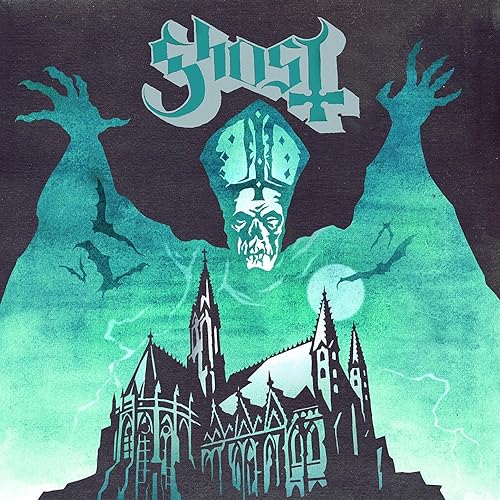
Then again, at this point in time, there was still a lot of fun to be had around Ghost's identities. Taking a leaf out of the Kiss playbook, the songwriting on Opus Eponymous was credited to 'a Ghoul Writer'; the frontman was the mysterious Papa Emeritus, and the band referred to as 'a host of Nameless Ghouls'. Furthermore, the album sported cool artwork and reinvigorated a strain of metal that could be subtle yet heavy, sinister yet campy and unafraid to revel in showmanship. In short, they basically revived 1972-77 era Blue Oyster Cult, but this time, with added devilry.

(Even the symbol Ghost use has a touch of the Kronos motif Blue Oyster Cult deployed on all their albums. Catnip for BOC geeks such as myself.)

I don't think it comes as a surprise that a collection quite so schlocky as Opus Eponymous opens up with a church organ dirge. Pretty standard stuff, really, when it comes to albums that celebrate Old Nick. All well and good for setting the scene, but it's over quite quickly and we're into the galloping 'Con Clavi Con Dio', which is what all of us in the peanut gallery came for. It's fucking badass - and makes me realise that although Ghost were working with a much more basic palette than on subsequent releases, that ability to fuse tunefulness and heaviness was there from the word go. One suspects that were this to appear on Meliora or Prequelle, it would be washed with keyboards and other such orchestration. One thing that does stand out is that the music has more 'gaps' than the thick tapestry of sound that typifies later releases.

Still, this no-frills approach gives it a pleasingly retro feel. Vocals aside, much of Opus Eponymous sounds like it could've been disinterred from the mid-1970s, or maybe the first dark flowering of the NWOBHM. This ersatz dustiness - a false vintage - perhaps puts Ghost, at least here, in the bracket of some kind of eldritch Sha Na Na, inviting the listener on a journey to a time that never quite took place in the first place. I'm not suggesting for a moment that Ghost belong in any serious kind of discussion about hauntology but their Blue Oyster Cult cosplay act is damn convincing.

I keep mentioning BOC here, and at this juncture I should also throw in other obvious influences such as Mercyful Fate, Alice Cooper, the Crazy World of Arthur Brown, Slayer; they're all there. But - but - but - you can taste the fact that Tobias Forge (the leader and frontman of Ghost) is intimately familiar with Long Island's finest between, especially that golden stretch between Tyranny and Mutation and Spectres. Damn it all, the keys in 'Con Clavi Con Dio' sound like they've been ripped from 'Tattoo Vampire'. Elsewhere, there are echoes of 'Flaming Telepaths', 'Career of Evil', 'Quicklime Girl' - the good news is that Forge's borrowings are from the absolute prime cuts, so it's all good. Greta Van Fleet, take note; when you want to emulate your heroes, just try and do it well in the first instance, yeah?

In any case, none of this would add up to a hill of beans if the songs aren't there - and, praise Satan, they really are. Forge isn't a screamer; in fact, for a metal singer his voice is quite soft, made even more pliant by enunciation informed by his Swedish background. However, if anything this makes the music sound even more unworldly and uncanny; compare and contrast with Kiss, who for all their attempts to shock polite society, couldn't hide the fact that they were a bunch of Noo Yawk schlubs if their lives depended on it. Instead, Forge relies on a building a sense of drama and majesty to propel his infernal ditties and it works splendidly. Ghost celebrate the Father of Lies with all the pomp and ceremony of a High Mass, and choruses to tracks such as 'Elizabeth' (about Elizabeth Bathory), 'Stand By Him' and 'Death Knell' simultaneously soar to the heavens and plumb the fiery depths.

Having listened to Opus Eponymous again, so soon after spending a lot of time with Prequelle, has brought me not only a sense of relief (i.e. that it's a banger) but also reminded me why I was so revved up by Ghost almost a decade ago. It's yanked me back to a small concert room in Bournemouth, and to marvelling at the audacity of trying to conceal the band's identities in the online age. The latter couldn't last, of course, but I enjoyed the schtick at the time. With a whiff of brimstone and a smear of greasepaint, Ghost delved backwards to bring the joy of the old-timey rock 'n' roll spectacle to the twenty-first century, for which we should all be grateful.

Sunday, 20 May 2018

Sonic Temple - The Cult

Provenance: I heard 'Fire Woman' on the radio one time and really liked it.

I've always been irked by the very existence of The Cult as it's prevented me from referring to the superior Blue Oyster Cult as anything other than 'B-O-C'. That, and that stupid 'She Sells Sanctuary' song.

Review: Emblazoned on the back of the album, in a typeface barely smaller than that used for the track listing, is notice that Sonic Temple is produced by Bob Rock. More commonly associated with Metallica's breakthrough into the commercial stratosphere, Sonic Temple almost feels like a warm-up to the monster albums Rock would helm (before, latterly, riding the desk for much of Michael Buble's career).

Although Metallica was a massive seller, metal fans are still torn over its merits and demerits. I've heard it dismissed variably as lightweight, mid-paced and aimed squarely at the casual listener, none of which I can particularly disagree with. But, as in the classic job interview scenario, it's exactly those seeming weaknesses that Metallica parlayed into strengths. I still don't rate it much as an album, but I can see clearly why it still pumps out of the car stereos of soccer moms the length and breadth of the Midwest.

But what's all this got to do with Sonic Temple? Well, because to these ears it sounds like a blueprint for Rock's approach with Metallica. A thick sound, big basic riffs, nothing sounding too busy or elaborate, songs all played at a mid-paced tempo. It's as if the lessons about producing an expansive, back-of-the-hall sound from Simple Minds' 'Don't You (Forget About Me)' were coupled with Mutt Lange's insistence that Def Leppard stripped down their riffs to the bones on Hysteria. The result is something that is digestible, radio friendly, chunky and, dare I say it, a touch cynical.

That's not to say Sonic Temple doesn't feature some good music. The opening one-two punch of 'Sun King' and 'Fire Woman' is pretty spectacular. These two songs loom out of the speakers, huge slabs of stadium rock with insanely catchy hooks. 'Fire Woman' in particular is an absolute stomper. This approach is also evident on cuts like 'Sweet Soul Sister' and 'New York City', where any pretence towards sophistication is sacrificed on the altar of simplicity. There's always been a place for big dumb rawk, as AC/DC could attest to, but here the grit and grime has also been cleared away in favour of a polished, layered sheen. And it mostly works. Hell, 'Soul Asylum' even gets away with a single note intro, that sounds like someone attempting to play Led Zeppelin's 'Kashmir' for the first time, and it still works.

However, Sonic Temple is only a qualified success. Let's revisit 'Soul Asylum', because after it actually does develop into a crappy version of 'Kashmir', things get even worse when Ian Astbury, hitherto one of rock's most preposterous popinjays, opens his fucking mouth. "Who - would break - a butterfly - on the wheel?" he emotes, before beginning another verse with "Who - would crush - this woman - underfoot?" Give me a fucking break, dude. I actually like Astbury's voice - it's distinctive, with a bit of yelp and swagger to it, but his delivery can certainly tip over into the histrionic and hammy (which is precisely why he fronted a latter-day version of The Doors, right guys?). But goodness me, some of those 'yeah-yeahs' he uses as punctuation get old fast.

The other big criticism I have is that Sonic Temple is two songs too long. Had the album stopped after 'Soldier Blue', I would've been much more hearty in my acclaim. "It's only two songs, you jabroni" I hear you say and yes, I dig, but in this instance it's more than a minor hitch. Given the absolutely unvarying tempo of the album, that final eight or nine minutes slides the experience over from rather enjoyable to a bit fatiguing. It's not that either 'Wake Up Time For Freedom' or 'Medicine Train' are bad songs per se, (though they both teeter close to the edge of acceptability), but these two constitute the sequencing equivalent of the mid-gig drum solo; you're looking at your watch and waiting for something more interesting to kick into gear, which in this case means putting on another album. Christ, 'Soldier Blue' is perfect to end on; ever since I read Simon Reynolds' (excellent) Shock and Awe I've been listening out for glam's influence on the rock music that came afterwards, and the mighty Glitter Band style drumming on this track is a prime example. Compared to the rest of Sonic Temple it even does something slightly different with the rhythm! Call it a day when you're on top!

Listening to this album for this blog has been fun, yet I genuinely had to blow dust off the CD box. I think I know why. Although I'm the mad king howling on the moor about the devilry of shuffle play, this is the perfect album to be mixed in to playlist. A lone track here and there, especially if it's 'Fire Woman', sound stunning. Two or three together are cool, you can drive to the supermarket to that kind of jive. The entirety of Sonic Temple in one sitting is, alas, a bit too much. It commits a cardinal sin of popular music, which is through precision-engineering and a dearth of variety, it becomes a wee bit boring. Oh, and that hokey blues intro to 'Medicine Train' is so bad as to be funny, worse than the bluegrassy bit that kicks off Warrant's 'Uncle Tom's Cabin', and that's saying something.

Tuesday, 27 March 2018

Night Songs - Cinderella

Provenance: When I was eighteen I went to see Blue Oyster Cult at The Brook in Southampton. I distinctly recall seeing a rather statuesque young lady alone in the crowd, and being both a) a bit cocky and b) entirely oblivious to the notion that she might not want to speak to me, I went over and introduced myself. She was a first-year student at the local university and, as it turned out, welcomed a chat as none of her peers had answered the call to see 'the Cult' live. We talked music, and it turned out she was especially enthused on a band called Cinderella, particularly a chap called Eric Brittingham.

I didn't get anywhere beyond talking about our mutual enjoyment of rock music as I suspect that sharing the same number of syllables in our names was about the only thing I and Mr Brittingham had in common.

Wind the tape forwards a few years and you'll find me sat in my tent checking the schedule at Sweden Rock Festival. Ahoy hoy, what's this? Cinderella playing a late afternoon 'cold beer' slot? Was I going to check them out? Too bloomin' right! And yeah, Cinderella were cool even though Tom Keifer had a goddamn baby voice.

Review: From looks alone one would reflexively lump Cinderella in with the spandex 'n' Aquanet glam metal mob. And indeed, there are certainly a few signifiers of that era present on Night Songs - noise-gated drums, trebly guitars, wailin' vocals. Yet that only tells half the story - because on this album, you can hear the serious intent of solid blues-rock musicians trapped within the glittery carapace of butt-rock dandies.

Unfortunately, this is the album's fatal flaw. Although Night Songs contains some great songs and sterling performances, it is hamstrung by a gauzy production job courtesy of Andy Johns. It's not as if Johns is a bad producer - he helmed the desk on Television's Marquee Moon after all - but I can only conclude that here he was making a misguided attempt to keep up with the zeitgeist. A strange decade, the 1980s; you had albums that sound immaculate - better than anything being produced in the present day (Sade's Diamond Life, Donald Fagen's The Nightfly, hell let's thrown ABC's Lexicon of Love into the mix too) - but for every bejewelled wonder you also had about three albums that sound like a clutch of synthesizers rattling around the bottom of a shipping container.

The good news is that the rather enervated production can't hide the quality of tracks like the rambunctious 'Shake Me' ("aaaAAAalll night!") and the monumental 'Nobody's Fool'. It's interesting to note that instead of a shack-shaker to kick off the collection, whoever sequenced Night Songs opted for the moody prowler 'Night Songs', a track very much in the mould of AC/DC's 'Hell's Bells'. A freaking bell even chimes during the intro, and it doesn't escape notice that Keifer is singing in the same range of a certain Brian Johnson of, er, AC/DC; shurely shome coincidensh?

It sags a little in the middle with 'Once Around the Ride' and 'Hell On Wheels', two generic rockers that would've sounded more than passable if they had some balls. Was glam metal one big emasculation fever dream? Lots of castrati-high vocalising and gender-bending raiment all in the service of men aggressively asserting their masculinity via some of the most sexist lyrics ever yelped into a microphone? I don't know where I'm going with this.

If you aren't disposed to like either heavy rock or freeze-dried production jobs you're not going to find Night Songs particularly palatable, but you might be able to look past its obvious faults and glimpse the promise of something quite wonderful. Also, when I mentioned 'blues-rock' in the fourth paragraph, I am of course talking about blues rock in its whitest iteration; there's nary a whiff of the Mississippi Delta about Night Songs. But an album that burns down the home stretch with pulsing dandruff-looseners like 'Somebody Save Me', 'In From the Outside' and the mighty 'Push Push' deserves respect. Good stuff all in all, but Eric Brittingham can do one.

Sunday, 21 January 2018

Club Ninja - Blue Oyster Cult

Provenance: I'm one of the biggest Blue Oyster Cult fans under pensionable age in the UK. I've got all the albums, hit up their shows, and I even used to pester them via email.

NB - this is my second BOC review and I feel I've hardly touched my music collection. However, if I did a different band every week, by the end I'll just be down to a rotation of Blue Oyster Cult / Steely Dan / Tom Waits (no bad thing, right?). For the sake of variety, I'll be sprinkling in the 'big boys' from now on, so you might get two or three BOC reviews before you encounter Atomic Rooster or Electric Wizard. Lucky you.

Review: In this guy's opinion the classic era of Blue Oyster Cult stretches from their self-titled debut (1972) through to Spectres (1977). One could therefore surmise, on that basis alone, that the 1985 album Club Ninja is not a classic - and one would be correct in doing so. However, just because a band is no longer in their pomp doesn't necessarily mean they aren't capable of pulling out the stops - witness Ratt in 2010 with Infestation, Cheap Trick's clutch of post-2005 releases or even Bob Dylan's sublime Love and Theft and Modern Times releases. Hell, I'd settle is this was Blue Oyster Cult's Get A Grip.

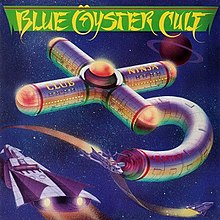
Well, Get A Grip it ain't. As was the case with last week's Hot In The Shade, Club Ninja features awful cover art, compounded by an absolutely dire name. [Adopting Jerry Seinfeld voice] And what's the deal with ninjas anyway? There was, of course, the execrable Michael Dudikoff vehicle American Ninja, a Cannon Films release from the same year as Club Ninja. You've got the Teenage Mutant Ninja Turtles, who made their first comic book appearance in 1984. The geekiest explanation involves the track 'Shadow Warrior', which doesn't mention ninjas explicitly but was co-written by thriller / fantasy novelist Eric Van Lustbader, who did write a 1980 novel called The Ninja. Your guess is as good as mine.

Another common factor with Hot In The Shade is songwriter Bob Halligan Jr. He wrote some cool stuff for Judas Priest like 'Take These Chains' and 'Some Heads Are Gonna Roll'. On his one outing with Kiss he penned 'Rise To It' (the song where Paul Stanley brags about maintaining an erection) and the crapfest 'Read My Body'. Here he's responsible for similarly cerebral cuts such as 'Make Rock Not War' and 'Beat 'Em Up'. Halligan now plays in a band who advertise themselves as a fusion of rock, Celtic and contemporary Christian music.

By this point in time BOC had sloughed off original members Albert Bouchard (drums / vocals) and Allen Lanier (keyboard / guitars), and had also long abandoned their creepy psychedelic proto-metal in favour of a more 'commercial' synth rock sound. Given all that Club Ninja is, in places - frustratingly - quite good. However, those two or three inspired tracks can't make up for the remainder on offer here, because when Club Ninja is bad, it's horrible. Brutally, irredeemably horrible.

The album starts promisingly enough, with Eric Bloom delivering a delightfully hammy vocal performance on the propulsive 'White Flags'. Buck Dharma (both an underrated guitarist and singer) is up next on 'Dancin' In The Ruins', which if anything is even better. I should point out that anything that works on Club Ninja does so either because of the music or the conviction of the vocal performances, because the lyrics are uniformly bobbins. The only track that gets close to resembling the golden years of Blue Oyster Cult is the sumptuous, shimmering 'Perfect Water', once again sung by Dharma, who also brings some questing guitar work to the table. These songs are really, really decent and could quite easily feature on 'best of' compilations without appearing out of place.

The rest, alas, is drivel. The aforementioned 'Make Rock Not War' and 'Beat 'Em Up' are as boneheaded and uninspired as the titles suggest. 'Spy In the House of the Night' has a stadium-sized chorus and a kicky riff to commend it, but that's about it. The final three tracks - 'When the War Comes', 'Shadow Warrior' and 'Madness To the Method' - all exist within a lacuna of their own; competently played, slickly produced but otherwise devoid of anything interesting. One exception - Dharma's guitar solo on 'When the War Comes' is much better than the track deserves. It's a song that floats by without leaving a mark, despite a voice-over from shock-jock Howard Stern (who was, I believe, married to Eric Bloom's cousin at the time) and, unaccountably, lifting the 'ooga-chu-ka' chant from Blue Swede's version of 'Hooked On A Feeling'. That sounds like something you'd want to be hepped to, right? Be my guest.

There's also not enough Joe Bouchard on this album. One of the defining elements that made Blue Oyster Cult brilliant was the interplay between the Bouchard brothers, Joe's freewheeling bass weaving around Albert's skittering jazz-influenced drumming. Jimmy Wilcox, the drummer on this album, played it straight, giving Joe little room for manoeuvre. And he's given, what, half a song to sing? Screw that. Joe Bouchard is a good dude, not least because he gave me an interview for my school magazine back in 2002 and answered all my dumbass questions with grace and patience. Did I really imply he might've been a Nazi sympathiser? Jeez Louise.

To sum up - Club Ninja was not the disaster it's sometimes made out to be. Indeed, Blue Oyster Cult followed a trend of 70s bands trying to update their sound to stay relevant. The gold standard for this approach will always be ZZ Top's Eliminator, which worked only due to the rarest of alchemy. Instead, this represented the terminus point of BOC's slide towards anonymity - where once they were the 'red and the black', now they were the dull and the bland. At least this didn't represent the end of their story...

Sunday, 23 April 2017

Can't Buy A Thrill - Steely Dan

Provenance: I heard a Steely Dan song or two on the radio and liked them. Consequently, I went and bought their first album. It's that simple.

Or, rather, it isn't. See, I don't just 'like' the music of Steely Dan - I am a swivel-eyed zealot, a slobbering devotee, a man for whom little else matters except the cool embrace of jazz-inflected, complex (but accessible!) soft rock. In short, I'm a fanboy.

For too long the Roman Catholic Church has held a monopoly on holy trinities. Subsequent to the crushing of the fourth-century Arian heresy, a few worthy challengers have appeared; Larry, Moe and Curly; Crosby, Stills and Nash; and of course, the adamantine and ever-victorious troika of McDonald's, Burger King and KFC. Well, here's another for the pantheon - Blue Oyster Cult, Judas Priest and Steely Dan. A triumvirate I esteem above all others.

Review: I don't listen to Steely Dan - I eat, sleep, breathe and shit Steely Dan. As with every album I review for this blog I have it playing as I write, but I don't need to. I know each and every word, the cues for all the instruments, the name of who plays what. I am a tiresome individual to be around, peppering my conversation with references to Steely Dan and acting with exasperation when my interlocutors haven't yet been exposed to the genius of Walter Becker and Donald Fagen. I drive my friends crazy. I don't have many friends.

If I am to find fault, it's that Can't Buy A Thrill has a supremely ugly album cover. Like, what else is wrong? The songs are brilliant. The performances are virtuosic. The production is crystalline (and this on their first album; the quest for sonic perfection has come to define Steely Dan to a great degree. When did they reach their apogee? Aja for my money, though some argue that Fagen's solo outings The Nightfly and Morph The Cat push the envelope further).

Do I love Steely Dan, or do I need Steely Dan? Certainly, I'm not the only person who considers 'the Dan' a lifestyle choice. I too want to drink fruity cocktails, roll out world-weary witticisms in sparkling company, wear rollnecks or floral shirts and leave parties early. I want my Nathaniel West cynicism delivered in gnomic couplets and wrapped around a saxophone solo. I want jazz chords, but not too many. I don't own a yacht but I live on the coast and see many go by my window.

Let's be serious for a moment (because one should not be too fatuous about Steely Dan, you'll never win); Can't Buy A Thrill is a stunner, and if it receives fewer accolades than it should it's because it shares the limelight with Aja, Katy Lied, Countdown To Ecstasy and the rest. The two most recognisable cuts here are FM staple 'Reelin' In The Years', tripping along like an urbane Wishbone Ash, and the filmic 'Do It Again', a series of hard-luck vignettes accompanied by organ and electric sitar. In fact, it strikes me that much of Steely Dan's work is in thrall to the silver screen, either employing recognisable motifs or even terminology in their lyrics that is borrowed from cinema. Someone should write an essay on it, so long as it's not me.

Then you have the rueful, crumbs-from-the-king's-plate grooves of 'Dirty Work' and 'Brooklyn (Owes The Charmer Under Me)'. Both seem to speak of a demimonde possessing a kind of flaccid, played-out glamour. It all sounds ineffably decadent, but remember kids, to be decadent you must first be civilised. That's the real secret to Can't Buy A Thrill - it's all so effortlessly cool. And as the 1970s wore on, Steely Dan would just continue to get cooler. Whilst other bands gurned and grunted their way through the most rudimentary riff-rock and catpiss guitar soloing, Steely Dan would be playing something miles more sophisticated, by the best musicians in the business, and it would sound great on the radio.

The thing is, it was never effortless. Becker and Fagen were martinets in the studio, demanding endless takes from their hired guns until it met their standards. Famously, there's a scene in The Shining where a slow zoom of Scatman Crothers took over sixty takes before Stanley Kubrick was satisfied (as legend has it, Crothers wept with joy and relief in a subsequent filming when the director called his scene a wrap within three takes). The appearance of serenity and the state of serenity are two very different things, and so Steely Dan, like Kubrick, split the difference and opted for the former. It's partly why Can't Buy A Thrill is such a full-bodied, kaleidoscopic success.

I've never seen Steely Dan and would drag my dick through broken glass in order to do so. The closest I came was one evening in Boston. I'd had a great time watching the Blue Man Group with my then-girlfriend - hell, I'd even participated in the show and had a fresh smudge of paint on my cheek as a memento - but emerging from the theatre I happened to glimpse the marquee opposite. It said STEELY DAN and I don't think I spoke another word that evening.  

Sunday, 29 May 2016

Spectres - Blue Oyster Cult

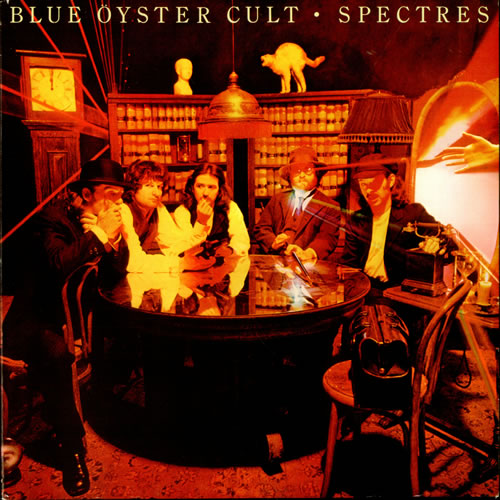
Blue Oyster Cult looking like legends on the front of the Spectres album
Provenance: I'd heard '(Don't Fear) The Reaper' on a rock compilation my dad bought and instantly declared it to be the best song ever written. So when I came across this in a secondhand shop for a fiver I had to buy it.

Review: Between the ages of about 15 to somewhere in my mid-twenties, Blue Oyster Cult were my life. I've seen them more than any other act. I have all their albums. I even interviewed bassist Joe Bouchard for my school newspaper. Between BOC, Championship Manager and active membership of an eFed, that I even so much as kissed a member of the opposite sex during this period is incredible.

The catalyst of '...Reaper' aside, this is where it all began for me. I am a callow youth with ten whole pounds to spend when I spy this in the racks. By this point it is already established that these hombres are responsible for the greatest song of all time. The album cover confirms my initial suspicion that BOC are the baddest band on the planet. There they are, hanging out in some weird badly-lit occult library, dressed to the nines and looking nonchalant because they're always holding cool seances and pissing off the cat with manifestations of ectoplasm and the like. The sleeve artwork alone should've guaranteed platinum status.

Now, some critics think Spectres is where BOC started the nosedive into generic pop-rock pabulum, one that would only be arrested momentarily by Fire of Unknown Origin. Some locate the tipping point as side two of Agents of Fortune. As a fan I completely understand, and objectively I might consider the first four studio discs to be the band's best output. But Spectres was special - like a first beer, or the first time you win promotion to Division One with AFC Bournemouth on Championship Manager 2. How do you go about explaining that magic?

Fortunately, the album kicks off with a true Cult classic - 'Godzilla', a song so potent that I was once assaulted on stage for playing the solo like a complete badass. If you're looking for the skittery, twisted mysticism of earlier BOC then look elsewhere - this had a big, dumb riff, lyrics about the scaly rogue terrorising downtown Tokyo and a Japanese spoken word section that I always had to do because nobody else in my band could remember how it went. Racer X do a splendid cover. It's difficult to resist a chorus hook that goes 'Oh no! There goes Tokyo!'

Other highlights, in order(ish): BOC were never much of a 'ballad' kind of band (and often not great when they gave them a shot) but 'Death Valley Nights' is up there as one of my favourite tracks they ever did. 'Golden Age of Leather' features buzzsaw guitars and a male voice choir to kick off proceedings. Meanwhile, the lilting arpeggios of 'Fireworks' propel the song towards one of Buck Dharma's best solos; I believe Jason Newsted said Dharma's playing was "like hot needles in your ears", which is brilliant but doesn't quite capture the agility and fluency that made his playing so distinctive.

Side two contains 'Celestial The Queen', which sounds like a Blue Oyster Cult / Electric Light Orchestra mash-up, and yet another decent ballad(!!) in 'I Love The Night', a stately attempt at ethereality which mostly comes off. My favourite moment comes in the form of the schlocky vampire yarn 'Nosferatu'; I find it hard to dislike any song that begins with the line 'Deep in the heart of Germany, Lucy clutched her breast in fear'. Canny stuff.

If I allow myself some critical distance, this is the album where the filler creeps in. The cod funk of 'Searchin' For Celine' never gripped me despite its clever lyrical allusions whilst 'Goin' Through The Motions' is a good example of nominative determinism. I've heard other fans slating the Capek-inspired 'R U Ready 2 Rock' as a bit one-note and generic but it's really grown on me over the years. Plus the title is indisputable proof that Prince, like all good people, was a huge fan of 'the Cult'.

Compared to other analyses, I'm only landing glancing blows. There are fans out there who truly count Spectres as a disappointment, or even a betrayal to BOC's roots. I could never be so hard on an album I've listened to countless times, one that set me off on a journey to fandom (and beyond) and most importantly, one that unfailingly evokes the most pleasurable of memories.