Showing posts with label sweden. Show all posts

Sunday, 1 August 2021

Jazz På Svenska - Jan Johansson


Provenance: In a Classic Rock article about the music that influenced them, one of the members of Opeth mentioned Jazz På Svenska. The concept behind it - Swedish folk music played on piano and double bass in a jazz idiom - intrigued me, so I bought it.

Review: I like jazz, I like Sweden, I like the piano. What I don't tend to like is minimalism, particularly. Or, to be more accurate, its sparseness that tends to turn me off. I've bought music, damn it - so why would I be content paying for the gaps in between?

Of course, those gaps are as integral to the sound as all the noisy bits I treasure so dearly. Nonetheless, I would guess there is an impatience lurking within my heart that finds most music that is meditative and ruminative in nature to be lacking. It's not quite the "don't bore us, get to the chorus" celebration of hooks, melodies and concision that admittedly has worked as a formula for much superb pop music; rather, I think I just like stuff to happen. As much as I clowned Gryphon for their strange an unaccountable pretensions, at least their music constantly shifted and probed, at times to bamboozling effect. Fundamentally, I could tolerate being guided through a maze of keyboards and krumhorns due to the energy and propulsion that went into their dizzying souffle of sound.

Here, on Jazz På Svenska, we are presented with a very different proposition; Jan Johansson on piano, Georg Riedel on double bass and...that's it. Two guys playing jazzy folk music, with no virtuoso moments or dazzling solos. Or vocals. It's the most barebones sounding thing I own, because as far as I can tell everything is done live with nary a hint of an overdub or any other production wizardry. There isn't even a producer listed on the liner notes, just a recording engineer (shout out to my boy, Olof Swembel).

In the past I've made much of how I love the sound of jazz albums of a certain vintage - essentially, that the music lives and breathes through all ensemble members being in one room and playing with each other, as music has been performed for millennia. As basic a concept as this is, it's unlikely to feature on any music that makes it to the charts. As such I cannot help but feel that huge swathes of modern audiences are missing out on the pure and crystalline beauty of hearing music played without stultifying layers of studio 'magic' mediating the experience between performer and listener.

Of course, there's plenty of music that relies on this membrane of teases and tweaks to achieve the intended result, but there's a small thrill in hearing music being played the way its done on Jazz På Svenska. And hey, you could argue that I'm cheating, what with volume knobs, stereo equalisation, even the concept of microphones. "Listen Swinetunes," I hear you say, "why don't you just go and listen to some fucker playing a flute in the woods if you think it's so great?" and yeah, I won't do that. But I did see - before buying this album, incidentally - the Preservation Hall Jazz Band in New Orleans. Some might find their strictly trad repertoire hokey, but hearing it being played in a small room, with the musicians almost at arm's length, with zero by way of amplification, really brought home to me just how distorting a lens technology can be when in the service of music.

However, I'm not about to become the music blogosphere's version of the Unabomber (on this issue, at least); rather, this perspective on the creation and playback of music has, I feel, given me a greater appreciation for Jazz På Svenska as a work of art. Next to the congested sound of rock, pop and the rest, it's a lovely, refreshing thing, redolent of clear mountain springs and wide blue skies. One could quite easily have this playing at a dinner party or a dentist's waiting room, sure - but that's only because its understated, unobtrusive charm lends itself to such settings. Active listening is advised.

On a couple of numbers, such as 'Berg-Kirstis polska', there are echoes of Brubeck's playfulness with tricky time signatures in Johansson's playing. In the main, however, Johansson relies on the tasteful lyricism of interspersing the sparse arrangements with jazzy little touches, such as diminished and minor seventh chords that were unlikely to have existed in the original folk songs. Nonetheless, the playing is deceptive, with even a novice pianist such as myself being gulled into thinking I could replicate much of the right-hand work on tracks like 'Visa Från Utanmyra' or 'Gammal Brollopsmarsch' until I listen again. Combined with the strolling bass of Riedel, there's more going on than is obviously apparent in these sweet, mournful little songs.

Despite being recorded at the dawn of the post-bop era, there is nothing exploratory, swinging or dissonant on Jazz På Svenska; on that basis, one could charge it with being perhaps too polite and conservative. No matter - mood, subtlety and elegance are the watchwords here. A peculiar album in relation to the rest of my collection, but one I treasure immensely. 

Sunday, 13 December 2020

Fire And Ice - Yngwie Malmsteen

Provenance: Fucking hell. Suffice to say that we all go through some awkward phases in our adolescence, and one of mine was a fleeting interest in shred. 

I confess, I wanted to play guitar like Satriani, Vai and Malmsteen, at one stage at least. Perhaps I was infected with a relatively benign precursor to Covid-19 as I certainly experienced an extreme lack of taste in order to walk into HMV, see this on the shelves and think to myself, "that'll do for me."

Even back then, green around the gills as I was, I had an inkling that Malmsteen had a hint of farce about him. Prior to being unmasked as a particularly charmless air passenger, there was the braggadocio about his own abilities, his disparagement of other fine guitarists and his ludicrous stage-hogging. 

But he can sure burn it up on the fretboard, right?

Review: I haven't listened to this for many, many years in the belief that it is doubtless garbage, and - surprise, surprise - I am right. Released in 1992, the tail-end of the butt-rock era, it has the sonics and clarity of an album produced ten years prior. Before I go any further, I would like to reproduce Malmsteen's personal thanks entry from the sleeves notes in full. I think these shed much light on the whole endeavour:

Yngwie Malmsteen's personal thanks to: Erika Malmsteen, Lennart & Lolo Lannerback, Fuzzy, Peter, 'Putte' Rooth, Guilio Lomma [sic], Nicolo Paganini [sic], J.S. Bach, Antonio Vivaldi, Ludwig van Beethoven, Jimi Hendrix, H.P. Lovecraft, Enzo Ferrari, Leo Fender, Dinsdale, Monty Python's Flying Circus and to all his family and friends.

What an absolutely marvellous porridge this is; and we shall come back to the principals in a moment, but there's a glaring omission here if influences are being reeled off. Where is Ritchie Blackmore? Surely one cannot produce what is essentially a bad Rainbow album, albeit one juiced to the gills on steroids, without a tip of the hat to the Man in Black? Fire And Ice is essentially the first three Rainbow albums sped up, with less interesting guitar playing, and a complete absence of the charm that made that trilogy so exceptional. So, power metal, essentially.

Credit should be given where due, and I am thankful that Fire And Ice is an attempt at squeezing Malmsteen's electro-baroque sensibilities into band format; much like Steve Vai's (admirable) Sex And Religion, we have a singer present to give shape and meaning to all the twiddling. Furthermore, the fellow in question - Goran Edman, a kind of throat-for-hire - does sterling work. It cannot save the material, naturally, much as one strong swimmer cannot tow a freighter into port, but he does a manful job nonetheless.

What we're left with, then, is a melange of Rainbow, Magnum, Stratovarius and a clutch of other bands that see merit in rhyming 'fire' with 'desire' and wailing away on harmonic minor scales (so, power metal, essentially). Where Jimi Hendrix figures in this whole farrago one can only speculate, but if Malmsteen is laughing into his sleeve at 'forgetting' Blackmore ('How Many Miles To Babylon', really?), the more deceased of his influences come through loud and clear. Boy howdy.

I am not a good musician, and as such I think I would find it a tough yomp trying to build a metal song around, say, a Bach fugue. This trickiness is untroubling to Herre Malmsteen, who cuts the Gordian knot by simply stopping the song in its tracks so we can hear some fruity organ work. It is distracting and tonally illiterate in 'Cry No More' and 'C'est La Vie'; at least he has the restraint(!!) to only bamboozle the listener for a few bars of this guff in fizzy AOR radio-bait 'Teaser'. Hey, what do I know? I ain't never had no number one album in Japan.

We should come to the soloing. It's all reheated Bach 'n' Paganini I'm afraid. Blackmore was, to my mind, the first to popularise neo-classical soloing in heavy rock and metal, but Malmsteen is the one who has really picked up the baton and run with it. But to where? He is undoubtedly a master at playing all these baroque and romantic scales incredibly quickly, but it's almost as if he's boxed himself into a corner. Taste, musicality, moderation are all sacrificed to a frightening, but ultimately banal, demonstration of speed and technicality. Malmsteen is not quite as incontinent a guitarist as double haircut-haver Michael Angelo Batio, but on a track like 'Forever Is A Long Time' (stupendous title) he runs Nitro's finest close.

Highlights? Yeah, there are a couple. Literally, two. After the snorefest of instrumental introduction 'Perpetual', the first track to feature vocals, 'Dragonfly', is pretty decent melodic metal. At the halfway mark, title track 'Fire And Ice' achieves something utterly absent on the rest of the album - a catchy chorus hook. It's a good track! Sad, then, that the album sags with the preposterousness of 'Forever Is A Long Time', and then takes a swan dive off a bridge with 'I'm My Own Enemy' (never a truer word spoken, etc.) which sounds like the Michael Schenker Group (drunken edition) in slow motion.

It's hard to truly loathe Fire And Ice, however. Much like its creator, it's a bombastic, strutting popinjay of an album, all surface and no depth, but it doesn't try to pretend to be anything it's not. I do want to be a little more charitable, truly. But then I hear a fucking lute on some dog awful shit called 'Golden Dawn', remember that Eddie Van Halen is dead but Malmsteen lives, and that I always have the option of listening to Helloween or Savatage.   

Sunday, 16 June 2019

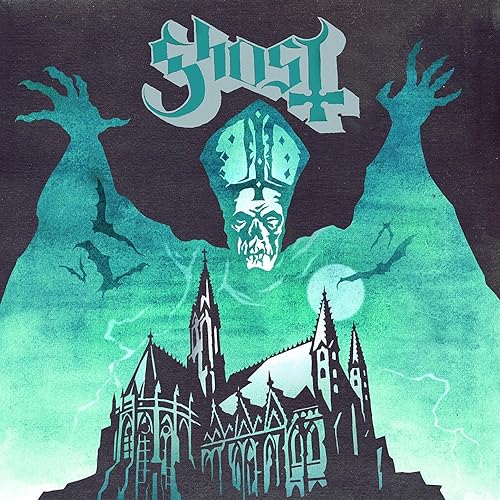
Opus Eponymous - Ghost

Provenance: For a band who I've followed avidly since they first burst onto the scene about ten years ago, my memories of how I became with Ghost acquainted are fuzzy.

I certainly recall my first live encounter with the band - March 2013, when they headlined that year's Jagermeister Tour; support acts were Gojira and The Defiled. Caught it down in Bournemouth with a few friends and family, tickets costing a princely five quid. Even back then, Ghost put on a hell of a show.

Anyway, last month I spent a week in North Macedonia and listened to fourth album Prequelle on the flights there and back. Having initially dismissed the latest as a bit ballad-heavy, I am now inclined to see it as their strongest album to date. So, having recently used this blog to pretend that I'm an adult with grown-up tastes, I now think it's time to check out a bunch of Scandinavians who wear masks and pretend to worship Satan.

Review: Prior to pressing 'play' on my stereo, I had a horrible impression that I was going to be less than fair with Opus Eponymous. What I saw in Bournemouth all those years ago was exciting and theatrical, but absolutely nothing like the slick outfit Ghost have subsequently become (I saw them in Brighton a couple of years ago for significantly more than a Lady Godiva). Likewise, the music on Prequelle is rich in texture and nuance, great swathes of orchestration wrapping around songs that have one eye on the charts (NB: this album didn't do any business in the US, whilst Prequelle peaked at number three on the Billboard Top 200).

Then again, at this point in time, there was still a lot of fun to be had around Ghost's identities. Taking a leaf out of the Kiss playbook, the songwriting on Opus Eponymous was credited to 'a Ghoul Writer'; the frontman was the mysterious Papa Emeritus, and the band referred to as 'a host of Nameless Ghouls'. Furthermore, the album sported cool artwork and reinvigorated a strain of metal that could be subtle yet heavy, sinister yet campy and unafraid to revel in showmanship. In short, they basically revived 1972-77 era Blue Oyster Cult, but this time, with added devilry.

(Even the symbol Ghost use has a touch of the Kronos motif Blue Oyster Cult deployed on all their albums. Catnip for BOC geeks such as myself.)

I don't think it comes as a surprise that a collection quite so schlocky as Opus Eponymous opens up with a church organ dirge. Pretty standard stuff, really, when it comes to albums that celebrate Old Nick. All well and good for setting the scene, but it's over quite quickly and we're into the galloping 'Con Clavi Con Dio', which is what all of us in the peanut gallery came for. It's fucking badass - and makes me realise that although Ghost were working with a much more basic palette than on subsequent releases, that ability to fuse tunefulness and heaviness was there from the word go. One suspects that were this to appear on Meliora or Prequelle, it would be washed with keyboards and other such orchestration. One thing that does stand out is that the music has more 'gaps' than the thick tapestry of sound that typifies later releases.

Still, this no-frills approach gives it a pleasingly retro feel. Vocals aside, much of Opus Eponymous sounds like it could've been disinterred from the mid-1970s, or maybe the first dark flowering of the NWOBHM. This ersatz dustiness - a false vintage - perhaps puts Ghost, at least here, in the bracket of some kind of eldritch Sha Na Na, inviting the listener on a journey to a time that never quite took place in the first place. I'm not suggesting for a moment that Ghost belong in any serious kind of discussion about hauntology but their Blue Oyster Cult cosplay act is damn convincing.

I keep mentioning BOC here, and at this juncture I should also throw in other obvious influences such as Mercyful Fate, Alice Cooper, the Crazy World of Arthur Brown, Slayer; they're all there. But - but - but - you can taste the fact that Tobias Forge (the leader and frontman of Ghost) is intimately familiar with Long Island's finest between, especially that golden stretch between Tyranny and Mutation and Spectres. Damn it all, the keys in 'Con Clavi Con Dio' sound like they've been ripped from 'Tattoo Vampire'. Elsewhere, there are echoes of 'Flaming Telepaths', 'Career of Evil', 'Quicklime Girl' - the good news is that Forge's borrowings are from the absolute prime cuts, so it's all good. Greta Van Fleet, take note; when you want to emulate your heroes, just try and do it well in the first instance, yeah?

In any case, none of this would add up to a hill of beans if the songs aren't there - and, praise Satan, they really are. Forge isn't a screamer; in fact, for a metal singer his voice is quite soft, made even more pliant by enunciation informed by his Swedish background. However, if anything this makes the music sound even more unworldly and uncanny; compare and contrast with Kiss, who for all their attempts to shock polite society, couldn't hide the fact that they were a bunch of Noo Yawk schlubs if their lives depended on it. Instead, Forge relies on a building a sense of drama and majesty to propel his infernal ditties and it works splendidly. Ghost celebrate the Father of Lies with all the pomp and ceremony of a High Mass, and choruses to tracks such as 'Elizabeth' (about Elizabeth Bathory), 'Stand By Him' and 'Death Knell' simultaneously soar to the heavens and plumb the fiery depths.

Having listened to Opus Eponymous again, so soon after spending a lot of time with Prequelle, has brought me not only a sense of relief (i.e. that it's a banger) but also reminded me why I was so revved up by Ghost almost a decade ago. It's yanked me back to a small concert room in Bournemouth, and to marvelling at the audacity of trying to conceal the band's identities in the online age. The latter couldn't last, of course, but I enjoyed the schtick at the time. With a whiff of brimstone and a smear of greasepaint, Ghost delved backwards to bring the joy of the old-timey rock 'n' roll spectacle to the twenty-first century, for which we should all be grateful.

Wednesday, 28 June 2017

The Final Countdown - Europe

Provenance: I bought this off a bloke for 50p, twelve or so years ago.

Review: I would like a refund.

Whilst, proverbially, curiosity is a slayer of felines, it was also the motivation behind me forgoing a can of Diet Coke to instead purchase Europe's magnum opus. After all, it contains that one track that even the least rock-conversant could recognise. As I sat down to write this review it struck me that hitherto this very moment I have only given this album one or two spins.

Over a decade on, I realise why. Please, feel free to fill in this gap with your own Europe / Brexit joke, because even the startlingly real prospect that the UK is flushing its economy and international good will down the john is less horrific than The Final Countdown.

To be fair, there were a couple of tracks that didn't induce the kind of metaphysical despair that Kafka merely hinted at. 'Rock The Night' is approaching competent for a big production hair metal number and...uh, that's it. I'm revising 'couple' down to 'a single song'. And lest you think I'm taking a kick at an easy target, bear in mind that I gave Faster Pussycat a pretty positive review (notwithstanding their questionable stance towards sexual activity with minors), and will no doubt be swooning over Ratt, Warrant and Dokken in the near future. I tend to like this bollocks. But not Europe, or at the very least, not The Final Countdown.

How did 'Carrie' become a hit? It's overwrought and boring. How did 'Ninja' (the second-worst ninja-related music title I own) or 'Time Has Come' make it past even the most cursory quality control? Little wonder that guitarist John Norum, the only one who demonstrates any flair on this release, quit soon after, claiming that the guitars had been buried under banks of keyboards. It's just a shame that upon completion The Final Countdown wasn't immediately buried under twenty metres of concrete, thus neutralising the radioactivity of its shittiness.

If I had to pick a standout for the most ball-achingly terrible moment on the album I'm going to go for 'Cherokee'. May I digress a little? Back in 2012 my partner was able to join me in the UK just in time for the Queen's Diamond Jubilee. I'd been living in this town for about two months, my partner for a week, and we were intrigued to see how the greybeards of the local council thought best to mark sixty years of Elizabeth Regina. I am sure Her Majesty would have been thrilled that it was basically a laser show set to 'The Final Countdown'.

In the same manner, Joey Tempest (lead vocals) thought a fitting way to commemorate the Trail of Tears was through the medium of butt rock. 'Cherokee' begins with what I can only assume is some kind of 'tribal' drumming, but done in so ham-fisted a manner that you wonder if the song is a piss-take. At which point you remember this is The Final Countdown, and it's no doubt meant in all earnestness. Generations of trauma, borne of a people torn from their birthright and rounded up like cattle, are perfectly realised and sensitively depicted through faux-orchestral synths and wailin' solos. I hope that the First Nations people of today are able to seek some comfort or solace in a song that sounded like it was rejected from Magnum's Vigilante album for being too limp.

And what of the title track, deemed by my town council to be fit for a queen? Well guys, I've got news for you; it's rump. If you like crappy, parping keyboard bombast married to some of the most idiotic lyrics ever penned by man or beast (there are, I suspect, apes that could do better) then 'The Final Countdown' is for you. If, however, the parts of your brain that process sensory information are halfway functional then you'll find a spot of waterboarding to be the more pleasurable alternative.

The Final Countdown is only forty minutes, but forty long minutes that transmogrifies your existence into a seemingly eternal waking nightmare. Which, fair play, is pretty strong stuff for a mere fifty pence. It's a pity that I'm allowing Europe to overshadow my almost completely positive impressions of Sweden (I've visited a number of times - let me tell you, the strawberries are a delight) so I'm going to go and cleanse my palate with a spot of Opeth and Vilhelm Moberg, lest I start ranting about blue passports, fishing quotas and the like. Adjö!

Sunday, 9 April 2017

Hot Shots: #7 - Cornelis Vreeswijk - Balladen om Fredrik Åkare och den söta fröken Cecilia Lind

Seeing as today's album review (2112 by Rush) was prompted by the wonderful Birke, I thought I'd share with you a song that cropped up in a previous conversation. Commonly shortened to 'Cecilia Lind', I would rank it as one of my favourite pieces of music of all time. Whilst I am by no means a Swedish speaker, I understand the tale told here and, yeah, I get emotional. I've had to pretend I've been chopping onions a few times.

How it came into the ambit of my musical knowledge is quite lovely (in my opinion, at least). It was at Sweden Rock Festival, camping with the girls mentioned in my Queensryche review, and I imagine the subject of singer-songwriters came up. Who was Sweden's Bob Dylan, eh? The answer - a Dutch-born fellow named Cornelis Vreeswijk.

And there, with evening summer sun streaming through the pine trees, the two girls sang this song, haltingly at first, a capella. The expression 'time stood still' has become a cliche but in that moment I felt the most indescribable sensation of calmness and, without wishing to be too woo-woo, oneness with my environment. Transmutation of experience into deathless words - writing - will forever be inadequate at capturing that instance. That's magic, then, isn't it?