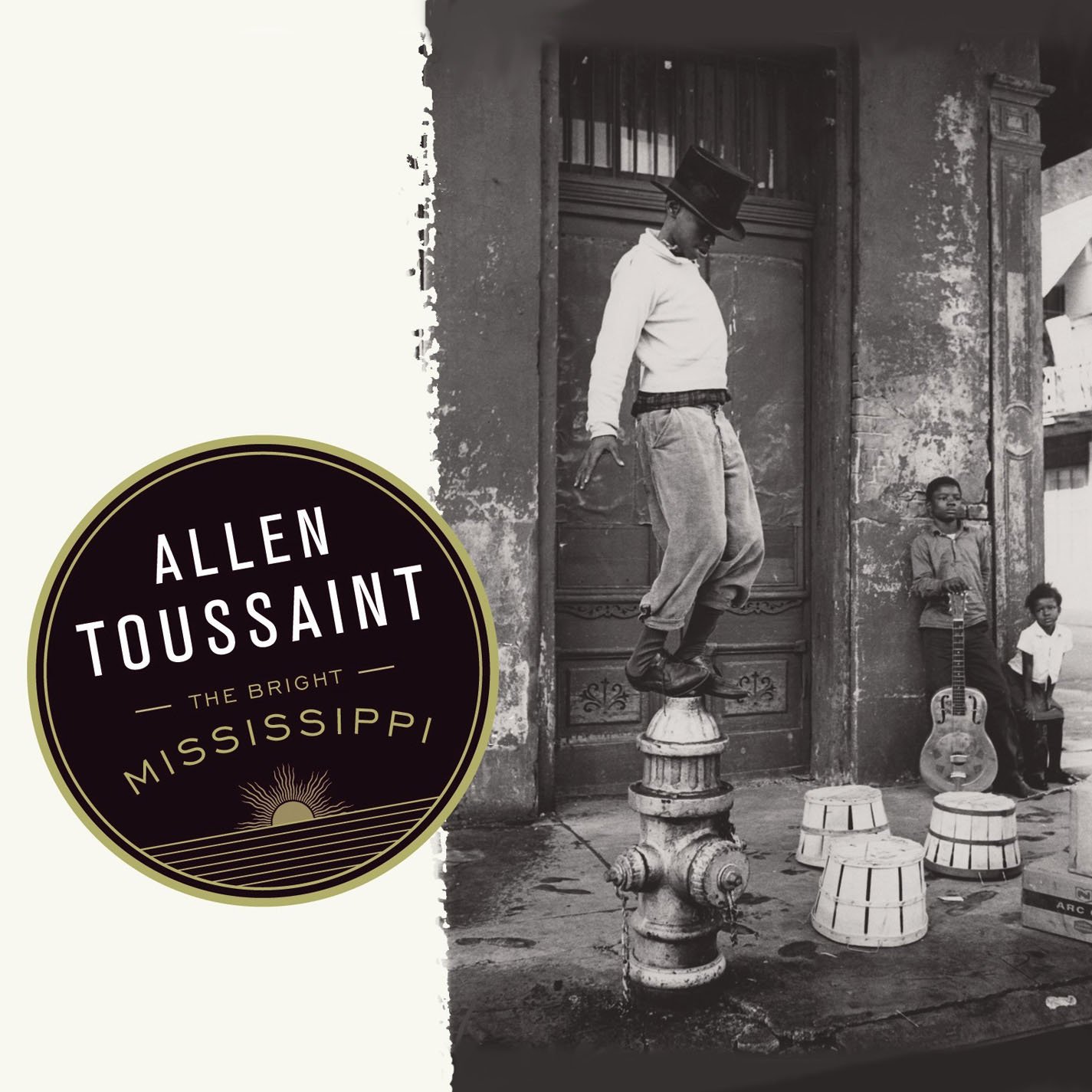
Provenance: There's three things I am sure of in life; I want my coke to be diet, my football to be catenaccio, and my piano players to come from New Orleans. Just take a look at some of the luminaries to come from the Crescent City - Dr John, Professor Longhair, James Booker, Fats Domino and Allen Toussaint.
When I was in New Orleans (my favourite American city - and the least American city?) I was fortunate enough to catch the Preservation Hall Jazz Band, playing the trad stuff unamplified in a small room. It's rare, I think, to see musicians of that calibre performing without any kind of PA in such an intimate venue; and from the moment they kicked into 'Sheik of Araby' I was captivated.
When I heard that Allen Toussaint had decided to make a jazz album that honoured the legacy of New Orleans I didn't need any more encouragement to go out and buy it.
Review: Sheer, unadulterated joy.
It genuinely feels like a privilege to hear the ensemble of crack musicians Toussaint gathered for this album to perform with such casual virtuosity. What could have been a tired jog through a clutch of musty old standards instead feels like a vital, ebullient celebration of a city and the music to which it is umbilically linked. It's both remarkable that The Bright Mississippi took a mere four days to record, and yet totally believable, as the sound is so organic that one imagines the band all set up in the room together, running through two or three takes and picking the best of the bunch. If there are overdubs to the live sound, my guess is that they are minimal.
From the very first bar of Sidney Bechet's 'Egyptian Fantasy' one can sense magic swirling around, but for me the album really moves into the realms of the sublime during 'St James Infirmary', a song I've heard many different times in various iterations but rarely does it reach such a degree of majesty as it does here. From then on, everything is immaculate - whether it's a sleepy-eyed rendition of 'Winin' Boy Blues' from jazz's ur-pianist Jelly Roll Morton, an iridescent 'Day Dream' (Duke Ellington) or my personal highlight, a languid interpretation of Django Reinhardt's already wonderful 'Blue Drag'. It might even top any version I've ever heard played by the Belgian master.
Every performer on The Bright Mississippi acquits themselves superbly, though I feel special mention should go to both trumpeter Nicholas Payton and clarinettist Don Byron. The contributions they make to each song on which they feature elevate each piece, with Payton playing some especially imaginative solos. However, the name on the CD is Allen Toussaint, and so it's only fair to pay attention to what he's playing.
Fortunately, Toussaint rises to the occasion splendidly. His playing is light and supple, hands moving across the keyboard with the twinkling grace of Fred Astaire in motion. Toussaint rarely elects to bang out big meaty solos, instead accenting his stylish playing with clusters of dancing notes, little trilling figures that complement the more sinuous sounds of the trumpet and liquorice stick (check me out using that hepcat jazz lingo, daddy-o). However, for all his panache Toussaint is also a two-fisted New Orleans piano player, and that generous, wide-open easy-rolling blues sound is given voice on King Oliver's 'West End Blues' and the traditional number 'Just A Closer Walk With Thee'; and I wouldn't want it any other way.
In every sense The Bright Mississippi is a triumph. The sound is such that it almost feels tactile - can you taste that thick Gulf air on your tongue as you luxuriate in the music? Do your eyes prick at a hint of cayenne pepper and onion? It is, of course, illusory; the jumbled symptoms of an imagination stirred by aural stimuli. But goodness me, what stimuli! I find in such situations that it's best just to sit back, pour a measure of something expensive and laissez le bon temps rouler.
A blog about one man and his stupid music collection. Mainly about the music, though the man intrudes now and again.
Showing posts with label django reinhardt. Show all posts
Thursday, 5 April 2018
Sunday, 4 February 2018
Devaju Retro Gold Collection - Django Reinhardt
Provenance: Back when I was first learning how to play guitar I heard tell of a man who, despite a partially paralysed left hand, could play incredible stuff. This was a time when Napster was in its infancy, so I happily shelled out for this cheap two-disc compilation when I spotted it in HMV one day.
The guitarist, of course, was the Belgian-born Romany jazz legend Django Reinhardt. As such, this is probably the first jazz album I ever purchased.
Review: Bear in mind that at the time of buying this my musical diet was a steady intake of Led Zeppelin, Black Sabbath, Deep Purple and other 'eavy bands of the classic rock era. Through picking up the guitar I was starting to learn about blues through the gateway of Stevie Ray Vaughan, albeit one could probably make the case that SRV was only half a step away from classic 1970s blues rock and thus more palatable to my ears than the likes of Charley Patton or Blind Lemon Jefferson.
Despite being a cloth-eared pithecanthropoid, even back then I knew I was listening to something quite sensational. I was one of those guitarists that went through a phase of equating technical brilliance to musical competence, and I saw Reinhardt through the same lens as Joe Satriani and Steve Vai. Almost twenty years later I barely ever whack Satch on the stereo, and can't recall the last time I gave Vai an outing. Reinhardt endures, however. Why?
For one, he was an incredible musician - not just in a technical sense (but let's not forget he was essentially playing with half the regular number of fingers on his left hand for almost his entire recording career) but also as an improviser. You can hear him lean into a song, strike up the melody and then run with it into new and exciting territories. Blazing virtuosity can work when it's in service to something greater than a demonstration of itself.
Secondly - once where I was fixated on the guitar, now I give equal attention to the other master to feature on these recordings, the violinist Stephane Grappelli. The grace and fluidity of his execution is the perfect complement to Reinhardt's quicksilver trickiness; imagine the bluegrass duels you might have heard between banjo and fiddle players, transplant that to a jazz idiom and you're not far off what's going on here. Although the liner notes don't say as much, I'm quite sure that all the tracks here are from their fruitful time together in the Quintette du Hot Club de France string ensemble.
The third thing to mention is that as I've grown older my sensibilities have changed and evolved. My criteria have expanded from 'heavy riffage' and 'cool fingertapping solos', which I suppose can be a sign of maturation. Anyway, when I was a teenager I didn't have an instinctive feeling for jazz, or more specifically swing. Now I've digested a lot more, I can appreciate just how hard some of this stuff swung, even more remarkable as it was achieved without the aid of brass or percussion. The boys playing rhythm (including Django's brother, Joseph) certainly knew their task but Reinhardt also provides some amazing moment of push-pull, throwing in half-bends and double-stops to add variation and spice.
Two CDs in a row is a bit wearying, as the tracks all possess a similar feel, but played sparingly this Django Reinhardt collection still has the ability to wow over eighty years later. The Quintette's output is still the gold standard by which gypsy jazz and string band swing is held to, and rightly so.
Subscribe to:
Posts (Atom)

