Sunday, 25 September 2016

Christopher Cross - Christopher Cross

Provenance: The first time I knowingly encountered the work of Christopher Cross was through a Saxon album that was, somewhat incongruously, for sale at a university bookshop. The song in question was, of course, their cover of 'Ride Like The Wind', which I considered a highlight.

The next time I really zeroed in on a Cross composition was when I encountered 'Sailing' in this episode of the always-excellent Channel 101 series Yacht Rock. For those unaware of Yacht Rock, I urge you leave this blog immediately and do something truly worthwhile, ie, binge watch the series on YouTube from start to finish. Please come back though.

Review: For all my heavy metal posturing (yeah, I saw Steve Grimmett's Grim Reaper this weekend), I really do love a bit of gleam and polish every now and again. I don't mean the flat, clippy, mechanically precise products of the Pro-Tools generation. However, give me a touch of pop sophistication, a dash of craftsmanship and perhaps Michael McDonald doing backing vocals and we're talking. Hall and Oates, Supertramp, Boz Scaggs (come on guy, 'Lido Shuffle' is just about perfect), Cate Brothers, Toto - these are my people. I prostrate myself at the altar of Donald Fagen and Walter Becker, and Steely Dan continuously vie with Blue Oyster Cult for the laurels of the coveted 'my favwite band evah' award.

Oddly, my enjoyment of the yacht rock genre (such as it has been called) means that I might actually be cool for once in my life, as this rather excitable and confused apologia argues. I don't buy it. Virtually every popular music genre undergoes a process of reappraisal at some point or another, with contemporary artists hip to the cause paying tribute in their work. All trends, including those that ride a wave of retro-nostalgia, eventually wane, leaving behind their artefacts for subsequent generations to (re)discover. Put more simply still, there's some enduringly great yacht rock out there. And I reckon that Christopher Cross is amongst the best.

You may have heard the story of how the formerly unheralded Fleetwood Mac roadie came from nowhere to sweep the 1980 Grammy Awards. Have you listened to the album recently? It's disgustingly good. Almost too pretty. There's not a hint of grit or a rough edge in sight. From start to finish it's like gorgeously delicious caramel is dripping from your speakers; you want to gorge on the almost too-rich sound. You've got Cross' soaring, strangely disembodied voice. You've got 'tasteful' brass parts. Lush arrangements. Congas. Hooks. Michael McDonald. Don Henley (the Eagles), J.D. Souther, Larry Carlton (Steely Dan), Victor Feldman (loads of people, plus Steely Dan) and Eric Johnson (Eric Johnson) all lend a hand too but the real mustard, as any fool knows (or believes), is a Michael McDonald backing vocal.

I don't think I'm being unfair when I say that Christopher Cross is a vacuous record. I'm not ascribing any negative connotations to that quality, as this is all surface; a pearlescent, refulgent surface, glowing pink and orange in a Malibu sunset. And that's not to say that Cross is a crap lyricist or anything. In fact, where Cross triumphs is the marriage of some fairly cute, albeit standard, sentiments about love (found, lost or unrequited) with the perfect musical accompaniment. Thus 'Poor Shirley' never sounds mawkish, and 'The Light Is On' is sketched with just enough mystery and apprehension, not to mention a superb chorus, to help it over the line that separates genius from stupidity.

As an aside, I should mention that my CD contains a quote from Mr Cross himself, recreated here in full because of its utter superfluity:
I'm a very nonpolitical and nonintellectual lyricist. But people have so many demands on them already in their lives. I'm just trying to give them a little enjoyment and relaxation.
Seriously Christopher, there is nothing - nothing - remotely controversial on the album. Nobody is confusing you with Billy Bragg or Skrewdriver. Nobody is going to start a white supremacist group after listening to 'Sailing'. The only time Cross sounds vaguely pugilistic is on 'Ride Like The Wind', a soft rock classic, featuring the wimpiest man in the world boasting about having a gun and never going to church. The final flourish is the soulful, doleful 'Minstrel Gigolo', sketching a seemingly enviable life of adulation but sung in the manner of a man down to his last pina colada, chalk-blue sports jacket slung over one shoulder. It is, as with everything else on the record, immaculate. Essential.

Sunday, 18 September 2016

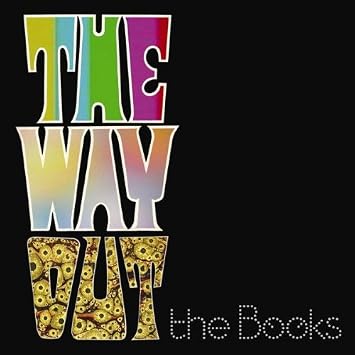
The Way Out - The Books

Provenance: This isn't really my album, but my partner's. However, as with all CDs in our dwelling, it has been subsumed into the collection in much the same way as 'the Blob' enveloped a small town in Pennsylvania. That was a good film, wasn't it? Anyway, as such The Way Out has been deemed a legitimate candidate for review on this blog. By that, I mean in essence that I make the rules up as I go along.

Review: Well. I like it. I've never actually listened to this all the way through until I sat down to write this review, but the few preconceptions I had were based around 'A Cold Freezing Night', a track beloved by my partner, which uses snippets of speech between two young siblings, coupled with a weird, slapstick electronica, to create a heightening sense of anxiety and tension.

This approach, it turns out is pretty par for the course - instruments and samples burst from nowhere, odd but never dissonant, and often delightfully surprising. I imagine Nick Zammuto and Paul de Jong have grown exceedingly bored of being called musical magpies, but it's entirely apt. This disparate grab bag of sound is often welded to guitar and drum machine, giving structure to what could be an unholy mess. In fact, through the uncanny mechanics of synthesis, much of The Way Out sounds like companion pieces to the output of other artists, as if their sweepings from the studio floor had been spliced together to make mutant music.

The most obvious comparison with The Books is the Ghost Box record label, whose stock in trade is 'hauntology', whereby a not wholly benign, atavistic past is summoned up through the sampling of documentary, movie and public information film, set to psychedelic electronica. The Ghost Box sound (what a wonderful name for a record label, by the way - don't you think it's brilliantly evocative?) comes very close to being replicated on 'Group Autogenics I', with its soothing, nonsensical self-hypnosis narrative, and 'Chain Of Missing Links'. Oddly, on 'IDKT' I got a strong whiff of Sex And Religion-era Steve Vai, whilst 'All You Need Is A Wall' could've come straight off Feist's Metals album.

Perhaps that's the point. Without speaking to either guy who constituted The Books (they disbanded in 2012), I would guess that there was a conscious effort to make, through a collage technique, something that sounded familiar without being entirely plausible as mere pastiche. At some point, the music becomes wrinkled, twisted; the sonic equivalent of a shirt that doesn't button up properly. All very clever.

But I like The Way Out without loving it. It's difficult to really explain why. Perhaps it's those rare moments where The Books are aiming for beautiful and instead hit pretty. Perhaps it's because it's just a smidge too self-consciously odd, a somewhat studied exercise in the bizarre. Contrast that with a Daniel Johnston, Wesley Willis or even a Captain Beefheart, from whom weirdness gushes forth as naturally as water from a spigot. Maybe it's just that I get a sneaking sensation that The Way Out is little more than a hauntological re-remembering of White Noise's groundbreaking 1969 album An Electric Storm, which feels simultaneously like a monstrous slur yet not inaccurate.

I want to listen to it again, though. And possibly again after that. Dark room, lava lamp, headphones, The Way Out - an agreeable way to enrich an hour of my existence.

Sunday, 4 September 2016

Heavy Traffic - Status Quo

Provenance: I like Status Quo. They were the first band I ever saw in a live setting, and it left a profound effect on me. The two most vivid things I remember about that gig was, firstly, the addictive quality of sheer volume; and secondly, my Dad singing along to 'In The Army Now'.

Review: Along with many, many other households in this sceptered isle, I also possess one of the legion Status Quo 'greatest hits' collections. (For my US-based readers, the Status Quo 'best of' is as ubiquitous as Frampton Comes Alive is in the Midwest). That's all the Quo most people require, but I saw them performing 'Jam Side Down' on Top of the Pops and thought it sounded decent enough to drop coin on the parent album.

And you know what? For the most part it is decent enough. Better than that, as it happens. Most of the songs sound a bit like other Status Quo songs, the good ones. We're mostly talking about the sledgehammer boogie sound Quo have almost trademarked since jettisoning their early psychedelic pretensions. In fact, 'All Stand Up', 'Creepin' Up On You', 'Solid Gold' and 'Money Don't Matter' could (and possibly do) sit comfortably with the rest of their material in a live set. The only curveball, sonically speaking, is 'Green', whose inheritance can be traced to 'Gerdundula'. The rest is a bit fillerish but not unpleasant. Except for one track - 'The Oriental'.

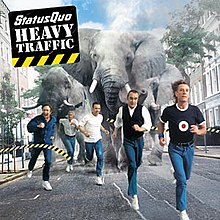
Status Quo don't generally deal in subtleties or finer feelings, so it's apt that they've actually included an elephant on the front cover to symbolise the one that 'The Oriental' introduces into the room. At some point in the writing process, Francis Rossi and John 'Rhino' Edwards (this paragraph is like a safari thus far) presumably thought it'd be a lark to write a tune about mail order Asian brides. Not in a sensitive manner, you understand. The more charitable listener might suggest that it's just a lark, and that half the lyrics are nonsensical. The latter is true - but the sticking point is the other half, replete with pidgin English (ha ha! Because East Asians all speak like that!), lazy cultural stereotyping and the apparent ease in which women can be traded or rented like commodities.

Making play with the perceived exoticism of the Far East has been the stock in trade for many Western musicians. Now, I don't want to be too harsh here because for boys and girls raised in suburban or working class Europe or America, playing somewhere like Japan must've seemed somewhat fantastical. So we get Deep Purple's 'Woman From Tokyo', Y&T's 'Midnight In Tokyo', Krokus' 'Tokyo Nights' and the weird Todd Rundgren song 'Eastern Intrigue' (and, I suppose, Aneka's 'Japanese Boy' or Carl Douglas' 'Kung Fu Fighting'). But that was way back when, and this is a bunch of late-middle aged men in 2002. I just can't find one redeemable or even venial element about 'The Oriental'. It is perhaps apposite that the lineup that recorded this crap actually looks like a bunch of guys who spend their evenings trawling mail order bride websites.

As well as being fairly racist, it's also a monumentally stupid song. There's some lyrics in the middle eight that, I guess, are supposed to convey the sense of a whistle-stop tour of the East. Except that 'and carry on to China / Asia Minor and some more' makes precious little sense, because Asia Minor is most accurately expressed today as the Asian territory of modern day Turkey. It serves to underline the rather parochial reputation that Status Quo have earned for their perceived lack of ambition in territories outside of the UK (whilst boogie contemporaries Foghat and AC/DC set about conquering the US and the world respectively). Perhaps I am expecting too much of poor old Rhino, a man of such delicate sentiment that in 2006 he was moved to write a song about his favourite Brentford FC striker.

Sorry if you expected a more forensic review of the album. Honestly, if you excised 'The Oriental' you have a really punchy, four-to-the-floor rock album. As it stands, its inclusion is as if somebody wiped their shitty ass over your nice new Belgian lace tablecloth. Use the skip function on your stereo, or download Heavy Traffic and delete track three. It's a reasonably lengthy album, you won't miss it. Nobody will miss it.

Sunday, 28 August 2016

Strikes - Blackfoot

Provenance: This one's a bit murky, but I'm fairly certain I bought this due to Warrant's cover of 'Train, Train'. It wasn't for the awesome sleeve art.

Review: Here's a weird one; quite often, bands of a certain vintage go through many incarnations. Increasingly it seems that you only need one or two original members (Blue Oyster Cult, Deep Purple, Uriah Heep, Y&T, Guns N' Roses) to keep the flame held aloft, with the expectation that a decent number of fans will accept a degree of rock 'n' roll wastage as time ticks by.

So what to make of Blackfoot, who currently boast zero original members? And we're not even talking about a lineup that features any members from a 'classic' era - hell, current Blackfoot look a bit like they still jam Papa Roach covers in the drummer's garage. Here's the kicker - original guitarist and frontman Ricky Medlocke, who plies his trade these days in another substitute-heavy band, Lynyrd Skynyrd, still lurks in the background, acting as a Southern rock svengali to his be-goateed and be-mohawked charges. But can it still really be called Blackfoot?

Fortunately we're on more solid ground with Strikes, released in 1979. Blackfoot's third album, it still featured the 'classic' (that word again) lineup of Medlocke, Jackson Spires (drums), Charlie Hargrett (guitar) and Greg T Walker (bass). So named because Spires, Medlock and Walker all shared a First Nations heritage, Blackfoot took the blues-rock template of Free and Bad Company and imbued it with a degree of soul raunch, courtesy of Medlocke's soulful singing.

In fact, Medlocke's vocals are the standout event in Strikes - that, and the ability to craft punchy, catchy rock, the kind that's suited to a long drive with the windows down. Of the two covers on the album, Spirit's already excellent 'I Got A Line On You' is slowed down, toughened up and deep fried. The other one is a waste of time - Free's 'Wishing Well' is a perfectly good song, and Blackfoot demonstrate they can play it so competently that it's almost redundant. Yes, it plays to all collective strengths, but when the end result is virtually a xerox of the original, what's the point?

The originals are where the real mustard is on this album. 'Road Fever' is a decent mid-tempo opener, but it really catches light at 'Left Turn On A Red Light' - the subtler connotations of which were not revealed to me until I drove around the USA and got in a crash on the second day of my car rental. It feels like it's brooding, building, growing into a full-blown widescreen epic, so it's surprising to see it's a shade over four and a half minutes.

'Pay My Dues' is another solid fist-clencher, after which Blackfoot seem to have their head turned by the FM radio market with both 'Baby Blue' and 'Run And Hide' (which bookend the redundant 'Wishing Well'). I've got nothing against bands striving for a commercial sound - I like Foreigner, for goodness' sake - and although these are tight and hooky, they contain no surprises. Were it not for Medlocke's superlative singing, they'd be pleasantly anonymous. Fortunately, things get back on track (pun unintended) with 'Train, Train', which curiously has its harmonica intro listed separately on the running order. It's cool, though, as its played by the song's writer, Shorty Medlocke, granddad of Ricky (and later covered both by LA glamsters Warrant and Dolly Parton). It chugs along atop its crunchy gutbucket guitar riff and features the lyric 'Well, leavin' here, I'm just a raggedy hobo' so it was always going to score highly from me.

Last up is 'Highway Song'. Now, I don't know whether I should be laying the blame at the feet of the Allman Brothers for their interminable noodling on Eat A Peach, Lynyrd Skynyrd for pub bore favourite 'Free Bird', or whether I need to reach back further to the jam bands of the 1960s, but somewhere along the line it appears that Southern rock bands became infected with a notion that they all had to write a big, long song that starts quietly, picks up the pace and ends with a guitar wig-out. (However, in terms of Southern rock, 'Free Bird' almost seems like the ur-text for this nonsense.) 'Highway Song' is not a particularly bad song, and it contains the blueprints for something that could've been genuinely good - but to my 21st century ears it sounds stale. I imagine it probably stunk a bit even in 1979.

I sense I come across as a tad harsh about Strikes, an album I sincerely enjoy and listen to frequently. Ricky Medlocke is such a factor that he alone elevates much of the material. However, if you are a member of a Southern rock band, or are thinking of forming one, please heed this call from me; stop churning out these naked, unabashed attempts to write your own 'Free Bird'. I don't know, maybe it's part of the Faustian pact Southern rock bands make when they go eat some BBQ chicken wings at a crossroads or whatever, and in return for their smokin' guitar tones and hollerin' vocals, they agree to write at least one ultra-dull piece of shit 'Free Bird' tribute. Resist the urge. Play a cover song. Veer off into techno. Make a cup of tea. But I beseech you, no more 'Free Bird'.

Sunday, 21 August 2016

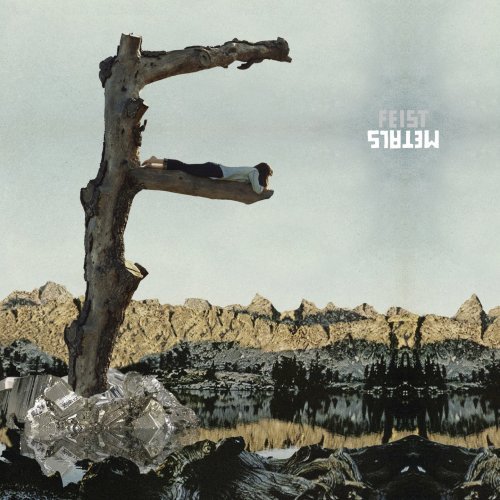
Metals - Feist

Provenance: Isn't it nice when you get turned onto something completely out of the blue? In this instance, this album came as part of a wedding gift from Noam Weinstein and his father Larry, two of the nicest people I think I've ever had the pleasure of meeting. Noam is a pretty fantastic musician himself, and I'm sure it won't be long before I review one of his albums on this blog.

Receiving albums as a wedding present isn't unprecedented in my family; when my parents got married one of their friends gave them a copy of Deep Purple's Stormbringer, Mk. III's inferior sequel to Burn.

Review: Feist is one of those artists I would never have discovered under my own steam. Too contemporary, too hip. I might hear the name in a conversation and I'll nod along affably before consoling myself that, really, I knew best and that it wouldn't be a patch on Jethro Tull. In short, I'm a total idiot under the sway of unshifting prejudices entirely of my own design. However, folk who don't know any better, such as the Weinstein family, chip away at my wall of ignorance and sometimes make small breakthroughs; I am now a confirmed Feist fan.

As for the music itself, I should probably start by saying that 'Graveyard' is one of my favourite songs - ever. Fragile, menacing, elegant and surreal, with an outro that boasts a brass arrangement that sounds as if it came off an early Alan Parsons Project long player. The quality doesn't dip on the next track either, 'Caught In A Long Wind', shimmering and poised, filigreed with oriental violin.

However, it would be wrong to characterise Metals as soporific (a term I don't use negatively, necessarily; I would happily describe John Martyn's Solid Air as soporific, inasmuch as half of the album conveys a sense of waking sleepiness). There are unabashedly quiet and delicate moments here, such as 'Bittersweet Melodies', 'Cicadas and Gulls' and 'Anti-Pioneer', but many of Feist's compositions are bursting with tension, threatening to unravel at the merest tug of the thread. At its most nervy, Metals inhabits that same weird nation of barely constrained emotion occupied by something like Stravinsky's Les noces. That's probably the most pretentious sentence I'm going to write this week.

Something else that stands out is the sound of the recordings themselves. In a world where clipping is a very real and stupid problem with recorded music, Feist and her producers have performed something of a minor miracle. The clarity given to each of the instruments used - and by the sounds of it, we're talking a whole heap of the damn things - gives an almost organic quality to the compositions. I'm especially taken with the percussion - in the best possible sense, the drums sound almost homemade, the bottom end rounded out with some really meaty rattles and clanks. My love for the Alan Parsons Project means that I would almost automatically be attracted by the brass arrangements, but it goes further than my prog predilections; one genuinely gets the impression of a colliery band, so full, so rich is the sound.

What else? One can't forget 'Comfort Me', by turns haunting and powerful, underscored by some swampy bayou guitar. It's such a good piece of music Feist could honestly sing me the words to the instruction manual of my vacuum cleaner and I'd be happy. Feist has a wonderful voice, incidentally - whispery and intimate without ever being truly warm. It sounds like the voice of someone alone, either living in their own head or cut adrift from the solid, mundane world. If, like me, you seek music to gift you that escapism from the quotidian and workaday, you may very well find it in Feist's strange, fractured universe.


Thursday, 4 August 2016

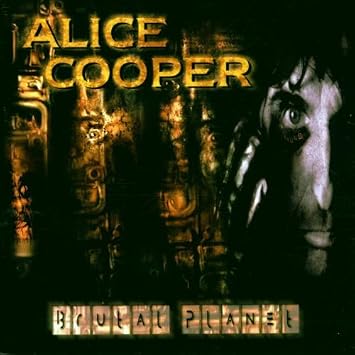
Brutal Planet - Alice Cooper

Provenance: Today is my Dad's birthday, so it's only right that I look at an artist I wouldn't have listened to were it not for him. From single albums to entire genres, my Dad has influenced my listening habits more than he probably realises, and for which I'm eternally grateful. That being said, I don't think I'll ever be receptive to the charms of Peter Skellern.

I first saw Alice Cooper on the Brutal Planet tour, headlining a show that featured Dio and Orange Goblin as support. I went with my brother and some friends, we all put the makeup on and had, oh, about the best time ever.

Review: We all know that Christian rock sucks, but what about when it doesn't? I'm not talking about pabulum like Stryper, who when a couple of friends saw them in London, threw yellow n' black bound versions of the New Testament into the audience for their encore. To Hell With The Devil? Give me a break.

For a rock fan whose teenage years fell around the turn of the millenium I was curiously averse to the charms of nu-metal (alongside those of Peter Skellern, of course). Some of it sounded raucous enough but the poses were a bit too studied, a bit too tired, and furthermore exponents like Limp Bizkit seemed simply idiotic. And yet here I am, thoroughly enjoying a Christian nu-metal album. Aha, I bet you didn't see that coming!

One has to respect Cooper for the way that this preacher's son has managed to maintain his rock credibility despite openly professing his rebirth as a Christian. He's never explicitly stated he avoids performing certain songs from his back catalogue, unlike W.A.S.P.'s Blackie Lawless (another born-again Christian) has done. He's still the guy who gets guillotined, electrocuted, tied up and beaten every night. And as a consequence he's managed to sneak out a couple of Christian rock albums without anybody really noticing.

Brutal Planet's first song (and title track) is pure 2000-era nu-metal, a thick, down-tuned chug; what distinguishes the track - as with much of Coop's output - are the hooks. For a fairly limited vocalist Cooper has a real facility with melody; and whilst his voice isn't the most gymnastic, he possesses one of the most characteristic sneers in rock music. It's loud, aggressive, bleak and has a big chorus - not a million miles away from what Rammstein were doing at the time. What makes it even more interesting is that "Brutal Planet", and many other tracks on the album, wink at his back catalogue.

Back in the latter days of grunge Cooper released The Last Temptation, a loose concept album that circles around a putative Faustian pact. It was replete with Biblical imagery around temptation and redemption, a strange and heady collection of somewhat disparate songs. Brutal Planet is the opposite - hard, unremitting, dark but identifiably a sequel to The Last Temptation. Both the title track and "Gimme" reprise the Faust theme (the latter even namechecking a ...Temptation track), but there are no saints being resurrected in this particular version of the world. Rackety pounder "Sanctuary" similarly follows on from Last Temptation's "Lost In America"; here, our anti-hero has grown up, got his house and wife, and has found his confusion supplanted by hatred.

However, as this is Alice Cooper, there are moments of levity. "Wicked Young Man" sounds more like a celebration than a condemnation, and it's tough to be too serious on a song that contains the lines "I've got every kind of chemical pumpin' through my head / I read Mein Kampf daily just to keep my hatred fed." Then there's "It's The Little Things", essentially heavy metal update of Carl Perkins' "Blue Suede Shoes" with added 'roid rage; fun all the way, with a couple of cute callbacks to "Welcome To My Nightmare" and "No More Mr Nice Guy" for the greybeards.

Yet in "Wicked Young Man" there's a chilling reference to school shootings, and the title track contains a jarring mention of the Holocaust. Perhaps Cooper grew a little tired of his reputation as a schlock merchant, because "Pick Up The Bones" is genuinely grim and disturbing trudge through the aftermath of a massacre. "Take It Like A Woman" is another one that looks backwards, this time to "Only Women Bleed". In concert, Cooper performed both songs together, segueing from the older song to its modern counterpart, and I think this is the best way to appreciate "Take It Like A Woman." "Only Women Bleed" was itself a bit of an outlier - in an era when rock artists were mainly writing about women as lyin', cheatin' objects of lust, Cooper crafted a rather quiet - and sad - paean to those in abusive relationships. "Take It Like A Woman" is more bombastic but continues to lament the enduring status quo of violent, insecure men and stoic women. It may not be the most sophisticated stripe of feminism but a bitter reminder that Cooper is one of the few mainstream men in rock with the ability to write sensitively about domestic abuse.

So then we reach the album's kiss-off, "Cold Machines" - and even for an artist who often makes hay with prevailing musical trends, this is a cheeky one. It's straight out of the Marilyn Manson playbook, recreating that odd mechanical piston-swing that was so identifiable in Manson's best work. It's probably the best thing on Brutal Planet too; huge guitars, chewy hooks and a chorus that simply soars. It's exhilarating, swaggering, and over all too soon. That Coop ripped off Manson so brazenly was, I suspect, a knowing little nudge aimed at the guy who took Cooper's schtick and repackaged it for angry kids who liked to stay in their bedroom.

There's the likelihood that my perception of this album is coloured by the fact that the Brutal Planet tour was the first of perhaps ten occasions I've seen Alice Cooper. He's never, ever disappointed, but the first time is something special, right? He knocked it out of the park that night in Bournemouth, and the Brutal Planet songs sounded monstrous. It's become impossible to rule on Brutal Planet without recalling the pleasure and excitement of that first gig, so why should I bother? Brutal Planet rules.

Sunday, 10 July 2016

Trans - Neil Young

Provenance: A recommendation from an online music forum member who once stated "I'm suspicious of anybody who doesn't like [Neil Young's] Trans."

Review: Ha ha ha! I'm going to say straight away that this is my favourite Neil Young album, and I own a whole bunch. I'm not being purposefully obtuse; but unlike most people, I encountered Trans thanks to passionate advocacy. The way one is primed to experience an album is, I think, rather important. On a related note, I'm a big fan of ZZ Top's Recycler album because I had literally never heard any of their music before so didn't feel the impulse to stack it against some of their more well-regarded releases.

Yet Trans is not completely reviled, even if much recent writing is focused on reconsidering or rehabilitating it, which suggests critics got it wrong the first time around. But some liked it, and that bellwether of public opinion, the Amazon customer reviews section, currently grants it four and a half stars out of five.

I can only guess why the impulse to defend this album still exists. I was minus three years old when Trans hit the shelves so I didn't have the benefit of growing up with Shakey as he moved from Buffalo Springfield to solo acclaim and the folksy harmonising of CSNY. In essence, I didn't have an idea of what Neil Young 'should be', and haven't felt that any of his numerous experiments represent any massive sea change. In any case, Neil Young does Kraftwerk sounds pretty sweet, no?

Trans actually begins with a track, "Little Thing Called Love", that gives few clues about what's to come and is arguably the weakest thing on here. It smacks of the weird mid-stream crises of confidence that seemed to infect many of Young's peers in the Eighties; over-produced, tinny guitar sounds, crap lyrics, congas. It's jaunty I suppose. We get the good stuff on track two, "Computer Age", which is stacked with synths and features a kind of hyperreal Young vocal, rendered impossibly high and airless via the use of a vocoder.

One thing I shall concede is that some of this material seems quaint, given the age we live in now. "Computer Age", "We R In Control" (which makes creative use of touch-tone telephone sounds) and "Computer Cowboy" all sound weirdly innocent given the connectivity of our world. How it sounded in 1982 I couldn't guess - but this is an age where, my Dad attests, a floppy disk (genuinely floppy) containing payroll records of the company where he worked was wiped because someone smoked too close to it. We were still over a decade away from Billy Idol's wonderful disaster Cyberpunk (1993) and the movie Hackers (1995); computing was a fringe pursuit to many. Besides, I have a sneaking suspicion that Young's tongue was in his cheek when delivering the line 'Come a ky ky yippee yi yippee yi ay' on "Computer Cowboy", a mangled digitisation of Lead Belly's herding cry from "When I Was A Cowboy" (or perhaps the TV cowboy show Rawhide?).

Young's fascination with electronica reaches its zenith on "Sample And Hold"; a monochrome drum machine holds together a bizarre, robotic song seemingly about a cyborg dating agency. He then proceeds to annoy long-term fans with an updated version of the Buffalo Springfield song "Mr Soul" (guess which rendering I prefer?) once again utilising a drum machine and a rather attractive, pillowy-sounding synthesised bass. This album is lovely - it pulses with a warm neon moonglow, human and machine working symbiotically. Young's singing especially benefits from electronic treatment, pushing an already ethereal voice into strange, unearthly realms.

And now I'm going to troll myself entirely here by saying that the least electronic, most traditional 'Neil Young' song on here, "Like An Inca", is the best. Yeah, they bust out the congas again, but they actually add texture to nine sparse minutes of druggy meditation on nuclear apocalypse. So good is this song that, in my opinion, it eclipses everything else somewhat. Look at me, talking about how Neil Young is great at electronica, before picking "Like An Inca" as the highlight! At long last, have I no sense of decency?

Before I wrap this turkey, one outside influence is worth bearing in mind when considering the creative impetus behind Trans. Neil Young's son Ben was born with cerebral palsy and was unable to speak. Young had recently bought a vocoder and, whilst experimenting with it, noticed that Ben would react when he spoke through the gadget. Viewed through the lens of a father attempting to communicate with his child, Trans suddenly assumes an unexpected poignancy and, all in all, seems a noble endeavour indeed.


Sunday, 3 July 2016

Bluesin' With The B3 - Wayne Goins

Provenance: Wayne Goins is my father-in-law.

Review: Whilst listening to this album, a meditation on the limitations of popular music criticism by Simon Reynolds came to mind. In his excellent work on electronic dance music, Energy Flash, Reynolds writes of the completely different vocabulary needed to write about a form of music that defied the 'literary' readings that worked for the majority of rock music. He points out that it's pointless talking about melody, harmony and lyrical content when dance music is (largely) designed specifically to bypass these notions; how can one nod along at home next to the stereo to a music that demands is tailored for communal consumption, drug consumption and bodily expression?

Now, jazz and dance are not the same, but for me, someone who is used to thinking about music as something to be read, I do find a commonality inasmuch as I struggle to find the right language when talking about it. As someone who grew up mostly listening to rock, being confronted with an album of organ trio instrumental numbers is a daunting prospect. Oh, and the guitarist is my father-in-law, who I'll be staying with in November this year, so no pressure.

Some things I do know; I can recognise virtuosity when I hear it. Jazz has a rich tradition of improvisation and exploration, an approach which is mirrored in (some) rock music (think Duane Allman, Jeff Beck, Warren Haynes, Steve Vai, Paul Gilbert - for example). Similarly, I muck around on guitar, so I can confirm that daddy-o is a crack musician (as would befit the Director of Jazz Studies at Kansas State University). I even know just enough to suggest that his style is not a million miles away from Wes Montgomery. There we go - slightly more than would fit on the back of a postage stamp, but amply accommodated by a standard C5 envelope.

The Hammond B3, on the other hand, is a universe of mystery to me. In the liner notes, Wayne mentions a bunch of players, of whom I've only heard of two (Lonnie Liston Smith, Jimmy McGriff) and consciously heard the music of one (McGriff). So, with apologies, as far as I can tell Ken Lovern is a fine player. Bear in mind that for me, organs pretty much come in two flavours - Keith Emerson and Korla Pandit. Ken doesn't sound like either, incidentally.

Recorded live, credit must also go to producer David Brown for capturing an instrument - the B3 - that can be notoriously tricksy due to the ultra-deep bass notes that can be produced by its Leslie cabinet. It can result in a blowy, fuzzy low-end mess, especially in a live situation - emphatically not the case here.

The best thing on this album is the wonderful, lilting Kenny Dorham track 'Blue Bossa', with its seductive rhythmic undertow and faint ghosts of Sidney Bechet's 'Egyptian Fantasy'. Another highlight is 'A Gogo', a moody, funky, almost gutbucket Jon Scofield composition. The first half 'A Gogo' also features Wayne's smokiest playing (Wayne, feel free to disagree with me on this one, but I'm right here, just as I'm right about Bob Dylan's output in the Eighties (a giant waste of time, incidentally)) on the night. I'm also a bit of a sucker for Duke Ellington so I'm happy to hear 'In A Sentimental Mood' sounding so lovelorn and bittersweet.

The album ends on Jimmy Smith's 'Back At The Chicken Shack', an opportunity to hear organ and guitar making the pentatonic scale sweat a bit. There's a moment at 3.15 when Ken just jabs his finger at a single note repeatedly, likes what he hears, and carries on jabbing - it's downright nasty. To me, that's what makes this album such a treat - the two principals know exactly when to push and pull, when to dial back and when to cut loose. This understanding is what elevates the music from technically brilliant renditions to a space where genuine mood and atmosphere is created.

If you like what I've written, why not buy the album, or indeed anything else by Wayne Goins and keep me in the good graces of my in-laws? Many thanks in advance.

Sunday, 26 June 2016

Painkiller - Judas Priest


Provenance: My friend the musician Ollie Hannifan recommended this back when he was the schoolboy Ollie Hannifan. I clearly recall Ollie tempting me in to the purchase by suggesting that, on this album, "they just don't stop."

Review: The first thing that needs to be said is that Ollie was wrong, as Painkiller stops at around the 46 minute mark. I get what Ollie meant though. Before its even cued up on the stereo your eyes are bleeding because the cover art work is so elite. A muscle-bound silver Corinthian warrior is riding a half-motorbike half-dragon contraption (in the sky), whilst below tower blocks are being engulfed in lava. You're sweating before you've even hit the play button.

It gets better. New drummer Scott Travis is immediately showcased with a pummelling intro to the title track, which duly explodes into some of the most full-on metal madness ever captured on tape. Nothing is left on the table. Lead-wailer Rob Halford (probably my favourite vocalist of all time) often uses his piercing falsetto as embellishment, but here he kicks off somewhere just inside the hearing range of canines and never lets up. He relents only in the pre-solo(s) mid-section but that's only so us mere mortals can hear him intoning 'Faster than a laser bullet / Louder than an atom bomb / Chromium plated boiling metal / Brighter than a thousand suns.' Bob Dylan this ain't (though Judas Priest take their name from a Dylan lyric), but I can't recall His Bobness ever dealing with mankind's destruction by alien cyborg monsters.

First track down and you're crying out for relief. No mate, because up next is 'Hell Patrol', then 'All Guns Blazing', then 'Leather Rebel'. Every single one of these rattles your skull, snaps your neck and boils your blood until you're left a limp bag of bones and, uh, anhydrous plasma (I'd guess). Hearing this power-metal-on-steroids sound is even more remarkable given that when Priest began at the dawning of the 1970s they happily sat alongside bands like Spooky Tooth and Atomic Rooster. Guitarist Glenn Tipton, who began playing guitar when the Beatles were a going concern, pulls off swept arpeggios like a player twenty years his junior - the sheer amount of practice required to operate at this level, put in by guys who could've rested on their laurels by the time this was released, is astounding. So, time for a respite and, perhaps a blood transfusion?

No chance - next up is 'Metal Meltdown', Halford screaming like a stuck pig before the song crashes into a grinding, fist-clenching chorus (which I can assure you does feature the phrase 'metal meltdown'). Another absolute juggernaut up next with 'Nightcrawler', one of those songs about indomitable hellbeasts that litter the Judas Priest back catalogue. Here, a bunch of people hide in the cellar from some bloodsucking anthracite menace, but...ah, I won't spoil the ending (but it doesn't end well! Everyone dies!). Then it's 'Between the Hammer and the Anvil', which is a gently whispered acoustic number with a strong Joni Mitchell influence. Not really! It fucking slays too.

You're pretty much on the home stretch before the pace abates somewhat with 'A Touch of Evil', which would sound heavy on any other album, but serves as Painkiller's ballad. For some peculiar reason I always get this confused with Defender of the Faith song 'Love Bites' when it's played live. I first saw Priest in 2004 when they headlined Arrow Rock Festival in Lichtenvoorde in the Netherlands. This was their first tour reunited with Halford and I had shaved my head and grown a beard so I could look just like him. They were amazing, but when the first bass note of 'A Touch of Evil' rang out, I was a lone voice in the crowd yelling "Yeaaaahh! LOVE BITES!", a mistake I doubled down on three years later. Can't see me ever getting this right to be truthful.

After a short instrumental called 'Battle Hymn' we're onto the final track, the valedictory 'One Shot At Glory', a track that wouldn't be out of place on a top quality Hammerfall or Helloween release. By the way, you're dead at this point, or comatose, or your blood has just turned into mercury. Different from anything else in the Priest catalogue, Painkiller is gloriously over-the-top, fun, intense, stupid and brilliant. It marked a fine conclusion to the first Rob Halford era.

Sunday, 19 June 2016

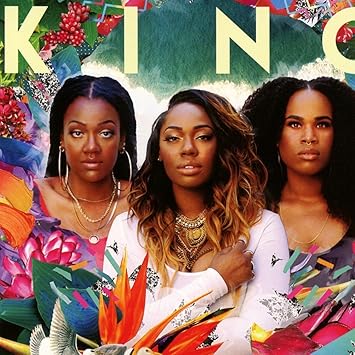
We Are KING - KING

Provenance: You wouldn't guess it to look at me, but when my body isn't being held together by gaffer tape I sometimes go to the gym. Anyway, I heard 'The Greatest' whilst getting ripped and felt compelled to explore further.

Review: Were I to indulge in a conversation with the sixteen-year-old version of myself he'd be incredulous to hear that I consider We Are KING to be the album of the year (so far). Here are a few problems:

1. No guitars
2. No fast songs
3. Not heavy
4. It's R&B
5. No songs about Satan, Wotan, etc
6. No guitars (edited to add: there are some guitars, but we're not talking some sweet-as Steve Vai soloing here).

I was, of course, a rock obsessed idiot back then, but fifteen years later We Are KING is an anomaly in my music collection. It's fair to say that the music I own is overwhelmingly white, male and guitar oriented. My saving grace is that I've become a smidgen more catholic in my tastes and a bit less ideological, inasmuch as I used to write off entire genres due to a lack of 'authenticity' (a concept that mostly stemmed from a perceived ability to play traditional rock band instrumentation).

Thank fuck I grew up and opened my ears a little, as We Are KING is a dreamy joy from beginning to end. Let's start with the single from the album that sucked me in, 'The Greatest', which sounds like a glorious throwback, like TLC's best slow-jam with an 8-bit filigree. It's woozy, weird, affirming and, with its nods to the late Muhammad Ali, poignant.

It also sets the tone for the rest of the album. Very rarely does We Are KING stretch its legs beyond a languid amble; 'Supernatural' is the only track that threatens to break into a sweat but settles into a gentle shuffle. The production matches the pace; liquid, warm and ambient. Regarding the vocals, comparisons with 1990s R&B are inescapable, diva virtuosity largely eschewed in favour of hushed, sensual intimacy. When all the voices are combined and recombined, the effect is not unlike the multi-layered and heavily treated vocals on an Enya album.

Throughout the mood is kept sweet and dreamy - 'Red Eye' exists in the same zone of peculiar half-somnolence one might experience on an transatlantic flight; the outro to 'Hey' dims the instrumentation down to a kind of background radiation, allowing the listener to lie back on a cushion of noise created by the group's whispered singing.

KING are Paris Strother, sister Amber Strother and friend Anita Bias. Paris must be considered the leader here; as well as singing, she plays and produces almost every sound on the disc, collaborated on designing the artwork and also owns a share of the publishing through her own company. We Are KING is totally the baby of a distinctive genius; many of the keyboard and synthesizer sounds Strother employs would sound at home on a 702 or Jade release but the end result comes across more like a knowing wink to that era rather than straight imitation.

It's nice to be blindsided by something that I wouldn't normally give a second thought to. My semi-frequent visits to the gym have yet to yield another doozy (and I might do something I'll later regret if I have Fleur East one more time) but it has reminded me that I shouldn't cocoon myself away in my headphones listening to hoary old favourites like Led Zeppelin and Judas Priest. Next review on Swinetunes: Judas Priest.