Provenance: I was only dimly aware of Body Count for many years, due to the notoriety of their 1992 song 'Cop Killer'. Nonetheless, quite by chance I stumbled across 'Black Hoodie' from Bloodlust on YouTube and was pleasantly surprised.
In any case, I prefer my rap-rock crossovers more of the Public Enemy and Anthrax flavour, as opposed to Run DMC vs Aerosmith. Can't particularly knock the latter, but it sounds tame compared to Chuck D and co. making an industrial sized ruckus.
Review: You don't so much as listen to this album as get beaten around the face with it. At times, the most accurate summation of the experience I can muster is that it's the aural equivalent of repeatedly taking a tyre iron to the bridge of one's nose. This is, of course, glorious. Heavy metal can be many things; slow, stately, symphonic, fast, virtuosic - but there's always space for a spot of the ol' ultraviolence, which is exactly what Ice T et. al. serve up for the discerning listener.
More albums should start with some kind of siren noise, incidentally. It's fucking cool. Doubly so if that song features Megadeth's Dave Mustaine, which 'Civil War' does; but it also contains a lyric that isn't too far flung from Frank Zappa's 'Trouble Every Day' in terms of message. Think of it as a twenty-first century update, but where Zappa seemed to meet the challenges of the day with a peevish lassitude, Ice T demands his audience take a side. Looking at what's unfolding in the body politic of the USA, how could it be any other way?
I was a bit worried that the entirety of Bloodlust would be a political diatribe - not because that is, in and of itself, a bad thing, but because Body Count aren't the most subtle operators. I was therefore delighted to hear that second track 'The Ski Mask Way' is brimming with all kinds of villainy and devilment. Basically, it's a paean to the practice of home invasion. Not something I imagine that we'll be hearing on BBC Radio 2 any time soon, I'll wager. Still, Ice T delivers it with a convincing aplomb. And why should popular music not be so matter-of-fact about objectively criminal pursuits? I recall seeing Ice T talking in a documentary about how he was influenced by the writing of Iceberg Slim, a pimp and all-round rascal who wrote books detailing his version of street life. I live in a society that tolerates any kind of awfulness if it's written plainly on a page, but recoils the moment it's depicted in song. Won't someone think of the babies?!
Aside from Dave Mustaine, a few other heavy pals are roped in to help. Max Cavalera (Sepultura) roars the refrain to 'All Love Is Lost', whilst Lamb Of God's Randy Blythe is on hand to lend some heft to 'Walk With Me', a true highlight. In truth, though, Ice T doesn't need too much window-dressing; his declamatory, hyper-aggressive delivery is the perfect match for Body Count's riffing. This is a band who make their instruments sound like power tools, and yet there's no shortage of finesse there. Indeed, 'Raining In Blood / Postmortem 2017' is probably the best Slayer cover I've heard, and it really works with (new) rapped verses. (NB - for those squinting at the tracklist, I am happy to report that 'Here I Go Again' isn't a reinterpretation of the Whitesnake arena-botherer of the same name.)
Still, I think Bloodlust reserves its strongest meat until the final furlong of the album. 'No Lives Matter' is a provocative title, and true to form, it's a slamming dose of focused, righteous rage. It's preceded by a short monologue by Ice T on the vacuity of the phrase 'all lives matter', which is succinct and spot on. I don't know how anyone can tune into the news or scroll through a social media feed without coming away with the notion that institutional racism is not a bug but a feature of American law enforcement. In a similar vein, 'Black Hoodie' - the number that piqued my interest in Bloodlust - is a two-fisted take-down of racial profiling by, you guessed it, law enforcement (NB - I mention American policing specifically in this review, because that's what Body Count are talking about, but things are far from perfect here in jolly old England). 'Black Hoodie' is the best track on Bloodlust - a chattering verse riff married to a doomy chorus, and Ice T spitting like he wants to strangle a motherfucker.
I would not listen to this album whilst in charge of a motor vehicle. I could not listen to this album when reading a book. When would I indulge in a spot of Bloodlust? Working out at the gym, preparing to enter a cage fight, and doing my taxes. The Body Count of Bloodlust does not strike against its enemies with surgical precision - it sledgehammers them into submission, and doesn't let up. Strange, then, that an album shot through with such a bleak strain of reality is simultaneously as affirming - and fun - as Bloodlust is, but that's testament to the skills of Ice T and Body Count. Powerful stuff.
A blog about one man and his stupid music collection. Mainly about the music, though the man intrudes now and again.
Showing posts with label racism. Show all posts
Sunday, 22 September 2019
Sunday, 26 May 2019
Mingus Ah Um - Charles Mingus
Provenance: This is the first jazz album I ever bought and it's entirely thanks to a friend I met at university, Mike.
I was in his room during the first year and we were chatting away about music. Despite christening me 'Hair Metal', a nickname that would stick for a good three years, we found each other fairly simpatico in terms of likes and dislikes. That is, until the subject of jazz arose.
'I don't think I like jazz,' I said. 'It's too complex.' It speaks to Mike's good taste and geniality that, instead of berating my ignorance, he loaded Mingus Ah Um into his stereo and pressed play.
In only a few short moments I couldn't believe what I was hearing. And by Toutatis, it swung like nothing else I'd experienced before! After allowing me the time to listen to a few cuts, Mike turned to me and said 'so what is so difficult about this?'
Nothing. Like an idiot, I thought jazz was either some lame-ass big-band granddad music played by dorks in bow ties, or it was a cigarette paper away from the pretentious gubbins parodied on The Fast Show's 'Jazz Club' skits. (NB: jazz can also be both of these things, much like rock music can encapsulate something as wonderful as Terry Reid's River and Kiss' Hot in the Shade).
Review: The last time I reviewed a jazz album I spent an entire paragraph complaining about how difficult I find it to write about this particular genre. I'll spare you the plaint once more, but suffice to say, I feel lost at sea with anything that falls outside of the popular music paradigm. Feel free to go back and read about my utter lack of qualification to write about jazz right now; but if you're feeling particularly masochistic, my friend, read on!
I have a clutch of albums from bandleader (and double bass player) Charles Mingus but this was my first, and still my favourite. From the off, those very first few notes in 'Better Git It In Your Soul', one feels a sense of weight and pregnancy. It's as if the band are straining at their leashes, or waiting for the traps to open. Sure enough, after those first few establishing motifs on bass and piano, the band kicks in with a swagger that is unmatched in almost anything I've ever heard. It's post-bop but in a way that sounds directly plugged into gospel and the blues, riding a tricksy 6/8 time signature but shimmying and simmering along to something elemental and raw.
From that most ebullient number, Mingus Ah Um shifts down into something more mellow and elegiac, the beautiful 'Goodbye Pork Pie Hat', Mingus' tribute to saxophonist Lester Young. A composition that's been covered by a fair few artists, my exposure to 'Goodbye...' first came about thanks to Jeff Beck's Wired album. It was the standout cut on that LP, but here, with horns taking centre stage, it's a whole new universe. In a world where the tenor saxophone is (too) often deployed for its potential to bring a note of brashness to proceedings, it's a revelation to hear it moaning the melody with a rare solemnity.
I vividly recall what Mike said about the third track on Mingus Ah Um, 'Boogie Stop Shuffle'; every time he put it on, it brought to mind a car chase scene in some 1940s gangland caper. He's spot on. As with 'Better Git It In Your Soul', 'Boogie Stop Shuffle' really shifts, motoring along with the kind of propulsion I had hitherto believed didn't exist in jazz. It's pretty close to a headbanger. It's enough to make a guy want to invest in a zoot suit and Tommy gun combination.
Mingus also excels when stepping into the jazz tradition of paying respects to other composers. Both 'Open Letter to Duke' (Duke Ellington) and 'Jelly Roll' (Jelly Roll Morton) paraphrase elements of each musician's work. 'Open Letter to Duke' especially does a fine job, starting off at a clip before gearing down to an easeful stroll, nodding to Ellington's ability to introduce shades of nuance and mood to the swing palette. 'Jelly Roll' is a little stranger; it's like some kind of ragtime fever dream, both utterly familiar and non-traditional all at once. It's a hell of a lot of fun, I'll say that!
Perhaps the album's centrepiece, however, is the eight-minute 'Fables of Faubus'. I had initially believed that the title came from antiquity ('Faubus' looks plausibly Latin in origin) but curiosity led me to learning of a much more contemporary source of inspiration. It turns out Mingus was referencing an unpleasant little shit called Orval Faubus; no doubt familiar to Americans but a name that would elude the majority of Brits. What he is associated with, however, is relatively well-known; he was the Governor of Arkansas who called in the National Guard in 1957 to prevent African-American students from attending Little Rock Central High School after a federal order to desegregate schools.
Thus 'Fables of Faubus' introduces a comic-buffo theme from the start, which crops up every now and again almost as a refrain to Faubus himself. The changing moods and time signatures within 'Fables...', which nevertheless always return to its opening theme, means that it could be read as a tone poem of sorts. Despite the events that undoubtedly fired Mingus to write the piece (Mingus Ah Um was released in 1959), motifs that bespeak sadness or frustration never linger too long; instead, 'Fables...' is defiant and satirical. Even the mock-heroic title jabs at the pomposity of the objectionable Faubus.
In conclusion; an amazing album, that came hot on the heels of another landmark, Blues and Roots. Whilst that one was a celebration of blues and gospel music, Mingus Ah Um twists some of those influences into a thoroughly modern and adventurous sound. I'm no jazz expert (being the son-in-law of a professor of jazz music has proved humbling at times) but this was the gateway drug for me to go out and explore artists such as Miles Davis, Herbie Hancock, the Sun Ra Arkestra, Rahsaan Roland Kirk, Sonny Rollins, Horace Silver and more. With the live-action Aladdin just released into cinemas, I can't pass up the opportunity to suggest that this was a whole new world to me, and one that I don't intend to return from any time soon.
Labels:
aladdin,
bop,
charles mingus,
jazz,
jazz club,
jeff beck,
lester young,
little rock,
mingus ah um,
orval faubus,
post-bop,
racism,
ragtime,
swing,
university,
wayne goins
Saturday, 18 August 2018
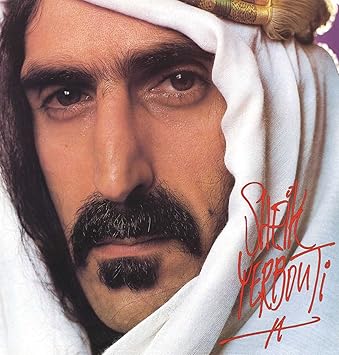
Sheik Yerbouti - Frank Zappa
Provenance: In a not insignificant number of ways I am my father's son, and nowhere is this more evident than my tastes when they edge towards the weirder end of the popular music spectrum. White Noise, Gryphon and today's subject - Frank Zappa - all came into my orbit as a consequence of my dad's listening habits.
In the instance of Sheik Yerbouti, I bought this to signal a small amount of independence. How so? Because dad didn't own this album. I distinctly recall as a youngster being impressed by cover art of both Overnite Sensation and Hot Rats, I thought the guy's name was cool (it sounds like a freakin' laser) and some of the songs made me laugh. Thus when I was older and casting around for my own bit of Zappanalia, I went for an album that was considered one of his more 'hard rock' efforts, as per my own inclinations at the time. Hence Sheik Yerbouti.
May I drift a little here? When it comes to worst fanbases of all time, you have to consider those of the Grateful Dead, Britney Spears and Pantera. They all have their demerits, but for me nothing comes close to being stuck with a Zappa fan when the topic of conversation is Zappa. I've had my head forcibly banged for me watching Iron Maiden, met some Megadeth fans who were happy to show me their Neo-Nazi tattoo collections and saw not one but three fights break out within spitting distance during a Madness gig. I'd happily endure all that again, and then some, if I didn't have to spend another moment in the presence of a Frank Zappa fan (my dad excluded, who is the epitome of the exception that proves the rule).
Review: Well, this is a bit of a disappointment.
I can imagine that, aged sixteen, I found some of this stuff funny. However, I've never found scatalogical humour particularly engaging, and any youthful proclivity I may have had towards it has certainly dimmed with age. In terms of my Zappa listening these days, it tends towards the more instrumental side, Mothers of Invention era cuts or Hot Rats (because 'Willie the Pimp features the greatest violin riff in rock music). Sheik Yerbouti has slipped to the bottom of the pile, and giving it a listen for this review has done little to rehabilitate it.
You know, 'I Have Been In You' might have elicited the odd yuk back when Peter Frampton was a ubiquitous presence in the homes of Middle America, but pastiche is a dodgy thing to pull off at the best of times. It's saying something that the parodical Bob Dylan harmonica stylings on 'Flakes' is the highlight of 'Flakes'. And revisiting the notion of jokes ageing poorly - whew - 'Jewish Princess' (yep) and 'Bobby Brown (Goes Down)' (a discotheque staple on continental Europe, which is enough to make me a full on Brexiter) would've surely been offensive forty or so years ago. In 2018 they come across as positively Neanderthal with their depictions of Jewish women and homosexuality, respectively. A former English Literature teacher of mine once felt moved to describe Zappa as a 'poet'.
I'm happy to say that, amongst the more overtly comedic songs, one still holds up - 'Dancin' Fool' is a stabby little lampoon of the disco scene that works through a combination of splenetic observational humour and metrical tricksiness, the latter effectively turning it into a disco track that can't be danced to. 'Tryin' To Grow a Chin' is also a lot of fun, drummer Terry Bozzio providing a demented vocal. Plus I like false endings, and this song's got one (sorry to spoil it for you, folks - but are you really going to listen to Sheik Yerbouti any time soon?).
Here's the frustrating part; the first track that appears to privilege musicianship above cheap thrills, the instrumental 'Rat Tomago', hits the mark. The push-pull percussion, jazzy keys and wild guitar improvisations afford a glimpse into realms beyond this album's - consciously applied - limitations. Oh, enjoyed that music, did ya? Never mind, here's some wisecracks about fisting. With Sheik Yerbouti we've reached a point in Zappa's career where he needed to do the stoopid stuff (and take it out on tour) to fund his more serious compositions, which had become prohibitively expensive, especially where recording orchestral works were concerned. At least, that was the line trotted out at the time. Who knows? Maybe that was the case, but then again maybe he just got a kick out of stigmatising homosexuality via the medium of comedy song.
As I have intimated, there are hints of a better (and shorter) album here; all the instrumental cuts are great, with 'The Sheik Yerbouti Tango' coming out on top because it sounds just that little bit out of control. Zappa fans might scream that their formalist hero knew exactly what he was doing, but I think it's sometimes pretty neat to hear the seams of the music. (Isn't this where improvisation becomes truly interesting? When instead of falling back on the rock / jazz / blues playbook of licks, they take their instrument on a journey that teeters between inspiration and failure?). Of the 'straighter' rock stuff, 'Broken Hearts Are For Assholes' has a certain appealing mania to it, even if it does descend into a coda about 'poop chutes'. 'Baby Snakes' is here and gone far too quickly, which is a shame because it's a little gem of hard-edged surrealism. 'City of Tiny Lites' really kicks out the jams - a spacey and strangely soulful number that skips along on busy percussion and a rubbery bass line. The guitar solo is fucking badass too.
I will say this - aside from the more objectionable extremes of Zappa's lyric writing, I enjoyed the experience of revisiting Sheik Yerbouti more than I had expected. It's also told me something about myself, and the ageing process. When I was in my teens, I would often skip the 'boring' instrumental tracks so I could get to the next chucklefest. Now, it would be the other way around. Once upon a time, this would've been my favourite Zappa album because it had some rawk 'n' roll on it, but now I gravitate towards his jazzier output (which coincides with a general awakening to jazz as a genre, I guess). Anyway, Sheik Yerbouti certainly treats the ol' lugholes to some interesting snippets of music, but you have to ask yourself whether it's worth wading through all the snark and calculated dumbassery to reach.
Labels:
avant garde,
bob dylan,
frank zappa,
hard rock,
humour,
jazz,
peter frampton,
racism,
sex,
sexism,
sheik yerbouti,
terry bozzio
Sunday, 11 June 2017
Handsworth Revolution - Steel Pulse
Provenance: Haven't a clue. I bought this from an HMV at some point within the last five years. It was probably on special offer and I thought it might be worth a punt. That's some cool album artwork, after all.
Review: I can't pretend to know what life could be like in late 1970s Handsworth, having grown up in 1990s Bournemouth. I originally come from a place in Greater London called Hayes, which many in my family still call home. My parents grew up in Hayes and, before I was born, lived for a while in nearby Southall. It shares something in common with Handsworth: during the 1981, both experienced riots sparked off by racial tensions. Those in Handsworth were set off by rumours of a march by the National Front, whilst Southall's disturbances were in response to a planned Oi! concert in the Hambrough Tavern pub.
Hit fast-forward to 2011 and parts of London are ablaze with rioting. I stand looking from the top floor of the hospital I work in as plumes of smoke ascend into the summer sky. I return home to see bars and supermarkets in genteel areas like Clapham boarded up in anticipation of violence. Rumour swirls that looters have left a treasure trove on Clapham Common as they seek to evade the police. A seldom-seen neighbour asks 'what shall we do?' and I shrug and produce a golf club. I take an evening walk down to Tooting and pass through the thoroughly middle-class preserve of Balham. I note that nothing is shuttered, although reports later emerge of smashed windows. It is 2011 and race is once again the tinder box, and the fatal shooting of a black man by armed police sparks unrest that will sweep across the country.
So it is now 2017 and things don't feel much better. The referendum on British membership of the EU saw one campaign group literally borrow from Third Reich propaganda to create a poster. Meanwhile, Donald Trump's ascent sees neo-Nazis rebranded as the 'alt-right' and their fashion choices are discussed by mainstream publications. So now I'm listening to the angry, defiant, questing Handsworth Revolution by the British reggae band Steel Pulse, and it's sounding fresher than ever. That's not to downplay the actual music itself, which is superb, but it would be silly to ignore the politics of Steel Pulse's debut, which are front and centre throughout. Putting it another way, the impact of the message has not diminished down the years.
So we have calls for social justice on the title track; 'Bad Man' begins sounding like a boast but mutates into a meditation on slavery; 'Soldiers' demands self-determination for Africans and the removal of the imperialist yoke; 'Prodigal Son' counsels a people to stay in touch with their culture and renew their knowledge; and it seems trite to hint at the gist of 'Ku Klux Klan'. Who could blame the guys in the band for rounding out the collection with the spacey 'Macka Splaff', which is unabashedly about the joys of smoking weed? Even Shakespeare leavened his tragedies with a few jokes.
The grooves are monstrous, the musicianship is top notch (I was especially taken by the delicate, Latin-tinged guitar on 'Prediction') and thus you could quite happily dig this album for all its surface qualities. It's a smashing reggae record. For my money though, Handsworth Revolution reveals its real charms when one tunes into the messages about unity, identity, history, race and spirituality. It's not altogether comfortable listening either, especially if you're a white guy from Bournemouth. Handsworth Revolution delivers a few home truths about my history that I may not want to hear, but certainly need to hear.
There's always hope - and so with 'Prediction', which envisages deliverance for the followers of Ras Tafari, so I'm going to allow myself to perceive a few green shoots. A man has led a General Election campaign on a solidly social-democratic manifesto and created the electoral upset of this century (domestically, at least). Those who sought to smear him as a terrorist sympathiser now find themselves propping up their rickety administration by cosying up to paleolithic bigots with much stronger links to terrorism. The hypocrisy stinks and it won't be tolerated as long as good people stay vigilant and press for a fairer, more tolerant society. To quote Steel Pulse, "Have some, have some faith! / The impossible have a habit of happening..."
Labels:
bournemouth,
britain,
handsworth revolution,
hayes,
oi,
politics,
racism,
rastafarianism,
reggae,
southall,
steel pulse
Sunday, 4 September 2016
Heavy Traffic - Status Quo
Provenance: I like Status Quo. They were the first band I ever saw in a live setting, and it left a profound effect on me. The two most vivid things I remember about that gig was, firstly, the addictive quality of sheer volume; and secondly, my Dad singing along to 'In The Army Now'.
Review: Along with many, many other households in this sceptered isle, I also possess one of the legion Status Quo 'greatest hits' collections. (For my US-based readers, the Status Quo 'best of' is as ubiquitous as Frampton Comes Alive is in the Midwest). That's all the Quo most people require, but I saw them performing 'Jam Side Down' on Top of the Pops and thought it sounded decent enough to drop coin on the parent album.
And you know what? For the most part it is decent enough. Better than that, as it happens. Most of the songs sound a bit like other Status Quo songs, the good ones. We're mostly talking about the sledgehammer boogie sound Quo have almost trademarked since jettisoning their early psychedelic pretensions. In fact, 'All Stand Up', 'Creepin' Up On You', 'Solid Gold' and 'Money Don't Matter' could (and possibly do) sit comfortably with the rest of their material in a live set. The only curveball, sonically speaking, is 'Green', whose inheritance can be traced to 'Gerdundula'. The rest is a bit fillerish but not unpleasant. Except for one track - 'The Oriental'.
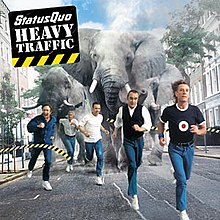
Status Quo don't generally deal in subtleties or finer feelings, so it's apt that they've actually included an elephant on the front cover to symbolise the one that 'The Oriental' introduces into the room. At some point in the writing process, Francis Rossi and John 'Rhino' Edwards (this paragraph is like a safari thus far) presumably thought it'd be a lark to write a tune about mail order Asian brides. Not in a sensitive manner, you understand. The more charitable listener might suggest that it's just a lark, and that half the lyrics are nonsensical. The latter is true - but the sticking point is the other half, replete with pidgin English (ha ha! Because East Asians all speak like that!), lazy cultural stereotyping and the apparent ease in which women can be traded or rented like commodities.
Making play with the perceived exoticism of the Far East has been the stock in trade for many Western musicians. Now, I don't want to be too harsh here because for boys and girls raised in suburban or working class Europe or America, playing somewhere like Japan must've seemed somewhat fantastical. So we get Deep Purple's 'Woman From Tokyo', Y&T's 'Midnight In Tokyo', Krokus' 'Tokyo Nights' and the weird Todd Rundgren song 'Eastern Intrigue' (and, I suppose, Aneka's 'Japanese Boy' or Carl Douglas' 'Kung Fu Fighting'). But that was way back when, and this is a bunch of late-middle aged men in 2002. I just can't find one redeemable or even venial element about 'The Oriental'. It is perhaps apposite that the lineup that recorded this crap actually looks like a bunch of guys who spend their evenings trawling mail order bride websites.
As well as being fairly racist, it's also a monumentally stupid song. There's some lyrics in the middle eight that, I guess, are supposed to convey the sense of a whistle-stop tour of the East. Except that 'and carry on to China / Asia Minor and some more' makes precious little sense, because Asia Minor is most accurately expressed today as the Asian territory of modern day Turkey. It serves to underline the rather parochial reputation that Status Quo have earned for their perceived lack of ambition in territories outside of the UK (whilst boogie contemporaries Foghat and AC/DC set about conquering the US and the world respectively). Perhaps I am expecting too much of poor old Rhino, a man of such delicate sentiment that in 2006 he was moved to write a song about his favourite Brentford FC striker.
Sorry if you expected a more forensic review of the album. Honestly, if you excised 'The Oriental' you have a really punchy, four-to-the-floor rock album. As it stands, its inclusion is as if somebody wiped their shitty ass over your nice new Belgian lace tablecloth. Use the skip function on your stereo, or download Heavy Traffic and delete track three. It's a reasonably lengthy album, you won't miss it. Nobody will miss it.
Labels:
asia,
boogie,
heavy traffic,
oriental,
racism,
rhino edwards,
status quo
Subscribe to:
Posts (Atom)


:format(jpeg):mode_rgb():quality(90)/discogs-images/R-6407680-1418483302-4435.jpeg.jpg)