Showing posts with label folk rock. Show all posts

Sunday, 24 October 2021

John Barleycorn Must Die - Traffic


Provenance: I bought a few albums whilst I was on holiday in Canada, and John Barleycorn Must Die was one of them.

But why this, eh? Did I just reach into the secondhand sales bin like a pier arcade mechanical arm game, scooping up anything within my grasp? No! As regular readers will know, my finely honed sensibilities mean that some discernment went into this selection.

The first of the 'pull' factors is that I remember hearing a version of 'John Barleycorn Must Die' years ago; it's on one of my dad's folk-rock vinyls, though unusually for me I cannot recall whether it's the version by Steeleye Span or Fairport Convention. I could just pick up the phone and ask him now, but nah.

The second thing drawing me to this was that I have been fortunate to see Steve Winwood live, supporting Steely Dan at Wembley Arena. Although he didn't play anything from this platter, I was (and remain) deeply impressed by his performance. Nobody's voice from that era has weathered the years better than his.

Finally, I do possess a version of 'John Barleycorn...' by Traffic on the fantastic Electric Eden Brit-folk compilation. It's not the cut that appears here, but it's one of the most gorgeous, atmospheric takes I've yet to hear, so if this comes close I'll be a very happy punter indeed. 

Review: Why should I bother when altrockchick has written this excellent overview? Not only does she actually analyse the music, she also provides much more background shading than the Swinetunes "uh, I think my dad has a copy of this somewhere?" brand of context. She's got a great taste in music overall - you should probably ditch this blog and migrate to hers, honestly.

However, if my particular viewpoint happens to float your boat (it's all subjective, yeah?), crack on. I confess, my expectations were subverted somewhat by the opener 'Glad' - I was anticipating gentle pastoral folk, and instead I'm treated to some lightly swinging jazz-rock with kicky piano interpolations thrown in for good measure. Nonetheless, in the best traditions of the late 1960s / early 1970s, its multiple sections and careful orchestration signal ambition and no little ability.

Does this album feature some of that weird, breathy jazz flute playing that has almost entirely vanished? Absolutely. Do I like it? Abso-damn-lutely. Flute is one of those instruments I am adamant should be part of rock's firmament (alongside the much-maligned saxophone), and 'Freedom Rider' would form part of my evidence submitted humbly to the jury and m'lud. Just as the era 1967-72 seemed to be a time when folks simply played the shit out of their bass guitars, circa. 1968-75 is also a primo time to hear some major dude wailing on the flute, be it in prog, fusion or soul. 

I am also fully in favour of the piano work on this album. As a novice ivory-botherer myself, who has only really got a grip on the minor pentatonic, I am cheered by the bloody-minded determination to play rolling New Orleans piano irrespective of the track. In this sense, Traffic are like a harbinger of a future to come where Squeeze's former keysman plays boogie over whatever his guests are serving up; John the Baptist to Jools Holland's Jesus Christ. Still, it does add a pleasing cohesion to proceedings - I dig albums that sound like the songs 'belong' with each other, even if they touch upon different styles and genres.

What of the title track then, eh? Well, it ain't quite as magical as the 'first version' that is on Electric Eden but it's still a fine, fine progressive folk testament. Where the 'first version' opts for sparseness, this one is fleshed out with more guitars, percussion and voices and ups the tempo a smidge. One wonders why the joint that ended up on the album was preferred to the earlier stab. There's a good chance that I'm in the minority here anyway, considering some of my other opinions. Regardless, it's a lovely, evocative track, the best thing on here and quite likely one of the better musical allegories about growing and harvesting barley out there (sez I, whose shelves are bulging with barley-related releases).

Solid stuff, then. Nothing here, 'John Barleycorn...' aside, has completely fried my synapses, but there is certainly a time, place and space for this kind of music. Traffic, at least on John Barleycorn Must Die, are certainly better at invoking mood than they are at writing memorable songs. It's pleasant to hear Winwood and co. 'going to church' on tracks like 'Empty Pages' and 'Every Mother's Son', and as per previous, I'll always go to bat for hyperactive rock flute. Always.

Sunday, 17 January 2021

Led Zeppelin IV - Led Zeppelin

Provenance: My mum owned this on vinyl.

How much of your taste in music is down to your parents? For me, it's a huge factor. I never saw the need to particularly rebel, because by and large my parents knew their onions.

Off the top of my head, in terms of albums my parents own that are mirrored in my collection, there's this and Led Zeppelin III, Tapestry by Carole King, a couple of Alice Cooper albums, ditto Frank Zappa, An Electric Storm by White Noise, a bit of Hawkwind. Not bad.

I didn't really take to Emerson, Lake and Palmer nor Rod Stewart, but although I haven't (yet) purchased Gryphon's Raindance, evidently I'd heard enough to make me curious. It was all very listenable, even if some of my parents' latter day choices (Mika's Life In Cartoon Motion, anyone?) might take a bit of digesting.

However, Led Zeppelin IV (or Zoso, if you're so inclined) was not only instantly gettable, it would also prove to be a watershed moment; I recall walking through the door one day after school, and evidently my mum had cued this bad boy up a moment beforehand. What I was to hear would essentially make me go, "yep, playing guitar, that's what I want to do", setting me on a course of joy and lifelong discovery. 

Review: Per the above paragraph; I heard Robert Plant's wailing, sure, but I felt the guitar in 'Black Dog'. It really was a few seconds, that's all it took, to convert me to a guitar player (albeit, at that time, sans guitar). I'd grown up listening to guitar bands like the Rolling Stones and Cream, and although I had liked what I'd heard, this was something different. Listen to Jimmy Page's opening guitar riff in 'Black Dog' again and you can hear a swagger, an arrogance almost, a sound that didn't just groove or roll, but strutted. Underpinned by John Bonham's thunderous drumming, there was only one word that came to mind: power.

Amazingly, given the time and distance between then and now, little has diminished my original teenaged assessment. Since that time I've become better acquainted with Led Zeppelin's overall body of music, which contains its share of missteps, and I must admit my opinions have been occluded by the impression given that they weren't a particularly likeable bunch; I have also wearied of the kind of pub bore who will insist Led Zeppelin are superb, and that everything else is a pile of horseshit created by computers or young people or whatever. Oh yes, and they were massive plagiarists.

But Led Zeppelin IV? A work of rare genius.

What I love about this album is that it jumps from the very 'eavy 'Black Dog' to the nitro-glycerine boogie of 'Rock And Roll' to the pastoral Tolkien-folk of 'Battle Of Evermore' - and then an amalgamation of all these qualities on 'Stairway To Heaven' - yet it still sounds conceptually tight. And that's just side one. An album that covers so many bases could (should?) be a mess, but it hangs together perfectly. The pacing is exquisite, a rollercoaster in the truest sense inasmuch as each track takes the listener in a different direction, whether it's mood, atmosphere, tempo, and yet each oxbow and undulation remains part of the same overall journey.

In my callow youth my favourites were 'Black Dog', 'Rock And Roll', 'Stairway To Heaven' and 'Misty Mountain Hop', all the muscle and blood tracks basically; now, although I cannot say any of the aforementioned have gone stale (yes, even 'Stairway...'), it's the more ruminative moments such as 'Battle Of Evermore' and the swooning 'Going To California' that have wormed their way deepest into my affections. Special mention must go to Sandy Denny's imperious singing on 'Battle...', a performance that alone impelled me to pay closer attention to Fairport Convention. I have, however, omitted one very important track. It ain't 'Four Sticks' (NB: a good song, but it comes across a little fidgety and half-formed for my tastes).

'When The Levee Breaks' may have been an old Kansas Joe McCoy and Memphis Minnie blues from 1929, but even now the version on IV induces a sense of awe and sublimity. As brilliantly wrought as the rest of the album is, there's sorcery at work here, friends. By a variety of measures there is heavier music out there, but little comes as close to being as weighty or portentous as 'When The Levee Breaks' is. Into the admixture is the haunting, otherworldly harmonica, Page's droning, modal guitar and Plant's anguished vocal; but the true star is Bonham's drumming. Eschewing flash or intricacy, Bonham instead booms away on a beat that sounds like depth charges being detonated. The overall effect is that 'When The Levee Breaks', a song about the Great Mississippi Flood of 1927, comes across every bit as doomy and apocalyptic as its subject matter. Eat that, Randy Newman.

There you have it - simply, in terms of my own personal relationship with popular music, one of the most important landmarks. There's a straight line between IV and me picking up a guitar, which in turn took me down avenues of exploration around blues music, heavy metal and all points in-between. An immense album, and one that has never ceased to be a pleasure. Perhaps those saloon bar stalwarts had a point, eh?

Saturday, 24 October 2020

Night Owl - Gerry Rafferty


Provenance: When I was in Year 4 I was selected to be one of three pupils in my school to appear on a breakfast request show at Hospital Radio Bedside in Bournemouth.

Selection was undertaken on the basis of letters we had written to the station manager, stating why we would make good radio presenters. I assume the other two wrote something funny or charming to secure their guest slots.

I, on the other hand, had written in saying that my favourite ever song was 'Baker Street' by Gerry Rafferty. A pretty slick pick for a eight or nine year old in the mid-1990s. As it transpired, when I was asked to step up as selecta for the beleaguered and ailing patients of Royal Bournemouth Hospital, I opted for the pop-reggae of China Black's 'Searching'.

Nonetheless, my regard for 'Baker Street' never waned, and to this day I consider it to be almost perfect. It was, I think, for this reason that it took me a quarter of a century to follow up and investigate more of Rafferty's back catalogue. My fear was that 'Baker Street' was a wild one-off, and that everything else would either be bereft of any of the elements that made 'Baker Street' so special, or a pale imitation, albums clogged with desperate attempts to bottle that lightning once again.

However, I had read some heartening reviews of both City To City (parent album to 'Baker Street') and this, its follow up, 'Night Owl'. Lo and behold, both albums were available in a two CD set for some ridiculously low price, so I took the plunge. 

It doesn't end there! I played City To City and fell in love; I then faced the trepidation of spinning Night Owl (my fear of being disappointed is layered like an onion), especially given a casual remark by one of my five-a-side teammates - and local heavy rock legend - Kevin, that "nothing got close to City To City where Gerry Rafferty was concerned". Thus Night Owl sat on the shelf until a combination of lockdown and curiosity convinced me to bite the bullet. (NB - isn't that track by Temple absolutely ace?).

Review: To my mind, the best albums are those which, in addition to containing good music, impart a sense of feeling, mood, or place. Nowhere is this better exemplified than Night Owl, which is less rambunctious than its predecessor, doesn't cover as much ground stylistically but comes across as a more cohesive affair through consistently evoking a kind of autumnal twilight. Night Owl is an album to wrap yourself up in against the bite of the evening; it also feels like a consolation to the solitary listener, Rafferty's inimitable voice a sweet, shy presence rimed with a gentle melancholy.

The music itself is mostly mid-paced, classy soft rock, poised somewhere in the same soft rock wheelhouse as Steely Dan, inasmuch as the layers of instrumentation are meticulous and immaculate; and maybe someone like Richard Marx, insofar as there's an undisguised romanticism in Rafferty's writing. However, Night Owl is neither jazzy or tricksy, nor does it ever tip too far towards the saccharine end of the scale. Maybe add the - I can't put this any other way - 'grown-up' sensibilities of Bob Seger's best writing into the mix. I simply cannot imagine kids ever buying this stuff (notable exception: me aged eight). Night Owl sounds every bit the creation of a man who was, by then, in his thirties and had been around the block a bit.

When all elements come together, it's simply lovely. I've already mentioned Rafferty's seemingly low-key vocal delivery, but it's worth talking about again; mid-Atlantic with a Hibernian twist, warm, sad, confiding, and used with the deftness and artistry of a master calligrapher. 'Baker Street' is most notable for its huge saxophone riff played by Raphael Ravenscroft (though I think it also sports one of rock's greatest guitar solos), but Night Owl relies on the vocals for its hooks. Listen to the way Rafferty slides between the chorus lines in the title track, or the way he drags vowels around in 'Days Gone Down'. There's a beautiful push-pull quality to the singing, an instinctive kenning about where to stretch out over the beat or when to gild the melody with understated little variations.

Yet for all the acute intelligence and lush orchestration present, Night Owl is unmistakeably a collection shot through with notions of regret and resignation. Even the most forceful number here, the excellent 'Take The Money and Run', is more rueful than angry. Check out some of the other song titles: 'Why Won't You Talk To Me', 'Get It Right Next Time', 'Already Gone' and 'It's Gonna Be a Long Night'. The most upbeat track 'Days Gone Down' seems to suggest a double meaning, whilst 'Night Owl' is almost harrowing in its portrayal of loneliness in the midst of popular adoration. 'The Tourist' (a title in itself that hints at dilettantism) contains a repeated refrain, 'but it's alright', that sounds utterly unconvincing in the context of a lyric describing the grind of touring. To me it sounds like a coded plea for help.

Does it matter, when everything sounds so effortlessly smooth? The lack of rough edges means that all the musical surfaces of Night Owl slide around each other with the serenity of a mah-jong game, which should be boring. Maybe to contemporary tastes, it is. No matter - I'm the one listening, and writing this review, and when I tune in I'm left with the powerful impression of an artist who treats his music as a refuge from a world he can't quite get to grips with. Remarkable.

Sunday, 8 December 2019

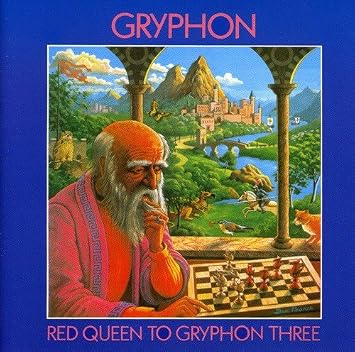
Red Queen To Gryphon Three - Gryphon

Provenance: A few years ago at work, we were idling away the hours on the taxpayer's dime chatting about striking examples of cover sleeve artwork. I recalled an album my dad still owns, Raindance, by today's subjects Gryphon. In the course of searching for the cover art online, I discovered that Gryphon had also produced a work called Red Queen To Gryphon Three, a concept album that's based on a game of chess and features a krumhorn. Armed with that knowledge, what do you think I did next?

Review: You know when people take that "none more black" line from This Is Spinal Tap and apply it to some other scenario, and it's never funny? Well, I'm not about to break the mould here, but in all human endeavour, there is none more prog than Red Queen To Gryphon Three. It takes two of the nerdiest things in existence - prog and chess - and fuses them together via the medium of medieval instrumentation. I imagine this as the product of only the most ascetic of proggers, denying themselves all pleasures of the flesh (most definitely women, although one suspects that wasn't difficult) to come up with this shining anthracite bolus of musical antimatter. So dimly, horrifyingly black that it sucks all pretenders into the gaping maw of its prog-rock singularity. Friends, this is geekery on a colossal scale.

We've got four lengthy tracks called 'Opening Move', 'Second Spasm' (lol), 'Lament' and 'Checkmate'. None of this makes any sense whatsoever, because this is prog so pure that it's entirely instrumental. Why besmirch this magical extravaganza with such earth-bound discordance as the English language? This is the music of the spheres! The universal resonance! I will concede that, possibly, the only thing more progressive would be to either make up your own language or perform your horrible compositions on ice.

I'm not sure I even need to tell you that Red Queen To Gryphon Three begins with a keyboard fanfare, as anyone with a passing knowledge of the genre could've guessed that already. 'Opening Move' is ambitious, in the sense that it takes the listener through a variety of moods - one moment jaunty, the next foreboding - none of which that I've ever experienced when playing chess. The performances are almost virtuoso, and it must be admitted that the quieter, piano-led moments are quite affecting. 'Second Spasm' (still laughing) starts off altogether rather 'hey nonny-nonny', but again, shifts about in timing and atmosphere; however, it retains a cheerfully martial feeling throughout, which gives it a good sense of cohesion, and the main theme (played on a variety of instruments) manages to be both knotty and catchy at the same time. Erk! I'm starting to enjoy this!

Ah, but now we're onto 'Lament', which is very sad and makes me cry. Kidding! Yeah, it's a bit more mournful than the preceding material, and the bassoon (a glum instrument) gets a decent workout, but any true emotion gets sucked out of proceedings by mere dint of it being a fucking prog track. Can you sob in 13/7 time? These guys seem to think you can. Weirdly for a track called 'Lament', there are a couple of brief movements that are frantic and upbeat, all crazy woodwind and Afrobeat guitar sounds. By this point I felt that I'd been listening to RQTGT for about a day, and so these moments of elation mirrored my notion that it was all soon to be over. A glimpse at the stereo revealed I was only just over halfway through.

Ahhhhh, but I can't quite hate it! The music is so guileless, so questing and brimming with ideas that cynicism feels churlish. It's not as if anything hangs around too long, either - Gryphon's modus operandi on RQTGT seems to be "getting bored of this twiddly bit? Don't worry, another will be along soon enough."

However, once you're halfway through 'Checkmate', exhaustion has almost settled in. Despite noble attempts to cut through all the jibjab by establishing a theme for each track, it's all starting to blur together. The jazz guitars! The clavinets! The bassoons! The krumhorns! (Reader, I have discovered that there are two krumhorn players on this album.) In summation, Red Queen To Gryphon Three certainly takes the listener on a journey - one where the destination can, at times, be obscure - but it's a quixotic undertaking. How anyone can conjure up a game of chess whilst being bombarded by this folk-prog maelstrom is beyond me.

At core, though, this is the most potently distilled prog in my collection, and so I shall cherish it forever. I'll probably listen sparingly, because I don't want to actually turn into a wizard, but listen again I shall.

Sunday, 1 December 2019

Aqualung - Jethro Tull

Provenance: I guess at one time I decided that should get into Jethro Tull. Anyway, I purchased this album before I went to university because it formed part of the meagre collection of burnt CD-Rs that accompanied me to halls of residence. I blasted the shit out of this thing during my first year.

Review: Some artists or albums are hardy perennials - they can be played almost any time of year and slot right in. For some reason, Jethro Tull are a seasonal band; I couldn't imagine spinning Heavy Horses or Songs From the Wood whilst the sun is shining. Very particularly, Aqualung is a winter album. Perhaps it's due to to the imagery of the title track, with its ice and 'December's foggy freeze'. It may be due to the seam of religion that runs throughout, which for some reason I've long associated with a dank coldness (the interiors of churches and cathedrals, perhaps?).

Or it might be that Aqualung goes well with the most deathly season because it sounds pretty goddamn deceased itself. I've got plenty of albums from eras where recording technology was still quite rudimentary, others whereby some creative studio trickery dates the music badly. I've even got a couple made by a sex offender in his basement. Whatever their flaws, none of them sound as dead as Aqualung. There are grime tracks recorded on mobile phones with more presence. The cardboard guitar in the video to Judas Priest's 'Breaking the Law' has better tonality than Martin Barre achieves. There are uncontacted tribes deep within the Amazon who have opinions about the production on Aqualung.

Let's be charitable. It was one of the first albums recorded at Island Record's Basing Street studios. Teething issues, an' all that. It's not as if any other album, being recorded at the exact same time at the exact same facility, sounds any good.

I've got more beef with Aqualung. About the only moment of human warmth and empathy on the entire collection comes early on, in the acoustic mid-section of 'Aqualung', where we are invited to feel sorry for the subject of the track, the titular tramp. For the rest of the album, Ian Anderson's lyrics are by turns arch and sneering, as if he's just that wee bit more clever than the listener. It's particularly insufferable on 'My God' and 'Hymn 43', which come across as 1971's equivalent of watching a YouTube atheist channel. (NB - please don't watch any atheist-themed YouTube content - it almost drove me, a staunch non-believer, to the seminary.)

Take, for example, Sparks - a band who are undoubtedly arch and oh-so-smart, but who wear their erudition lightly, and deploy a winking charm to make their references to Shakespeare, the Rockefellers and the human reproduction cycle slide down easily. Jethro Tull, alas, come across as dour as any carping Presbyter or dorm-room Maoist in their attempts to enlighten.

It's a shame, because putting aside the hectoring and shit production, Aqualung possesses the kernel of a prog classic. The electric guitar riff to 'Aqualung' is a blooter, and is rightly smashed out by greenhorns in guitar shops up and down the country. 'Cross-Eyed Mary' has some wonderfully angular guitar work, and is probably the leanest, dirtiest thing on the platter. 'Locomotive Breath' is another corker, an indomitable chugger that is nevertheless not as heavy as the version that plays in my head. It also sounds like a rubber band is part of the instrumentation. Ah, fuck it, 'Locomotive Breath' properly smokes.

Even 'Hymn 43' doesn't sound so bad, if you ignore the lyrics. In fact, it would have fit in very nicely on Atomic Rooster's Death Walks Behind You, an album that I like very much.  Pick of the bunch for me is 'Mother Goose', not only for its delightfully absurd lyrics, but because it best resembles the twisted folk that would appear on my favourite Tull joint, Songs From the Wood. Hey, maybe I'm being tough on Aqualung because it's not Songs From the Wood! Maybe!

Look, I can take the sermonising if the music sounded immaculate, and it doesn't. I still like this weird, somewhat cerebral little beast but it could certainly do with someone like Steve Wilson to give this a bit of remastering spit and polish. Oh, and I was wrong earlier on - contrary to my claims that Aqualung was altogether bloodless, 'Wond'ring Aloud' possesses a lot of heart. It's rather beautiful, in fact.

NB - my CD version of Aqualung contains a rather interesting interview with Ian Anderson about Aqualung. In the interests of fairness, it's not just me who thinks the album doesn't quite sound right; Anderson uses a portion of the conversation to bemoan the production, and the difficulties of getting decent performances on tape in the particular studio Jethro Tull were assigned.

Sunday, 7 July 2019

Liege And Lief - Fairport Convention

Provenance: My memory is fuzzy on this, though I recall buying Liege and Lief for my dad at some point. That's how I first heard it; and it obviously left an impression, because I bought it for myself many years later.

Certainly, if it wasn't for dad I wouldn't have an inkling about the folk rock scene. The first band of that ilk I remember hearing were Steeleye Span, probably their Below the Salt album. I was less familiar with Fairport Convention but distinctly recall Babbacombe Lee being in my parents' vinyl collection. In a slightly odd twist, during my MA I would live a few yards from the prison where they tried to hang John "Babbacombe" Lee - three times, if I recall correctly - before a halt was called to proceedings.

But enough rambling about Babbacombe Lee, it says at the top of this article that I'm reviewing Liege and Lief, so I'd better start paying some attention.

Review: Iconoclastic. Before getting into the nuts and bolts of Liege and Lief, it's worth noting a bit of context. I would direct any reader with the slightest interest in the British folk scene to pick up a copy of JP Bean's oral history called Singing From the Floor. This book both manages to dispel and enhance the perception that folk is an austere, scholarly pursuit riven by purists and gatekeepers of the worst kind. I say enhance, because a few major figures certainly fit the bill. Ewan MacColl in particular comes across as something of a martinet, obsessed by the technicalities of folksong and running the rule over which songs were 'acceptable' to be performed at his clubs. I should say that despite his stated orthodoxies and the faintly ridiculous 'finger-in-the-ear' style of singing that entered popular culture, MacColl and others like Bert Lloyd did much to preserve a dying tradition, and in MacColl's case to contribute some fine songs of his own.

Where Singing From the Floor dispels the notion of folk as altogether too stuffy is in its depiction of the Soho scene. Here, young British performers mingled with American counterparts such as Paul Simon and Jackson C Frank; ideas around tradition and authenticity were a little looser, and I don't think its surprising that the more innovative musicians in folk - Bert Jansch, John Martyn, John Renbourn, Roy Harper et al - emerged from this crowd. This is also the crowd that gave birth, in stuttering form, to Fairport Convention.

Liege and Lief is Fairport Convention's fourth album. Founding members Simon Nicol, Ashley Hutchings and Richard Thompson were here joined by fiddler Dave Swarbrick, singer Sandy Denny and drummer Dave Mattacks, the replacement for Martin Lamble after his death in a road accident in which every member of the band at the time except Denny were involved. Whilst coming to terms with loss and injury, bassist Hutchings buried himself in researching traditional music archives housed in Cecil Sharp House. Denny was already familiar with much traditional music, and Swarbrick had a knowledge of folk that Thompson would describe as 'encyclopaedic'. What they subsequently did - take music that stretched back centuries in origin and electrify it - would prove to be a game changer.

From the perspective of 2019, where it feels like every genre has been run through the electro-wringer (though electro-swing definitely shouldn't be a thing), Liege and Lief might be considered quaint. Certainly, some early rock 'n' roll sounds a bit tame to my ears, even as I strain to discern its importance in the development of popular music. Given that folk already has a somewhat unthreatening patina to it, I was worried that a reappraisal of Liege and Lief would be full of caveats. I'm happy to say that they're not necessary.

In some ways, this record is wilder than anything floating around at the moment, even in the edgier 'hard folk' circles. Firstly, the electric backing to songs that already sound unearthly transport Liege and Lief into the realms of psychedelia. This weirdness is heightened by the fantastical nature of some of the lyrics - 'Reynardine' and 'Tam Lin' being standout examples of songs that read like trippy, twisted fairy tales. The playing is exemplary - Mattacks' backing to 'Reynardine', for example, which consists of little else than slow swells on the cymbal, is breathtaking in its simplicity and ability to create a sense of otherworldliness. The truly mindbending element in the mix is Swarbrick's electric fiddle, which at times drones away like John Cale's viola in the Velvet Underground's 'Venus In Furs'; at other times, it simply kicks free from gravity and takes flight. The mid-album medley of 'The Lark in the Morning / Rakish Paddy / Foxhunter's Jig / Toss The Feathers' is a blistering showcase of Swarbrick's enormous talent, but the band behind him is no less facile with the shifting tempos and time signatures.

And yet, in my opinion Swarbrick's incandescent talent is eclipsed by that of Sandy Denny. Hands down, Denny is my favourite female vocalist. My dad might argue for Maddy Prior's powerhouse vocals, others might highlight Annie Briggs' almost bell-like purity. Both excellent singers, but neither could inhabit a song with the same expressiveness as Denny does on Liege and Lief. Tender, strident, doleful, commanding, playful - whatever the song - hell, whatever that particular lyric demands, Denny delivers. The most dazzling example is the murder ballad 'Matty Groves', which Denny tackles as if it's a play and she's somehow wound up acting as every character.

Furthermore, just in case you weren't convinced, she repeats the trick on 'Tam Lin', a 16th century ballad that's transformed here into a spiky, ominous, lysergic rocker. There comes, at around two minutes, the moment where Swarbrick's violin opens up in delicate counterpoint to Denny's vocal melody and the feeling it engenders can only be described as blissful. The constantly changing dynamics of 'Tam Lin' means that the song seems to morph around Denny's moods, making it the most sophisticated track on Liege and Lief and the one that, for my money, packs the most wallop. I don't think that I've ever heard anything quite like it anywhere else.

Have I convinced you? Do you still automatically associate folk with fustiness, beards and real ale? Or can you begin to imagine it - at least in the guise of Liege and Lief - as a gateway to that which is inherently and indigenously strange about British folk ways? Folk can sometimes seem hobbled by its homeliness and rather old-fashioned insistence on telling stories; Liege and Lief serves as a startling reminder as to the power, vitality, violence and peculiarity of British traditional song. Hell, it should be on the National Curriculum. A peerless, important work.