Showing posts with label texas. Show all posts

Wednesday, 29 December 2021

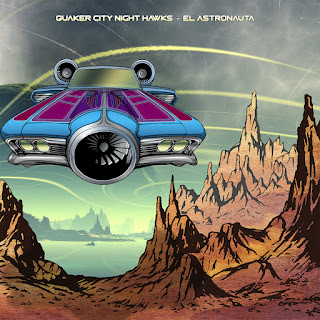
El Astronauta - Quaker City Night Hawks


Provenance: A Christmas present from my partner! Who, in turn, heard Quaker City Night Hawks on Spotify and thought that I'd enjoy what they had to offer. Let's see...

Review: Despite providing me with one of the most underwhelming live experiences of my life, I remain staunch in my love of ZZ Top. Every era had something to sink one's teeth into, whether it was their early psychedelic rhythm 'n' blues, the world-conquering techno-boogie most people are familiar with or even their greasy latter day scuzz-rock. I am one of the faithful where the Church of ZZ Top are concerned - and so, it seems, are Quaker City Night Hawks.

Like the boys with the beards, QCNH are unabashedly Texan, with songs that tell of oil fields and goin' down Mexico way. Then there's the title of the album itself, El Astronauta, taking its cues from Tex-Mex Top nomenclature such as Tres Hombres, Deguello and Mescalero (a naming convention that was never adhered to rigidly, though Billy F Gibbons has more than once suggested that their eighth album might be reconsidered as El Iminator, the sly old dog!). But most of all, the kinship is there in the boogie, swagger and desert-fried weirdness that both bands revel in.

After some roaring numbers to start the album - 'Liberty Bell 7' being a particular favourite - things start to get a little spacey on 'Something To Burn', a slow funk jam laced with a spooky vocals and soulful electric piano. Changing pace again, 'Beat The Machine' is up-tempo acoustic rock that could almost be described as summery, reminiscent of the cruisin' good-time tracks that peppered the albums of another Texan, Edgar Winter (when he wasn't laying the smack down over gnarly riffs with his saxophone, natch).

In fact, over the course of thirty-seven minutes 'n' change, there's a nice variety within the QCNH sound - from the more stoner-influenced stuff like 'Mockingbird', 'Good Evening' and 'Medicine Man' through to the toe-tap shuffle of 'Duendes' or the atmospheric Rio Grande mindbender 'The Last Great Audit', plus the aforementioned switches in gear. Also keeping things interesting are the little filigree touches throughout, whether it's a burble of weird synth here or a glissando of prepared piano there; clearly this is a band with an expansive vision for how rock music can sound. For a moment I thought my speakers would implode at the finale of 'The Last Great Audit', which is of course very satisfying.

It's rare that I review an album on the first pass, but fortunately there's an immediacy and vibrancy to El Astronauta that gives me confidence to scribble down some thoughts. Fortunately, QCNH have produced something that I'll be spinning again and again - and maybe I'll be moved to revise my opinions in the future? Hey, this is the internet, and this is my blog, I can do what I like. For now, though, I'm more than happy with this festive treat and I'll certainly be delving deeper into the Quaker City Night Hawks catalogue. 

Sunday, 15 November 2020

La Futura - ZZ Top


Provenance: By the time I wound up getting this album I was already a hardcore ZZ Top fan. Big into the albums and a few years away from being thoroughly disappointed by a lacklustre live performance at Wembley Arena.

(The Wembley gig, which I attended with my friend Sandy, sucked. The Arena a bit of a pain to get to on public transport, isn't it? Once there, I went through a screening process more rigorous than at most international airports and then spent £14 on two beers.

Jimmy Barnes from Cold Chisel was the support act, and although his ragged bellowing was fun for a while, he failed to do 'Seven Days', his best solo track. ZZ Top were worse; Billy Gibbons can move about but can't sing, whilst Dusty Hill can sing but can barely move.

After little over an hour, including covers of 'Sixteen Tons' and 'Jailhouse Rock' - a song that nobody ever needs to cover, ever again - the Top shuffled off stage and the lights came on. Sandy hoped that the second half would be better, but it was clear to me that they'd stuck a fork in it. Sixty-five, seventy minutes at a push? Eye-watering ticket prices and untold hassle? Cheers guys. Frustrated, we headed to the much-missed Big Red bar, saw a cracking metal act for free, and were able to get a pint under a fiver.)

Review: I don't know what everybody else was expecting from ZZ Top in 2012 but kicking off La Futura with a cover of a 1989 Houston hip-hop track possibly wasn't one of them. Yet ZZ Top have never been afraid to go off-piste, from individual oddities such as 'Manic Mechanic' from Deguello right the way through to fusing synthesizers and drum machines with southern boogie, practically inventing their own genre with Eliminator. So repurposing DJ DMD and the Inner Soul Clique's '25 Lighters' into 'I Gotsa Get Paid' - a nice nod to 'Just Got Paid', no? - shouldn't really set any eyebrows heading north. 

In fact, if one wasn't aware of its background, you'd just think it was another great raging slab of ZZ Top's smoke 'n' chrome hard rock that's been their hallmark since Rhythmeen. Crucially, both 'I Gotsa Get Paid' and the chugging blueser 'Chartreuse', tracks uno y dos, are simply better than anything from previous album Mescalero; an album that had its charms, not least the preponderance of Spanglish in the lyrics, but was ultimately too sprawling, flabby and unfocused for its own good.

Here, though, ZZ Top have enlisted Rick Rubin, which means two things - no excess, and a back-to-basics sound. So, aside from a few guitar overdubs, what one hears on La Futura is the basic rock combo formula of guitar, bass, drums and voice. There's the odd extra flourish here and there - the rather ponderous ballad 'Over You' fleshes out its sound with a much needed keyboard, for example - but insofar as these elements are used sparingly, it's a strikingly similar setup to that of ZZ Top's best album, Tres Hombres.

Accommodations have been made for time passed, however. Billy Gibbons, one of the more instantly recognisable guitarists out there, plays with gusto in that choppy, greasy style that makes ZZ Top records so goddamn fun, but he's quite obviously close-mic'd to allow for deficiencies in the voice department. But it's good! In fact, the additional sandpaper to a voice already coloured with road rash makes everything sound ten percent meaner and sleazier than would otherwise be the case. Sticking with performances, my only real bugbear is that Frank Beard still demonstrates some tasty stick work but it's nowhere near as creative as the rhythms he was banging out before Eliminator. Go back and give those old platters a spin and you'll hear some chewy, fiddly drum figures. Beard was (is?) a superb drummer with a great pocket feel. On La Futura the latter is in evidence, but it lacks finesse.

(I remember playing 'Just Got Paid' with my former band, and easily the most taxing aspect of recreating the feel of the original was getting the drum pattern right. Fortunately, that's nothing to do with me, guv!)

If one or two numbers can be a bit samey - just how many times can you chop and change the blues? - it's alright, there's enough variety elsewhere to maintain interest, and at a hair under forty minutes La Futura is well-paced. I was surprised a couple of times - 'Flying' High' had an almost power-pop feel to it, and the best track was a little unexpected. I've often been underwhelmed when ZZ Top slow things down, yet the molasses-crawl of 'It's Too Easy Manana' possesses an authoritative, anthemic quality and one of the more characterful vocal deliveries on the joint. Mescalero was rotten with these songs, which, when coupled with its hour plus run time, dragged the thing into a swamp. Here, the two strollers act as welcome interludes.

All things said and done, La Futura isn't going to cause ships to capsize, but it's a very good addition to the ZZ Top canon. Stripping back their sound exposes the dirty innards of the engine, and they sound all the better for doing so; I don't think there's a skeevier intro around than the sound of Gibbons' guitar revving up on 'I Don't Wanna Lose, Lose You'. A triumph, then - and certainly more rewarding than the live experience. 

Sunday, 1 November 2020

Townes Van Zandt - Townes Van Zandt


Provenance: This is slightly odd, insofar as a half-remembered post on a music message board percolated away for more than a decade before breaking through into my consciousness.

Back in 2018 my partner was away for a few days, and I was idly lounging around on my bed trying to think of something new to tickle the tympanic membrane with. For some reason, the name 'Townes Van Zandt' floated to the surface, and as we own a couple of those accursed Amazon Echoes, I asked it to play me some of his music.

The only reason I even knew of TVZ was due to a single poster on the forum, who during the mid-2000s would respond to every 'best songwriter', 'most underrated songwriter', 'most overlooked artist', etc., thread with the same answer: Townes Van Zandt. Going purely by a few detail-light posts sandwiched between threads on John Corabi and Bang Tango, I has assumed he was some sub-Neil Young Laurel Canyon folkster.

Ten minutes after commanding my personal surveillance device, I felt like punching myself. I'd heard what sounded like the strangest, most pungent, deep country music I'd ever encountered - the mighty, cinematic double-cross ballad 'Pancho and Lefty', the harrowing 'Waitin' Around To Die' and one of the most singular compositions ever, the ominous, apocalyptic two-chord blues 'Lungs'. I bought this album, which features the latter two, and The Late Great Townes Van Zandt, almost immediately.

Review: I like discussions about great songwriters - in fact, just last night my father-in-law and I were marvelling together at the prodigious output (and success) of the Brill Building stable of the 1960s and 1970s. A few nights previous, I was advancing to a group of friends that Ray Davies of the Kinks has to be considered in the same bracket as Lennon and McCartney, at least where British performers are concerned. There's no real answer, obviously, because what are you looking for in a song? Beautiful music? Storytelling? Mood creation? Nonetheless, if I were to put together a Mount Rushmore of American songwriters, Townes Van Zandt would be my first nomination.

Here, on his third album, is the most consistent and cohesive collection that TVZ put out in his career. For the most part it's three- or four-chord country music, with acoustic guitar to the fore, songs driven by Van Zandt's deceptively complex fingerpicking and swooning, keening Texan drawl. Although it's absolutely the kind of album to inspire me to dribble out inanities like 'timeless', there are signs of an era; hand drums on 'For the Sake of the Song' and a harpsichord to back that and subsequent track, the pure romance of 'Columbine', mark it as a product of the late 1960s.

These two are perfectly good compositions and would be standouts on any other singer-songwriter collection, but it's on 'Waitin' Around To Die' where things get interesting; an itchy, nervy drum tattoo and tubercular harmonica underscore a tale of almost grotesque woe, taking in abandonment, infidelity, criminality and drug dependence. Reflecting some of the bummer endings creeping into popular cinema at the time, this doozy ends on one of the grimmer twists in country. 

What's abundantly clear is that Townes Van Zandt is a testimony of an artist fully in command of his talent and his craft. In any other hands, 'Colorado Girl' would be pedestrian, perhaps even a little goofy. However, TVZ's ability to imbue his simple, homespun poetry with untold depths of feeling make this remarkable. When he steps outside his established metre to deliver the line "I got to kiss these lonesome Texas blues goodbye" it just about breaks your heart. If you're missing somebody in your life right now, perhaps save this one for later. A few tracks later, he's back to making you feel like utter dogshit again on the tender, consolatory 'I'll Be Here in the Morning'.

Betwixt and between moments where he's duffing your into an emotional wreck, something else remarkable happens - the ominous, hallucinatory 'Lungs', apparently written whilst in an illness induced delirium. Crossing the imagery of the Book of Revelations with the haunted Texas blues of Blind Lemon Jefferson, 'Lungs' feels like an entire dread universe has been called into being in the span of two and a half minutes. As mentioned previously, it's a whole two chords, with a needling guitar riff and some gunslinger slide playing added in to spice the recipe, but that doesn't tell half the story. Above it all is TVZ sounding both fearful and mighty, as if he knows the spell he is weaving possesses a rare and unpredictable power. Lightning in a bottle.

In just ten songs, and less than thirty-five minutes, Townes Van Zandt manages to do something peculiar. The palette of sounds Van Zandt works with is not particularly diverse, and nor does he ever demonstrate much vocal range (albeit, the singing is gorgeous). Nonetheless, this album takes in the ache of romance, existential horror, teary-eyed wistfulness and the depths of insanity. Both 'Lungs' and, say, the delicate country waltz of '(Quicksilver Dreams Of) Maria' are indelibly TVZ songs, yet in terms of sensibility couldn't be any further apart. This is one of the many reasons why I feel Townes Van Zandt ranks right up there: it's not just brilliant, it's also substantial, and maybe even important.